Category:Wine news

Winebits 764: Low-cal wine, inflation, Trader Joe’s

three people drinking wine
“I know I should drink less because wine is bad for me, but it’s the inflation that’s killing me.”

This week’s wine news: Big money investments in low-cal wine, plus inflation and booze sales and the tale of Trader Joe’s Manhattan wine shop

• Less calories: DrinkWell, a low-alcohol beverage retailer, has received a £1 million investment to boosts its offerings. The British company, with e-commerce and traditional stores, will expand its lines of low-cal beer and wine with the cash. The news release quoted in the link offers the usual sorts of marketing speak about lifestyle and younger consumers in touting the demand for its products, but it still seems to be a small, regional English retailer. Hence, can it make a difference?

• Less drinking? A Morning Consult study says we’re spending about the same amount on alcohol, inflation or no. Its survey found that the average American adult over 21 spent $34 on alcohol in June — only $1 more than at the same time in 2021. That compares to $26 in August 2021 and $38 in May 2022. The reason for the change? The survey found a variety, including the usual lifestyle choices (see the previous item), but one-third said they had cut down to save money.

• Union busting? Trader Joe’s, the specialty grocer, had just one location in New York City where it could sell wine (thanks to the state’s liquor license laws). Now it has none, after closing the location earlier this month. The freestanding wine shop closed unexpectedly, and the cyber-ether was abuzz with reasons why. It is odd that the company should close its only outlet that sells alcohol, yes? Turns out Trader Joe’s may have been union busting. Several news outlets reported that the store’s 30 employees were about hold a union vote, and that the company closed the store for that reason. It would have been the second New York TJ to vote on unionizing.

Japan: Nuts to this abstinence business

Churro at laptop
Churro, a Millennial himself, has a variety of thoughts about increasing drinking among Japan’s youngest adults.

Japanese tax agency is paying for ideas to boost drinking in the wake of slumping revenue

No, this is not one of these.

Rather, it’s another sign Japan has not found a way to cope with a host of demographic problems that includes too low birth rates.

Reports the BBC: Japan’s tax agency has launched a national competition called “Sake Viva!” that hopes to come up with a plan to make drinking more attractive for 20- to 39-year-olds. It’s asking the age group for ways – marketing, promotions, or whatever — to increase demand among its peers for sake, shochu, whiskey, beer, and wine. There’s even a website.

Sound desperate, given the health problems – and cost to society — associated with increased drinking? Indeed. But the numbers show how desperate the government is to boost alcohol tax revenue, which has crashed as Japan ages and as its younger adults drink less.

Booze consumption among the young fell one-quarter between 1995 and 2020; by comparison, U.S. consumption for that demographic remained more or less steady during the same period. Booze taxes, meanwhile, accounted for about 5 percent of total revenue in 1990, but just 1.7% in 2020.

The Wine Curmudgeon is not eligible for the contest – too old and not Japanese. But the blog does have an unofficial Japanese bureau, and Churro (the blog’s associate editor) and I will be touch with our colleagues to offer a solution.

Quality $10 rose solves most problems, yes?

Winebits 763: Robert Parker, glass bottles, wine history

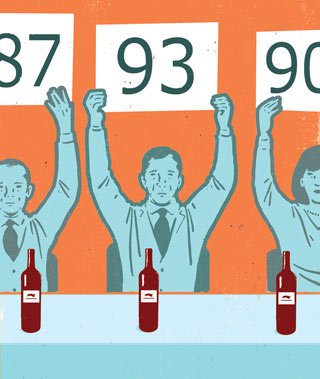
Judges giving wine scoresThis week’s wine news: Robert Parker’s legacy, one more attack on glass bottles, and drunk monkeys as part of the history of wine

• Parkerization: John McCarroll, writing in Punch, looks at the legacy of Robert Parker, the most famous critic and perhaps the most influential person in wine since the end of Prohibition. He’s mostly spot on, though he does take a while to make his point: That Parkerization is still with us, even if Parker isn’t. Parkerization is the idea that producers made – and still make — wines to conform to Parker’s palate to get a higher score. McCarroll also argues that the idea of Parkertization is about more than the big, over-ripe, alcoholic wines that Parker liked, but that the system is set up to deify one critic, regardless of that critic’s preferences, to make it easier to sell wine. In other words, if the WC somehow became winestream, producers would make wines to conform to my palate. Which, of course, is hard to believe. In this, McCarroll overlooks that Parkerization is about prices and premiumization, and the idea that the best wines cost more money — and that we need a deity to convince us to spend $40 on an otherwise ordinary wine. Because what’s the point of deifying a critic who says drink what you like, but be willing to try something else?

• Duck! Eric Asimov, writing in the New York Times, unleashes another attack on glass bottles, and he’s getting almost as cranky as I am about the damned things. “Yet glass bottles have never been more of a problem than they are today, at a time of global trade disruptions and climate crisis.” Crash. Smash. The rest of the story gets even more gloomy – the failure of two companies that tried to re-use wine bottles, the lack of a decent alternative to glass, and all the rest. His best hope? Boxed wine, which for all its ecological flash, has never made much of an inroad.

• Drunk monkeys: Christopher Howard, writing for the Genetic Literacy Project, looks at the history of wine and finds that “the evolution of wine precedes agriculture and the domestication of grapes. The genesis of wine may even predate our species.” The piece is an excellent overview of grapes, wine, and how we got to where we are today. The bit about the drunk monkeys, and how evolution and genetic changes made it easier for primates to process alcohol in their bodies, is fascinating.

Follow-up: Gallup alcohol survey 2022

Mad magazine's A;fred E. Neuman
Alfred E. Neuman, the poster boy for the post-modern wine business

Another study that cries gloom and doom? Who cares?

Last year, when the Gallup survey about U.S. alcohol consumption showed that no one who wasn’t an older, college educated woman much cared about wine, the wine business was in an uproar. I even sold two freelance pieces about the reaction to the survey.

But what happened this year, when the survey showed mostly the same thing — as well the even more worrisome continuation of the drinking less trend?

The reaction was the opposite: What, me worry?

In other words, the wine business has made peace with declining sales, less alcohol use, and its generation gap. It is banking on premiumization, even though there are signs that that premiumization is wearing itself out, and what the blog’s official wine marketer calls “consolidation to grab market share;” that is, when sales decline, just buy another company to paper over the problem.

Obviously, this is not a long-term solution. But as wine has demonstrated over the past decade, long-term solutions are for suckers. The mantra these days is short-term profits, and the rest will work itself out.

Hardly a sound business plan, but what do you expect from a business that still acts like it’s 1995?

The other intriguing bit about the survey? There didn’t seem to be any difference in alcohol preferences based on politics. That’s a change from previous studies, including one I noted when I wrote the alcohol piece for the late American Demographics magazine. That showed a relationship between wine and more conservative voters; that doesn’t seem to be the case here.

Gallup alcohol survey 2022

Man holding bottle of beer
“I’m going to get wasted, but it sure won’t be with wine.”

We’re still not falling down drunk, and older, college educated women are still carrying the wine business on their back

The good news in this year’s Gallup survey about U.S. alcohol consumption is that wine – which got a kick in the teeth last year – doesn’t seem to be any worse off. Which, given how badly it did in the 2021 survey, is very good news.

And we still don’t drink very much, despite all the scare mongering over the past couple of years. Abstention remains around one-third, where it has been for decades, and those of us who do drink are still drinking less: “3.9 drinks in the past seven days, which is roughly in line with the readings historically. In 2003 and 2004, the average was around five drinks a week.”

In other words, a 20 percent decrease. Now how are we going to pass out on the sofa every night with those numbers?

Briefly:

• Wine, beer, and spirits are split, each around 30 percent, as the alcohol of choice. The big loser is beer, which apparently lost share to spirits and continues its decades-long decline as our favorite alcohol.

• Just 17 percent of men say they prefer wine, compared to 49 percent of women. And that’s not as bad as last year, when the numbers were 15 and 49.

• Wine’s age gap is still with us – about one-quarter of those younger than 39 say they prefer wine; the number is 39 percent for those 54 and older.

• My favorite? Wine is ever more bougie – it’s preferred by those who have attended college by a 2-1 margin over high school graduates.

Finally, Gallup included some silliness about how we perceive alcohol; was a respected multi-national trying to appease the neo-Prohibitionists? Not surprisingly, about three-quarters of us say alcohol has some sort of negative affect on society and on drinkers. What did they expect to find? I’d have answered the question the same way, and I write about alcohol for a living.

Photo: Tobias Tullius on Unsplash

Making sense of wine fraud

cartoon: Criminal bribing policeman
“Honest, office. Those are really investment-quality wines.”

How did we get to the point where con artists are faking Yellow Tail to turn a profit?

The Wine Curmudgeon, despite his newspaper reporter’s cynicism and the idea that nothing in wine can surprise me any more, must admit: I still can’t make any sense out of wine fraud.

I mention this because wine fraud has been roiling up the cyber-ether this summer, and especially over the past several weeks. Someone was even faking Yellow Tail in Britain – yes, $6 Yellow Tail. Meanwhile, the Lidl grocery chain — which should know better – got burned with fake Spanish wine.

So my question: Aren’t there easier ways to cheat people and to make more money in the process? Who’s going to make millions and millions with a wine fraud? Which, of course, is what happens with those old standbys, stock and real estate frauds. And if you want to be colorful and still clean up, you can always use fake race horses.

Nevertheless, wine fraud seems to be as much as part of the business as scores and premiumization. So what’s going on?

• Snobbery, of course. Most of the high-end swindles in wine have focused on rare wines, because every old rich guy wants to own rare wine. Whether it’s real or not is just a minor inconvenience.

• Wine as an investment. This shows how much wine has changed and is sadly pathetic. Con artists bilked 150 people, mostly older, out of $13 million by promising high returns on investments in rare wine and whiskey. If only they had wanted to buy wine to drink. Note that this is actually a stock fraud; hence the big payoff.

• Too much wine in the world. There have been a variety of frauds focusing on supermarket wine, which usually wouldn’t afford enough margin to be worthwhile. But given the wine glut in Europe and Australia, one can take bulk wine, slap a supermarket label on it, and turn a profit.

• China. Trying to understand wine fraud in China is like trying to understand cricket. Good luck unless you grew up with it.

• Taxes, and especially in Europe. Tax evasion in parts of Europe is as much a pastime as football; the only thing missing is a World Cup. So when you see a story that says someone counterfeited wine for no apparent reason, chances are it was to get around the tax police.

Winebits 762: Bootlegging, convenience store wine, Utah

Bad Spaniels dog toy and dog
Churro, the blog’s associate editor, knows about smuggling wine and booze.

This week’s wine news: Three of the WC’s favorite subjects, none of which ever seem to be out of the news

• Plastic pipelines: Ukrainian border officials broke up a vodka smuggling ring last month that was sending the booze through plastic tubing across the Ukraine-Moldavia border. Thedrinksbusiness reports that the pipeline apparently started in Moldavia and ran for 300 meters (about 1000 feet), ending near the home of a Ukrainian citizen. It was discovered by border guards who detected “the characteristic smell of alcohol,” according to Ukrainian officials.

• More wine for c-stores! The pandemic continues to benefit wine sales in convenience stores, says the MarketWatch trade magazine. This is a trend we’ve noted many times on the blog, as more convenience stores are selling wine and have upgraded the quality of the wine they sell. In addition, it seems c-stores (as they’re known in the trade) are a fine way to reach younger wine drinkers. The story says that, by one measurement, “the millennial generation makes up 50% of the c-store consumer base.” Which, frankly, is an astonishing statistic and much different than in the past.

• Ah, Utah: The state, best known for some of the goofiest liquor laws in a country with lots and lots of goofy liquor laws, may bring back the sale of mini-bottles of wine and spirits. The state’s alcohol cops, noting that Utah was about the only state that didn’t allow small bottle sales, have approved a proposal for sales for 50 ml liquor and 187 ml wine in state-run and state-contracted liquor stores. Oh my. What’s next? Hard seltzers?