Tag Archives: wine bottles

Wine’s glass bottle dilemma

glass wine bottle and cork
No, the glass wine bottle — and cork — isn’t going away, if a consumer survey is to be believed.

What do you do when you’ve convinced consumers that “real” wine comes in heavy glass bottles?

Two recent news stories outlined wine’s glass bottle dilemma – if you’ll pardon the following – with crystal clear clarity.

In the first, a group of retailers, including Whole Foods and Naked Wines in the U.S., agreed to try to make the bottles they sell much lighter, given that glass bottle weight is wine’s biggest contribution to climate change.

But in the second, a survey found that consumers cared little about the bottle’s earth-killing carbon footprint. In fact, they saw heavy bottles as a sign of wine quality.

Talk about – sorry again – the glass being half full.

None of this is surprising to any of us who have been paying attention (or who reads the blog). The wine business has worked its way through any number of alternatives to glass over the past 25 years, where each as been declared the next big thing and then quietly faded away – be they boxes, TetraPaks, or cans.

My take, of course, is that the wine business could care less about getting rid of glass bottles, and that the survey is not so much a take on consumer sentiment as it is on the success the wine business has had in convincing us that wine has to come in a bottle – the heavier the better, and with a cork for good measure. Because only cranky ex-newspaper reporters want to drink cheap wine from a light bottle with a screwcap – or, Bacchus forbid, from a box.

So getting rid of heavy bottles is left to retailers.

Yes, some of that is because the retailers want to do the right thing. But lighter bottles will also save them millions of dollars in supply chain costs, and that figures in to their decision as much as anything. And, in one of those ironies that I love so much, the wine business might even benefit because someone else did the work that it didn’t want to do.

Five nights drinking wine from something besides a bottle

man drinking from box wine
“Dinner? Who drinks boxed wine at dinner?”

The results were uneven, and helps explain why the glass bottle still dominates packaging

We’ve discussed alternative packaging on the blog for years, so what better way to see where wine is with something other than glass bottles than to drink wine packaged in something else?

That’s what the Wine Curmudgeon did last week – five nights drinking wine at dinner from a variety of “premium” 3-liter boxes (so no Franzia) and 250-ml cans. Why dinner? Because that remains the occasion where most wine is consumed.

Sadly, the results were uneven, and reminded me why the glass bottle – despite all its flaws – still dominates wine packaging.

My thoughts after five nights with something other than glass bottles:

• Convenience. Boxes and cans don’t do well at dinner. How do you keep track of how much wine you’ve had when it comes from a box? In addition, wrestling the spout into its holder remains a challenge, as does pouring the wine into a glass. And where do you put the box when you’re eating dinner? It needs to sit on a counter, to make pouring easier, so you have to get up every time you want another glass. And finding space in a normal-sized refrigerator for chilling the box? Good luck. Cans aren’t as awkward, but opening another can after the first is empty – and disposing of the empties – remains an inconvenience.

• Quality. Uneven, which was really depressing. Most of the canned wine tasted like it should, though some had a noxious, sour aroma when first opened (which I’m told isn’t unusual). The box quality, sadly, was all over the place. One rose was undrinkable, tannic and bitter. One red blend was OK, but nothing more. In this, boxed wine consistency hasn’t improved much over the years – decent one year, not so decent the next.

• Price. Again, uneven. The point of 3-liter boxes is price, and most figure out to $6 to $8 a bottle. Hence, the theory is we’ll put up with crappier wine since it costs less. But, as my experience with the rose proved, that’s not always the case. Just the opposite is true with cans – prices are higher because we’re paying for the convenience. For dinner, though, that means a $10 bottle of wine costs $15. And what’s the point of that?

Winebits 783: Veritas, wine bottles, natural wine

Jeff Siegel talking
The WC’s semi-claim to fame: I was almost a talking head in a documentary about American wine, filmed at Veritas.

This week’s wine news: Veritas, perhaps Dallas’s best wine bar, is closing. Plus, re-using old wine bottles and how not to report a natural wine story

So long, Veritas: One of the best chapters in Dallas’ wine history will end when the Veritas wine bar closes. The Wine Curmudgeon will miss Veritas; it almost always offered interesting wine at fair prices, and owners Brooks and Bradley Anderson have been great friends of the blog (as well as terrific traffic ticket attorneys). I’ve interviewed winemakers at Veritas, including a Mondavi; held cheap wine book signings and shot a TV news segment about cheap wine there; and once filmed some talking head bits for a documentary about American wine that never aired (the pandemic cut off the funding). And I even talked myself out of a high-paying consulting gig during a business meeting with a couple of tech types who wanted to start a wine website. It was at that meeting that Ellie Cohn, Veritas’ long-tenured and much admired manager, took me to task for fussing about an orange rose. “Open your mind, Jeff,” she said. Ellie was correct about that, but it didn’t change the fact that the rose was oxidized and not particularly rose-like.

Old wine bottles: How to use old wine bottles for something other than candle holders? The Lifehacker website suggests using them for watering plants — “wine bottles and watering cans are incredibly similar.” The point is that wine bottles and watering cans each have long necks, which are ideal for plants. I must admit: I’ve used empty wine bottles for a variety of things over the years, but never thought of this. One more point: Screwcap wine bottles work best, which doesn’t surprise me at all.

Statistics? The Winestream Media – and to a lesser extent, lifestyle writers – always go gaga over natural wines, and almost every story makes some claim that natural wine is immensely popular. In fact, natural wine isn’t popular; the best statistics show it has maybe a couple of points of sales in the U.S., and those are concentrated among the wine elite. Nevertheless, this piece from something called Civic Science boasts “Millennials Are Raising Their Glasses to Natural Wines” without actually offering any evidence. In fact, the few numbers in the story say just the opposite – how about that 53 percent of the those surveyed say they’ve never heard of natural wine? This is not to say that natural wine hasn’t been influential or that it hasn’t generated much discussion. Rather, it’s to point out, as I always do, that if you’re going to write something, do the reporting first.

Winebits 763: Robert Parker, glass bottles, wine history

Judges giving wine scoresThis week’s wine news: Robert Parker’s legacy, one more attack on glass bottles, and drunk monkeys as part of the history of wine

Parkerization: John McCarroll, writing in Punch, looks at the legacy of Robert Parker, the most famous critic and perhaps the most influential person in wine since the end of Prohibition. He’s mostly spot on, though he does take a while to make his point: That Parkerization is still with us, even if Parker isn’t. Parkerization is the idea that producers made – and still make — wines to conform to Parker’s palate to get a higher score. McCarroll also argues that the idea of Parkertization is about more than the big, over-ripe, alcoholic wines that Parker liked, but that the system is set up to deify one critic, regardless of that critic’s preferences, to make it easier to sell wine. In other words, if the WC somehow became winestream, producers would make wines to conform to my palate. Which, of course, is hard to believe. In this, McCarroll overlooks that Parkerization is about prices and premiumization, and the idea that the best wines cost more money — and that we need a deity to convince us to spend $40 on an otherwise ordinary wine. Because what’s the point of deifying a critic who says drink what you like, but be willing to try something else?

Duck! Eric Asimov, writing in the New York Times, unleashes another attack on glass bottles, and he’s getting almost as cranky as I am about the damned things. “Yet glass bottles have never been more of a problem than they are today, at a time of global trade disruptions and climate crisis.” Crash. Smash. The rest of the story gets even more gloomy – the failure of two companies that tried to re-use wine bottles, the lack of a decent alternative to glass, and all the rest. His best hope? Boxed wine, which for all its ecological flash, has never made much of an inroad.

Drunk monkeys: Christopher Howard, writing for the Genetic Literacy Project, looks at the history of wine and finds that “the evolution of wine precedes agriculture and the domestication of grapes. The genesis of wine may even predate our species.” The piece is an excellent overview of grapes, wine, and how we got to where we are today. The bit about the drunk monkeys, and how evolution and genetic changes made it easier for primates to process alcohol in their bodies, is fascinating.

studio microphone

Winecast 70: Ray DelMuro of Refresh Glass and recycling wine bottles

Ray DelMuro of Refresh Glass
Ray DelMuro: It’s all about rescuing bottles.

“People tell me they recycle wine bottles because of the way it makes them feel, but they ignore the economic realities of recycling.”

Ray DelMuro of Refresh Glass in the Phoenix area may know as much abut wine bottle recycling as anyone. His company has been doing it for 15 years, works with hundreds of thousands of bottles a year (soon to become millions), and keeps expanding. Currently, his company takes in glass from across the west coast.

So believe DelMuro when he says that glass recycling rates are so poor (less than one-third) because it’s an expensive, bulky, and awkward business, especially when compared to other recyclables. Paper and aluminum can be bundled and are relatively light and easy to load and transport, for instance; glass is none of those.

In fact, we had a fine discussion talking about why recycling economics are so crucial to the process, as well what wine drinkers can do to help:

• If you want to do more than leave your bottles on the curb, find a glass recycler in your area. Put the bottles in a box (preferably the one they came in), and make sure to remove the cork or screwcap.

• One key to expanded wine bottle recycling is finding new uses for recycled glass. These include fiberglass home siding, road building materials, and other construction uses.

• There is an urgency in the industry to improve that recycling rate, and more money is available for research and new technologies.

Click here to download or stream the podcast, which is about 17 1/2 minutes long and takes up 12 megabytes. Sound quality is very good to excellent.

Winebits 748: Paper wine bottles, Champagne lawsuit, wine real estate

paper bottle
Yes. a paper bottle. Nuts to you, glass.

This week’s wine news: A paper wine bottle debuts at a British on-line grocer, while Champagne revs up another lawsuit and Napa prices don’t have anything on Texas

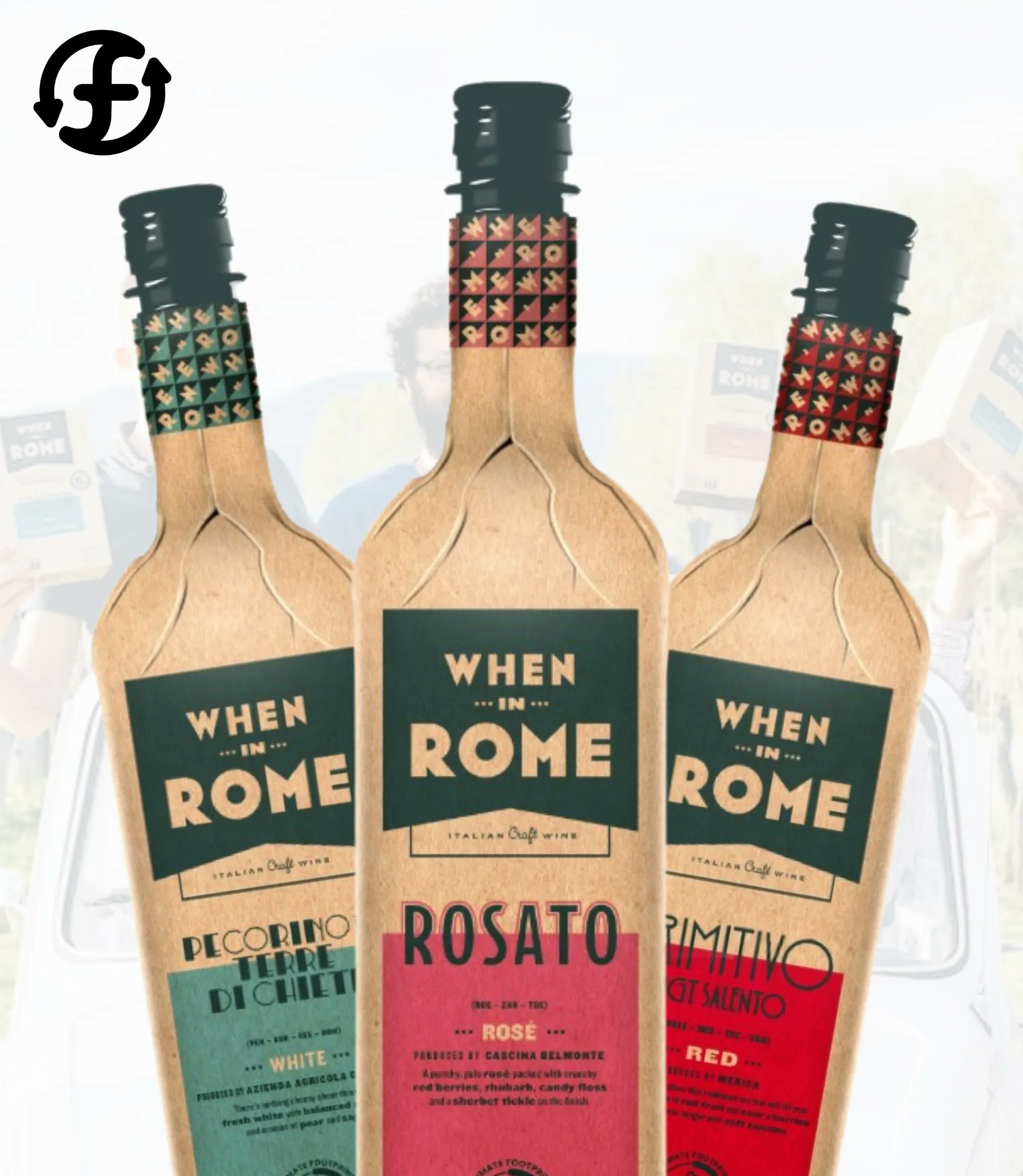
Paper wine bottle: What may be the first paper wine bottle in Britain is set to debut when a brand called When in Rome will sell a red, white and rose at on-line retailer Ocado. The bottle, a collaboration between the producer and Britain’s Frugalpac sustainable packaging company, is said to be made from 94 percent recycled paper and have a carbon footprint 84 percent less than a single-use glass bottle. Says When in Rome founder Rob Malin: “We believe great wine doesn’t have to come in glass bottles. We’re here to prove that whether you’re drinking from a glass bottle or a paper bottle, the quality of the wine is not impacted.”

One more lawsuit: The Champagne business, responsible for some of the great lawsuits in an industry that is renowned for them, has struck again. Cristal, which successfully sued Cristalino (and for which the WC got a cease and desist order), has lined up its lawyers for an action against a small Oregon winery that makes a sparkling wine called Crystal Visions. The producer, Landmass Wines, used the name Crystal Visions to honor Stevie Nicks of Fleetwood Mac fame. The phrase “crystal visions” appears in the lyrics of the Fleetwood Mac song “Dreams.” But, of course, the Cristal lawyers were not satisfied, even though Landmass got a favorable ruling from the U.S. patent office. Ain’t it great to be a Big Wine company?

Have $16 million? That will get you a one-half acre compound near Austin in central Texas. The offer includes a main house, two guest houses, a party barn. and an office, totaling 10,000 square feet of living space as well as seven bedrooms and 9 ½ baths. Plus, of course, a tempranillo vineyard, with enough vines planted to make a couple of hundred bottles a year. Hmm. I wonder if I could use the guest house for an office for myself, and let Churro, the blog’s associate editor, have the other one?

Winebits 731: The “new year is a lot like the old year” edition

wine and health
“Math? We don’t need no stinkin’ math!”

This week’s wine news: The French are furious over the alleged wine and cancer link, plus new EU rules for grape growing and plant-based wine bottles

Who can blame them? The French wine business, which has a better sense of itself than we do in the U.S., has lashed out at the infamous wine and cancer study. The head of a French wine trade group called the study the same thing as declaring war on the wine business. The study, of course, is the infamous Lancet effort, which was later repudiated by another peer-reviewed report that called into question its defective math. Said the trade president: “Cancer is a disease caused by multiple factors. These are simplistic analyses… ,” adding that the same logic would prevent breathing, since the air is polluted.

Different grapes? The European Union, which regulates grape growing for its member states, will allow countries to plant vines that will be better able to adapt to climate change. This is huge news, since it says it’s OK to plant something other than vitis vinifera, the traditional genus and species that includes chardonnay, merlot, and the like. Why is this such big news? It means that in regions like Bordeaux and Tuscany, where law – as well as centuries of tradition – only allow certain grapes to be grown, it’s now possible to plant new grapes.

Goodbye glass? A new plant-based beverage bottle may bring the drinks industry one step closer to getting rid of glass. That’s the conclusion of the GlobalData consultancy, which says Suntory’s soft drink bottle for products sold in Japan and Europe “represents a step forward for the beverages industry towards the holy grail of biodegradable packaging,” Glass wine bottles, of course, have been under target for almost a year as one more cause of climate change. The Suntory bottles are made with what the company calls “bioplastic,” made from non-food biomass and non-food-grade feedstock. In other words, lots of garbage.