Churro, the blog’s associate editor, knows about smuggling wine and booze.
This week’s wine news: Three of the WC’s favorite subjects, none of which ever seem to be out of the news
• Plastic pipelines: Ukrainian border officials broke up a vodka smuggling ring last month that was sending the booze through plastic tubing across the Ukraine-Moldavia border. Thedrinksbusiness reports that the pipeline apparently started in Moldavia and ran for 300 meters (about 1000 feet), ending near the home of a Ukrainian citizen. It was discovered by border guards who detected “the characteristic smell of alcohol,” according to Ukrainian officials.
• More wine for c-stores! The pandemic continues to benefit wine sales in convenience stores, says the MarketWatch trade magazine. This is a trend we’ve noted many times on the blog, as more convenience stores are selling wine and have upgraded the quality of the wine they sell. In addition, it seems c-stores (as they’re known in the trade) are a fine way to reach younger wine drinkers. The story says that, by one measurement, “the millennial generation makes up 50% of the c-store consumer base.” Which, frankly, is an astonishing statistic and much different than in the past.
• Ah, Utah: The state, best known for some of the goofiest liquor laws in a country with lots and lots of goofy liquor laws, may bring back the sale of mini-bottles of wine and spirits. The state’s alcohol cops, noting that Utah was about the only state that didn’t allow small bottle sales, have approved a proposal for sales for 50 ml liquor and 187 ml wine in state-run and state-contracted liquor stores. Oh my. What’s next? Hard seltzers?
This week’s wine news: Jason Wilson deconstructs the neo-Prohibitionists, plus carding underage drinkers and Brexit may be worse than three-tier
• No booze for you: Jason Wilson, writing in the Washington Post, offers a long and detailed look at neo-Prohibitionism, Dry January, and all the rest. A couple of caveats (as well as a shameless plug): The WC shows up in the story (though I didn’t know that until it was published), and Wilson subscribes to the blog. His point, though, is all his own: We spend so much time arguing about whether drinking is good or bad that we know almost nothing about what Wilson calls “drinking literacy;” that is, serving sizes and alcohol by volume. In other words, how much actual booze is in what we drink, so we can better figure out how much to drink.
• Card those kids! Lifehacker, the blog’s unofficial Mainstream Media site that sometimes writes about wine, tells us everything we need to know about how services like Drizly and Instacart avoid selling to the underage. Know two things here: First, this is not a new trend – I was writing trade stories about this a decade ago. Second, it’s going to be a very important story as delivery becomes more important over the next several years. Some services use electronic verification, while some are still in the “Let me see your driver’s license” stage. For what it’s worth, I am occasionally carded when I use these services, and I stopped looking underage a long time ago. The piece also notes that, failing delivery service access, “your kid may turn to the old-fashioned alcohol procurement method of hanging around outside a liquor store and asking skeezy looking reprobates to buy for them.”
• All that paperwork: British wine wholesaler Daniel Lambert is moving to France, where it will be easier for him to do business in Britain thanks to Brexit. Reports the Guardian newspaper: “His Twitter posts about the Brexit regulations have a brisk following among fellow businesses, as he was one of the earliest to come to terms with the 200 pages of paperwork per consignment.” So those of us who are unhappy with U.S. laws – three-tier! — now have someone else to feel sorry for.
“Wow — it was so hard to choose between so many silly state liquor laws,”
Once again, it’s time to vote for the silliest liquor law in the U.S.
Despite the Wine Curmudgeon’s cynicism, the three-tier system continues to astound me with its foolishness. Just when I think I’ve seen it all, I obviously haven’t, as these six state laws demonstrate. Click on the law to vote for it. Voting runs through Sunday and I’ll post the results on Monday. And not to worry — even though I live in Texas, I won’t make you produce three kinds of identification to vote.
Or, sadly, as the laws in the blog’s first poll demonstrated. The winner was Indiana and its ban on selling cold beer. So, once again, a poll: Choose the silliest state liquor law from among these six.
Once again, the choices are hardly complete. If I did miss one, leave it in the comments. It’s difficult to pick my favorite: How can I choose between Maryland’s Robert Parker law and South Carolina’s Frances Willard day? I find it past ironic that the state had to certify Parker as “an alcohol beverage writer” so he could get samples. And I know about Willard from my college days, when I lived down the street from Willard’s Women’s Christian Temperance Union headquarters in Evanston, Ill.
So tell us, Wine Curmudgeon, why should we allow direct shipping?
Why can’t we buy the wines we like via direct shipping? What’s so evil about that in the second decade of the 21st century?
This is the second of two parts looking at how the century-old three-tier system still prevents us from buying wine on-line or from out-of-state retailers, hamstringing 21st century technology and sensibility. Today, part II: Dear Supreme Court: Please fix three-tier and allow direct shipping. Thursday, part I: The Supreme Court’s 2005 Granholm decision, and why it didn’t change three-tier as much as everyone hoped.
Dear Supreme Court:
Yes, I know you’re busy. And yes, I know you are facing immense constitutional decisions that could alter the future of the republic. Still, it’s not like this one isn’t important, either: Please fix three-tier, so we can buy wine on-line and from out-of-state retailers.
I ask this not just to make it easier to buy $10 Gascon wine. I ask this because wine drinkers should be able to buy whatever they want, and not the wines that multi-billion dollar wholesalers and retailers allow them to buy. Because that’s the way the system works now – three-tier says each wine has to have a distributor in every state, so if a distributor isn’t interested in the wine, we’re out of luck. And since big distributors and big retailers want the same boring wines, we’re doubly out of luck.
Second, I’m getting more complaints about availability than ever, and it’s not like I write about weird wines made with weird grapes. No natural or orange wines on the blog, and certainly nothing from places like Georgia. Instead, wines from the five or six biggest producing countries in the world, made with reasonably common grapes — and that I have bought so I know that they are available somewhere. My mantra has always been: An independent retailer in a good-sized city should be able to sell readers the wines I write about.
But that seems to be less applicable as wine consolidates. A reader wrote the other day that he couldn’t find a California wine in California, and his search included an independent retailer. Even worse: another reader, no doubt more frustrated, asked if I could cobble together some sort of retail network for the blog’s wines. This is what it has come to, dear justices – someone wants the Wine Curmudgeon to sell wine. And I can’t even figure out a way to sell t-shirts.
So please do something, sooner rather than later (though I would be happy with later). In fact, it almost doesn’t matter if you decide to forever forbid retail to consumer shipping. It’s a decision, at least, and as bad is it would be for wine, it’s still better than what we have now. Which makes everyone crazy save the people who benefit from it.
Voting is closed, and the winner is Indiana and its foolishness about not selling cold beer. Minimum pricing in Connecticut and Michigan were second. Thanks to everyone who participated.
The choices are hardly complete; that Mississippi isn’t listed says something about how silly the rest are. No doubt, I could have included something from almost every state. If I did miss one, leave it in the comments. Those of you who get the blog via email may have to go to the website — click here to do so.
My favorite, of course, is Utah’s Zion curtain. It’s mostly gone, but not to worry: The state has other safeguards to protect children from the glamour of working in a bar.
Poll image courtesy of The Fine Print, using a Creative Commons license
This week’s wine news: Is the plastic PET bottle the future of wine? Plus, Coronavirus wine humor and Utah may let residents bring wine into the state legally
• Is plastic the future? One analyst, noting that most wine produced today is made in bulk and to drink immediately, says recycled PET is “a realistic alternative” to glass bottles. Emilie Steckenborn, writing for the Beverage Daily website, says the plastic bottles are much better than the traditional glass bottle – lighter, more cost effective to ship and store, and infinitely more environmentally friendly. In this, the piece is surprisingly frank about the inefficiencies of the traditional bottle, and she sounds more like a certain curmudgeon than a member of the Winestream Media.
• Coronavirus wine? Let me apologize for this item first, but I couldn’t resist: A Dallas wine shop says it has “Coronavirus vaccine sold here: bubbly, white, red available.” As the article notes, it’s a refreshing change from the toilet paper hording stories that are dominating the news and even – dare we say – a reason to smile? Also, please note the difference between this and the hucksters and scam artists flooding the market with fake cures and testing kits.
• Finally, Utah? Regular visitors here know the WC enjoys poking fun at Utah, whose liquor laws are some of the most restrictive – and silliest – in the country. Well, there may be one less reason to poke fun: the state is about to let the state’s residents join wine clubs and bring wine in from another state without committing a crime. The Salt Lake Tribune reports that the bill just needs the governor’s signature. Fortunately, the new law is very Utah – no home delivery for wine club members, who would have to pick the wine up at a liquor store and pay the state’s 88 percent markup in addition to the cost of the wine.
This week’s wine news: Supermarket wine prices vary significantly from state to state, plus a study says liquor stores and high crime are related and the FTC is going after social media influencers
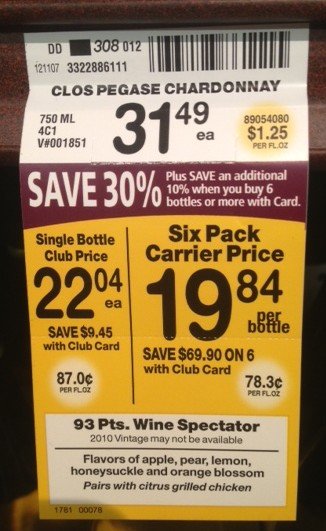
• Supermarket wine prices: A home product review and renovation site says U.S. supermarket wine prices vary significantly by state, with Mississippi and Georgia selling the most expensive bottles. I mention this not because it’s news to anyone who spends any time on the blog, but because it’s always fascinating to see how non-booze sites deal with wine. To its credit, House Method, which did the survey, doesn’t draw any conclusions about why there is such disparity. (Or explain how it bought wine in supermarkets in states without supermarket wine sales.) The results, at the link, are interesting, if nothing else. Who knew red wine was less expensive in Hawaii than in California?
• Less booze, less crime? That’s the approach one study is urging on Baltimore officials as city leaders rewrite its zoning laws, with an eye toward reducing the number of liquor stores and bars in the city. North Carolina researchers used a computer model that took into account homicide rates in Baltimore, as well as previous research that showed one-half of violent crime can be attributed to alcohol access. The result? The study found that cutting the number of alcohol outlets might reduce homicides by as many as 50 a year, as well as generate savings of as much as $60 million annually.








 This week’s wine news: Supermarket wine prices vary significantly from state to state, plus a study says liquor stores and high crime are related and the FTC is going after social media influencers