


Tag Archives: Robert Parker

Winebits 763: Robert Parker, glass bottles, wine history

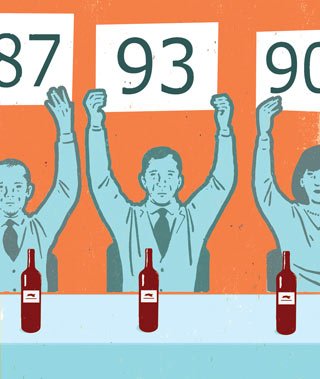
Judges giving wine scoresThis week’s wine news: Robert Parker’s legacy, one more attack on glass bottles, and drunk monkeys as part of the history of wine

Parkerization: John McCarroll, writing in Punch, looks at the legacy of Robert Parker, the most famous critic and perhaps the most influential person in wine since the end of Prohibition. He’s mostly spot on, though he does take a while to make his point: That Parkerization is still with us, even if Parker isn’t. Parkerization is the idea that producers made – and still make — wines to conform to Parker’s palate to get a higher score. McCarroll also argues that the idea of Parkertization is about more than the big, over-ripe, alcoholic wines that Parker liked, but that the system is set up to deify one critic, regardless of that critic’s preferences, to make it easier to sell wine. In other words, if the WC somehow became winestream, producers would make wines to conform to my palate. Which, of course, is hard to believe. In this, McCarroll overlooks that Parkerization is about prices and premiumization, and the idea that the best wines cost more money — and that we need a deity to convince us to spend $40 on an otherwise ordinary wine. Because what’s the point of deifying a critic who says drink what you like, but be willing to try something else?

Duck! Eric Asimov, writing in the New York Times, unleashes another attack on glass bottles, and he’s getting almost as cranky as I am about the damned things. “Yet glass bottles have never been more of a problem than they are today, at a time of global trade disruptions and climate crisis.” Crash. Smash. The rest of the story gets even more gloomy – the failure of two companies that tried to re-use wine bottles, the lack of a decent alternative to glass, and all the rest. His best hope? Boxed wine, which for all its ecological flash, has never made much of an inroad.

Drunk monkeys: Christopher Howard, writing for the Genetic Literacy Project, looks at the history of wine and finds that “the evolution of wine precedes agriculture and the domestication of grapes. The genesis of wine may even predate our species.” The piece is an excellent overview of grapes, wine, and how we got to where we are today. The bit about the drunk monkeys, and how evolution and genetic changes made it easier for primates to process alcohol in their bodies, is fascinating.
If Robert Parker, why not the Wine Curmudgeon?

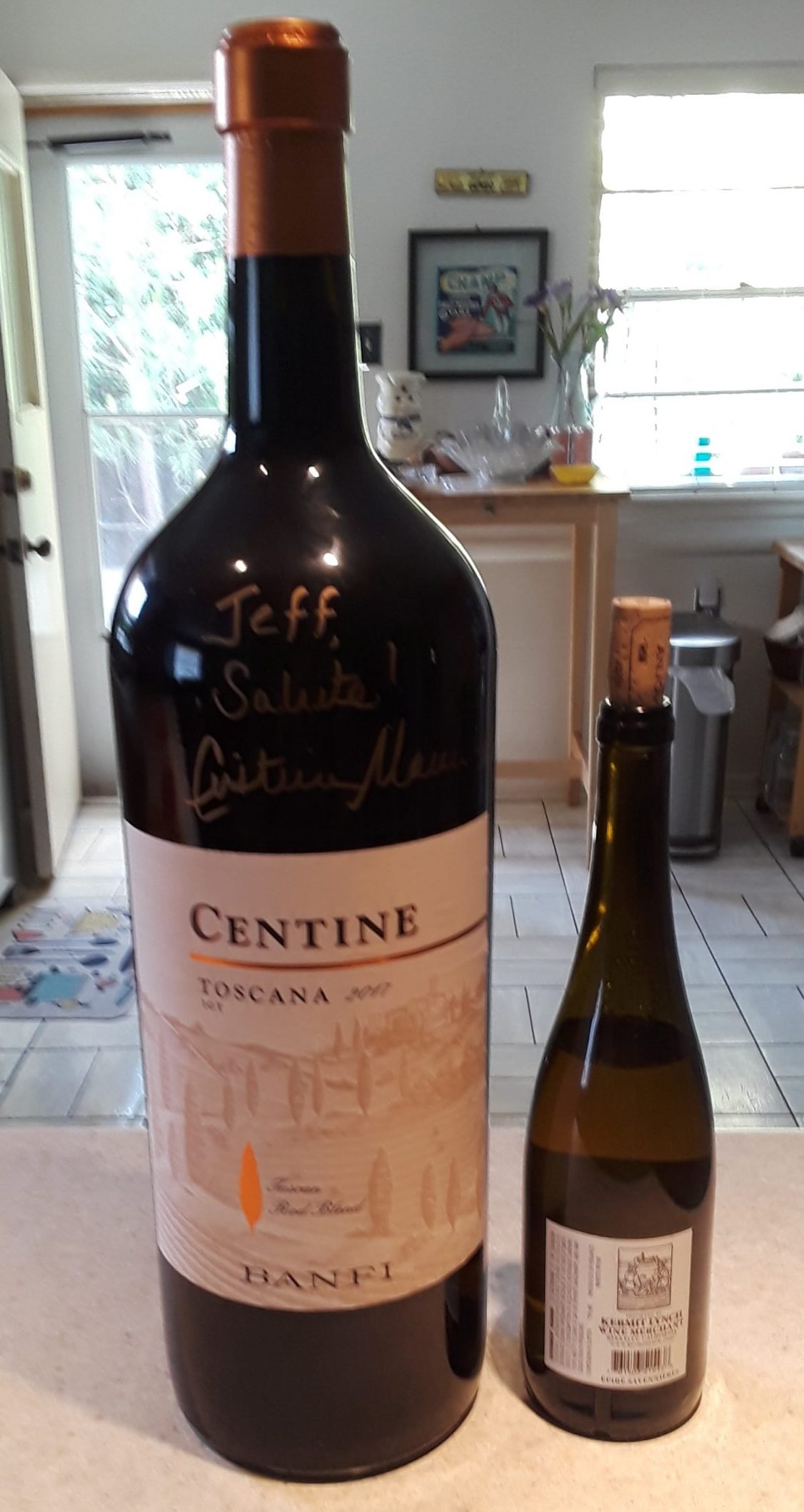
5-liter bottle banfi centine
The Banfi Centine can be yours, with the money going to your favorite charity.

My 5-liter Banfi Centine may not raise $1.8 million for charity, but I’m willing to give it a shot

Robert Parker, once the world’s most influential wine critic, recently donated a rare 100-point wine for a charity auction, where it raised $1.8 million.

Turns out the Wine Curmudgeon has a wine equally as worthy of a charity auction – a 5-liter bottle of Banfi Centine, the Hall of Fame $10 Italian red blend. It was a gift from former Banfi high roller (and long-time pal of the blog) Dan Peabody – so it’s inscribed, even.

So here’s what we’ll do: Anyone reading this can email me with a bid; bidding will close at 5 p.m. CDT on June 17. I’ll update everyone who bids by email, so everyone has a chance to keep bidding. I’ll also update the auction’s progress on the blog. Let’s start the bidding at $100, since a 5-liter bottle is almost seven bottles – 7 x 10 = $70.

The winning bidder will get the wine, and I’ll turn the money over to the charity of the winning bidder’s choice. The usual rules apply, since I don’t want the alcohol police to think I’m selling wine on the blog.

And let’s hope we do better than the last time I tried to piggy back on a Parker charity thing.

Winebits 497: Corks, Robert Parker, outer space wine

outer space wine
My brother’s wine is much better than the plonk we make here.

This week’s wine news: The cork industry says wine drinkers prefer corks, plus the Michelin Guide gets into the Winestream Media and outer space wine

Who would have thought it? A new study says U.S. wine drinkers prefer corks, which would be amazing news save for one thing – the cork industry paid for the study. So when the report says that 97 percent of us think cork is an indicator of wine quality, it’s so much hooey. Because what would you expect a survey paid for by the cork industry to reveal? That 97 percent of us think screwcaps are a better closure? The cork business is notorious for this kind of thing, and I have written about it before. One day, perhaps, cork producers will figure out we’re not so easily fooled. Until then, I will keep reminding them of that point.

A one-star winery? The Michelin Guide, perhaps the best-known restaurant rating service in the world, has bought 40 percent of Robert Parker’s Wine Advocate magazine. This is another indication of the continuing premiumization of all parts of the wine business, since Michelin focuses on high end restaurants and sees the Advocate as a chance to enrich the restaurant guide part of its business.” This is the second time the Advocate has been sold; Asian investors bought most of the company from Parker a couple of years ago.

Outer space wine: Can wine be made in outer space? That’s the question Gizmodo website put to the woman at NASA who runs the space agency’s crop program. The answer? Maybe, maybe not, given the challenges involved in growing and then fermenting the grapes. And even then it wouldn’t matter much: Given the size of the International Space Station, there’s enough room for just one bottle’s worth of grapes.

The Wine Curmudgeon’s Lunch for Literary

literacy educationIn which I’m offering my services to raise money to benefit literacy education — because, if Robert Parker can do it, why can’t I?

Parker, the man who popularized the 100-point scoring system and was the most powerful person in wine for decades, is donating his knowledge, his time, and exclusive wines from his cellar to raise money for heart disease research. All it takes is $25,000 — which is well and good, but more than almost everyone in the world can afford.

Which is where I come in. I’ll donate my knowledge, my time, and $10 wines from my cellar.

All I need is a literacy group to take me up on this offer, and I’m willing to work with one in any part of the country. Literacy has long been one of my causes, not only because I write for a living, but because we can’t have a functioning democracy unless we can read and write. So pass this post along to a literacy group near you, and we will make this work.

We can do it the same way Parker is doing his, but charge less money to make it more accessible to the vast majority of wine drinkers. The idea would be to raise awareness as much as money, and what better way to do that than to teach people about the joy of cheap wine at a wine lunch (especially given my fondness for wine lunches)?

Frankly, raising money for literacy by introducing wine drinkers to Gascon whites, Sicilian reds, chenin blanc, cava, and all the other wines they’re not supposed to drink would be more fun than any curmudgeon is supposed to have.

Robert Parker, Parkerization, and the judgment of history

Dear Mr. Parker:

I smiled when I read details of your recent interview with the French wine magazine Terre des Vins, where you said you didn ?t think Parkerization ? the idea that wines should be richer, riper, and more alcoholic, a practice that has become de rigueur for many high-end producers in France and California ? existed. It reminded me what Joan Baez once said: That she never wanted to be famous, just well known.

Yes, Parkerizaton exists (as even your wife has apparently noted). Why else would I get a sample of $50, 15.2 percent California pinot noir, other than to impress you? It ?s not like anyone else would want to drink it.

Frankly, denying Parkerization is too Shakespeare ? you are protesting too much. Instead, you should acknowledge the influence you had on the wine business over the past 20 years, when even the greatest French producers would accept your verdict as gospel. That ?s pretty damned impressive.

Before Ernest Hemingway, everyone wrote like Henry James. After Hemingway, everyone wrote like Hemingway. Papa reveled in that, and never tired of reminding the world that he was behind it. See the scenes with F. Scott Fitzgerald in ?A Moveable Feast ? for evidence.

My guess, and it ?s only a guess, because we ?ve never met and I don ?t know you (though I greatly respect your work) is that you were having a Baez-like moment. Could all the changes in the wine business and the way wine is made have really happened because of you? You were, all those years ago, just an attorney who loved wine. There ?s no way you, one man, could have changed so much, is there?

Afraid so, and you only have a couple of choices now. Accept your role, like Hemingway (without the looniness, hopefully). There are an almost infinite number of wine writers who wish they were in that position. Or, if you really think Parkerization is wrong, say so. Say it forcefully and often. Look back at what you wrote and see where, maybe, you opted for unctuousness (one of your favorite terms) over subtlety. And did it happen more often than you remember?

Regardless, accept that most of us would not be doing this sort of thing if not for you. I, for one, am grateful for that.

Sincerely.

Jeff Siegel
The Wine Curmudgeon

Robert Parker and the end of an icon

Robert ParkerIt ?s hard not to be cynical about the announcement yesterday that Robert Parker is making significant changes at his Wine Advocate newsletter ? quitting as editor and selling a good part of it to Asian investors.

It ?s also easy to feel just a little bit sorry for the critic, who used to be the most important person in the wine business — and not all that long ago. The sale, though, shows someone trying to remain important in a wine world that is far different than when he started three decades ago.

None of this is to downplay what Parker has done or how important he has been. The Wine Curmudgeon, after all, has insisted on those two things for years. But, the changes, as first reported by the Wall Street Journal, show someone not quite sure about what comes next:

? Three Singapore-based investors will buy a ?substantial ? interest in the Advocate, and operate the financial side of the business from Singapore.

? Parker will continue to review Bordeaux and the Rhone and become chairman. The editor will be Singapore-based correspondent, Lisa Perrotti-Brown. She ?s quoted as saying she wants more editorial control over wine reviews.

? The print version of the Advocate could end, perhaps as soon as next year. There has been some dispute about whether the Journal reported this correctly, including a later Parker statement that this will happen.

? The Advocate will accept advertising for the first time ever, though only for ?luxury ? brands and not wine or wine-related products. It will also sponsor Advocate-branded events and tastings, much as the Wine Spectator does.

The driving force behind all of this? That Parker, 65, needs to make a decision about what happens next. He is the Advocate, and businesses with a one-person identity don ?t last long after the person is gone. Does anyone remember Arthur Treacher fish and chips?

It ?s also important to note that the Advocate probably never made Parker rich, even though he was ?The Emperor of Wine. ? His company is private and doesn ?t release financials, so these are all estimates based on available information. The newsletter grosses less than $4 million annually in subscriptions; a partner at a top law firm (Parker was an attorney before going into wine) can earn that much without having to worry if the postal service actually bothered to deliver the latest issue.

In this, the new investors have their eye firmly on the bottom line. Eliminating the print edition could save as much as one-third of expenses, and end pass-throughs, the practice where someone subscribes to the Advocate and shares it with a couple of other people. In a digital world, those couple of other people will have to pay $75 a year if they want the newsletter, potentially doubling or tripling subscription revenue.

And accepting advertising ? well, we know what that means. It ?s easy to say, as Perroti-Brown did, that the ads would come only ?from sponsors where there is absolutely no conflict of interest, ? but there ?s no such thing. Once a publication takes ads, advertisers feel they have a legitimate right to ask for favors. And sometimes, it ?s hard to say no.

Finally, the new Advocate will add reviews on wine made in China and southeast Asia. This is, as Parker admitted to the Journal, chasing after those 1.2 billion Chinese who are the next great wine market. That few Chinese wines are of Advocate quality doesn ?t seem to matter ? a potential conflict of interest as great as taking ads. What happens the first time an important Chinese winery gets a 79? Or if a reviewer, hesitant to give a wine a 79, hems and haws it up to 85?

And I would not be me if I didn ?t note that Advocate still does very little with wines made in the 47 states in the U.S. that aren ?t on the west coast. But, then, there aren ?t 1.2 billion of us interested in regional wine.

Robert Parker finally elected to Vintners Hall

Which is as welcome as it was overdue. Parker redefined wine writing not only in the United States but in the world, and his 100-point scoring system made him the most powerful person in the wine business well into the 21st century.

Somehow, though, the wine writers and and Hall members who vote didn't elect Parker to the Vintners Hall the first two times he was on the ballot. That changed this year, when the 81 people who voted (out of some 220 who were eligible) put him in. As I wrote in July, when I sent in my ballot — with Parker's name on it:

There is no reason why Parker shouldn ?t be in. We ?re told we should vote
for someone who made "the greatest contributions to the California wine
industry in any area of achievement." I ?ve got news for them. That ?s
Parker, no matter how jealous they are of his success or how envious
they are of his prestige and popularity. If I ?m writing this, and I
think the 100-point system is dumb, then the rest of the other 216
writers (and current hall members) who have a ballot have no reason not
to vote for Parker.

Also elected were winemaker Merry Edwards, wine writer Frank Schoonmaker, and labor leader Cesar Chavez, all of whom I voted for. The late Chavez, who has been on the ballot at least three times, was a surprising — but well-deserved — selection.

Parker's election does raise a couple of questions. First, what will happen when he and hall member Randall Grahm — no fan of Parker, the 100-point scoring system or the Winestream Media that Parker epitomizes — see each other at the induction ceremonty? Second, what will I have to complain about when I vote next year?