Category:Wine news

Winebits 750: Wine consumption, wine humor, California wine

wine drinker
“I’m not sure how I’m supposed to pass out on a bottle of wine a month, either.”

This week’s wine news: World wine consumption statistics, plus the New Yorker offers wine buying tips, and a 50th anniversary celebration for some of California’s top wineries

• Not nearly as much: The Europeans still drink the most wine in the world, per capita, but their consumption has declined dramatically, reports Decanter. In France, In France, consumption has fallen by about half, per capita, in the last 50 years, as it has in Italy. The Portuguese are the biggest wine drinkers in the world, with about 69 bottles a year per person. Per capita consumption in the U.S. remains a little more than one bottle a month, though we’re still the biggest wine drinking country in the world by total volume. Neo-Prohibitionists: Explain how we’re all getting drunk every night on a bottle of wine a month, would you?

• Gen Z, baby! Nate Odenkirk, writing in The New Yorker, has figured out wine buying, an offers this advice: “What font do you see? Helvetica? Loopy cursive? Tasteful balloon letters? Yes, please! The wine inside may be aged, but the label screams Gen Z.” His take – which includes three other tips — is appropriately humorous and and playful, as we would expect from the magazine that published James Thurber and S. J. Perelman. “Farewell, My Lovely Appetizer,” anyone?

• Happy birthday: Dave McIntyre, writing in the Washington Post, demonstrates why he is one of the top writers in country with this take on the 50th anniversary of some of California’s most important wineries. They include Caymus, Silver Oak, Dry Creek, and Smith-Madoren. Dave tells the story with perspective and intelligence, never once lapsing into winespeak. Perhaps most importantly, he writes for an audience that may be interested in wine, but doesn’t want to geek out over it. Would that more U.S. wine writing did that.

Winebits 749: Wine marketing, supply chain woes, 500-year-old wine book

wine marketingThis week’s wine news: The blog’s official wine marketer sounds off on the failures of wine marketing, plus supply chain price gouging and the oldest wine book written in French

• Failure all around: Paul Tincknell has a more than a few words of wisdom for the wine business in its hunt for younger consumers – and they aren’t compliments. Tincknell, the blog’s official wine marketer, calls out producers, the Winestream Media, restaurants, wholesalers, and consolidation on his company’s blog. The result, he says, has given us too high prices – and even price gouging – and this “excessive pricing … raises the risk of purchase for many to unacceptably high” levels. So they drink beer instead. The piece is a bit long, but well worth reading for a thorough analysis of what’s wrong and how to fix it.

• Speaking of price gouging: The New York Times, dissecting the supply chain woes we’ve come to know all too well in wine, writes that shippers are gouging small companies for no other reason than they want to. “Carriers are exploiting the supply chain chaos to breach contracts and jack up rates,” says the story, also noting that a variety of experts predicted that this would happen when the federal government deregulated the shipping industry. Says one small businessman: “Contracts are not worth the paper they are written on these days. They just don’t honor them.”

• Oldest wine book: The University of California-Davis, world-famous for its viticulture and enology programs, has acquired the first wine book written in French. The school’s library bought the only known copy of “Le débat du vin et de leaue,” printed about 1515. The price was not disclosed. The book is a debate between water and wine, used to offer advice about how to live a virtuous life, a common topic during the Renaissance.

Encork: A better way to close an open wine bottle?

encorkThe Encork stopper seems to keep wine fresh after the bottle has been opened
Tyler Rice may be on to something, and he used an apple to do it.

Rice is one of the people behind a wine closure called Encork. It aims to fill the void between the ultra-pricey Coravin and the more simple and less expensive Vacu Vin-style systems, which are used to close open bottles of wine and to keep the wine from oxidizing. No pumping is required and Encork doesn’t need pricey accessories like argon capsules or replacement needles.

Instead, it’s a plastic stopper with a tab on the part that goes into the bottle. Remove the tab, insert the stopper, and a compound on the bottom of the stopper is supposed to absorb the oxygen in the open bottle and slow oxidation.

Which is where the apple comes in.

Oxidation in wine works the same way it does with an apple. Cut an apple, expose the flesh, and it turns brown; the same thing happens to wine (you can sometimes see the browning in white wine). Wine also picks up an almost brandy-ish taste. When Rice and his colleagues tested the Encork compound, they put an apple core in a wine bottle. If Encork didn’t work, the core would turn brown.

It didn’t.

“There was a lot of skepticism about whether this would work,” says Rice, “and there has been a very positive reaction that it works as well as it does.”

Which it does seem to do. I can’t vouch for the 99 percent oxygen removal that the brand claims, but it worked when I used the sample Rice sent me. I closed a variety of crummy sample wines with Encork, leaving each bottle about half full. My thinking? That well-made wine can hold out for several days without oxidizing because it is well made; poorly-made wines, like the samples, should oxidize almost immediately.

But none of them did, and each tasted remarkably the same the next day. In fact, one rose – slightly sweet and a bit tannic – was still slightly sweet and a bit tannic when I opened it 24 hours later.

A box of 12 Encork stoppers costs $30, or $2.50 each, and can only be used once to prevent oxidation (though it’s a perfectly fine stopper if all you want to do is close an open bottle). The price makes the product better suited for wine costing more than $15, and I can see the Big Guy using it for his $18 red Bordeauxs.

Regardless, it’s much easier to use than the Vacu Vin (which I use) and certainly more affordable than the Coravin, Who knew an apple core would pay off like that?

Winebits 748: Paper wine bottles, Champagne lawsuit, wine real estate

paper bottle
Yes. a paper bottle. Nuts to you, glass.

This week’s wine news: A paper wine bottle debuts at a British on-line grocer, while Champagne revs up another lawsuit and Napa prices don’t have anything on Texas

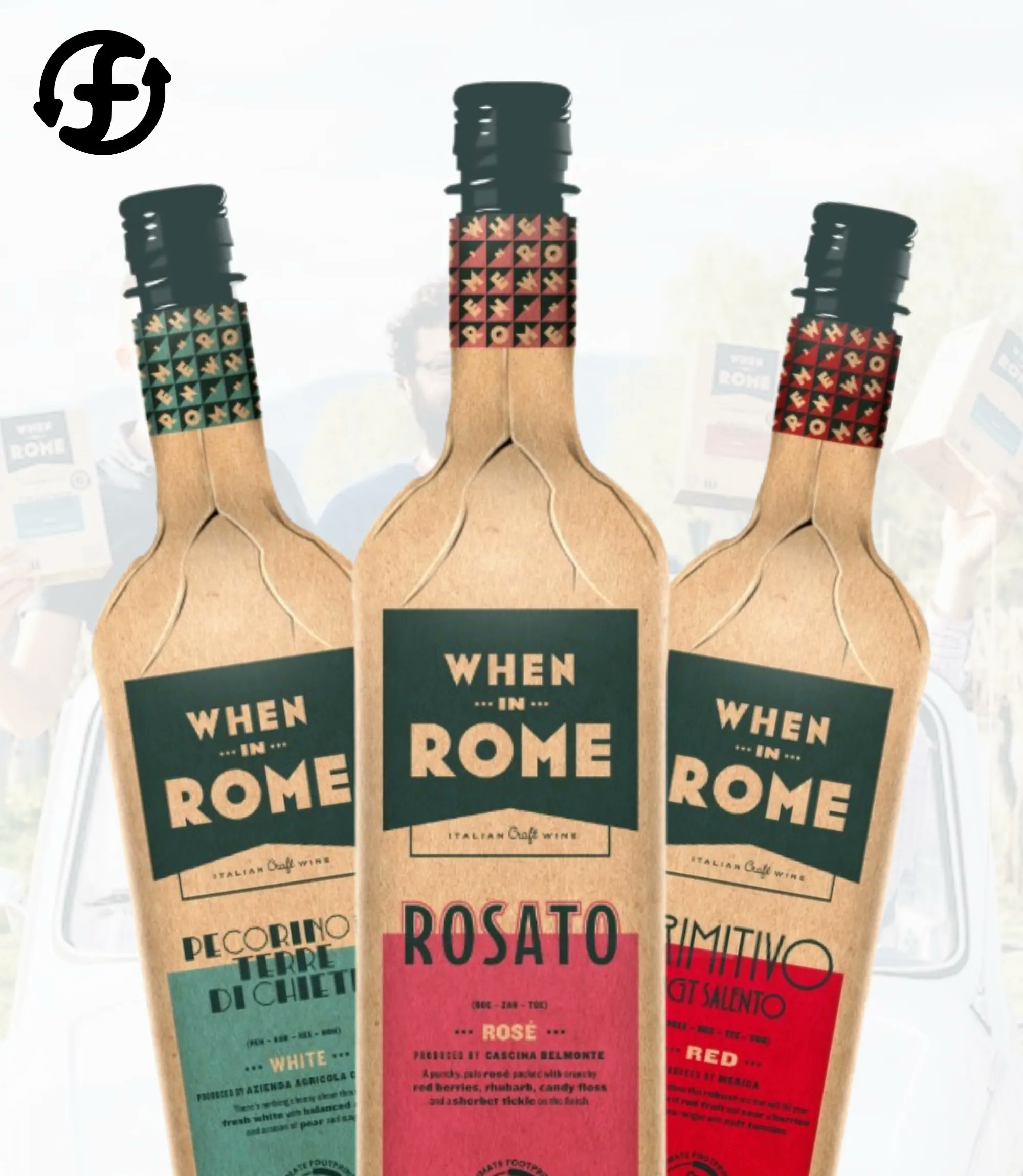
• Paper wine bottle: What may be the first paper wine bottle in Britain is set to debut when a brand called When in Rome will sell a red, white and rose at on-line retailer Ocado. The bottle, a collaboration between the producer and Britain’s Frugalpac sustainable packaging company, is said to be made from 94 percent recycled paper and have a carbon footprint 84 percent less than a single-use glass bottle. Says When in Rome founder Rob Malin: “We believe great wine doesn’t have to come in glass bottles. We’re here to prove that whether you’re drinking from a glass bottle or a paper bottle, the quality of the wine is not impacted.”

• One more lawsuit: The Champagne business, responsible for some of the great lawsuits in an industry that is renowned for them, has struck again. Cristal, which successfully sued Cristalino (and for which the WC got a cease and desist order), has lined up its lawyers for an action against a small Oregon winery that makes a sparkling wine called Crystal Visions. The producer, Landmass Wines, used the name Crystal Visions to honor Stevie Nicks of Fleetwood Mac fame. The phrase “crystal visions” appears in the lyrics of the Fleetwood Mac song “Dreams.” But, of course, the Cristal lawyers were not satisfied, even though Landmass got a favorable ruling from the U.S. patent office. Ain’t it great to be a Big Wine company?

• Have $16 million? That will get you a one-half acre compound near Austin in central Texas. The offer includes a main house, two guest houses, a party barn. and an office, totaling 10,000 square feet of living space as well as seven bedrooms and 9 ½ baths. Plus, of course, a tempranillo vineyard, with enough vines planted to make a couple of hundred bottles a year. Hmm. I wonder if I could use the guest house for an office for myself, and let Churro, the blog’s associate editor, have the other one?

Winebits 747: Ann Pollack, Vinho Verde, ancient wine

ann pollack
Ann Pollack, 1945-2022

This week’s wine news: Ann Pollack, long-time Drink Local stalwart, dies. Plus, young people like Vinho Verde and more ancient wine discoveries

• Ann Pollack, 1945-2022: Ann Lemons Pollack, who helped make Drink Local Wine a success, died last week. She was 76. Ann, along with husband Joe, was instrumental in the success of our Missouri event in 2011 in St. Louis. Ann, a food writer, knew everyone in town and used those contacts to plug the event. How else would a Chicagoan end up doing a spot on the uber-St. Louis radio station, KMOX? And, unlike so many other food writers, she understood that local wine was just as relevant as local food to the locavore movement. Even more important: Ann was a fine person, generous with her time and wisdom. The string of tributes in St. Louis-area media is not surprising.

• Vinho Verde: The WC, in my enthusiasm for Portugal’s cheap and delightful Vinho Verde white wine, never thought it would make me cool. But a British magazine reports that the hipsters are in love with a Vinho called Chin Chin: This “Portuguese white wine went viral in the same way as banana bread, quizzes and moderate depression – and its reputation has kept growing ever since. Particularly popular among drinkers in their 20s and 30s, the merrily named Vinho Verde also become symbolic of a new type of wine consumer.” What’s next for the WC? TikTok? BeReal?

• 6,300 year old wine: Wine may have been a part of everyday life in early Bronze Age Greece, according to a recent discovery in the northwestern part of the country. Researchers found grape seeds and pomace that had been preserved in a house fire that took place around 4300 BC. It’s not clear if the grapes for the wine were grown or foraged, but what is clear, says the report, is that this is the earliest evidence of wine production in Europe.

Photo: St. Louis Public Radio

Rose season 2022 preview

rose 2022
“The WC is right — where are all those $10 roses?”

This year should be better than last, but still expect higher prices and supply snafus

Two years of pandemic-related supply shortages should ease a little as we approach the start of 2022’s rose season. The blog’s 15th annual rose post will run on May 26 to mark the occasion.

Which is the good news. The bad news? Expect to pay more for your favorite pink wine – not a lot more, but just enough to notice the price increase.

I talked to a variety of retailers and importers over the past couple of weeks, and that was pretty much the consensus. Among their thoughts:

• Shipping remains an issue. One rose sample, which I always get around the beginning of April, won’t ship until the end of this month. “It’s still definitely not normal,” says Charles Bieler, whose roses include blog favorites Charles & Charles from Washington state and the French Bieler et Fils Sabine,

• Most of what we do get will arrive over the next couple of months, and that will be that, says Todd Nelson, vice president of marketing and PR for importer Winesellers, Ltd., which handles France’s Mont Gravet, another blog favorite. “When the brands are sold out, they’ll be sold out,” he emailed me. “Fewer brands will bring in late arrivals.”

• Prices will be higher, said almost everyone — $10 wines up to $12, $12 wines up to $14, and so forth. Interestingly, says Nelson, roses costing $20 and more haven’t fared as well over the past couple of years, and it looks like producers won’t make as many at those prices.

• Why higher prices? Inflation, certainly, as well as glass and cardboard shortages (used for wine boxes). There’s also a sense, one California producer said, that demand has increased for cheaper grapes from high-end producers, who are trying to cut costs. Which, ironically, means higher prices for $10 wines, since that raises the price of the cheaper grapes used to make those wines.

Winebits 746: “Clean wine,” convenience store wine, three-tier system

clean wine
The federal government says this is about the only kind of clean wine that is legal.

This week’s wine news: The federal government warns on “clean wine,” plus Gallo soars at convenience stores and a history of the three-tier system

• No such thing: The cyber-ether has been beside itself with news about clean wine, healthy wine, and the like over the past year or so. Now, the federal government agency that regulates alcohol has told marketers to calm down. The Tax and Trade Bureau, part of the Treasury, announced recently that “clean” should not be used to create the “misleading impression” that consumption of the alcohol beverage will have health benefits, or that the health risks otherwise associated with alcohol would be somehow lessened. The statement didn’t say if there would be legal penalties for anyone who did that; consider it a warning. And, added the bureau, “consumers should not interpret the term as meaning that the beverage is organic or has met other production standards” set by the federal government.

• Gallo soars in c-stores: The WC, ever alert to changing wine trends, keeps a sharp eye on convenience store sales, which are about the only bright spot for wine these days. As such, E&J Gallo helped a Midwestern chain increases its wine sales 8 percent over the past year. The key to success? Sweet wine, selling to Millennials, and making sure the wine was cold.

• Keeping it three-tier: Two of the most knowledgeable people in the country dissect the history of the three-term system in this interview, featuring Sovos ShipCompliant’s regulatory general counsel Alex Koral and Tom Wark, executive director of the National Association of Wine Retailers and author of the Fermentation Newsletter (both of whom have been on the blog). The interview gets a bit wonky, but it’s well worth reading for anyone who wonders how we ended up down this rabbit hole. My favorite bit? How a book published in the early 1930s, called “Towards Liquor Control,” still determines how we regulate booze in the U.S. The great Lou Bright once had one of my El Centro classes spellbound talking about the book.