

Tag Archives: ancient wine

Winebits 747: Ann Pollack, Vinho Verde, ancient wine

ann pollack
Ann Pollack, 1945-2022

This week’s wine news: Ann Pollack, long-time Drink Local stalwart, dies. Plus, young people like Vinho Verde and more ancient wine discoveries

Ann Pollack, 1945-2022: Ann Lemons Pollack, who helped make Drink Local Wine a success, died last week. She was 76. Ann, along with husband Joe, was instrumental in the success of our Missouri event in 2011 in St. Louis. Ann, a food writer, knew everyone in town and used those contacts to plug the event. How else would a Chicagoan end up doing a spot on the uber-St. Louis radio station, KMOX? And, unlike so many other food writers, she understood that local wine was just as relevant as local food to the locavore movement. Even more important: Ann was a fine person, generous with her time and wisdom. The string of tributes in St. Louis-area media is not surprising.

Vinho Verde: The WC, in my enthusiasm for Portugal’s cheap and delightful Vinho Verde white wine, never thought it would make me cool. But a British magazine reports that the hipsters are in love with a Vinho called Chin Chin: This “Portuguese white wine went viral in the same way as banana bread, quizzes and moderate depression – and its reputation has kept growing ever since. Particularly popular among drinkers in their 20s and 30s, the merrily named Vinho Verde also become symbolic of a new type of wine consumer.” What’s next for the WC? TikTok? BeReal?

6,300 year old wine: Wine may have been a part of everyday life in early Bronze Age Greece, according to a recent discovery in the northwestern part of the country. Researchers found grape seeds and pomace that had been preserved in a house fire that took place around 4300 BC. It’s not clear if the grapes for the wine were grown or foraged, but what is clear, says the report, is that this is the earliest evidence of wine production in Europe.

Photo: St. Louis Public Radio

Break out the Adams extract!

ancient wine
“Honey, where did you say you put the vanilla? You know my boss won’t drink our wine any other way.”

Evidence suggests ancient wine drinkers enjoyed vanilla-flavored wine

The Wine Curmudgeon has long wondered why so many wine drinkers want their chardonnay – or even more astounding, their pinot noir – to taste like vanilla.

Now we may have one reason why: Wine drinkers have, apparently, always liked vanilla in their wine.

Researchers excavating a 2,500-year-old site in a Jerusalem neighborhood found organic residues of vanilla, then an exotic spice, on wine jars. The Jerusalem Post reports that the archaeologists were surprised to find the residue, given how rare and expensive vanilla was at the time.

Does this mean they found the Old Testament version of this wine?

The story emphasizes that the wines were not vanilla-flavored from oak aging, which is mostly what imparts the flavor these days. Rather, the residue shows that the spice was actually added to the wine. In addition, the researchers think the wines were aimed at an upscale market; not only was vanilla expensive, but it likely came from as far away as India, making it far less common than it is today,

So why vanilla? The story doesn’t say, though we can assume several things:

• Ancient wines were likely unpalatable, at least to 21st century tastes. Fermentation depended on wild yeast, so there was probably little consistency in flavor or quality.

• The wines were what one source I found called “robust” – so big and tannic? No one had yet figured out how to control those qualities — or to even think that they needed to be controlled.

• Adding seawater or sweetener (honey or grape juice must) to ancient wine was common, as was adding spices. The reasons are many, though I assume the most common was to make the wine taste better.

The other thing that I find fascinating about this? Given that vanilla was so rare and so expensive, was its use an ancient form of premiumization?

Winebits 730: The “end of the year, and aren’t we glad“ edition

wine sales
Where have all of wine’s customers gone?

This week’s wine news: More bad news about wine consumption, plus the origin of wine grapes and airline wine

Struggles of wine: That headline on the third quarter alcohol sales report says it all, and if that’s not enough: “wine is still facing an uphill battle — let’s hope the holiday season gives it the boost it needs.” The report comes from the Wine & Spirits Wholesalers Association, which tracks wine and spirits sales from wholesalers to retailers. In this, it’s one of the most reliable sources of wine sales in the country. And the news isn’t good – table wine sales down 7.2 percent over the same period last year, and “wine is expected to follow spirits in having a strong holiday season but will most likely not see a positive trend before the new year.”

Wine grape origins: The best wine grapes come from the genus and species vitis vinifera, which includes cabernet sauvignon, chardonnay, and the like. The evolution of vinifera was always something of a mystery until DNA testing, which finally allowed scientists to start to make sense of where each grape came from. Now, a study in the journal Nature has solidified those beginnings even more: “all analyses support a single domestication event that occurred in Western Asia and was followed by numerous and pervasive introgressions from European wild populations.” In other words, every grape used to make wine today evolved from the first grapes planted in western Asia about7,000 years ago.

• In the air: Need extra wine? Consider buying it from an airline. Several have been selling off their wine collections during the pandemic, and American Airlines has gone a step further. Its Flagship Cellars wine club sells wine directly to consumers via a home delivery service, reports thedrinksbusiness. The service costs around $99 per month; consumers get three “premium” wines per month delivered to their doorstep. Once the excess inventory is gone, the service will end.

Winebits 720: Ancient wine, mocktails, North Korea

ancient wineThis week’s wine news: A massive ancient winery complex has been found, plus the increasing popularity of mocktails and North Korea and wine labels

Ancient Big Wine? Archaeologists have unearthed a 1,500-year-old winery in central Israel that may have covered as much as two acres. According to a statement from the Israel Antiquities Authority, “We were surprised to discover a sophisticated factory here, which was used to produce wine in commercial quantities. We should remember that the whole process was conducted manually.” As part of this, the excavation found five wine presses and uncovered warehouses where the wine was stored and prepared for sale. This is just the latest discovery over the past several years confirming the key role wine played in the ancient Mediterranean economy. At a time when it was unsafe to drink water, wine was the everyday beverage of almost everyone, rich or poor, and wine was traded throughout the region.

More mocktails? Nation’s Restaurant News reports that mocktails – cocktails made without alcohol – continue to grow in popularity. The story even quotes someone from what appears to be a very hip restaurant in Seattle: “I’m not ashamed to admit that I initially thought they were stupid. Which I now totally regret!” The new mocktails not just mimic traditional cocktails, but are made with better quality ingredients. And prices are apparently even increasing – call it mock-iumization.

Designing wine labels? North Korea is perhaps the most secretive country in the world, where Supreme Leader Kim Jong Un has almost unparalleled control over its citizens. So any news coming from North Korea must be take as rumor first and foremost. Still, a recent report said Kim’s several absences from public life from January through May could have been related to a design competition, where the Supreme Leader was judging wine label mockups (as well as designs for school uniforms, buses, and a cargo ship). And we thought the wine business was weird in this country.

Winebits 710: Villa Maria bankruptcy, ancient wine, wine marketing

ancient wine
There’s more evidence that the Romans traded wine throughout their empire, and even as far as France.

This week’s wine news: Villa Maria’s mysterious bankruptcy appears over, plus an ancient wine discovery and more wine marketing faux pas

Bankruptcy over? New Zealand’s Villa Maria, which has apparently been in some sort of bankruptcy since at least May, has been sold. The story in the link is very vague, as almost all news reports of the winery’s financial difficulties have been. On the one hand, the winery may have been profitable, but it also owed its lenders NZ$212 million (about US$149 million). Why the situation forced bankruptcy now has never been made clear. Villa Maria was purchased out of receivership by a New Zealand winery called Indevin, which seems to make private label wine for retailers and supermarkets. All of this has been more depressing news for those of us who care about quality cheap wine; Villa Maria’s $15 sauvignon blancs are always top notch.

More ancient wine: Researchers have found the ruins of a ship near Sicily that may have been transporting wine in the Mediterranean more than 2,000 years ago. Decanter reports that amphorae, ancient storage jars used to transport wine, were discovered alongside the ruins of the ship. It’s the second shipwreck discovery in a matter of weeks off the coast of Sicily. The Romans, of course, were great wine producers and innovators, and may even have invented wine writing. This discovery, say researchers, adds more evidence to the theory that wine and olive oil were trade throughout the Roman Empire, and especially by ships in the Mediterranean that went as far as northern France.

Bring back the Curmudgies! The Curmudgies ran on the blog from 2012 to 2017, honoring the worst in the wine business. This included a worst news release award, of which there were always far too many to choose from. But this release, reported by Lew Perdue at Wine Industry Insight, may be the all-time worst. It has just one line: “Please call with any inquiries.” Apparently, the subject line was supposed to get the editor to call, so there was no reason to send anything else. Is it any wonder I worry about the future of the wine business?

Winebits 705: Drink Local, glass bottles, ancient wine

ancient wine
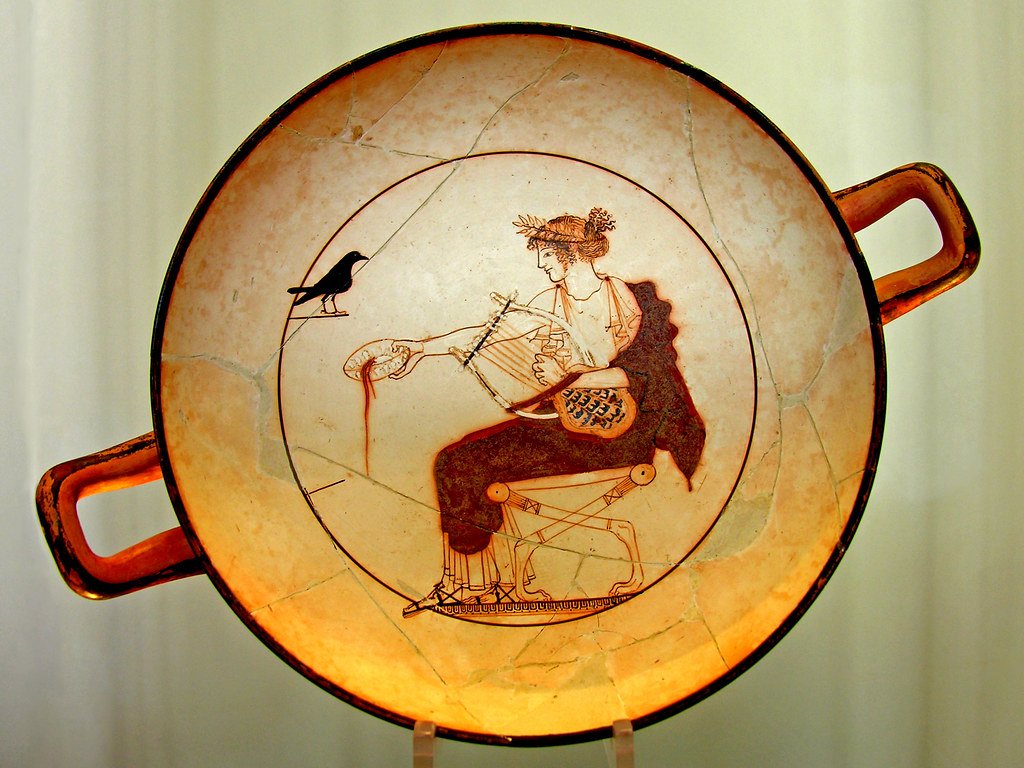
The Greek god Apollo apparently enjoyed a cup or two wine when he wasn’t spreading plague.

This week’s wine news: Is regional wine coming to the wine business’ rescue? Plus, one more analysis dissects glass bottles and wine may be even more ancient than we thought

Regional wine to the rescue? The mainstream media has again discovered Drink Local, offering it as a way to enjoy wine without crowds and high prices as the pandemic ends. Plus, writes Erica Lamberg in USA Today, “Just keep in mind your wine-tasting and winery visits may be different that you’re used to. But that can be a good thing.” Which, of course, is what those of us who support regional wine have been saying for years. Lamberg suggests Colorado, Virginia, and Pennsylvania, as well as Oregon – though it’s hardly off the beaten path. The first three are first-rate suggestions, and it’s especially nice to see Pennsylvania – not among Drink Local’s best-known states – on the list.

No more glass? Emilie Steckenborn, writing in the British trade magazine Harpers, doesn’t mince words: “The sustainability wave is sweeping across the world, and there’s hardly an industry that could see a more radical transformation than food and beverages. While consumers are happy to see changes in food packaging, the wine sector – with 19 billion glass bottles sold into the global market annually – is a slow mover.” Which, of course, is not news to anyone who has been paying attention. Still, that the article appears where it does, and that it speaks so forcefully, is a sign that more and more people who are part of wine see the need for change.

How old was it? Wine drinking in Europe may date to 4300 BC in prehistoric Greece – much earlier than previously thought. Archaeologists working in northern Greece have found thousands of ancient grape seeds and pomace – residue from pressed grapes – in the remains of a burned house near Philippi. That may be a couple of thousand years earlier than first suspected. As such, it’s the earliest evidence of wine drinking in Europe, and researchers expect the work to shed more light on the daily activities of ancient Greeks. So far, there is no evidence that the three-tier system existed in ancient Greece, but that’s probably just an oversight.

Photo: “Greece-0895 – Wide-bowled Drinking Cup” by archer10 (Dennis) is licensed under CC BY-SA 2.0


Winebits 664: Fast food wine pairings, ancient wine, pandemic wine sales

Fast food wine pairings
No, this was not the WC’s favorite hat of all time, though the uniform did turn me off polyester forever.

This week’s wine news: Are fast food wine pairings the next big thing? Plus, 7th century BC wine, and more confusing numbers about pandemic wine sales.

Bring on the Whoppers: Who knew the Wine Curmudgeon would be able to discuss the fast food of his youth two weeks in a row? But Christine Struble, writing for the Foodsided blog, asks: “Are fast food wine pairings becoming the newest food trend?” Perhaps, but the concept isn’t new. I received a release in the blog’s early days from a brand called Fat Bastard touting fast food wine pairings; I’ve written about it here several times; and I taught them to wine classes at the late Cordon Bleu and El Centro. Because if you’re trying to reach people whose diet consists of fast food, what better way to teach pairings? Or, as I asked one group of Cordon Bleu students, “What do we pair with a Burger King cheese Whopper?” The consensus was supermarket-style merlot; plus, they got to hear about working the broiler at the Burger King on Skokie Road in Highland Park, Ill., resplendent in my polyester uniform and paper hat.

2,700 years ago: Archeologists have discovered the first Iron Age wine press in present-day Lebanon, reinforcing the idea that wine played a key role in the ancient world. They found the press, used to extract juice from grapes, during excavations at the Phoenician site of Tell el-Burak near the present day city of Sidon (an important trading hub in wine and other goods in the Mediterranean region). Grapes were grown in and around Tell el-Burak, which was inhabited from the late eighth to the middle of the fourth century BC. Researchers have also found amphorae, ancient wine bottles, in the area. But no one was quite sure how the grapes were turned into wine until this discovery.

More conflicting statistics? Blake Gray, writing on Wine-Searcher.com, finds even more conflict in wine sales during the pandemic. He cites research from California’s Sonoma State University, which found that even though U.S. wine sales overall are up, 57 percent of U.S wineries say their own sales are down. Or, as we have noted here, there’s little sense in trying to make sense of any of the numbers. Ostensibly, “Big wineries are taking more market share at the expense of small wineries,” said the report. You will also be happy to know, according to one analyst at the same seminar, that Americans may have had more disposable income than ever, despite the pandemic. I wonder: What country is he living in?

Photo courtesy of MeTV, using a Creative Commons license