Category:Wine trends

Yes, we were drinking less during the pandemic

what ifAnd this marketing researcher may have the numbers to prove it

Was it the great urban myth of the pandemic? Were we passed out drunk over the last year, swozzled, snockered, and stewed beyond belief? Websites reported it. So did respected news organizations. And the medical studies? According to entirely too many of them, the booze epidemic during Covid-19 was as bad – if not worse – as heroin, opioids, and crack cocaine.

Because, of course, it may well have been an urban myth, perpetrated by neo-Prohibitionists and medical researchers who were aided and abetted by sloppy journalism and a complete indifference to understanding how the alcohol supply chain works.

And Jordan Cohen may have the numbers to prove it.

“I was frankly surprised to see the results,” he says. “Given all I read and heard, I expected the opposite. But I can tell you that I am extremely confident in the results, based on our sample size, our random selection, and that the study was weighted for the census.”

Significant declines

Cohen’s results? That, in fact, drinking did not increase during the pandemic, and that it actually declined significantly for a variety of age groups. The study, The Pandemic Shopper, was conducted in February by What If Media Group, where Cohen is the chief marketing officer. The results are at a 99% confidence level with margin of error +/- 2.5 percent.

And they don’t mention snockered, swozzled, or stewed:

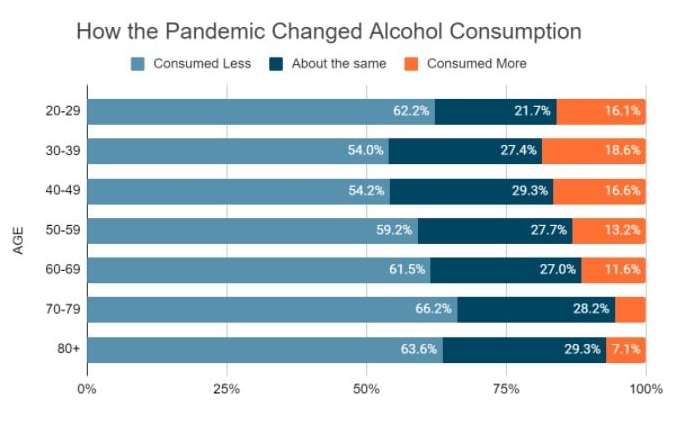
• Almost three out of five consumers reported consuming less alcohol during the pandemic.

• No age group reported significant increases in drinking. The biggest jump came in the 30-39 group, where almost 19 percent said they drank more. Overall, only one out of six people in the study said they increased their alcohol consumption over the last year.

• Some 62 percent of those aged 20-29 said they drank less, which is not surprising to anyone paying attention. Booze costs money, and the youth unemployment rate was 18.5 percent in July 2020. That was down from 26.9 percent in April but still about twice as high as a year earlier. So, healthy lifestyles aside, they couldn’t afford to get wasted.

So what’s going on here?

Why did What If Media Group’s study get such different results? This is not to discount the horrors of alcoholism or to infer that’s it’s OK to drink more. As noted on the blog many, many times, I know the ruin alcoholism produces.

Rather, says Cohen, there are many reasons for the discrepancies. First, just because consumers stocked up on alcohol at the beginning of the pandemic doesn’t mean that they drank it all at once, or even eventually. “Everyone was in a mad rush to buy all sorts of products,” he says. “We didn’t use all that toilet paper at once. Why would anyone assume we drank all that beer at once?”

Second, flaws in how many of the other studies were conducted. Cohen says a survey of depressed women would almost certainly find that they were drinking more during the pandemic, since that group is predisposed to drink more. He also cited too small sample sizes, which would make some results less reliable.

Third, these results jive with other studies – not disputed – that show people were trying to eat healthier and work out more during the pandemic.

Finally, how could alcohol use increase during the pandemic when people were staying home? Bars were closed. People weren’t going to parties. When, asks Cohen, did they have an opportunity to drink more?

“We didn’t do the study to take sides,” he says. “We wanted to find consumer patterns so we could sell the information to advertisers.”

Which, if advertisers are smart, they’ll pay attention to – instead of one more report that says Americans turned into drunken sots during the pandemic.

Chart:  The Pandemic Shopper, by What If Media Group

 

Pandemic pricing: Are we trying to buy less expensive wine?

pandemic pricing
“Who knew this sauvignon blanc would taste better than chardonnay — and cost half the price?”

New data shows consumers have been targeting less expensive varietals

Some surprising pricing news from one of the country’s most respected wine analysts: Consumers have been targeting less expensive wine for more than a year. Sales of varietals that cost less, like sauvignon blanc and “red blends,” are up, while the totals for more expensive cabernet sauvignon and chardonnay are down.

Why surprising? Because prices continue to go up, thanks to the Trump tariff, pandemic-related supply chain snafus, producer and distributor consolidation, and premiumization. But the numbers, from Wine Market Council president Dale Stratton using wholesaler data from April 2019 to March 2020, show that we’re still looking for bargains.

In fact, this is the second bit of pricing news to show this kind of trend. Earlier this year, a study found that the average price of a bottle of wine bought directly from a winery dropped 9 1/2 percent in 2020 – the first decrease in at least a decade.

So what’s going on here?

“I think this is a great question and not one that is easy to answer with one data source,” says Stratton. “I am confident there is still premiumization in the wine category, but there is a consumer group that is more focused on value. This group has always been there and are very valuable to the category, as they tend to be frequent consumers — i.e., one or two glasses every day.”

The sales numbers are especially intriguing since they come from wholesalers and include all wine retailers and restaurants, and not just the biggest stores, chains, and supermarkets that are included in Nielsen reports. So this is data from supermarkets, independents, small restaurants, and even convenience store (measured by the amount of wine sold):

• Red blend sales increased 5.9 percent – more the five times the annual growth rate each of the last couple of years. Blends priced between $11 and $14.99 grew 53.3 percent, while every other red bend price segment was flat or down.

• Sauvignon blanc sales increased 6.5 percent. This number wouldn’t be as surprising if the data only included supermarkets, which are home to dozens and dozens of inexpensive sauvignon blancs. But that it included independents may hint at something more permanent going on.

• Stratton seemed genuinely stunned by the growth of pink moscato, which was up 11.6 percent. He attributed it to the wine’s sweetness, and there’s certainly some truth to that. But don’t overlook its price: Bottles costing $4.50 to $7.99 at retail made up almost three-quarters of pink moscato sales.

• On the other hand, cabernet sales declined 2.2 percent and chardonnay fell 5.4 percent. Which, if we look at pricing, makes sense. Consumers, one Long Island retailer told me recently for a freelance story about red blends, are looking for bang for their buck. They can get that with red blends and sauvignon blanc in a way they can’t with cabernet and chardonnay.

Photo: Gary Barnes from Pexels

Three wines that give the WC more reason to worry about the future of the wine business

three reasons
“Come on. … you know you want this 15 percent Spanish wine. … you know you do.”

Why do producers – big and small – make and market wine in such confusing ways?

The samples and the e-mails for the samples keep arriving, offering wines that seem to have no relation to reality. So I ponder and ruminate: Why is someone making these wines? What’s the economic reason for these wines? Why would anyone buy them? Or are they just three more reasons to worry about the future of the wine business?

• A $45 Italian white blend made with chardonnay and sauvignon blanc. First, chardonnay and sauvignon blanc aren’t Italian grapes, so this looks like little more than a marketing project. Dig deeper and it gets even more bizarre: The link in the e-mail goes to the wine’s Vivino page, where the wine has a crummy rating and the Vivino algorithm compares it to wines costing $7.99. Meanwhile, this Arneis and this one – both much more Italian – cost less and have better reviews.

• A 15 percent Spanish tempranillo. Spanish tempranillo’s reason for being, save for a few Winestream darlings from Ribera del Duero, is elegance and grace, with a bit of rusticity for balance. Plus, higher alcohol wines are becoming less popular. So why would anyone make a Spanish wine that has the same amount of alcohol as a California fruit bomb? Isn’t it easier just to buy the fruit bomb?

• An email touting an $8 wine because it has a new label – “featuring the iconic Andes Mountain range, a bigger and bolder logo and easy to read color-coded varietal listing.” No one knows better than I do the quality conundrum inherent in supermarket wine and how difficult it is to sell those wines around quality. But isn’t there a better way to market it than to note a picture of mountains?

Six wine questions to answer as we come out of the pandemic

wine questions
Who knew we could have this much fun drinking wine without a bar or restaurant?

No one knows what wine will look like post-pandemic, but the answers to these questions will shed some light

So far, so good – infection numbers are down, vaccinations are progressing, and some sort of return to normal looks more and more possible. So what will that mean for the wine business as the pandemic winds sown?

Because, of course, no one knows . There are expert analyses, prognostications, and the like – but since this sort of thing hasn’t happened in a century, how can we be sure? Hence, six wine questions to answer as we come out of the pandemic:

Where will we buy wine once businesses re-open?

The biggest changes in wine during the pandemic were the boost in supermarket, winery sales directly consumers (or DtC), and Internet sales. Will that surge continue? Or will wine buyers return to the previous mix – supermarket, chain, and big boxes; then independents; and then DtC and Internet? There has been lots of cyber-chatter about how much the pandemic boosted independent wine shops, but much of this evidence has been anecdotal. It’s difficult to believe that some of the changes, like the increase in supermarket sales, won’t continue – and to the detriment of independent retailers and smaller producers.

What will prices do?

Go up, almost certainly. This may be the only thing that’s not much of a guess. The wine supply chain is so bonkered, thanks to the pandemic, that supply is often short. And that raises prices. Throw in continuing consolidation among the biggest producers and wholesalers – which never would have passed anti-trust muster a generation ago – and higher prices are almost inevitable.

Will there be a wine boom?

No less than Silicon Valley Bank’s Rob McMillan expects a boom, and he knows more about this stuff than almost anyone. But, again, this situation is not comparable to anything that has happened in the past century. We assume there is pent-up demand, but there has been little evidence to suggest that. So a boom would not be a surprise – but neither would the opposite.

Will wine tourism come back?

It’s amazing how many people I talk to expect wine tourism to come back, just because they expect it to come back. But, here, too, that’s little evidence one way or the other. Regional tourism seems to be doing well enough, but how many people will be willing – or will be able to afford – to fly to San Francisco, rent a car, and drive to Napa or Sonoma any time this year? That’s the sign wine tourism is back, and not whether someone in the Washington, D.C., area drives an hour to northern Virginia or someone in Austin drives 45 minutes to the Texas Hill Country.

What’s the future of restaurant wine?

Kyla Peal, writing in Bon Appetit: “Perhaps we’ll see [restaurants] with smaller and smarter wine lists that also include more budget-friendly bottles to safeguard against being saddled with lots of high-end inventory should another shutdown occur.” And if pigs had wings. … Sadly, everything I’ve seen over the past 15 months points in the other direction – restaurants using wine to recoup losses during the pandemic. One steakhouse in the Dallas area is charging $36 for a bottle of Meomi pinot noir, and that’s the second cheapest wine on the list. So, no, I’m not optimistic about a recovery in the restaurant wine business.

Will we continue to eat at home?

Consumer spending on restaurants was higher than supermarket food spending in 2019, a remarkable development. The pandemic reversed that, and there is lots of evidence – and even some decent numbers – that more of us will eat at home post-pandemic. If so, we can kiss off any hope for a revival of restaurant wine, which was muddling along even with record restaurant sales. On the other hand, more people eating at home might be a boost for wine, as I’ve noted many times. Buy a couple of chicken breasts at the supermarket, pick up a $12 bottle of white wine, and you’re having wine with dinner at one-quarter the cost of the same dinner at a restaurant.

Photo: Kelsey Chance via Unsplash

TV wine ad review: This Premier Estates commercial was so tasteless it was banned

“Taste the Bush” is even dumber than The Roo – which means it could be the worst TV wine ad ever

Yes, there was the Orson Welles ad. And the John Gielgud and the Mateus rose ads. And the Roo, which was in a class of awful all by itself.

Until now. Somehow, despite the Wine Curmudgeon’s eternal vigilance, I missed what is quite possibly the worst TV wine ad ever, Premier Estates’ 2015 campaign for “Taste the Bush.” How bad? It was banned by Australia’s Advertising Standards Authority.

And yes, those of you who are thinking what you’re thinking about why the ad was banned are absolutely correct. Said the ad authority ruling: “…we considered that the ad presented the woman in a degrading manner, and concluded that it was likely to cause serious or widespread offence.”

Indeed. Is it any wonder I worry about the future of the wine business?

Why would anyone think this would sell wine? It’s the kind of snickering, male adolescent humor that was common when the WC was 12. For all their failings, one would think 21st century wine marketers would be well past that.

But apparently not.

So watch the video – but only if you are prepared to be offended. And be glad someone, somewhere, had the good sense and the authority to tell the wine business to grow up.

A tip o’ the Curmudgeon’s fedora to the United Kingdom’s The Wine Merchant magazine, which spotted this ad and included it in a story that featured many of the WC’s all-time worst ads.

More about TV wine ads
• TV wine ads: San Giuseppe Wines, because you can never have too much bare skin in a wine ad
• TV wine ads: Drink Black Tower, invade a foreign country
• Wine business: Watch this beer spot to see how TV wine ads should be done

Ernest Hemingway, wine and writing about wine

Hemingway
A clean, well-lighted place.

New documentary reminds us Hemingway was a damned fine writer about wine

The Ken Burns-Lynn Novick PBS documentary, “Hemingway,” has done much to restore Ernest Hemingway’s reputation as one of the most important American writers of the past 150 years. Its combination of candor, research, and razor-sharp criticism (especially from Irish writer Edna O’Brien) demonstrated why and how Hemingway changed the way English is written. His short, sharp, declarative sentences, stripped of adjectives and exclamation points, is still seen today, whether in ad copy or in stories on wine blogs.

And it’s also a chance to remember that Hemingway was a damned fine writer about wine:

“As I ate the oysters with their strong taste of the sea and their faint metallic taste that the cold white wine washed away, leaving only the sea taste and the succulent texture, and as I drank their cold liquid from each shell and washed it down with the crisp taste of the wine, I lost the empty feeling and began to be happy and to make plans.”

Wine is a constant in Hemingway’s European books

• Robert Jordan and the Spanish partisans drink to forget in “For Whom the Bell Tolls:” “I am drunk on wine,” says Pablo, “and I would be happy except for those people I have killed. “ These days, something sort of similar would be the Tamaral tempranillo from Ribero del Duero.

• In “A Farewell to Arms,” Frederic Henry describes a dark, rough, tannic wine served to the Italian soldiers so they’ll be just drunk enough to accept the horrors of the trenches. But he also (according to the Italian Wine Guy) enjoys something that might be Valpolicella: [Y]ou pulled the neck of the flask down with the forefinger and the wine, clear, red, tannic and lovely, poured out into the glass held with the same hand.”

• Hemingway and his first wife slurped oysters and drank all that white wine in “A Movable Feast,” his sort of non-fiction reminiscence of his early days in Paris. Which, of course, is an excuse to mention one of my favorite Chablis.

Bring on the bubbly

The first novel, “The Sun Also Rises,” is especially about wine. Jake Barnes drinks wine on a bus with a group of Basques as he travels to Spain: One of the Basques was “a young fellow, and he held the wine bottle at full arms’ length and raised it high up, squeezing the leather bag with his hand so the stream of wine hissed into his mouth. He held the bag out there, the wine making a flat, hard trajectory into his mouth; and he kept on swallowing smoothly and regularly.” And, of course, there is terrific Basque wine.

Finally, when Jake, Lady Brett Ashley and a Greek count share Champagne, Jake tells the count “You ought to write a book on wines,” and the latter answers: “Mr. Barnes, all I want out of wines is to enjoy them.” Which sounds like a fine idea, and especially with this Champagne.

It’s worth noting, as more than a few critics have, that there is little of this kind of drinking in the Nick Adams short stories, as well as much of the rest of Hemingway’s work set in the U.S.

And why should there be? Prohibition had just started when Hemingway returned from Italy at the end of World War I; drinking during Prohibition, as Raymond Chandler biographer Tom Hiney has noted, was not just illegal but serious business. Who had time to banter with royalty? It was find a speakeasy, get drunk, and leave before the place got raided.

Photo: “Les Deux Magots” by Serge Melki is licensed under CC BY 2.0

Is Gallo about to change the idea of winery tasting rooms forever?

Tasting rooms
Will wine drinkers soon be toasting each other with Gallo wine in company-branded tasting rooms?

Winery tasting rooms have traditionally been about Drink Local; Gallo’s plan could turn them into the wine equivalent of Disney stores

June 16 update: Bring on the Barefoot! The world’s biggest wine producer successfully negotiated the hurdles detailed in the first post and will build its warehouse, cannery, and bottling plant in rural South Carolina.

South Carolina Gov. Henry McMaster says the plan will hire almost 500 people over the next eight years, an impressive achievement for a county with around 1,000 residents.

The final agreement will allow Gallo to open three tasting rooms, but the company has not said where they will be.

Continue reading →