Category:Wine trends

10 years of premiumization — and all the damage that has been done

heimlich
Is there a Heimlich maneuver for premiumization’s stranglehold on the wine business?

Higher prices are strangling wine to death, so that we may have lost a generation of wine drinkers

This is the first of two parts looking at premiumization’s grip on the wine business. Today, Part I: A decade of higher prices has chased away wine drinkers. Friday, Part II: Is ultra-premiumization the next logical – and terrifying – step?

More than once over the past decade, I’ve predicted the end of premiumization – and I’ve been wrong every time. Today, as we mark a decade (more or less) since premiumization took hold of the wine business, we can see the results.

It is strangling wine to death.

The numbers are as stark as they are depressing. The Wine Intelligence consultancy reports that in 2020, only 18 percent of those aged 18-34 in the U.S. were “regular” wine drinkers. That compares to 28 percent in 2010. In other words, wine may have lost an entire generation, if not more.

Meanwhile, the company that owns the Wine Spectator – and which never fails to gloss over what it doesn’t want to be true – has finally admitted that “the wine industry in the United States is expected to suffer a 0.5% volume decrease this year … volume growth has been modest at best in each of the past ten years due to fierce competition from whiskies, hard seltzer, and other ready to-drink brands.“

Yes, there are dozens of reasons why that’s the case. But, in the end, it’s difficult not to believe that price matters the most. People don’t buy something if it costs too much, and wine’s average price has increased by about one-half, from $6 or $7 a bottle in 2010 to close to $10 today.

We can argue all we want whether quality has improved by that much (and no, it hasn’t). But when you can buy a six-pack of decent beer for less than $10 or a more than adequate bottle of whiskey for $15, why pay $10 for supermarket plonk? Who pays $10 for a fast-food hamburger?

No one, and certainly not if they’re younger and have less money – and especially in today’s corporatized economy, when they have fewer prospects than their parents and grandparents did. So bring on the hard seltzer!

This is about the point, on the old blog, when people would send emails or leave comments telling me I knew nothing about wine, and that $20 or $30 or whatever was affordable and to shut up because you’re hurting wine and I’m canceling my free subscription.

Of course, if they were paying attention, they would have noticed that I was about the only one left who was drinking wine with them.

Photo: “CPR in J’bad” by Todd Huffman is licensed under CC BY 2.0
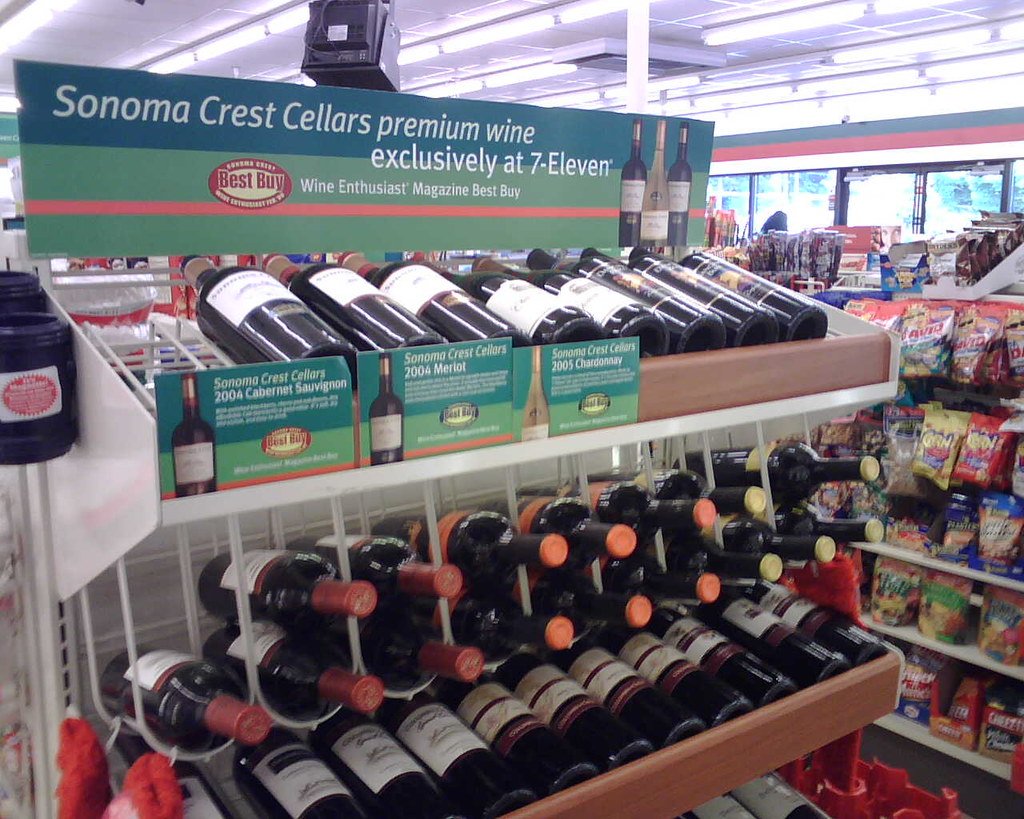
Convenience stores to the rescue!

convenience store wine
“Hey, honey, pick up some of that 7-Eleven wine when you get the diapers and the milk.”

Forget all the bad wine news – convenience store wine sales are surging

You know all that gloom and doom in the wine business?

Forget about it.

Wine sales at convenience stores surged in 2020, the fourth consecutive year of increases at 7-Eleven, QuikTrip, and the like. Wine sales, as a percentage of store revenue, increased some 20 points, as did average wine sales per store. Plus, more stores than ever sold wine, about 54 percent.

This is impressive enough. But given that overall wine sales remained flat in 2020, despite the pandemic surge, it’s even more impressive. So what’s going on?

First, since restaurants and bars were closed, we bought more wine at convenience stores, says Jeff Lenard, vice president, Strategic Industry Initiatives, for the National Association of Convenience Stores. The numbers come from the trade group’s 2020 “State of the Industry Report.” Plus, says, Lenard, the pandemic changed shopping behavior – so that buying wine at a convenience store didn’t seem nearly so odd.

Which, of course, we’ve seen before. The convenience store business has noticed this change; a recent trade magazine story urged store operators to stock more rose and canned wine, and to consider adding biodynamic and natural wine. Most wine shops don’t even carry much of the latter two. Also worth noting: A nearby  7-Eleven is selling Kendall Jackson chardonnay and Nobilo sauvignon blanc for the same price as several neighborhood supermarkets. When’s the last time a convenience store cared about competitive pricing?

In fact, wine’s growth, though starting from a smaller base, showed more or less the same percentage increases as beer. Which, given the way the convenience store business works, is amazing.

And the best news? “It’s too early to predict where things will go in 2021,” says Lenard, “but so far sales are strong, with stores holding on to some of the gains from changes in behavior in 2020, plus increasing sales from the regular customers returning to everyday life.”

Which, for wine, is even more amazing. Who knew 7-Eleven could be the wine business’ savior?

Photo: “IMG00003.jpg” by patientfox is licensed under CC BY 2.0

More about convenience store wine sales:
• Convenience store wine sales 2019
• Jerry Jones and 7-Eleven wine
• Convenience store wine sales 2018

Winecast 61: Michael Wangbickler and what comes next for wine

michael wangbickler
Michael Wangbickler: Wine tourism looks like it’s back, but serious questions remain about wine demand.

Michael Wangbickler: The pandemic exposed a lot of a weaknesses in the wine business

Michael Wangbickler, who runs Napa’s Balzac Communications, is one of the most clear-eyed people in the wine business — no wishful thinking, no this is going to happen because we want it to, no rose-colored glasses. This is one reason why Balzac is one of the premier marketing companies in the wine business. So who else better to talk to about what comes next for wine in the post-pandemic, young people aren’t interested, and hard seltzer days we’re in?

I’ve known Mike for years; he was one of the people who made Drink Local Wine work when we changed the way the world thought about regional wine. And yes, I’m jealous of his beard. We talk about it, as well as the future of wine marketing and wine criticism, on Mike’s “Hit the Bottle” podcast — complete with production effects. It focuses on trends in the wine business, so our discussion is quite detailed for those of you so inclined. And, not surprisingly, I am critical of the Winestream Media.

In this podcast, we talked about the changes on the way for wine, good and bad. Plus, we learn I didn’t drink when I turned 18:

• The pandemic did spur innovation among many producers, who recognized they couldn’t sell wine the same way they had for years. For one thing, many have 21st century websites in the 21st century.

• Direct to consumer — buying directly from wineries — will continue to grow, and despite the legal difficulties. Mike thinks it’s one of the few ways smaller producers can replace the business they lost when restaurants shut down for a year. And he’s not optimistic about the return of the restaurant wine business.

• He also isn’t optimistic about big changes in three-tier, despite reforms made during the pandemic. Change will come gradually, depending on the political climate in each state. That has much to do with the biggest producers and the biggest wholesalers, who have the political clout to prevent wholesale changes.

• Don’t expect a wine boom coming out of the pandemic. People were drinking less before the pandemic, so why would they drink more now? Premiumization, though, will continue — younger consumers drinking more expensive wine as they drink less. They’re also going to drink so-called “healthy” wine — Mike thinks that’s a key trend.

Click here to download or stream the podcast, which is about 15 1/2 minutes long and takes up about 10 megabytes. Quality is excellent — have I finally figured out Zoom?

Follow-up: Wine, younger consumers, and cooking shows

cooking shows
“No, no wine here, honey — you’re too young to make YouTube happy.”

60 cooking shows had a chance to make money from wine; none of them were interested

The post about this generation’s cooking shows and their lack of interest in wine turns out to be more than my sharp-eyed insight or even curmudgeonly ranting. Bill Wallace, a long-time wine sales and marketing executive, invented a way for cooking shows to sell the wine they featured on their episodes.

This came at no risk to the shows, was completely legal, and offered the potential for a nice cash return as well as viewer good will.

So how many shows signed up, Bill?

“I pitched over 60 cooking shows and never received a response,” says Wallace, who has been doing this long enough that he helped Julia Child get wine for a couple of benefit cooking demonstrations during her heyday. “Must be a generational issue.”

Sigh. Is it any wonder I worry about the future of the wine business?

There seem to be a number of things going on here besides an indifference to wine. One reader said she was surprised by the post, since Alison Roman includes wine in her cookbooks. So my guess includes the following:

• YouTube’s adult viewing restrictions, to stop minors from accessing pornography. Videos with alcohol must be labeled for adults only, as I found out when I did the PLMA shoot. So if your target audience includes ages 16 to 18, putting wine in a video will lock them out. So no wine.

• Wine’s cost. Many of today’s YouTube chefs seem to have minimal budgets, given the production values, the lack of editing, and so forth. So buying enough wine to cook with may push the budget over the edge. The catch here is that wine doesn’t show up much on Food Network shows, and one would think they have the budget.

• Our old friend three-tier. Wallace says his proposal was completely legal – vetted by lawyers, even. But as we’ve seen over the years, it’s difficult to expect people who aren’t retailers to understand that. They see how difficult it is to sell wine, what with the layers and layers and layers of red tape and regulation, and then run in the other direction.

In the end, of course, a complete indifference to wine seems to be the primary reason for its lack of acceptance on these cooking shows. But the other stuff doesn’t help, either.

Photo: RODNAE Productions from Pexels

High-alcohol, unpleasant wines: The Trump tariff legacy

Trump tariff wine
“Oh no — more of that horrible Trump tariff wine.”

Some European producers boosted alcohol to get around the Trump tariff, and their wines suffered badly

The Trump wine tariff taxed British, German, French, and Spanish wines an additional 25 percent. The exception, save for sparkling wines, were wines from those countries with more than 14 percent alcohol.

Not surprisingly, many producers made wines with 14 percent alcohol from the 2019 and 2020 harvests to get around the tariff – even if the wine was a white, rose, or a light red that didn’t normally contain that much. Much of the time, the extra alcohol didn’t make too much difference, given the way alcohol levels are measured. The label could say 14.5 percent, for example, but have as little as 14 percent – or even less, allowing for winking and nudging. The 2016 El Coto Crianza, which would have been released around the time of the tariff in October 2019, lists 14.5 percent alcohol. But it remains a classic Rioja wine – spicy, fresh, and with just the right heft.

Some wines, though, were ruined by the extra alcohol. It turned a fresh, crisp and enjoyable wine into something heavy, bloated, and almost undrinkable. These wines, sadly, included some of my favorites.

I list four of them to let you know what to watch for, and not to call out the producers and their importers. As a friend, who had tasted several of these said with a sigh, “They had payrolls to meet, and the extra 25 percent meant they might not be able to do that. So they did what they had to do.”

• Kermit Lynch’s Domaine Dupeuble Beaujolais ($18) is one of the great values in the wine world – an amazing French red that is always in short supply in Dallas. But the 2019 is 14.5 percent and tasted it. There was no Beaujolais character at all, just a hot and annoying wine that was missing most of its fruit. I had bought two bottles, without thinking to check the alcohol level. Oops.

• The 2019 Eguren Ugarte Rioja ($10). Remember what I wrote about the El Coto? This was just the opposite, and went down the drain. Sadly, several other Spanish reds were equally as dreadful and suffered the same fate.

• The 2019 Henry Fessy Beaujolais-Villages Vieille Vignes ($12): This, too, was 14.5 percent, and was even more out of whack than the Dupeuble. And Fessy is almost as dependable a French producer; the 2019 Gamay Noir was 13.5 percent and delightful — wine of the week quality.

• The 2019 Cote Mas Sauvignon Blanc Vermentino ($10/1 liter). France’s various Mas wines are almost always well-made and consistent, offering tremendous value. This one wasn’t. Directly from my notes: “14.2 percent. One of the worst professional wines I’ve ever tasted. It’s hot, devoid of any varietal character, not especially ripe, and bitter and tannic.”

Whatever happened to the post-pandemic wine boom?

wine demand
This picture may be as close as we get to a post-pandemic wine boom.

It’s looking less and less likely, as the pandemic economy continues to do what it wants – and not what we want it to do

Remember all those predictions for a Roaring’20s wine boom as we came out the pandemic? It may be time to forget about them.

More and more economic indicators are pointing to a gradual overall recovery, and wine seems to be even more gradual than that. For instance:

• The highly-regarded IWSR consultancy says consumption of wine costing $15 and more won’t reach 2019 levels until 2022.

• Wine depletions – a more encompassing term than wine sales – turned negative in March and April vs. a year ago. This compares to spirits depletions, which have shown steady growth for the past 12 months.

• Supply chain problems continue to plague wine producers, and especially imported wines.

No less than Silicon Valley Bank’s Rob McMillan, perhaps the leading wine analyst in the country, says he may have been wrong about the wine boom.

“I might have missed on a prediction that I made,” he wrote earlier this month. “But I underestimated the impact of a single fact. … I ignored the fact that still wine sales have been plagued by declining growth rates since 2017. Even before the Pandemic, growth was effectively zero for the category.”

So where does that leave us? McMillan – who I respect tremendously – was not the only one to see what hasn’t been there. But why not? The U.S. economic situation is unlike anything we’ve seen in a century, and that’s even before taking the pandemic into account. There are near-record disparities of wealth, a gig economy that masks actual unemployment, and supply chain snafus that most of us have never seen in our lives. Buying a bone-in chicken breast in Dallas often requires visits to two or three stores.

So even smart people can make mistakes. But that’s because wine still hasn’t solved the problems that have plagued it since the end of the recession – it’s too expensive and too confusing compared to beer and spirits; it’s seen as something old white people drink, and hence not especially relevant; and the wine business still puts too much emphasis on the Baby Boomers instead of marketing to their children and grandchildren.

The good news? The blog’s unofficial wine analyst isn’t quite as pessimistic as that. He says, despite all the bad news, there are some positive trends in all this gloom. “Core“ wine drinkers – those of us who drink wine at least once a week – are still buying wine. The losses have come from “marginal” wine drinkers, who is everyone else.

So let’s hold on to that, and try to figure out a way to wean the marginal wine drinkers off their craft beer and Manhattans.

Photo: “National Drink Wine Day” by steevithak is licensed under CC BY-SA 2.0

Why don’t younger people drink wine? Because it’s not on the cooking shows they watch

julia child
“Make sure we get the wine in this shot, OK?”

The Baby Boomers had Julia Child and Jacques Pepin, but the You Tubers popular with Gen X and the Millennials don’t bother with wine

The Wine Curmudgeon has solved wine’s most vexing problem – why younger people don’t drink wine. The reason? Their cooking shows don’t feature it the way the Baby Boomer cooking shows did. Hence, the youngest generations have never learned that wine is just as much a part of dinner as plates and letting the pots soak.

Don’t look so surprised. Yes, there are other reasons – wine’s complexity, its cost, and the country’s emerging neo-Prohibitionism. But I don’t think it’s a coincidence that the peaks of the U.S. wine boom, first in the 1970s and early 1980s and then in the 1990s, happened at the same time as wine-savvy cooking shows became a fixture on PBS.

Julia Child served wine with her meals, even though in those long ago days it was called things like Mountain Red. So did Jacques Pepin. So did Lidia Bastianich. So did Justin Wilson. So did Ina Garten, even though she never seemed to much care about it. In fact, wine was such a part of these shows that Julia Child contemporary Graham Kerr used it as shtick.

But the people who cook for today’s generations – many quite talented – rarely have alcohol anywhere in the kitchen, even to cook with. Frankie Celenza? Nope. Molly Yeh? Nope. Alison Roman? Cider maybe, but nary a glass of wine.

In fact, I’ve pitched several of them about adding wine to their shows. What better for their straightforward, cost-conscious recipes than the Wine Curmudgeon’s straightforward, cost-conscious wine advice? Alison, pal, I know just the $10 wine for your Internet-famous chickpea stew.

Never heard back from anyone. Which, I suppose, is understandable. Once you’ve experienced Alvin Zhou’s 30-pound Oreo, what does wine matter?

Pepin has said wine was crucial to what he was trying to do, that it was important to introduce U.S. viewers to the joys of wine and food. He also thought it was important to point out that wine doesn’t have to be expensive: “I am not a snob about wine, you know. I usually buy a bottle under $10 or whatever, if you know what to buy.”

My guess is that this change started 20 years ago, more or less around the time America’s Test Kitchen became popular. Its format rarely includes wine, and former host Christopher Kimball told me wine was entirely too hard. Instead, it focused on more “practical” matters, where wine advice wasn’t seen as helpful to its audience as finding the best saute pan or the best supermarket chocolate chips.

Which, frankly, is the younger generations’ loss. Wine is a lot of fun; just strip away the snobbery and the cost. That’s what this $8 rose was invented for. Anyone who appreciates a 30-pound Oreo should appreciate that.