

Tag Archives: wine demographics

Wine’s generation gap may be even bigger than we think

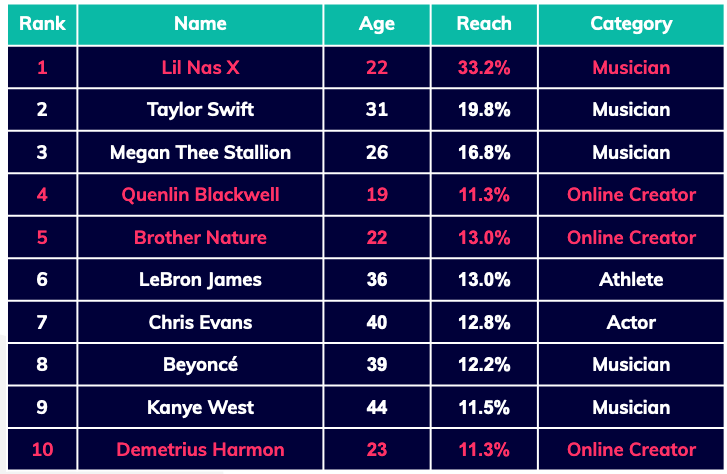
gen zThese influencers matter to Gen Z – who in wine knows who they are?

Gen Z is the demographic coming up behind the Millennials – born after 1996 and who are just becoming old enough to drink wine. Given the bang-up job wine has done reaching Millennials (yes, sarcasm), is there any hope it can reach Gen Z?

Not really, if the chart at the top of page is as important as it seems to be (chart from Helixa, via Wine Industry Insight). These are the 10 most important influencers for Gen Z, the people they follow most on social media.

Not one wine critic, wine magazine, sommelier, or wine personality on the list.

Yes, we can have a long, academic discussion about influencers and their role – real or imagined, necessary or marketing hype – but that doesn’t change the fact that Lil Nas X reaches one-third of those ages 24 and younger. And when’s the last time you heard anyone in wine talk about Lil Nas X? (Go on, Google him. You won’t be the only one.)

In fact, look at the entire list, and you’ll notice not only how young they are, but how little they match any wine demographic. The closest is probably basketball superstar LeBron James – and when he’s the closest, you know how little the list has do with wine drinkers as they are today.

The one constant about wine over the past 20 years, the thing that has been overlooked in all of the rest of the foolishness, is that wine it isn’t cool anymore. Because it used to be. Damn, it was cool – Jessica Lange drinking wine in “Tootsie” cool.

But then wine got hung up on scores and $100 bottles and snottiness and all the rest, and it barely held on to Gen X and it lost the Millennials. Cool turned into bougie, and younger people switched to hard seltzer.

And you don’t have to know who Lil Nas X is to know he isn’t bougie.

Follow-up: Wine, younger consumers, and cooking shows

cooking shows
“No, no wine here, honey — you’re too young to make YouTube happy.”

60 cooking shows had a chance to make money from wine; none of them were interested

The post about this generation’s cooking shows and their lack of interest in wine turns out to be more than my sharp-eyed insight or even curmudgeonly ranting. Bill Wallace, a long-time wine sales and marketing executive, invented a way for cooking shows to sell the wine they featured on their episodes.

This came at no risk to the shows, was completely legal, and offered the potential for a nice cash return as well as viewer good will.

So how many shows signed up, Bill?

“I pitched over 60 cooking shows and never received a response,” says Wallace, who has been doing this long enough that he helped Julia Child get wine for a couple of benefit cooking demonstrations during her heyday. “Must be a generational issue.”

Sigh. Is it any wonder I worry about the future of the wine business?

There seem to be a number of things going on here besides an indifference to wine. One reader said she was surprised by the post, since Alison Roman includes wine in her cookbooks. So my guess includes the following:

• YouTube’s adult viewing restrictions, to stop minors from accessing pornography. Videos with alcohol must be labeled for adults only, as I found out when I did the PLMA shoot. So if your target audience includes ages 16 to 18, putting wine in a video will lock them out. So no wine.

• Wine’s cost. Many of today’s YouTube chefs seem to have minimal budgets, given the production values, the lack of editing, and so forth. So buying enough wine to cook with may push the budget over the edge. The catch here is that wine doesn’t show up much on Food Network shows, and one would think they have the budget.

• Our old friend three-tier. Wallace says his proposal was completely legal – vetted by lawyers, even. But as we’ve seen over the years, it’s difficult to expect people who aren’t retailers to understand that. They see how difficult it is to sell wine, what with the layers and layers and layers of red tape and regulation, and then run in the other direction.

In the end, of course, a complete indifference to wine seems to be the primary reason for its lack of acceptance on these cooking shows. But the other stuff doesn’t help, either.

Photo: RODNAE Productions from Pexels

Why don’t younger people drink wine? Because it’s not on the cooking shows they watch

julia child
“Make sure we get the wine in this shot, OK?”

The Baby Boomers had Julia Child and Jacques Pepin, but the You Tubers popular with Gen X and the Millennials don’t bother with wine

The Wine Curmudgeon has solved wine’s most vexing problem – why younger people don’t drink wine. The reason? Their cooking shows don’t feature it the way the Baby Boomer cooking shows did. Hence, the youngest generations have never learned that wine is just as much a part of dinner as plates and letting the pots soak.

Don’t look so surprised. Yes, there are other reasons – wine’s complexity, its cost, and the country’s emerging neo-Prohibitionism. But I don’t think it’s a coincidence that the peaks of the U.S. wine boom, first in the 1970s and early 1980s and then in the 1990s, happened at the same time as wine-savvy cooking shows became a fixture on PBS.

Julia Child served wine with her meals, even though in those long ago days it was called things like Mountain Red. So did Jacques Pepin. So did Lidia Bastianich. So did Justin Wilson. So did Ina Garten, even though she never seemed to much care about it. In fact, wine was such a part of these shows that Julia Child contemporary Graham Kerr used it as shtick.

But the people who cook for today’s generations – many quite talented – rarely have alcohol anywhere in the kitchen, even to cook with. Frankie Celenza? Nope. Molly Yeh? Nope. Alison Roman? Cider maybe, but nary a glass of wine.

In fact, I’ve pitched several of them about adding wine to their shows. What better for their straightforward, cost-conscious recipes than the Wine Curmudgeon’s straightforward, cost-conscious wine advice? Alison, pal, I know just the $10 wine for your Internet-famous chickpea stew.

Never heard back from anyone. Which, I suppose, is understandable. Once you’ve experienced Alvin Zhou’s 30-pound Oreo, what does wine matter?

Pepin has said wine was crucial to what he was trying to do, that it was important to introduce U.S. viewers to the joys of wine and food. He also thought it was important to point out that wine doesn’t have to be expensive: “I am not a snob about wine, you know. I usually buy a bottle under $10 or whatever, if you know what to buy.”

My guess is that this change started 20 years ago, more or less around the time America’s Test Kitchen became popular. Its format rarely includes wine, and former host Christopher Kimball told me wine was entirely too hard. Instead, it focused on more “practical” matters, where wine advice wasn’t seen as helpful to its audience as finding the best saute pan or the best supermarket chocolate chips.

Which, frankly, is the younger generations’ loss. Wine is a lot of fun; just strip away the snobbery and the cost. That’s what this $8 rose was invented for. Anyone who appreciates a 30-pound Oreo should appreciate that.

Winebits 570: Box wine, wine drinkers, restaurant trends

box wine

This week’s wine news: Why isn’t box wine more popular? Plus, identifying U.S. wine drinkers and restaurant wine trends for 2019

No boxes, please: Box wine, despite its increasing popularity, remains a minor part of the wine business. It accounts for just four percent of wine sold worldwide by volume; box sales have declined in Australia, one of the few places where it’s popular; and younger wine drinkers prefer bottles to boxes. One expert thinks he knows why: The technology was developed for battery acid, and producers treated the wine they put in boxes much the same way, using it for lower quality products.

Parsing the wine drinker: A study has divided U.S. wine drinkers into six groups in one of those exercises that only marketing types can understand. The study uses terms like social newbies and premium brand suburbans to divide us by age and demographics. As near as I can tell, the idea is that younger wine drinkers are more adventurous and older wine drinkers buy the same brands of chardonnay and white zinfandel over and over. Which, of course, isn’t all that new; perhaps it means something the marketing gurus in the audience?

Restaurant wine trends: Of which there aren’t any in 2019, if this forecast from a restaurant consultancy is accurate. It lists 13 trends for next year, including higher prices, new spins on Asian food, and “motherless meat.” But it doesn’t say one thing about restaurant wine, which makes perfect sense given what we’ve seen of restaurant wine over the past couple of years. So don’t expect the conundrum that is restaurant wine — higher prices, mediocre quality — to be solved anytime soon.

Winebits 354: Costco wine, wine demographics, wine and drugs

costco wine
Annette Alvarez-Peters

? Costco’s Peters speaks: Annette Alvarez-Peters, who buys alcohol for the Costco warehouse chain, is one of the most important people in the wine business; as such, she rarely gives interviews. Hence my surprise at an interview with the Shanken News Daily trade news service, even thought it’s short and Alvarez-Peters doesn’t say all that much. What’s worth noting is how much of its private label wine Costco sells; its Kirkland pinot grigio and cabernet sauvignon are two of the chain’s biggest sellers, both at less than $10 a bottle. That consumers will drive to Costco just to buy its wines is mind-boggling in the day of the Great Wall of Wine. Most retailers would kill for that kind of loyalty, which they’d have to do because they don’t know how to get it any other way. The other reason to mention this? Because a Costco piece that ran on the blog in 2012 is the second most popular post , based on one-day visitors, in blog history. Shoppers don’t just want to go Costco — they want to read about it.

? Who drinks wine? The Wine Market Council has updated some of its numbers, and the results are intriguing. If you’re a high-frequency wine drinker (you drink wine at least once a week), you’re more likely to be married than if you drink wine less than once a week, the occasional wine drinker. High frequency wine drinkers are older, 51-44, than occasionals, but it’s not like either of them is young. The latter makes perfect sense given the wine business’ inability to understand it should try to sell wine to people other than old white guys. Note to advertisers: the blog’s demographics skew younger than that, no doubt because I write about wine that younger people can afford.

? Examine that spending: The British spend about 1 billion (about US$1.6 billion) more on illegal drugs and sex each year than they do on wine and beer, according to a just-released UK government study. That works out to about 260 (US$422) per adult. I don’t know whether that’s a lot of money for dope and whores, but I think the numbers are a little dicey. The average adult in the U.S. spends about $150 a year on wine (based on 242 million adults and $36.3 billion in wine sales, per the Wine Institute) and $413 on beer (based on $100 billion in beer sales, per the Brewers Association). That a country with a pub culture spends less per capita than we do on beer and wine is hard to believe, which makes me think the drugs and sex number should be higher. By comparison, I spend nothing on the latter and some US$2,500 (about 1,500) annually on wine, which doesn’t include other booze or restaurant wine purchases. I’ll let you draw your own conclusions about that.

Millennials and how they’re changing the wine business

Or, as my pal W.R. Tish phrased it in the headline for my story in Beverage Media magazine: ?Boom go the Millennials ?.

The wine business has mostly accepted that the Millennials, born between the early 1980s and the early 2000s, are here to stay; I hardly hear any grumbling about parent ?s basements anymore. And, as John Gillespie, the president of the Wine Market Council has said many times, anyone who doesn ?t pay attention does so at their own peril.

The story is here. Some of the highlights after the jump:

Continue reading