






Ernest Hemingway, wine and writing about wine
 by Wine Curmudgeon Posted On

New documentary reminds us Hemingway was a damned fine writer about wine
The Ken Burns-Lynn Novick PBS documentary, “Hemingway,” has done much to restore Ernest Hemingway’s reputation as one of the most important American writers of the past 150 years. Its combination of candor, research, and razor-sharp criticism (especially from Irish writer Edna O’Brien) demonstrated why and how Hemingway changed the way English is written. His short, sharp, declarative sentences, stripped of adjectives and exclamation points, is still seen today, whether in ad copy or in stories on wine blogs.
And it’s also a chance to remember that Hemingway was a damned fine writer about wine:
“As I ate the oysters with their strong taste of the sea and their faint metallic taste that the cold white wine washed away, leaving only the sea taste and the succulent texture, and as I drank their cold liquid from each shell and washed it down with the crisp taste of the wine, I lost the empty feeling and began to be happy and to make plans.”
Wine is a constant in Hemingway’s European books
• Robert Jordan and the Spanish partisans drink to forget in “For Whom the Bell Tolls:” “I am drunk on wine,” says Pablo, “and I would be happy except for those people I have killed. “ These days, something sort of similar would be the Tamaral tempranillo from Ribero del Duero.
• In “A Farewell to Arms,” Frederic Henry describes a dark, rough, tannic wine served to the Italian soldiers so they’ll be just drunk enough to accept the horrors of the trenches. But he also (according to the Italian Wine Guy) enjoys something that might be Valpolicella: [Y]ou pulled the neck of the flask down with the forefinger and the wine, clear, red, tannic and lovely, poured out into the glass held with the same hand.”
• Hemingway and his first wife slurped oysters and drank all that white wine in “A Movable Feast,” his sort of non-fiction reminiscence of his early days in Paris. Which, of course, is an excuse to mention one of my favorite Chablis.
Bring on the bubbly
The first novel, “The Sun Also Rises,” is especially about wine. Jake Barnes drinks wine on a bus with a group of Basques as he travels to Spain: One of the Basques was “a young fellow, and he held the wine bottle at full arms’ length and raised it high up, squeezing the leather bag with his hand so the stream of wine hissed into his mouth. He held the bag out there, the wine making a flat, hard trajectory into his mouth; and he kept on swallowing smoothly and regularly.” And, of course, there is terrific Basque wine.
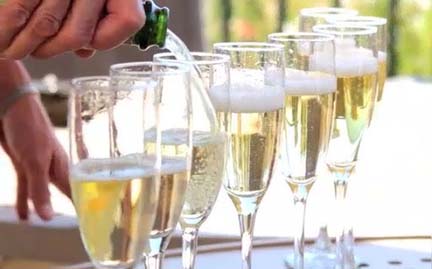
Finally, when Jake, Lady Brett Ashley and a Greek count share Champagne, Jake tells the count “You ought to write a book on wines,” and the latter answers: “Mr. Barnes, all I want out of wines is to enjoy them.” Which sounds like a fine idea, and especially with this Champagne.
It’s worth noting, as more than a few critics have, that there is little of this kind of drinking in the Nick Adams short stories, as well as much of the rest of Hemingway’s work set in the U.S.
And why should there be? Prohibition had just started when Hemingway returned from Italy at the end of World War I; drinking during Prohibition, as Raymond Chandler biographer Tom Hiney has noted, was not just illegal but serious business. Who had time to banter with royalty? It was find a speakeasy, get drunk, and leave before the place got raided.
Photo: “Les Deux Magots” by Serge Melki is licensed under CC BY 2.0