Category:Wine trends

Update: Wine prices 2021

Wine Prices
Where’s the $18 Italian chardonnay?

Making sense of an $18 Italian chardonnay blend, the California grape glut, and higher wine prices despite flat demand

Would you pay $18 for an Italian chardonnay blend? Chardonnay, of course, is hardly an Italian white grape and it certainly doesn’t speak to terroir the way Italian wine is supposed to. But there it was, on the dinner table, in its heavy bottle with a big punt – just like any other luxury wine.

Which, as much as anything, speaks to the pricing conundrum that wine drinkers are facing this year.

I’ve spent the past couple of weeks trying to make sense of why, despite the law of supply and demand, wine prices are higher than they should be.

I’ve spent the past couple of weeks trying to make sense of why, despite the law of supply and demand, wine prices are higher than they should be. It baffled me at the beginning of the year, and it still does.

And I’m not the only one who is confused:

• Jeff Bitter, who oversees the Allied Grape Growers trade group, says California has way too many vines, and needs to pull out almost 50,000 acres. Otherwise, he says, the continued oversupply will cut prices in a flat market.

• Wine critic Dan Berger doesn’t pull any punches: “One of the wine industry’s Achilles heels, and a topic no one ever talks about, is that domestic wines’ retail prices always seem to go up and almost never come down.” His analysis: Price has been associated with quality for so long that producers are terrified that lower prices will mean their wine is crummy.

• Steve McIntosh, writing in the Imbiber’s Journal: “By far the most frequently discounted variety on my radar this year is not nebbiolo or grenache or sangiovese. It’s cabernet. And you know who bottles cabernet labeled as such? Not France. Not Italy. And certainly not Spain or Germany. California does. More specifically, Napa Valley cabernet.” In this, Napa caberent – and, to a lesser extent, other California cab – is being heavily discounted on so-called flash sites, which buy from producers who can’t sell what they make through normal channels.

So what’s going on?

Why are we seeing $18 Italian chardonnay – and so much other pricey wine – when the evidence shows there is no apparent economic reason for it?

My guess – and it’s only a guess, without a study to support it – is that wine is finally crossing the divide from agricultural product to consumer packaged good. The former’s price revolves around the cost of the grape; higher grape prices mean more expensive wine, and lower prices mean less expensive wine. That’s been the case for centuries.

Consumer packaged goods, on the other hand, are priced according to brand. That’s why Tide detergent costs almost three times as much as Arm & Hammer, even though the ingredients are mostly the same. You’re paying for the Tide name, which the manufacturer has worked diligently to promote as denoting quality that’s worth three times more.

Is that where we are with wine? The $18 Italian chardonnay was well-made, but was it worth almost 30 percent more than my Domaine Tariquet? Has packaging and price become the symbol of quality, just like laundry detergent, rather than what’s in the bottle? Are we expected to pay more for a wine not because it’s better or more interesting, but just because we’re supposed to?

I hope not, but premiumization’s continuing presence in the face of economic logic seems to say otherwise.

Photo: “Wine Prices” by mason bryant is licensed under CC BY-SA 2.0

Wine history lesson 3: Bring on the French wine!

norman wine
“Thank God, this isn’t any of that vinegary English wine.”

The Norman Conquest of Britain almost 1,000 years ago paved the way for French wine to take over the English-speaking world

Who knew that 1066, the year of the Norman Conquest of England, also meant the beginning of the French wine conquest of the English-speaking world?

But that’s apparently what happened:

Although the Normans had some success with wine production in England, English wine was still considered inferior to French wine. Fortunately, if the grapes were rated as being not ripe enough for wine they could be turned into verjuice, a sharp vinegar which featured heavily in medieval cuisine.

Vinegar, indeed.

In this, wine drinking increased in Britain after the Norman conquest, becoming the alcohol of choice for the nobility and the upper classes through the Middle Ages. Dare we call it an early version of premiumization?

In fact, English history is replete with evidence of the influence of French wine. That includes Henry II’s marriage to Eleanor of Aquitane in the 12th century, which gave him control of Bordeaux – then as now a prized wine region. And the growth of the port business 250 years ago had as much to do with the series of wars between France and England in the 18th and early 19th centuries as it did with port.

And Britain’s enthusiasm for French wine eventually showed up in its colonies, and especially the 13 that would become the United States. Thomas Jefferson’s French wine geekiness is an established part of U.S. wine lore, and his repeated failures to grow European-style grapes like chardonnay and cabernet sauvignon in early 19th century Virginia is equally as celebrated. Because, of course, if he had succeeded, who would have needed California?

More wine history lessons:
• A brief history of wine
• Maynard Amerine on quality, price, and value
• Wine business history: The more things change, the more they stay the same

Illustration, from the Bayeux Tapestry, is in the public domain

Buying supermarket wine during the pandemic

supermarket wine
Quick. … we need to buy more wine at the supermarket because it’s a pandemic.

Six tips to make sure you get your money’s worth at the supermarket Great Wall of Wine

Supermarket wine was one of the big winners during the pandemic, with more of us buying it from the supermarket Great Wall of Wine than ever before. As a high-ranking official at a top Italian producer told me: “Multiple shopping stops are not happening, so instead of going to the grocery store, then to the fine wine shop, butcher, cheese monger, and so forth, people are getting everything in grocery stores.”

And one leading wine trade magazine expects that to continue, with double-digit sales growth perhaps being part of the new normal.

Which leads to a particularly Wine Curmudgeonly dilemma: How does one buy cheap wine that offers both value and quality in the supermarket – and especially when so much supermarket wine seems to be more or less the same? As noted here many times, the biggest half dozen or so U.S. producers make most of the wine supermarkets sell.

So how do you avoid the stuff that looks and tastes the same as the other stuff? Consider these six tips:

• Check the website. It may not say the actual company’s name on the label, and most don’t. But the company’s website always does. No, I don’t know why this is, and neither did the researcher of a seminal Big Wine study.

• Alcohol percentage. This isn’t a hard and fast rule, but it’s true often enough to keep in mind. Many Big Wine products say 13.5 percent even if the alcohol isn’t 13.5 percent. The law allows this, and it’s easier for tax, regulatory, and production reasons to do it. Wines from smaller producers tend to be more precise.

• Look for something other than the usual grapes, so petite sirah instead of cabernet sauvignon and viognier instead of chardonnay.

• Imported roses. Yes, the tariff has hurt pricing, but they’re still mostly what they’re supposed to be. Some domestic roses, on the other hand, are creeping up the sweetness ladder – and no, I don’t know why that is, either.

• New Zealand sauvignon blanc. Some of the least expensive wines aren’t especially well made, but those in the $10 to $15 range are well-made, varietally correct,  and offer value.

Welcome back, restaurants: Please let wine drinkers help you return to normal

pandemic wine
Want to fill those empty tables? Then meet wine drinkers halfway.

Five suggestions to increase restaurant wine revenue and make wine drinkers happy

Dear restaurant business:

I know we haven’t always been on the best of terms, given restaurant wine prices. But that doesn’t mean I don’t want restaurants to recover as we begin to come out of the pandemic. Because I do understand how bad the past year has been – in jobs and store closings, as well as $27 billion in lost sales.

And, despite our differences, we both understand that restaurants and wine are part of each other – when one suffers, we both do. So please, don’t exclude wine drinkers as the recovery begins. Let us help you:

• Don’t take us for granted, and assume we’ll be back just because. Because we may not be. Many of us discovered that home cooking isn’t as bad as we thought it was.

• Keep experimenting. Many operators tried something different during the pandemic, and much of it worked out quite well. Or, as one Texas restaurant official told me about cocktails to go: “How do we help to provide opportunities for restaurants, and especially since what looked like it was going to be a two-week crisis has turned into 10 months? This was a way to do that.” So why stop experimenting now?

• Meet us halfway on pricing. Why expect the old rules from the old normal to be relevant given all that has happened? So consider (where legal) offering wine bottle discounts. Or (again, where legal) buying two or three glasses to get the next one free. Or even cutting wine markups from 3- and 4-to-1 to 2- and 1½-to-1. As noted on the blog many times before, this can bring in thousands of dollars of revenue that would otherwise be left on the storeroom shelf.

• BYOB is an opportunity to regain customer loyalty and trust, and not – as some complain – lost revenue. What better way to win back those of us who enjoy drinking wine with dinner than to let us bring it to your restaurant? We would be happy to pay the corkage fee, and you’re getting two or three or four people at the table who might otherwise stay home.

• Shake up the wine list. Offer us something that we haven’t seen at the supermarket or Drizly or a chain retailer. This is an opportunity to replace the wholesaler-driven, Big Wine brands that you use because it’s easy, with wine that’s interesting and different. Which is how you think about your food, isn’t it?

As always, let me know if there is anything else I can do to help.

Your pal,
The Wine Curmudgeon

Photo: “Restaurant tables” by TChapman9 is licensed under CC BY 2.0

Shocking news: Wine tastes better when it costs more money, even when it doesn’t

wine tasters
“OK, now before we decide if we like this wine, let me check and see how much it costs.”

New study finds “Pleasantness of the budget wine increased when presented with a fake higher price”

The Wine Curmudgeon is regularly asked why he doesn’t like expensive wine. That the question is always framed that way speaks to the snobbery and elitism inherent in wine. Because, of course, expensive wine is the only wine worth drinking.

But I don’t dislike expensive wine. What makes me crazy is wine that’s expensive for the sake of being expensive — that costs more to cost more, and not because it’s better or worth the money.

For which there is one more piece of evidence, a study to be published later this year in an academic journal called “Food Quality and Preference.” The result? Expensive wine tastes better, even when it’s cheap wine given a fake, higher price.

Ain’t wine marketing grand?

“Was I surprised at all the attention? Well, a bit… but then again, no,” says Jens Gaab, a professor in clinical psychology and psychotherapy at the University of Basel in Switzerland, who co-authored the study. Their work has made the rounds of the wine, popular science, and mainstream media in the past couple of weeks, with the usual sort of headlines: “Yep, Cheap Wine Really Does Taste Better if You Increase The Price Tag.”

In the study, 140 people tasted three different low-, mid- and high-priced wines. Pricing didn’t seem to affect what the study called intensity of taste; it reflected retail prices, with costlier wines doing better. But if they thought the cheaper wine cost more, the tasters rated it more highly in what the study called pleasantness.

This was not the case if they knew the price or were not given price information; perhaps more importantly, “deceptive down-pricing of high-price wine had no effect on pleasantness ratings.” In other words, “cheaper” wines didn’t do better, even if they weren’t cheap. Talk about price being stitched on our frontal lobes as a decider of wine quality.

Which should not be surprising. We assume price is some sort of Holy Grail of wine quality, but as Paul Tincknell, the newsletter’s official wine marketing guru, points out, wine doesn’t work that way. (And, actually, he says, almost nothing does – we just assume wine is different.)

“The pricing study is the same exercise as when the same wine is poured from bottles with different labels,” Paul says. “A taster would probably rank an $8 cabernet sauvignon lower than the same $8 wine if it was poured from a $50 cabernet bottle. They might be disappointed by the ‘expensive’ wine, but would still rank it higher.”

So, once again, it’s not price that matters – it’s the perception of quality that comes with price. So drink the wine, decide what it’s worth, and go from there. Don’t let price fool you.

Photo: “Wine tasting group” by UmbriaLovers is licensed under CC BY-SA 2.0

Pandemic study: We’re cooking at home and we want our wine

pandemic wineOne more survey finds wine – just like household cleaning products – has played a key role during the pandemic

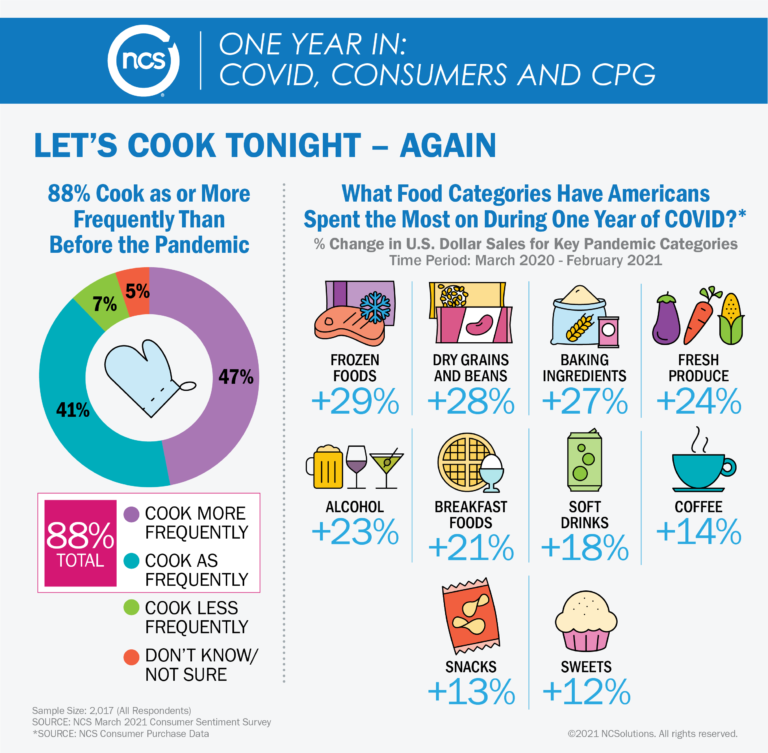
Yet another more pandemic study says we’re cooking more at home and we want wine with our dinner – and we want it more than spirits and seltzer.

That’s just one of the findings in last month’s household grocery spending survey by NCSolutions, a marketing consultancy for the consumer packaged goods business. Its analysis of 12 months of proprietary data, as well as a March consumer survey, suggests that a variety of consumer behavior has changed over the past year, and that these changes might last.

And that includes wine with dinner.

In this, the NCSolutions’ methodology seems legitimate (though its PR company never set up an interview, despite repeated assurance it would do so), so I can’t vouch for the results. I also wasn’t able to find out if the survey asked about wine specifically, or just lumped it in with beer and spirits.

Still, that it found the same thing as other studies speaks to what may be important changes in the way consumers see wine. For example:

• We spent 23 percent more on wine, beer, and spirits between March 2020 and February 2021 than we did in the previous 12 months. That’s consistent with other surveys; equally as important, it’s about the same increase as fresh produce, and bigger than soft drinks and coffee.

• Tie that into the fact that almost half of those surveyed said they were cooking more at home over the last year, and a pattern starts to emerge.

• Plus, about two in five said they “enjoyed more meals and beverages at home,” second only to those who said they watched TV and movies to get away from the stress of the pandemic. That was about 10 points higher than those who said they ordered takeout to relax.

• And almost one-quarter said they needed to have wine and beer in the house.

The only bad news? That just one-third said they planned to eat more at restaurants this spring and summer, as life becomes more normal, and less than half said they would travel. Those aren’t promising numbers for anyone who expects winery tourism and restaurant wine sales to pick up later this year.

Finally, for anyone wondering if cleaning house will remain important: 96 percent – yes, almost everyone – said they spend the same or more time cleaning than they did before.

Graphic: NCSolutions. using a Creative Commons license

Did independent convenience stores and small grocers do better during the pandemic than traditional wine retailers?

convenience stores
“Let’s pop down to the corner for Champagne to drink while we cook dinner tonight.”

One study suggests that the independents and neighborhood retailers saw wine sales grow more than 40 percent

The biggest news in wine sales during the pandemic has been the tremendous rise in Internet, delivery, and direct-to-consumer – that is, more consumers buying wine from non-traditional retailers. But lost among that surge was another significant change: The growth in wine sales at convenience stores and neighborhood retailers.

Regular readers already know that convenience stores have been one of the few bright spots in wine sales over the past several years. But a study by a company that sells point of sale software to independent convenience stores; mom and pop grocers; and small liquor shops has further reinforced that good news. Same store wine sales for retailers using the National Retail Solutions system increased 44.5 percent between 2019 and 2020, about double the growth for all convenience stores.

Even more intriguing is that its data may show a relationship between younger consumers and wine – not because it’s wine, but because of where these shoppers buy their wine, says the company’s Suzy Silliman, senior vice president of data strategy and sales.

The company’s sales data hints that younger, more affluent, more urban consumers who are less likely to be white are buying wine at small, local retailers. This behavior seems to be pandemic driven; instead of going out for dinner and drinks, they’re walking down to the corner to buy wine to have with dinner at home.

In one respect, this behavior isn’t surprising, since local has been the marketing mantra for anyone trying to reach younger consumers since the Millennials came of age. But I don’t know that there have been any good numbers to prove the point.

Completely different behavior

And this behavior is completely different behavior from their parents and grandparents, who have powered the growth in companies like Total Wine and have helped Kroger become one of the biggest wine retailers in the world. As such, the wine business has made less effort to sell its product to those smaller retailers. What’s the point if Kroger buys everything you make?

So what’s the catch? The numbers, as Silliman points out, are far from definitive. The software doesn’t track demographics, so the assumption that these are younger, more urban consumers is based on where the stores are located and not actual shopping data. In addition, the pandemic may have skewed the statistics in a way no one has ever seen before. If we return to some semblance of normal, will these consumers still buy wine at the shop down the street?

Maybe. Silliman told me that “a lot of behavior becomes habit.“ She says she misses going out to dinner, but that she didn’t realize just how much she enjoyed staying at home, without the idea she had to go out and do something.

“This may have been a forced experiment, with people having to stay at home,” says National Retail Solutions’ COO Elie Katz. “But I’ve talked to a lot of Fortune 500 companies, and there’s no guarantee that everyone is going back to the office.”

And the numbers that do exist are stunning:

• The 1,221 stores that use the software, mostly on each coast, in Texas, and in the Chicago area, added 800 wine labels to their inventory in 2020. That’s so big a number as to be practically unprecedented. It’s even more amazing when you consider that grocers can’t sell wine in New York state.

• There seems to be evidence suggesting that shoppers asked their local stores to add specific brands, which accounts for all those new wines on shelves. This behavior is markedly different from what happens at a large retailer, which rarely adds wine based on customer requests.

• Sales of high-end Champagnes, including Moet and Chandon, more than doubled. That these stores even carry $50 Champagne speaks to what’s gong on here. The Moet, in fact, was the fifth best-selling wine in dollar terms over the 12-month period.

• The best selling wine was Stella Rosa, a sweet red – but its sales tripled in the process.

• Luc Bellaire, another high-end French sparkling wine, was the third best-selling wine, and its sales tripled as well The wine can cost as much as $15 for a 187-ml bottle.

• And less we think that luxury items wack these numbers out of proportion, the $9 1.5-liter bottle of Barefoot was the third best-selling wine.