Tag Archives: wine history

Wine history lesson 10: Prohibition — the law no one paid attention to

Prohibition agents dumping wine from barrels
This picture, from the Chicago Daily News in 1921, shows Prohibition agents dumping wine.

Yes, it was the law, but many – perhaps most – just ignored it

Consider this quote, from a leading Prohibitionist:

“I earnestly hoped with a host of advocates of temperance, that it would be generally supported by public opinion. … This has not been the result, but rather … that a vast army of lawbreakers has been recruited and financed on a colossal scale; that many of our best citizens, piqued at what they regarded as an infringement of their private rights, have openly and unabashedly disregarded the Eighteenth Amendment. …”

That was industrialist John D. Rockefeller, of the Rockefellers, writing in 1932 about the failure of the noble experiment. I ran across his quote while I was writing a freelance piece about Prohibition and the birth of the three-tier system (I’ll link to the story when it appears; probably next month).

One of the things that surprised me the most was just how many people ignored Prohibition. Yes, I had an idea that it was unpopular, but it was the law of the land. Certainly, most people outside of a couple of mob-dominated cities like Chicago and New York obeyed the law.

Apparently not.

It turns out that much of the country never wanted to stop drinking. So large portions of the U.S., and particularly urban areas, just ignored the law. The famous statistic is that there were as many as 100,000 speakeasies, or illegal bars, in New York City during Prohibition, but the number almost doesn’t matter. The point is that local police departments, whether in Chicago or New York – as well as in Los Angeles, San Francisco, New Orleans, Kansas City, Philadelphia, and Washington, D.C., to name just a few — didn’t enforce Prohibition and never really intended to.

Yes, they were paid off, as were the politicians who ran the cities and controlled the cops. But there’s a sense, looking at the literature and talking to the experts, that drinking would have happened anyway. In one of my other careers, I wrote extensively about American hard-boiled fiction, which had its roots in Prohibition. And, as Raymond Chandler wrote in “The Big Sleep:” “All through Prohibition Eddie Mars’ place was a night club and they had two uniformed [cops] in the lobby every night to see that the guests didn’t bring their own liquor instead of buying it from the house.”

So the next time the neo-Prohibtionists start to wax poetic about the old days, show them the Rockefeller quote. He was there; if he saw the need for repeal, then we needed repeal. And would need it again today.

Photo: Chicago History Museum
Wine history lesson 9: Wine is too expensive, 1972 edition

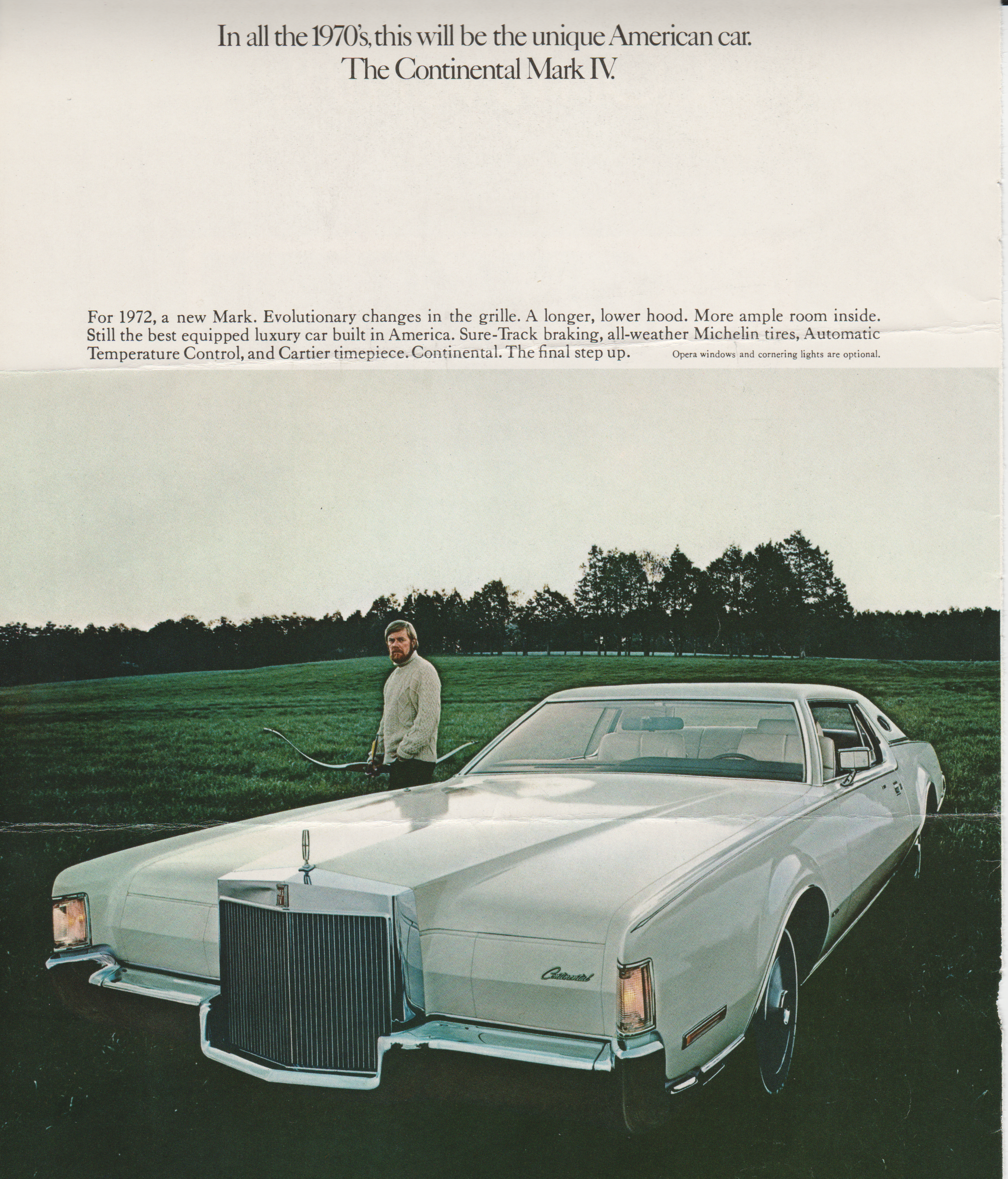
1972 Lincoln-Mercury ad
If you could afford gas for this car, high wine prices might not have been a problem.

“Something can be done about wine prices”

Some 50 years ago, when higher wine prices were “making many knowledgeable wine drinkers unhappy,” a writer named Robert McDermott suggested we buy certain wines – first, before they became popular, and second, from less well-known regions of the world to save money.

Sound familiar?

The story (this is the link to it) appeared in the Winter 1971-72 issue of a magazine called The Continental, which was distributed at what were then Lincoln-Mercury dealerships. As such, it focused on high-end wines, which even in 1972 – as McDermott notes – were out of reach of most wine drinkers. He cites $250 for a 1959 Hau-Brion (which costs 16 times that now).

Some of the piece is truly dated — $10 for Pommard, a red Burgundy, seems like a steal even then. But most of it makes as much sense today:

• “Exceptional bargains are uncommon among the well-known wines of Bordeaux and Burgundy.” Indeed. A very ordinary bottle of red Bordeaux costs $20 and Burgundy prices are even more out of whack.

• “A premium, large or small, is paid for the stature of French wines.” He suggests buying Italian sparkling instead of Champagne, which was such good advice that it’s one of the reasons for the popularity of Prosecco.

• He was an advocate for California and Chilean wines long before the rest of the world caught on, especially praising California’s cabernet sauvignon. Ironically, the four brands he mentions are mostly gone, gobbled up Big Wine (though Charles Krug is still making fine wine).

Ironically, McDermott also foresees the growth of Liv-Ex and the secondary wine market, where bottles are traded likes stocks and bonds. “The art of pleasurable and profitable wine buying in some ways parallels trading in securities. There are blue chips and there are wildly speculative issues.”

The only difference? There are no wildly speculative wines any more. They’re all expensive.

A tip o’ the WC’s fedora to John Bratcher, who found the story.

More wine history lessons:
Wine history lesson 8: The evils of drinking
Wine history lesson 7: When drinking alcohol was a good thing
Wine history lesson 6: Was this California fortified wine one of the state’s first post-Prohibition efforts?

Wine history lesson 8: The evils of drinking

anti-drinking poster from ProhibitionHistory tends to repeat itself, and especially when it comes to booze

Consider these two quotes:

• “The fight against evil is always an uphill one, and the hill is never steeper than when you fight the liquor interests.”

• “Alcohol consumption and its associated harms are reaching a crisis point in the United States.”

The first? William Jennings Bryant in 1910, advocating for state-wide prohibition in Nebraska. The second? A 2022 study, advocating for more explicit anti-drinking warnings on wine, beer, and spirits.

Not much difference in the two statements — despite the century-plus difference in when they were made, as well as the philosophies behind the people who made them. Bryan, an ardent Prohibitionist, believed drinking was a moral weakness, while the study’s authors are respected researchers who are focused on science.

In this, I’ve always been surprised at how much the original and the current group of anti-drinking crusaders have in common. It’s the same message, but couched in just enough of a different style. That way, we won’t be quite as offended when they tell us that drinking is evil. Which, to give the Neo-Prohibitionsts their due, is damned clever. It’s still offensive, but at least they understand the morality bit is probably too dated to work any more.

More wine history lessons:
Wine history lesson 7: When drinking alcohol was a good thing
Wine history lesson 6: Was this California fortified wine one of the state’s first post-Prohibition efforts?
Wine history lesson 5: Big Wine’s forebear — the infamous California Wine Association

Winebits 790: Winespeak, screwcaps, wine history

Students study an equation on a chalk board
“You think this is bad? Did you see the tasting notes for that new 98-point wine?”

This week’s wine news: Winespeak isn’t inclusive (shocking, right?), plus another call for screwcaps and wine may be older than we think

Not inclusive? Nat Sellers, writing in Wine-Searcher, argues that winespeak isn’t inclusive for a new generation of wine drinkers. Which is all well and good, but overlooks the biggest problem with winespeak. It has never been inclusive, catering mostly to wine geeks and confusing almost anyone else who came into contact with it. Even the simple stuff was baffling: I never did a tasting, wine class or seminar when someone didn’t ask, “If the wine tastes like grapefruit, does that mean there is grapefruit juice in it?” And why was winespeak confusing? Because the wine business wanted it that way – it’s easier to sell product to people who are confused, yes?

Bring on the screwcaps: The Robb Report, whose audience would never be mistaken for mine, doesn’t mince words: “Why It’s Time for Fine Wine to Ditch the Cork and Embrace Screw Caps.” Excuse the WC if he does a double take; the wines in the piece cost three figures, and bear no resemblance to my beloved Gascon whites and $10 roses. That a magazine catering to the uber-wealthy is advocating for screwcaps like I do is another sign that it’s time for the cork to go.

New theory: It has been accepted historical fact that grape cultivation and winemaking started in what is modern day Georgia in Eurasia  some 6,000 to 8,000 years ago. Now, new research has found that wine may be even older than that, originating in the Near East as well as the Caucasus about 3,000 years before then. In fact, says the study, published in Science, the origin of wine in Western Europe is associated with cross-fertilization between native wild grapes and domesticated grapes originating from the Near East that were initially used as food sources. If this is true, and the study makes a good case, will change the way archeologists look at how wine influenced the growth of civilization.

Photo: “Students study an equation on a chalk board” by simpleinsomnia is licensed under CC BY 2.0.

Decades and decades of wine books

Great Wine Values book cover
Yes, the Wine Spectator once knew what a wine value was.

The Internet Archive offers a look at more than a century of books about wine

Ever wonder what the various Windows of the World wine books have been like during their almost 40 year history? Or – believe it or not – that there was once a book from the Wine Spectator called “Great Wine Values,” focusing on 1,000 wines costing $10 or less? Or that yes, there was wine news was published in the U.S. during Prohibition?

Now you can find out about all of those, as well as thousands of other wine books and articles thanks to something called the Internet Archive, a non-profit library of millions of free books, movies, software, music, and websites dating back dozens of decades.

The site says it tracks some 41 million books and texts; books published before 1927 are available for download, and hundreds of thousands of others can be accessed through the site’s Open Library.

In this, it’s one of the things about the Internet that almost makes up for the rest of the cyber junk that we’ve been force fed over the past 20 years.

So it’s possible to find out that Alexis Bespaloff wrote “The Signet Book of Wine” in 1971 and to access the first handful of pages and the table of contents. How about sections on Russian and Algerian wine? Or that, in the early 1970s, the author noted: “America is not a wine drinking nation.”

Or to learn, in a book called “The Epicurean,” that the wine service for Delmonico’s restaurant in New York in the second half of the 19th century differentiated between American diners (thy were served Haut Sauterne and Perrier-Jouet Brut, among several others); French diners (the wines included Graves and Yellow Cliquot), and German diners (“no wines or mineral waters in the reception rooms”).

The website’s search process is not necessarily intuitive, but once you fiddle with it for a bit, you should be able to figure out how to look for books by title, subject, author, and even date. And yes, I spent way more time on the site than I needed to to write this post.

And, believe it or not, there are almost 100 pages of $10 U.S. wine in the Spectator book.

Wine history lesson 7: When drinking alcohol was a good thing

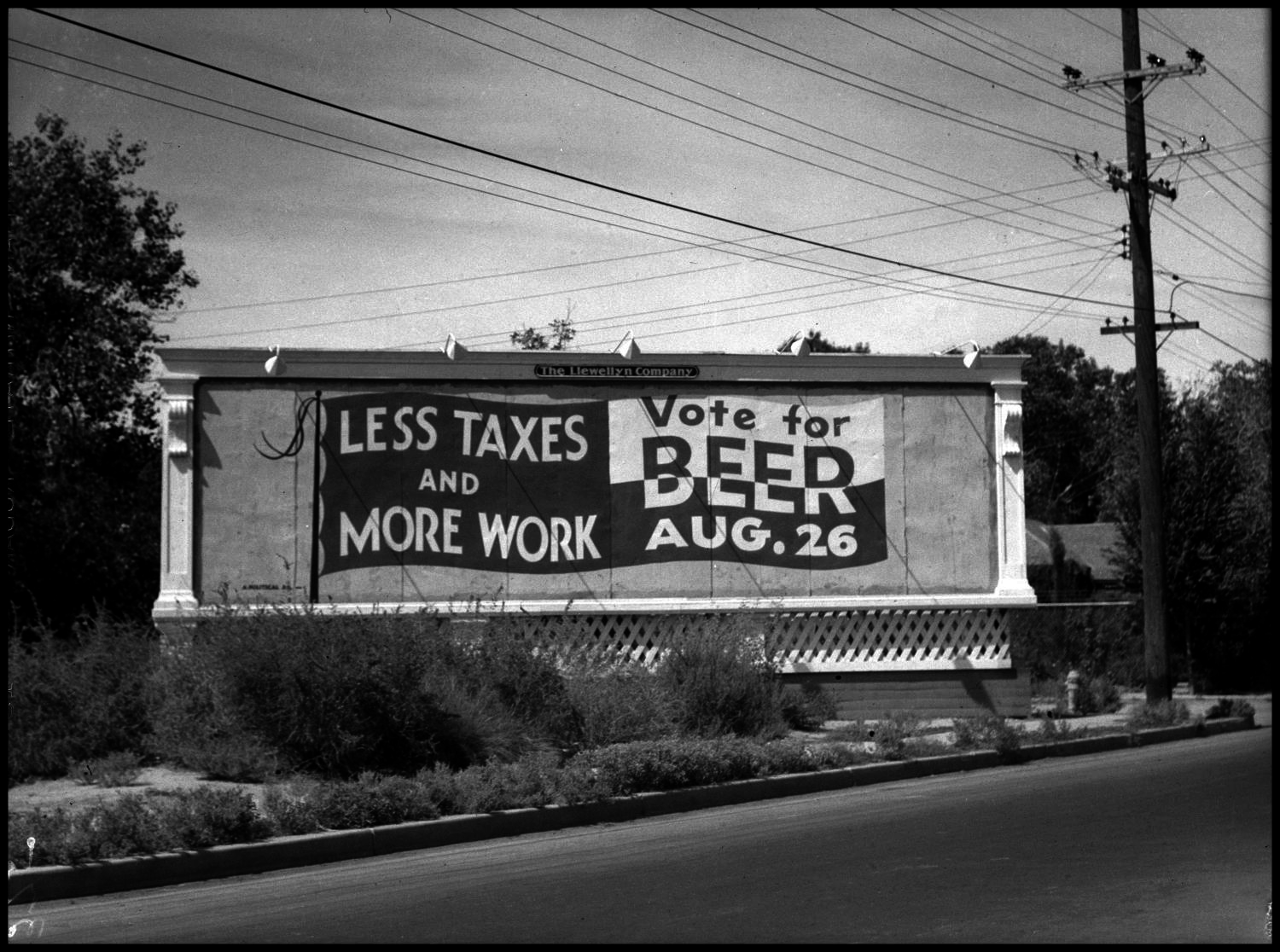
Billboard urging a vote for beer
This billboard pretty much says it all.

Yes, once upon a time, drinking was a good thing

This billboard, from El Paso in 1933, speaks to a time when the argument against Prohibition was more clear cut. The election it notes came as Texas counties voted whether to remain dry after the end of Prohibition.

Most states held similar wet-dry elections after the 21st Amendment repealed Prohibition, and the arguments then were much the same that they are today. The difference? Everyone who had just endured the previous 14 dry years knew what a failure Prohibition had been, despite its intent — and despite what its apologists claimed.

So the next time someone tells you that it’s a great idea to force the rest of us to stop drinking in moderation, show  them this.

A tip o’ the WC’s fedora to John Bratcher, who sent this along from the Texas Reader history newsletter.

More wine history lessons:
Wine history lesson 6: Was this California fortified wine one of the state’s first post-Prohibition efforts?
Wine history lesson 5: Big Wine’s forebear — the infamous California Wine Association
Wine history lesson 4: Those damned high prices

Wine history lesson 5: Big Wine’s forebear — the infamous California Wine Association

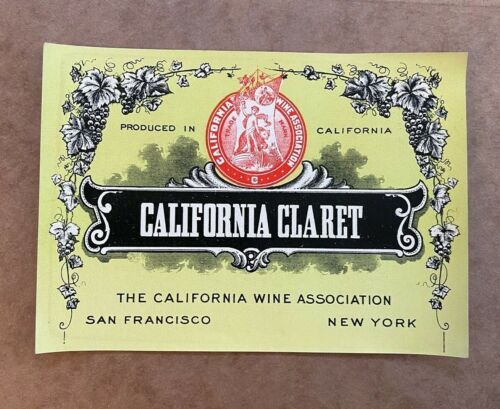
California wine association label
California Claret? Why not, when you have a wine production monopoly?

The 19th century wine cartel controlled more than 80 percent of the state’s wine business

Those of us who worry about the future of the wine business wring our hands and cast our eyes upwards every February, when the new top 50 wineries list is released. Each year, it seems that wine gets more and more top heavy, with just a handful of companies controlling 90 percent of U.S. production.

But imagine how much hand wringing we would have done at the end of the 19th century, when a cartel called the California Wine Association controlled 84 percent of the California wine business.

I touched briefly on the CWA in the cheap wine book, noting the wine boom in California that saw production increase five-fold in the 30 years or so before Prohibition. The boom, though, came at a heavy cost to everyone but the cartel, which controlled prices up and down the wine supply chain. It low-balled growers, who had no market for their grapes if they didn’t sell to the CWA, and it gouged retailers across the country, who didn’t have any wine to sell if they didn’t pay the CWA’s prices.

Best yet, as the noted wine writer Paul Lukacs wrote, the CWA didn’t particularly care about wine. It just cared about profit. Its organizer, wrote Lukacs, was an Englishman named Percy Morgan, who “did not much care who drank the wines, or what kind of wines they drank. His goal above all else was profit, and he clearly realized it.”

Frankly, the parallels to today’s 21st century wine business are more than a bit spooky:

• The seven wine companies that formed the CWA knew what they were doing was probably illegal; the Sherman Anti-Trust Law has just been passed. But they did it anyway. According to one historian, the wine business was in such a mess after the economic turmoil caused by the Panic of 1893 that it seemed the only way to save it.

• The cartel apparently stabilized California’s wine business and led to the previously mentioned wine boom, But it wasn’t much of a boom. In 1910, the average American drank 10 times more beer than wine, and most of the wine they did drink was imported from Europe.

• Prohibition, not surprisingly, destroyed the CWA. In 1920, there were 2,500 commercial wineries in the U.S.; less than 100 made it through Prohibition. The CWA understood what Prohibition would do, and made some attempt to market non-alcoholic wine – but with little success. Cue the Twilight Zone music.

More wine history lessons:
Wine history lesson 4: Those damned high prices
Maynard Amerine on quality, price, and value
Wine history lesson 3: Bring on the French wine!