






Wine history lesson 6: Was this California fortified wine one of the state’s first post-Prohibition efforts?
 by Wine Curmudgeon Posted On
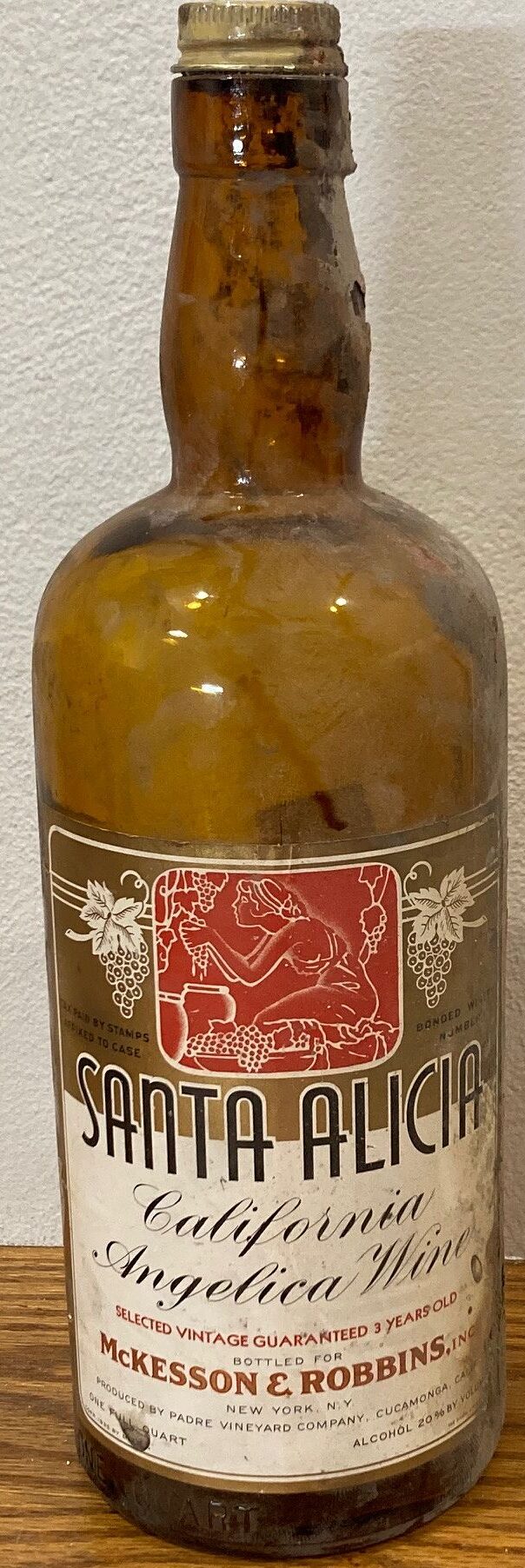 This Angelica bottle, made in the mid-1930s, is a “historical find”
Angelica, a fortified wine made with with the mission grape, is all the rage these days. I wrote a freelance piece about it, and Angelica shows up on the websites and social media that the cool kids use. Ask California winemakers about vintage Angelica, and they practically salivate.
But we can do them one better, thanks to blog reader Phil Buckles.
He found this bottle in a crawl space in a Denver home. The bottle, thanks to sleuthing from noted wine writer Mike Dunne and legendary Sacramento retailer Darrell Corti, is an Angelica sold around 1938 (there’s a 6-cent state liquor tax stamp on the back of the bottle). This means, says Corti, that “if it was three years old when bottled, as it says on the label, then it probably would have been one of the first vintages after the repeal of Prohibition.”
Further confirmation: Buckels found the bottle wrapped in newspapers, one of which was from February 1928 (touting the stock market, ironically enough, just 19 months or so before the crash that started the Great Depression).
Says Corti, whose family sold this producer’s wines in the 1950s: “This is a real historical find. It is the first time I am seeing something like this.”
A little background: Padre Vineyard was in Cucamonga (today, Rancho Cucamonga, more or less a Los Angeles suburb). It was owned by the Vai family, who made wine under the Vai Brothers and Padre labels. The winery was built in 1870 and renovated by the Vais in 1909 and likely closed in the 1960s, when suburban sprawl uprooted most of the surprising number of wineries in the Los Angeles area.
The distributor, McKesson & Robbins, was the forerunner of today’s McKesson pharmaceutical giant. It wasn’t unusual for drug companies to sell alcohol before Prohibition, and many were able to stay in business during Prohibition because they did sell medicine.
The mission grape was brought to California and the U.S. southwest by colonizing Spanish priests in the 17th century, who used it to make communion wine. There are still a handful of centuries-old mission vineyards throughout the state, some of which were planted to make Angelica for miners during the California gold rush. Angelica has enjoyed a resurgence over the past decade or so, with younger winemakers looking for something more interesting to make than another bottle of cabernet sauvignon.
More wine history lessons:
• Wine history lesson 5: Big Wine’s forebear — the infamous California Wine Association
• Wine history lesson 4: Those damned high prices
• Maynard Amerine on quality, price, and value