Tag Archives: wine during the pandemic

studio microphone

Winecast 59: Eric Orange of LocalWineEvents on wine drinking, wine tastings, and wine events post-pandemic

eric orange
Eric Orange: “There will be a surge.”

Eric Orange: It may be mid-summer or fall before we see a surge in wine events, but we will see a surge

What do you when your business is completely dependent on local wine events – and there aren’t any local wine events?

Not much but hope for the best, says Eric Orange, the founder and CEO of LocalWineEvents, which is a calendar, listing service, and perhaps the ultimate resource for finding wine events in 500 cities around the world.

“That’s when 5,000, 6000 postings a week just paused,” says Orange, who started LWE almost 21 years ago. “Everything just went off a cliff. … that was a tough week.”

Since then, Orange – who I’ve known since Drink Local Wine days, when he was a huge help publicizing our events – has been hoping for the best. The site adjusted, of course, running listings for virtual tastings, wine education, and the like. But there wasn’t much else to do with wineries, restaurants, and local events shut down because of the pandemic.

Hence, he is convinced wine drinkers are ready to end their isolation.

“Much of it will depend on the mask mandates,” says Orange. “But I think there is a lot of pent up demand, people who want to get out. There will be a big surge. I think it will return to a more normal existence in the fall.”

Among the other things we discussed:

• Virtual tastings were not a success for LWE, and he wonders about the future of those kinds of events. On the other hand, virtual wine education might continue after the pandemic.

• Wineries, many of which have already resumed outdoor tastings, may lead the wine event revival. They don’t have to worry about social distancing, for one thing.

• Restaurant events, including winemaker dinners, should come back in a big way, says Orange. His only concern? The extent of the damage to the restaurant business from the pandemic.

• Spirits tastings, including bourbon and Scotch, might do even better as we come out of the pandemic.

Click here to download or stream the podcast, which is about 17 minutes long and takes up almost 11 megabytes. Quality is good to excellent. Zoom cooperated once again, save for an odd voice telling me I was recording – and then stopping – our conversation. Which led to a bit of a giggle from the two of us.
Yes, we were drinking less during the pandemic

what ifAnd this marketing researcher may have the numbers to prove it

Was it the great urban myth of the pandemic? Were we passed out drunk over the last year, swozzled, snockered, and stewed beyond belief? Websites reported it. So did respected news organizations. And the medical studies? According to entirely too many of them, the booze epidemic during Covid-19 was as bad – if not worse – as heroin, opioids, and crack cocaine.

Because, of course, it may well have been an urban myth, perpetrated by neo-Prohibitionists and medical researchers who were aided and abetted by sloppy journalism and a complete indifference to understanding how the alcohol supply chain works.

And Jordan Cohen may have the numbers to prove it.

“I was frankly surprised to see the results,” he says. “Given all I read and heard, I expected the opposite. But I can tell you that I am extremely confident in the results, based on our sample size, our random selection, and that the study was weighted for the census.”

Significant declines

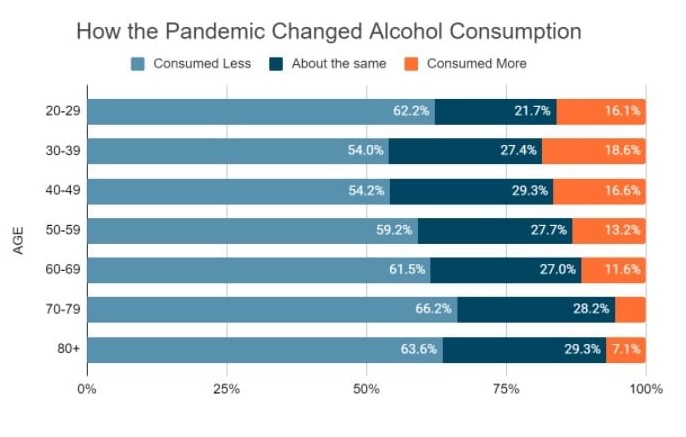
Cohen’s results? That, in fact, drinking did not increase during the pandemic, and that it actually declined significantly for a variety of age groups. The study, The Pandemic Shopper, was conducted in February by What If Media Group, where Cohen is the chief marketing officer. The results are at a 99% confidence level with margin of error +/- 2.5 percent.

And they don’t mention snockered, swozzled, or stewed:

• Almost three out of five consumers reported consuming less alcohol during the pandemic.

• No age group reported significant increases in drinking. The biggest jump came in the 30-39 group, where almost 19 percent said they drank more. Overall, only one out of six people in the study said they increased their alcohol consumption over the last year.

• Some 62 percent of those aged 20-29 said they drank less, which is not surprising to anyone paying attention. Booze costs money, and the youth unemployment rate was 18.5 percent in July 2020. That was down from 26.9 percent in April but still about twice as high as a year earlier. So, healthy lifestyles aside, they couldn’t afford to get wasted.

So what’s going on here?

Why did What If Media Group’s study get such different results? This is not to discount the horrors of alcoholism or to infer that’s it’s OK to drink more. As noted on the blog many, many times, I know the ruin alcoholism produces.

Rather, says Cohen, there are many reasons for the discrepancies. First, just because consumers stocked up on alcohol at the beginning of the pandemic doesn’t mean that they drank it all at once, or even eventually. “Everyone was in a mad rush to buy all sorts of products,” he says. “We didn’t use all that toilet paper at once. Why would anyone assume we drank all that beer at once?”

Second, flaws in how many of the other studies were conducted. Cohen says a survey of depressed women would almost certainly find that they were drinking more during the pandemic, since that group is predisposed to drink more. He also cited too small sample sizes, which would make some results less reliable.

Third, these results jive with other studies – not disputed – that show people were trying to eat healthier and work out more during the pandemic.

Finally, how could alcohol use increase during the pandemic when people were staying home? Bars were closed. People weren’t going to parties. When, asks Cohen, did they have an opportunity to drink more?

“We didn’t do the study to take sides,” he says. “We wanted to find consumer patterns so we could sell the information to advertisers.”

Which, if advertisers are smart, they’ll pay attention to – instead of one more report that says Americans turned into drunken sots during the pandemic.

Chart:  The Pandemic Shopper, by What If Media Group


studio microphone

Winecast 51: Ray Isle, Food & Wine magazine and wine during the pandemic

ray isle
Ray Isle: “Producers are doing anything they can to keep prices from going up.”

“It’s a complicated time for sure, and especially complicated for small producers. … It’s not a time I’d want to be starting a winery.”

Ray Isle, the executive wine editor of Food & Wine, has a unique perspective on wine during the pandemic. He not only writes about wine for one of the country’s leading food magazines, but he brings a practical sense to the job that many of his colleagues don’t bother with. Or, as he said during our chat: “I got into wine as a poor graduate student, and my budget for wine was about $14.99 a month, and I’ve never abandoned that. You have to write about the affordable stuff. That’s what people like to drink.”

We talked about that, and Ray offered a variety of value wine suggestions, including the Sokol Blosser Evolution No.9 white blend (in a 1.5 liter box, no less, which I also liked); a South African red and white; and an $11 Chianti. We also touched on:

• Wine prices and availability during the pandemic — both seem to be better for domestic wines than for imports because of the tariff.

• The future of the tariff; he, too, is cautiously optimistic about getting rid of the 25 percent levy regardless of what happens in November.

• The state of restaurant wine, and why we should be worried about the future of the U.S. restaurant business because trouble there means trouble for or wine.

Click here to download or stream the podcast, which is about 18 minutes long and takes up about 12 megabytes. Quality is very good to excellent.