Category:Wine trends

Big Wine 2022

wbn 2022E&J Gallo may have accounted for almost one of every three bottles of U.S.-made wine sold in this country last year

Big Wine didn’t necessarily become any more dominant in the United States in 2021, but the biggest of the big grabbed a near stranglehold on the market.

That’s one of the most revealing items from Wine Business Monthly’s 18th annual wine industry survey, which tracks the ups and downs of the U.S. wine business and ranks the 50 biggest producers in this country.

It’s not news that the top 50 producers accounted for 90 percent of domestic wine sales, even though there are some 11,000 wineries in the U.S. That’s been true for years. And it’s not news that the 10 biggest sold about three-quarters of wine made in the U.S., something else that has been true for years.

What is news is that E&J Gallo, the world’s biggest wine company, got even bigger – the study estimates that it sold 100 million cases in 2021, which works out to just a little less than one out of every three bottles of U.S.-made wine sold in 2021.

Which, frankly, is staggering. By comparison, General Motors and Toyota each control a bit less than 15 percent of the U.S. car market, while Amazon and Walmart are just less than 10 percent each of U.S. retail. So one company with close to 33 percent? Almost unprecedented.

How did Gallo get to this spot? It’s well-run, certainly; the company owns best-sellers Apothic and Barefoot. It benefited from others’ misfortune, as No. 6 Treasury Wine Estates lost 4 million cases and No. 7 Bronco dropped 1 million cases from last year

Most importantly, Gallo bought a good chunk of Constellation Brand’s wine portfolio a couple of years ago in a deal that was mostly approved by U.S. regulators despite the implications that Gallo would dominate U.S. wine. Which is, of course, what happened.

Among the report’s other highlights:

• It notes wine’s continuing sales woes, quoting one analyst: “This could indicate the entry on-ramp to wine is fading. If the trend continues, the industry could be in trouble at all price points except above $25, which is where wine is popular with Boomers with money.”

• It notes that many producers seem unconcerned with wine’s sales struggles, quoting several as saying the industry’s focus is on taking market share from competitors and not necessarily selling more wine.

• Two of the most interesting Top 50 companies are Josh Cellars with 5 million cases at No. 10 and Cooper’s Hawk at No. 25 with 1 million cases. Josh Cellars didn’t show up on the list until 2015, at 1 million cases, and Cooper’s Hawk is a restaurant chain.

• In addition, says Cyril Penn, the magazine’s editor, three wineries made the list, including first-timer First Leaf, that don’t really have traditional retail outlets. They sell almost exclusively directly to the consumer.

• In this, e-commerce is not just about buying directly from a favorite winery, which is how most of us still think of it. Rather, “major wineries have focused efforts on being part of online grocery purchasing, whether through traditional grocers, like Kroger and Safeway, or online-based shopping, including Instacart baskets.” This is something that the recent SVB report also found, showing that Big Wine is using the Internet to get bigger.

More about Big Wine:
• Big Wine 2021
• Big Wine 2020
• Big Wine 2019
SVB report follow-up: What? The wine business worry?

what me owrry
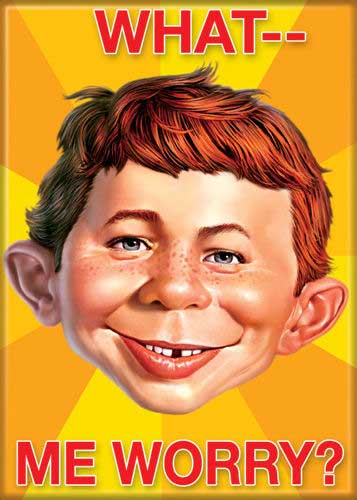
Is Alfred E. Neuman the new poster boy for the wine business?

Want to see how little the wine business understands its existential crisis? Follow the headlines

The Wine Curmudgeon has a stock photo he uses for stories likes this – a man with his head in a hole in the ground, based on the myth about ostriches burying their head in the sand when there’s danger. They supposedly do this because, “if they can’t see the predators, then the predators can’t see them.”

Ostriches don’t actually do that, but it’s a useful metaphor when someone or something acts in ignorance of the facts. The assumption is that if they hide from the crisis, then the crisis won’t happen.

Cue the wine business.

Wednesday’s Silicon Valley Bank report, an annual survey of the state of the wine business, says wine may well be facing an existential crisis thanks to climate change and water shortages in California, as well as what looks to be the continuing collapse of the restaurant wine business.

Most importantly, the report notes, people younger than 50 aren’t especially interested in wine. That means, as the Baby Boomers die off, fewer people will drink wine – a lot fewer people. Which, the report says, “poses a primary threat to the business. That issue has yet to be addressed or solved, and the negative consequences are increasingly evident.”

So how did the wine business react? Save for the San Francisco Chronicle, which didn’t pull any punches – “New report rings a desperate alarm for wine” – it was business as usual for news coverage of the report, as well as similar, wine-related news.

Call it the perfect Alfred E. Neuman storm:

• U.S. wineries report bumper year

• Global Wine Market Size Expected to Reach $456 Billion In 2028, for a release issued the same day as the report and which noted wine’s “increased consumption pattern.”

• Wine’s Premium-Plus Tier On The Rise As Total Market Slips, from our friends at the company that owns the Wine Spectator.  My favorite bit: “premiumization remains a key driver of value for the industry, with higher-priced segments significantly outperforming less expensive categories.” In other words, nuts to everyone who doesn’t buy $40 wine.

• Survey: After robust 2021, winery owners face long-term challenges

Know something else here. The report’s author, Rob McMillan, is a banker. Bankers typically don’t call out their clients for – to be polite – acting like ostriches. That Rob did speaks to how serious the problem is. And, frankly, it took guts. One person, who knows how the report is compiled, told me that Rob may face intense criticism for what he wrote: “That’s the price of a widely released report and trying to provide leadership for change. People resist change, so he’ll get a few arrows over this.”

In which Rob shows more concern for the wine business than it shows for itself.

Full disclosure: I wrote a trade piece about the report, but I didn’t gloss over the issue. The second paragraph said: “The bad news? Wineries may well need those two banner years to offset the aging of the industry’s Baby Boomer base, the continued decline in on-premise sales, and the beginning of climate change-related water shortages and restrictions.”

Wine trends 2022

Look into the Future
“Yes, yes.. mindful drinking.. I can see that.”

Welcome to “mindful drinking,” as consumers re-examine how much — and what kinds — of wine they drink

This is the second of two parts looking at wine prices and wine trends in 2022. Today, Part II: Wine trends 2022. Thursday, Part I: Wine prices 2022.

Call wine trends 2022 more of the same, as the wine business struggles to return to some sort of pandemic-era equilibrium. Of course, this prediction comes with the caveat that we’re in an unprecedented economic environment, where everything going on hasn’t happened at the same time before. So forecasts, usually iffy, are even more iffy this year:

• “Mindful drinking,” in which wine drinkers – any alcohol drinker, for that matter – make a conscious effort to drink less. The catch here is the definition of less: It’s just not the low- and no-alcohol and “healthy” wines that have popped up over the past couple of years. It’s also drinking less when they do drink, like two or three glasses with dinner instead of an entire bottle, as well as drinking wines that aren’t as boozy. That means lighter reds instead of 15 percent California bombshells, more 12 percent whites, and more sparkling wine – not because it’s sparkling, but because it’s less alcoholic.

• The beginning of the end of the way varietals dominate the wine business. I’m working on a trade magazine story, trying to figure out what the next big wine will be, the way it was once white zinfandel and has been sweet red blends for almost a decade. And every expert I talked to said the same thing: Wine trends aren’t necessarily about varietals any more – they’re about what one analyst called “specific consumer segments.” So while people will still look to buy cabernet or chardonnay or whatever, more and more wine drinkers will buy a wine because it’s organic or “healthy” or no-alcohol or lower in sugar. And no, I don’t necessarily believe this. But that’s what some really smart people think.

• The beginning of the end of the heavy glass wine bottle. Again, a lot of really smart people say this will happen. I’m more skeptical. This is not to say it shouldn’t happen, but I know how the wine business works, and solving the “bottle crisis” is not high on its agenda.

• More three-tier reform, as well as continued efforts from the second tier to block as much of it as possible. I’m not expecting as much here as others are; been burned once too often. But incremental progress is progress nonetheless, and I’ll settle for that.

Photo: “Look into the Future” by Reiner Girsch is licensed under CC BY-ND 2.0

Wine prices 2022

bottle lot
How much will these wines cost in 2022? Your guess is as good as mine.

Wine prices 2022 are a conundrum – a riddle wrapped in a mystery inside an enigma

This is the first of two parts looking at wine prices and wine trends in 2021. Part I: Wine prices 2022. Part II: Wine trends 2022.

One of the most basic rules of writing? Don’t say at the beginning of your piece that it isn’t worth reading – because, then, why would anyone bother?

But as I pieced together all the bits that would go into the blog’s 14th annual (more or less) wine price trends post, I realized that no one has any idea what wine prices will do – even those who are supposed to. That’s because we’re in an unprecedented economic environment, where everything going on – pandemic, supply chain, inflation, and all the rest – have never really happened at the same time before.

Nothing illustrates this better than an analysis from Chris Bitter of Vintage Economics, titled, “Has Premiumization Peaked?” and which concludes that maybe it has and maybe it hasn’t. I note this not to criticize Bitter or his piece, but to reiterate that almost no one is sure about what will happen.

So, as best I can, a look at the various of factors tugging wine prices in various directions. How the tugging will work out is anyone’s guess:

• A grape glut, which no one will actually call by that name. Yes, we’ve heard about reduced harvests in parts of Europe and in New Zealand, but there are way too many grapes – way, way too many – elsewhere in the southern Hemisphere. And California has been chugging along, too, producing near-record harvests even in “down” years. So too many grapes, which means prices should go down.

• Continuing demand for some high-end grapes, like cabernet sauvignon and chardonnay, and for some high-end wines, which puts pressure on prices in the other direction. If I need cabernet for $25 and $30 wine, there will be less of it available for $15 wine and which will raise the price.

• Lots and lots of wine sitting in warehouses. I wrote about this a couple of years ago, and there has been no sign that there still isn’t lots of wine sitting in warehouses. So too much inventory, lower prices.

• The 1 percent scarfing up all the ultra-premium wine they can find, which has led to higher prices all the way down the prestige chain. Hence, the $10 Chateau Bonnet red Bordeaux costs $20 – not because it’s worth it or even because of premiumization, but because the 1 percent have bid up the prices of the most exclusive Bordeaux wines, and those wines have dragged the rest along with them.

• Decreased consumption, by any measurement. Plus, restaurant wine sales have not returned to anywhere near normal. So pressure on prices going down.

• Continuing wholesaler consolidation, with two more significant deals in the past couple of months. This may be the most important factor keeping prices higher, given the over-sized role wholesalers play in the U.S. system. The top four or five control so much of the market – maybe two-thirds now – that they can wiggle around the law of supply and demand. Or, as a very smart person wrote me, “The big wholesalers are ignoring all the problems through mergers and acquisitions. Why bother growing the consumer base when it is much easier to just buy someone else’s consumers? Expansion is expansion, even if it is at the detriment of the industry as a whole. They’ll just keep carving up the market pie into bigger and bigger slices for themselves, even though the pie is getting smaller.”

Photo: brandy turner on Unsplash

More about wine prices:
• Wine prices 2021
• Wine prices 2020
• Wine prices 2019

Welcome to the fight, Wine Spectator

wine spectator
“C’mon, WC. You’re making this up.”

No, this isn’t a Dry January joke – the most Winestream of all the Winestream Media is endorsing “cheap” wine

Who says, to paraphrase the great Shirley Povich, that hell can’t freeze over?

The Wine Spectator, perhaps the most Winestream of all the Winestream Media, is endorsing “cheap” wine. On Friday, the magazine announced its first ever “Top 10 Values” list and its 2021 “Wine Value of the Year.”

Sound familiar?

Of course, because it is the Spectator, scores are involved and the wines on the best value list can cost as much as $40. Which, of course, is cheap only for people who read the Wine Spectator. But the 2021 top value wine is a $17 New Zealand sauvignon blanc, which wouldn’t be out of place in a review posted on a website run by a certain cranky ex-newspaperman.

So who am I to quibble?

And, no, I don’t know why the Spectator is doing this. Does it mean someone there actually knows who I am and thinks that what I do has merit? Which is actually kind of terrifying – the wine business is screwed up enough without the Spectator borrowing from me. What’s next? Someone in California admitting that premiumization is destroying wine as we know it?

Or, and which is more likely, someone did a marketing study and saw a need to focus on labels other than the stereotypical Spectator wine – which always seem to be red, made in Napa, and cost $80. Because, of course, young people.

Regardless, welcome to the fight, Wine Spectator. It’s good to see you acknowledge that wine doesn’t have to cost as much as a laptop to be worth drinking. Who knows? Maybe we can work out some sort of joint thing next year when I do the Hall of Fame and you do your next value list.

And, then to paraphrase my pal Dave McIntyre, I can declare victory in the cheap wine wars and retire to my back porch, where I will drink Gascon wine and tell long, boring stories about the old days.

Photo: Alexander Krivitskiy on Unsplash

Wine scores not only refuse to die, but seem to be increasing like the spawn of the devil

wine scores
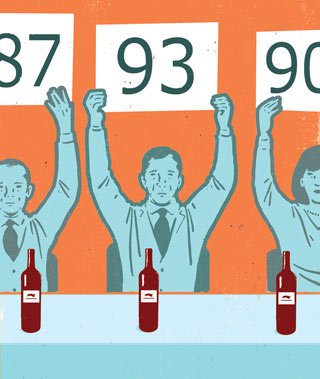
Does the world truly need 16 different wine scoring systems?

One retailer lists 16 ratings systems – and that doesn’t include a couple of the most popular

The blog, in its own small way, has accomplished great things over the years – helping to launch Drink Local and popularizing rose, to name just two.

But I haven’t – despite repeated and furious efforts – been able to put a stake in wine scores. Or, even, sort of sharpen a stake.

This failure came into focus with an email from Wine.com – differentiating between the 16 different wine scoring systems it uses on its site.

16? 16??? 16???

Yes, 16. And this didn’t include Britain’s Jancis Robinson and her 20-point system or Natalie MacLean’s 100-point ratings that are used throughout Canada.

How did we get to the point – given how useless scores are for the vast majority of wine drinkers – that at least 16 are used widely?

Because they truly are useless for most wine drinkers: They discriminate against white wine. They discriminate against less expensive wines. They discriminate against wines that aren’t from the proper region or made with the proper grapes. And, perhaps most importantly, they reflect the critic’s perceptions and prejudices, which are almost certainly not those of most wine drinkers.

Yet we’re stuck with them, despite the best efforts of many, including me.

The reasons why we’re stuck with them have also been well documented: First, as a crutch for retailers and especially the big chains and supermarkets that increasingly dominate wine sales. Second, help for smaller producers without marketing budgets; a 92 from one of the 16 might attract buyers who would not otherwise notice the wine (though whether they’ll like the wine is a different story). Third, the reviewers are so damned powerful because of reasons one and two.

So what can we do? About the same thing we’ve been doing, and try not to lose sight of our purpose – help wine drinkers find wine they will like, and not wine others tell them they should like. Because even Wine.com has a blurb next to those rankings: “While ratings may influence your decision, the ultimate judgment is your palate.”

Couldn’t have said it better myself.

Birthday Week essay 2021: The WC’s plan to save the wine business from itself

wine lecturing
“I know, I know — it’s not like ingredient labels are such a revolutionary idea.”

These six steps will reinvigorate wine in the U.S., and (dare we hope?) make wine cool again

Dear Wine Business:

It’s time to put our differences aside. I know you don’t like me, and I certainly have countless reasons to be fed up with you. But wine’s future is at stake, so it’s time to work together to solve the existential crisis facing something that we love and that makes our life that much more enjoyable.

Younger consumers don’t drink wine, don’t want to drink wine, and don’t care about wine. It’s not just the infamous Gallup poll that showed this, which described the typical wine drinker as a 50-something, college-educated woman and that young people – if they drink – barely drink wine at all. There’s also this from the Wine Intelligence consultancy, which says that wine has lost the two generations younger than the Baby Boomers.

Hence, as the blog celebrates its 14th annual Birthday Week, the Wine Curmudgeon’s six proposals to save the wine business from itself – and to make wine cool again:

1. Market wine to younger consumers in language they understand. Wine is notorious for crappy marketing, with its one size fits all, scenic vineyards and deep-voiced narrator approach. Wine is fun; why not sell it to Gen X, the Millennials, and Gen Z that way? How about showing young people – some of whom aren’t white — drinking wine together and having a good time? It works for Coke, and we all know how unhealthy soft drinks are.

2. Bring back the Fighting Varietals, but in 21st century guise. How about a California version of the La Vieille Ferme red, white and rose wines – quality, cheap bottles with a cute animal label? That fits what one of your own pleaded for a couple of years ago: “some sexy brands at $7 or $8 per bottle.” Because that’s exactly what the Fighting Varietals were in the late 1980s – affordable, quality wine that was so affordable and so well made that they helped jump start the 25-year-long Wine Boom.

3. Embrace the health message. Driving drunk was a rite of passage for the Baby Boomers; Gen X and Millennials invented the designated driver. The wine business has failed to acknowledge this difference. Spirits and even beer have a robust health message associated with their product; wine has a line on the back label. Encouraging moderation is not only the moral thing to do, but it could even sell more wine.

4. Really embrace the health message. One of wine’s most important analysts has long pleaded with the business to sell wine as the most natural of all alcoholic beverages. Which, of course, has fallen on deaf ears. Most younger consumers almost certainly don’t know how natural wine is – no added sugars, no artificial ingredients, mostly just yeast and grapes. Compare that to a hard seltzer, which contains sugar, “natural flavors,” citric acid, and sodium citrate.

5. Stop ignoring the neo-Prohibitionists and their exaggerated claims about the dangers of moderate drinking. How can you let them get away with saying wine with dinner is all but binge drinking and that drinking any amount of alcohol is as deadly as cigarette smoking?

6. Ingredient and nutrition labels. This is 2021, not 1971. There is no reason not to use those. None. How else will younger consumers know that a glass of wine has only 125 calories, while one canned cocktail brand, boasting just 5 percent alcohol, has 180 calories and almost 10 times the U.S. recommended amount of sodium?

I hope this helps. Yes, you may have screwed the pooch with younger people, as one editor put it to me. But it’s not too late to change. As always, let me know what else I can do.

Your pal,
The Wine Curmudgeon

Photo: Dreamstime.com

More Birthday Week perspective on the wine business:
• Wine as expensive shiny baubles instead of something to savor and enjoy
• How do you write about quality cheap wine when the system is rigged against it?
• Have we reached the end of wine criticism?