


Tag Archives: Wine Spectator

Welcome to the fight, Wine Spectator

wine spectator
“C’mon, WC. You’re making this up.”

No, this isn’t a Dry January joke – the most Winestream of all the Winestream Media is endorsing “cheap” wine

Who says, to paraphrase the great Shirley Povich, that hell can’t freeze over?

The Wine Spectator, perhaps the most Winestream of all the Winestream Media, is endorsing “cheap” wine. On Friday, the magazine announced its first ever “Top 10 Values” list and its 2021 “Wine Value of the Year.”

Sound familiar?

Of course, because it is the Spectator, scores are involved and the wines on the best value list can cost as much as $40. Which, of course, is cheap only for people who read the Wine Spectator. But the 2021 top value wine is a $17 New Zealand sauvignon blanc, which wouldn’t be out of place in a review posted on a website run by a certain cranky ex-newspaperman.

So who am I to quibble?

And, no, I don’t know why the Spectator is doing this. Does it mean someone there actually knows who I am and thinks that what I do has merit? Which is actually kind of terrifying – the wine business is screwed up enough without the Spectator borrowing from me. What’s next? Someone in California admitting that premiumization is destroying wine as we know it?

Or, and which is more likely, someone did a marketing study and saw a need to focus on labels other than the stereotypical Spectator wine – which always seem to be red, made in Napa, and cost $80. Because, of course, young people.

Regardless, welcome to the fight, Wine Spectator. It’s good to see you acknowledge that wine doesn’t have to cost as much as a laptop to be worth drinking. Who knows? Maybe we can work out some sort of joint thing next year when I do the Hall of Fame and you do your next value list.

And, then to paraphrase my pal Dave McIntyre, I can declare victory in the cheap wine wars and retire to my back porch, where I will drink Gascon wine and tell long, boring stories about the old days.

Photo: Alexander Krivitskiy on Unsplash
Winebits 638: Michael Broadbent, drinking alone, expensive wine value

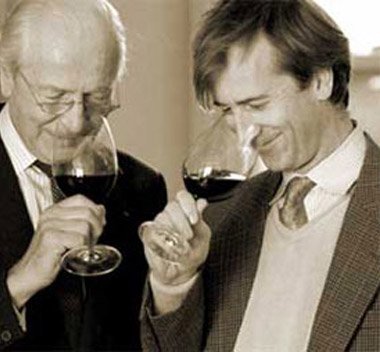
Michael Broadbent
Michael and Bartholomew Broadbent

This week’s wine news: Michael Broadbent, a leading English wine writer and critic, has died at 92. Plus, is it OK to drink alone and does expensive wine offer value?

Michael Broadbent: Broadbent, to quote his obituary on thedrinksbusiness trade site, “was a towering and influential figure in the wine trade.” He was a master of wine, wrote two books about wine that were considered standard texts, and was a wine columnist for Decanter magazine for almost 50 years. And that was after he pioneered fine wine auctions for Christie’s. The family business, Broadbent Selections, which is run by son Bartholomew, is one of the finest small importers in the U.S.

Drinking alone? The New York Times’ Eric Asimov asks: “But what if social distancing means you are actually by yourself? Is it all right to open that bottle?” His answer? “If you do have a problem with alcohol or issues with depression, drinking alone is not the responsible choice. But otherwise, why shouldn’t we enjoy the beauty of wine, especially if it is augmenting a meal? If we are going to take the loving step of cooking for ourselves, I believe we should absolutely make the experience even better by enjoying a glass or two of wine as well.” I couldn’t have said it better myself.

Value for money? David Morrison at the Wine Gourd blog looks at the Wine Spectator’s annual top 100 list, which has few inexpensive wines, to find out if it offers value for money. The result? Mostly, though his analysis does rely on points: “yes, good value-for-money can be found in this Top 100 list — go for the highest-scoring wine at $20, or the cheapest wine at your favorite score.” The finding that most interests me is that the best price for value is around $20, since those are among the least expensive wines on the Spectator list. And, as Morrison notes, there is “some very poor value-for-money, but in those cases you are getting vinous excitement, instead.” I’ll settle for the value, thank you.

Winebits 560: Wine trends, Wine Spectator lawsuit, Coke and weed

wine trendsThis week’s wine news: The Italian Wine Guy notes several disturbing wine trends, plus the Wine Spectator sues another magazine, and Coke wants in the weed business

Making money: Apparently, I’m not the only one worried about the future of the wine business. The Italian Wine Guy, who spent the last three months visiting retailers and restaurants around the country, writes that price “seems to be one of the biggest factors. It’s the economy, stupid. The wine trade has often been a race to the bottom, and these days, there is a significant concern for revenue and profit.” Consumers, he was told, are showing “high anxiety over a buying decision.” In other words, not everything is peachy-keen in the era of premiumization. And his take on the three-tier system? Intriguing and insightful for someone who used to work for the biggest distributor in the world.

It’s time for the lawyers: The Wine Spectator is suing a new marijuana magazine called the Weed Spectator for infringing its trademarks and copying its familiar 100-point rating scale for wine to rate cannabis. Reuters reports that the filing says Wine Spectator owner M. Shanken has no interest in associating Wine Spectator and the Wine Spectator marks with cannabis, a largely illegal drug. Any association of this type is likely to tarnish the reputation and goodwill that has been built up in the Wine Spectator marks and business for decades, resulting in dilution of the brand.” I’m most fascinated by the charge the weed magazine is copying the 100-point scoring system. I’d love to watch that unfold in court, given how many people use it and that the Wine Spectator didn’t invent it.

One more time: Those of us with long memories still laugh about Coca-Cola’s failure in the wine business in the late 1970s. So its foray into marijuana beverages elicits a similar chuckle. Nevertheless, reports the BBC, “the drinks giant is in talks with [Canadian] producer Aurora Cannabis about developing marijuana-infused beverages. These would not aim to intoxicate consumers but to relieve pain.” Apparently, it would be a “recovery drink,” aimed at the same market as Gatorade and Powerade. I’ll leave that straight line alone – it’s almost too easy.

Winebits 494: Wine Spectator, Warren Buffet, song royalties

warren buffetThis week’s wine news: A compliment for the Wine Spectator, plus Warren Buffet takes on three-tier and more wineries can legally play music

Well done, Dr. Vinny: The Wine Spectator gets a lot of well-deserved abuse in this space, but when the magazine does something right, that should be mentioned, too. In its Dr. Vinny wine advice column, the doctor told a reader to stop being such a wine snob: “Most wines sold here are on the sweet and simple side and cost less than $10 – and I think that’s OK. I want wine to be accessible and part of our culture. I love that I can turn on the television and regularly see characters holding a glass of wine. As much as I’d like to share my passion with everyone I know, I don’t feel a need to dictate style. There are styles to appeal to every palate. It would be boring if we all had the same thing in our glass.” Dr. Vinny, that’s a 100-point answer.

Taking on three-tier: Warren Buffet’s Berkshire Hathaway holding company owns a Texas food distributor, and the distributor wants to sell alcohol in Texas. To do so, it needs a state wholesalers license, but the state doesn’t want to give it one. Hence, legal wrangling and perhaps a lawsuit. The story describing all this, written by long-time journalist Liza Zimmerman, does a good job explaining a very complicated subject, though I wish she had been a little more even-handed in assessing the need for three-tier. Still, the point is well taken: If even Buffet, long regarded as one of the great capitalists and entrepreneurs in the history of the world, thinks three-tier is obsolete, why are we still messing with it?

Solving the royalty problem: Anyone who has heard recorded or live music at a winery, and especially a small winery, may have been party to a copyright law violation. That’s because many wineries were playing music without paying royalties. This is another controversial and complicated topic that has been going on for years; it’s enough for us to note that the companies that collect royalties for musicians are notorious for their diligence and that many of the wineries couldn’t afford to pay the royalties even if they knew about them. Finally, though, a compromise, brokered by the Wine America trade group, which should solve the problem – affordable royalties. I mention this because music, live and recorded, is key to the survival of many local and regional producers, and anything that helps Drink Local is welcome.

Wine Curmudgeon will sell blog to Wine Spectator

“Bring on the scores – 90 points for everyone!”

Jeff Siegel, the Wine Curmudgeon, who has spent the past decade extolling the virtues of cheap wine while skewering wine’s foolishness and snobbery, has had enough. He will sell the blog to the Wine Spectator on April 1; on that date, it will immediately begin using scores, running tasting notes no one can understand, writing about wine that isn’t available to buy, and being as arrogant as possible.

“What’s the point in doing what I’ve been doing?” said Siegel. “No one cares, either among consumers or producers. They just want to drink what the Spectator tells them to drink, and they want to pay two or three times what the wine is worth because it’s in the Spectator. I want to get in on that gravy train.”

A Spectator spokeswoman, who declined to be identified because she was too embarrassed to be quoted in a story about Siegel, said the magazine bought the blog because it was tired of being the butt of so many of its jokes. That included the special Curmudgie award it received every December as well as the blog’s annual April 1 post.

“On the one hand, it’s not like anyone cares about what Siegel writes,” she said. “Who really wants to drink cheap wine? And the few people who read him aren’t really good enough to read our magazine anyway. But some of the old white guys here figured we should shut him up before he causes any trouble.”

Financial terms were not disclosed, but a source close to Siegel laughed when asked how much money changed hands. “Money?” said the source. “Money? When has Siegel ever made a dime off his wine writing?”

More April 1 wine news:
Big Wine to become one company
Wine Spectator: If you can’t buy it, we won’t review it
Supreme Court: Regulate wine writing through three-tier system

The 2015 Curmudgies

2015 curmudgiesWelcome to the 2015 Curmudgies, the fourth time we’ve given the awards to the people and institutions that did their best over the previous 12 months to make sure wine remained confusing, difficult to understand, and reserved for only the haughtiest among us. This year ?s winners:

? Worst news release: Another banner year for releases that insulted my intelligence, committed any number of grammatical errors, and did nothing to promote the product. The winner is 24-Group PR & Marketing for a release for Three Hunters Vodka, which included this foolishness (and a hat tip to my pal Tim McNally, who sent it my way): “We live in a time when some of the most important choices we make come prepackaged and predetermined by companies who know nothing about us. The decisions we make about the things we put in our bodies are constantly manipulated by clever and misleading advertising, and misconceptions about nutrition and health.” Why would anyone write that about vodka? Also, it is a classic example of the pot calling the kettle black.

? The regional wine award, or the more things change, the more they stay the same: To every restaurant in Dallas, and there are too many to list here, that doesn’t carry Texas wine. This is a disgrace given the improved quality and availability of Texas wine in the second decade of the 21st century, and speaks to the restaurant wine mentality that makes wine drinkers crazy. If Lucia can find a Texas wine to include on its otherwise all Italian list, so can the rest of you.

? The three-tier system is our friend award: To the 200 Minnesota cities that, thanks to one of the oddest state liquor laws in the country, operate their own liquor stores. As the Star-Tribune newspaper reports in a solid piece of journalism, “In 2014, 34 Minnesota cities, all outstate, lost a total of $480,000 on their liquor outlets ? money they had to backfill from their own coffers. Another 60 outstate cities saw sales drop from the previous year.” Given how much trouble so many cities, big and small, have doing basics like police and fire protection and garbage pickup, that some want to run liquor stores is mind boggling.

? The Wine Spectator will always be the Wine Spectator: For James Laube’s February 2015 blog post, which included this: “If you want to save more and waste less [on wine], consider how much money you spend on wine that you don’t drink, and how many bottles of wine you opened last year that should have been opened sooner.” Wine that we don’t drink, huh? Wine that we let sit in the cellar too long? Wish I had those problems. That one of the Spectator’s top columnists wrote about it speaks to how little the magazine has to do with how almost all of us drink wine.

? Would someone please listen to this person? The positive Curmudgie, given to someone who advances the cause of wine sensibility despite all of the obstacles in their way. The winner this year is Forbes’ Cathy Huyghe, who spent the month of November writing about the wine that most of us drink, and not what Forbes’ one percenters drink. “…[I]t has turned out to be one of the most eye-opening projects I ?ve ever done. … The longer I ?m a wine writer, the further away it ?s possible to get from the wines that most people drink.”

For more Curmudgies
? The 2014 Curmudgies
? The 2013 Curmudgies
? The 2012 Curmudgies

Scores, value, and the Wine Spectator top 100

Wine Spectator top 100 The most important part of the 2015 Wine Spectator top 100 isn’t the top-ranked wine or even the wines themselves. It’s this line, buried in the fifth paragraph:

Overall, the average score and average price are the same as in 2014 ?s Top 100: 93 points and $47 — an excellent quality-to-price ratio

That the magazine’s editors could write this speaks to how screwed up scores are and to how little the Spectator understands about the relationship between quality and value. A few thoughts:

? A $47 wine should get 93 points, if only because it costs $47. What’s the point of buying it otherwise? I could just as easily buy a $35 wine that got 90 points, which offers a better dollar per points ratio (a concept that, as I write this, makes my stomach turn).

? If I owned a winery and spent the millions of dollars necessary to make $47 wine and I didn’t get at least 93 points, the winemaker’s job would be in jeopardy. Baseball managers who don’t win get fired; why not winemakers?

? True value is a $10 wine that gets 88 or 90 points, a dollar per points ratio of .11, vs. the .51 for the $47 wine (sorry — couldn’t help myself). These are the wines that score-driven consumers have been to taught to buy, and I hear from them all the time. “Parker gave that $12 wine 90 points. Do you know where I can find it?”

? No score can guarantee whether you’ll like the wine. No. 21 on the list, with 93 points, is the Cloudy Bay sauvignon blanc from New Zealand. It’s a nice wine, but certainly not my favorite New Zealand sauvignon blanc and certainly not the 21st best wine of 2015 if I was doing the ranking.

? And, in one of those peculiarly Spectator leaps of logic, the rankings list scores and boast about them but the wines aren’t ranked by scores. Rather, they are chosen for “quality, value, availability and excitement.” Excitement? Did Fred Sanford judge the wines this year?