Tag Archives: wine rants

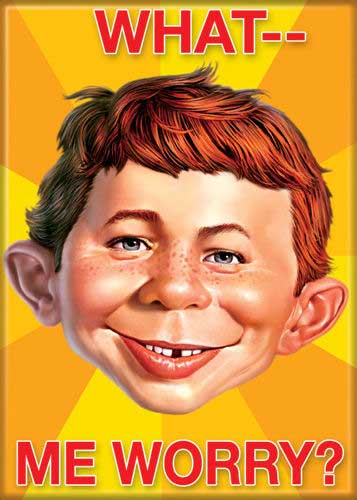
SVB report follow-up: What? The wine business worry?

what me owrry
Is Alfred E. Neuman the new poster boy for the wine business?

Want to see how little the wine business understands its existential crisis? Follow the headlines

The Wine Curmudgeon has a stock photo he uses for stories likes this – a man with his head in a hole in the ground, based on the myth about ostriches burying their head in the sand when there’s danger. They supposedly do this because, “if they can’t see the predators, then the predators can’t see them.”

Ostriches don’t actually do that, but it’s a useful metaphor when someone or something acts in ignorance of the facts. The assumption is that if they hide from the crisis, then the crisis won’t happen.

Cue the wine business.

Wednesday’s Silicon Valley Bank report, an annual survey of the state of the wine business, says wine may well be facing an existential crisis thanks to climate change and water shortages in California, as well as what looks to be the continuing collapse of the restaurant wine business.

Most importantly, the report notes, people younger than 50 aren’t especially interested in wine. That means, as the Baby Boomers die off, fewer people will drink wine – a lot fewer people. Which, the report says, “poses a primary threat to the business. That issue has yet to be addressed or solved, and the negative consequences are increasingly evident.”

So how did the wine business react? Save for the San Francisco Chronicle, which didn’t pull any punches – “New report rings a desperate alarm for wine” – it was business as usual for news coverage of the report, as well as similar, wine-related news.

Call it the perfect Alfred E. Neuman storm:

• U.S. wineries report bumper year

• Global Wine Market Size Expected to Reach $456 Billion In 2028, for a release issued the same day as the report and which noted wine’s “increased consumption pattern.”

• Wine’s Premium-Plus Tier On The Rise As Total Market Slips, from our friends at the company that owns the Wine Spectator.  My favorite bit: “premiumization remains a key driver of value for the industry, with higher-priced segments significantly outperforming less expensive categories.” In other words, nuts to everyone who doesn’t buy $40 wine.

• Survey: After robust 2021, winery owners face long-term challenges

Know something else here. The report’s author, Rob McMillan, is a banker. Bankers typically don’t call out their clients for – to be polite – acting like ostriches. That Rob did speaks to how serious the problem is. And, frankly, it took guts. One person, who knows how the report is compiled, told me that Rob may face intense criticism for what he wrote: “That’s the price of a widely released report and trying to provide leadership for change. People resist change, so he’ll get a few arrows over this.”

In which Rob shows more concern for the wine business than it shows for itself.

Full disclosure: I wrote a trade piece about the report, but I didn’t gloss over the issue. The second paragraph said: “The bad news? Wineries may well need those two banner years to offset the aging of the industry’s Baby Boomer base, the continued decline in on-premise sales, and the beginning of climate change-related water shortages and restrictions.”

Welcome to the fight, Wine Spectator

wine spectator
“C’mon, WC. You’re making this up.”

No, this isn’t a Dry January joke – the most Winestream of all the Winestream Media is endorsing “cheap” wine

Who says, to paraphrase the great Shirley Povich, that hell can’t freeze over?

The Wine Spectator, perhaps the most Winestream of all the Winestream Media, is endorsing “cheap” wine. On Friday, the magazine announced its first ever “Top 10 Values” list and its 2021 “Wine Value of the Year.”

Sound familiar?

Of course, because it is the Spectator, scores are involved and the wines on the best value list can cost as much as $40. Which, of course, is cheap only for people who read the Wine Spectator. But the 2021 top value wine is a $17 New Zealand sauvignon blanc, which wouldn’t be out of place in a review posted on a website run by a certain cranky ex-newspaperman.

So who am I to quibble?

And, no, I don’t know why the Spectator is doing this. Does it mean someone there actually knows who I am and thinks that what I do has merit? Which is actually kind of terrifying – the wine business is screwed up enough without the Spectator borrowing from me. What’s next? Someone in California admitting that premiumization is destroying wine as we know it?

Or, and which is more likely, someone did a marketing study and saw a need to focus on labels other than the stereotypical Spectator wine – which always seem to be red, made in Napa, and cost $80. Because, of course, young people.

Regardless, welcome to the fight, Wine Spectator. It’s good to see you acknowledge that wine doesn’t have to cost as much as a laptop to be worth drinking. Who knows? Maybe we can work out some sort of joint thing next year when I do the Hall of Fame and you do your next value list.

And, then to paraphrase my pal Dave McIntyre, I can declare victory in the cheap wine wars and retire to my back porch, where I will drink Gascon wine and tell long, boring stories about the old days.

Photo: Alexander Krivitskiy on Unsplash

The Wine Curmudgeon’s favorite posts of 2021

Hemingway
“The wine was cool. I drank it. It was good.”

These eight posts weren’t necessarily the most popular, but they were among my favorite posts of 2021

Welcome to the Wine Curmudgeon’s seventh annual year-end top 10 list, which is not about the most read posts. Or necessarily has 10 items. Would you expect either here?

Instead, these are the posts that I enjoyed writing, thought were important to write, or both. Why not a best read list? That’s because, on the old blog, Google determined that, and the various Barefoot posts were always the most read. Which, frankly, was kind of depressing.

Here, then, in no particular order, are my favorite posts of 2021:

• “Saturday Night Live” takes on wine marketing, with an almost scary parody of selling high-end Champagne. Why scary? Because, as our exhaustive critique of wine marketing has shown, the real thing is often a parody of itself, which the SNL sketch understands perfectly.

• The Bad Spaniels dog toy post, an incisive look at wine criticism, including a video of Churro, the blog’s associate editor, playing with the dog toy. I know some of you might not care about my take (yet again) on the failings of wine criticism, but how could you pass up a cute dog playing with a toy?

• Yes, we were drinking less during the pandemic. All the numbers were there, from a third-party study of alcohol consumption during the pandemic. And we weren’t all falling down drunk. And no one paid the least attention save for a handful of blog readers. I realize I’m just one small voice in the babble that is the Internet, but it would have been nice if someone at a Mainstream news media outlet had seen this and had written about it — even if only to make fun of me.

• The young people. wine, and cooking shows posts. The Baby Boomers learned about wine through cooking shows, but the Gen X and Millennial cooking shows don’t feature wine. Hence, one more reason why younger consumers aren’t interested in wine. How do I know this mattered? Because several really smart people who know wine and the media told me so after reading them.

• The Worf and premiumization wine parody. The video parodies have rarely done well over the blog’s history; I’ve never been able to figure out why. I write them, despite the effort required, because I enjoy doing it. And this one is funny — Star Trek’s Worf talking about wine prices and his honor.

• The Ernest Hemingway wine post. Those of us who learned to write in the 1970s grew up on Hemingway, so this year’s PBS documentary about his life was an opportunity to look at Hemingway and wine (as well as his alcoholism). There is even a not so veiled criticism of wine writing in The Sun Also Rises.”

More of the WC’s favorite posts:
• Favorite posts of 2020
• Favorite posts of 2019
• Favorite posts of 2018

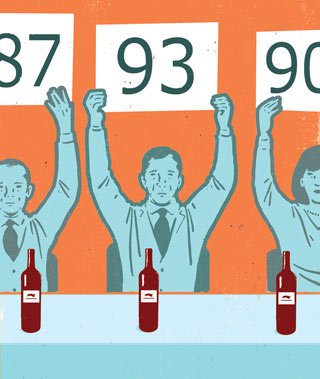
Wine scores not only refuse to die, but seem to be increasing like the spawn of the devil

wine scores
Does the world truly need 16 different wine scoring systems?

One retailer lists 16 ratings systems – and that doesn’t include a couple of the most popular

The blog, in its own small way, has accomplished great things over the years – helping to launch Drink Local and popularizing rose, to name just two.

But I haven’t – despite repeated and furious efforts – been able to put a stake in wine scores. Or, even, sort of sharpen a stake.

This failure came into focus with an email from Wine.com – differentiating between the 16 different wine scoring systems it uses on its site.

16? 16??? 16???

Yes, 16. And this didn’t include Britain’s Jancis Robinson and her 20-point system or Natalie MacLean’s 100-point ratings that are used throughout Canada.

How did we get to the point – given how useless scores are for the vast majority of wine drinkers – that at least 16 are used widely?

Because they truly are useless for most wine drinkers: They discriminate against white wine. They discriminate against less expensive wines. They discriminate against wines that aren’t from the proper region or made with the proper grapes. And, perhaps most importantly, they reflect the critic’s perceptions and prejudices, which are almost certainly not those of most wine drinkers.

Yet we’re stuck with them, despite the best efforts of many, including me.

The reasons why we’re stuck with them have also been well documented: First, as a crutch for retailers and especially the big chains and supermarkets that increasingly dominate wine sales. Second, help for smaller producers without marketing budgets; a 92 from one of the 16 might attract buyers who would not otherwise notice the wine (though whether they’ll like the wine is a different story). Third, the reviewers are so damned powerful because of reasons one and two.

So what can we do? About the same thing we’ve been doing, and try not to lose sight of our purpose – help wine drinkers find wine they will like, and not wine others tell them they should like. Because even Wine.com has a blurb next to those rankings: “While ratings may influence your decision, the ultimate judgment is your palate.”

Couldn’t have said it better myself.

Holiday shocker: Hundreds of FedEx packages were dumped in a ravine

fedex
Using this picture in no way implies that FedEx is a badly-run company that doesn’t care about its customers, and that drivers dumping packages is a common occurrence.

No one who has had wine delivered by FedEx should be surprised, but FedEx sure seemed to be

Blog regulars know this story all too well – a wine shipment never arrives at their home, and FedEx (or UPS) claims to know nothing about what happened.

So you can imagine my lack of surprised when I saw this on Thursday: A FedEx driver had dumped hundreds of packages into a ravine in Alabama. Local police, who are investigating, told the New York Times that the driver had done it at least six times, though they aren’t sure if the driver wanted to steal the items or if dumping them was easier than delivering them.

But not to worry: “The security of our customers’ shipments is a top priority and we are committed to treating our customers’ packages with the utmost care,” a FedEx spokesman told the Times.

Yeah, and I’m drinking $150, 98-point, 15.2% Napa cabernet sauvignon for dinner tonight.

The problem is not that FedEx or UPS packages go missing. Of course they do, as the Times story noted – a stunning number, almost 2 million a year by one estimate. And, of course, there was the obligatory reference to porch pirates.

The problem, as has been demonstrated on the blog as well as in the piece I wrote for Pix.wine, is that the delivery services don’t care. And each knows that there’s little any of us can do about their lack of interest, since the two companies control the private delivery business in the U.S.

The question to ask (and which, sadly, the Times reporter did not): How could the driver dump packages at least six times and not have FedEx notice? I’ve been told that delivery packages are scanned at least three times: When they arrive at the facility where they will be loaded on the truck, when they’re loaded on the truck, and when they’re delivered. And the truck is also scanned when it returns to the facility to make sure nothing is left on it by mistake.

One would think, with all that cyber-tracking, that FedEx would have noticed something was amiss after the second or third time the driver didn’t deliver the packages. But what’s the point? Then they’d have to do something about it.

Birthday Week essay 2021: The WC’s plan to save the wine business from itself

wine lecturing
“I know, I know — it’s not like ingredient labels are such a revolutionary idea.”

These six steps will reinvigorate wine in the U.S., and (dare we hope?) make wine cool again

Dear Wine Business:

It’s time to put our differences aside. I know you don’t like me, and I certainly have countless reasons to be fed up with you. But wine’s future is at stake, so it’s time to work together to solve the existential crisis facing something that we love and that makes our life that much more enjoyable.

Younger consumers don’t drink wine, don’t want to drink wine, and don’t care about wine. It’s not just the infamous Gallup poll that showed this, which described the typical wine drinker as a 50-something, college-educated woman and that young people – if they drink – barely drink wine at all. There’s also this from the Wine Intelligence consultancy, which says that wine has lost the two generations younger than the Baby Boomers.

Hence, as the blog celebrates its 14th annual Birthday Week, the Wine Curmudgeon’s six proposals to save the wine business from itself – and to make wine cool again:

1. Market wine to younger consumers in language they understand. Wine is notorious for crappy marketing, with its one size fits all, scenic vineyards and deep-voiced narrator approach. Wine is fun; why not sell it to Gen X, the Millennials, and Gen Z that way? How about showing young people – some of whom aren’t white — drinking wine together and having a good time? It works for Coke, and we all know how unhealthy soft drinks are.

2. Bring back the Fighting Varietals, but in 21st century guise. How about a California version of the La Vieille Ferme red, white and rose wines – quality, cheap bottles with a cute animal label? That fits what one of your own pleaded for a couple of years ago: “some sexy brands at $7 or $8 per bottle.” Because that’s exactly what the Fighting Varietals were in the late 1980s – affordable, quality wine that was so affordable and so well made that they helped jump start the 25-year-long Wine Boom.

3. Embrace the health message. Driving drunk was a rite of passage for the Baby Boomers; Gen X and Millennials invented the designated driver. The wine business has failed to acknowledge this difference. Spirits and even beer have a robust health message associated with their product; wine has a line on the back label. Encouraging moderation is not only the moral thing to do, but it could even sell more wine.

4. Really embrace the health message. One of wine’s most important analysts has long pleaded with the business to sell wine as the most natural of all alcoholic beverages. Which, of course, has fallen on deaf ears. Most younger consumers almost certainly don’t know how natural wine is – no added sugars, no artificial ingredients, mostly just yeast and grapes. Compare that to a hard seltzer, which contains sugar, “natural flavors,” citric acid, and sodium citrate.

5. Stop ignoring the neo-Prohibitionists and their exaggerated claims about the dangers of moderate drinking. How can you let them get away with saying wine with dinner is all but binge drinking and that drinking any amount of alcohol is as deadly as cigarette smoking?

6. Ingredient and nutrition labels. This is 2021, not 1971. There is no reason not to use those. None. How else will younger consumers know that a glass of wine has only 125 calories, while one canned cocktail brand, boasting just 5 percent alcohol, has 180 calories and almost 10 times the U.S. recommended amount of sodium?

I hope this helps. Yes, you may have screwed the pooch with younger people, as one editor put it to me. But it’s not too late to change. As always, let me know what else I can do.

Your pal,
The Wine Curmudgeon

Photo: Dreamstime.com

More Birthday Week perspective on the wine business:
• Wine as expensive shiny baubles instead of something to savor and enjoy
• How do you write about quality cheap wine when the system is rigged against it?
• Have we reached the end of wine criticism?

Five things the Wine Curmudgeon learned in moving the blog from free to paid

wine writing
“Where are all the reviews!!!”

And yes, most of the changes were improvements

The blog’s 14th annual birthday week starts today. So here are five things I’ve learned about wine writing, the Internet, and the wine business in the eight months that the blog hasn’t been free:

1. No need or reason to deal with SEO ever again. For which the Wine Curmudgeon is more grateful than he can describe. SEO, for those of you who haven’t had to acknowledge Google as your master and overlord, stands for search engine optimization. All posts must follow a variety of “suggestions” to make it easier for Google to find the post (or website or whatever) so that it can show up on the first page of search results. This used to make me crazy – how can I write a quality review if I have to make sure the name of the wine is in the headline, the subhed, and in the post three or four times? That’s not writing; that’s nursery school repetition.

2. No more complaints about the ads. These usually came in two forms: Either the ads stopped the page from loading quickly, or the ads were stupid. I couldn’t do much about the first reason, but the second was usually the fault of the person complaining. Most of the ads that showed up (given the way the Internet works) were tailored to the person’s web browsing habits, age, and demographics. So they saw what they were clicking on elsewhere. Ironically, most of the people who complained about the ads (yes, I kept a list) didn’t move to the paid version.

3. Too many marketing and PR people telling me what to run on the blog. I actually had discussions (some email, some on the phone) with people who didn’t understand why I made the editorial decisions. “But this is something your readers need to know about,” I heard over and over. And over. And over. And no, I don’t know why this happened so much in the past eight months.

4. I will never, ever, ever have to write a $3 wine review again. This was always one of the most popular posts – thank you, SEO – and it was always a tremendous aggravation to write. It’s not so much that the wines were terrible, which they were. It’s that they were the same terrible every year, and I would get emails from people who didn’t understand why the wines were the same terrible. I’m not criticizing them for liking them; I don’t judge people by the wine they drink. I just wish they didn’t expect me to like them, too.

5. “You don’t run enough wine reviews.” One man canceled his $7 a month subscription because the 200 or so reviews that appear each year weren’t enough. Which taught me you can’t please everyone, though I still catch myself trying to do just that.

Photo: A Koolshooter from Pexels