Tag Archives: wine rants

Hard seltzer’s popularity may be waning; can the wine business finally relax?

hard seltzer
When’s the last time you saw this many young people drinking wine?

Hopefully not, since hard seltzer was just one of wine’s many problems. But don’t bet on it.

The news traveled through the cyber-ether last week so quickly that it was past viral: “Is the hard seltzer craze turning sour?” “Has the hard seltzer bubble popped?” “America’s Taste for Hard Seltzer is Suddenly Starting to Wane”

One trade editor even emailed me: Did you see this? Is there a story here?

So huge massive news, since hard seltzer’s growth over the past couple of years has often been cited as the reason younger consumers aren’t drinking wine. And, if true, raises another question: If hard seltzer has fizzed out, can the wine business relax? Does this mean younger consumers, bored with Truly and White Claw and all the rest, will reach for a bottle of wine?

The answer? No.

NO.

NONONONONO!!!!!!!!!

Hard seltzer, as noted here and elsewhere, was just one example of wine’s problems with younger consumers. It was everything that they think wine isn’t – cheap, low in calories, low in sugar, low in alcohol, low in carbs, and convenient. Pop a top, get just a little buzz, and smile. Anyone who thinks hard seltzer’s troubles mean they will move to a product that comes with an indecipherable label, requires a special tool to open, comes in mostly big bottles, and doesn’t disclose calories or ingredients is kidding themselves.

In other words, way too much of the wine business. Or as Wine Business Monthly columnist Jake Lorenzo put it recently, “A class system is developing, and the wine business is not only welcoming it, but we are driving it. In Wine Country things are not getting back to normal, they are wallowing in abnormal.”

Think of hard seltzer as a kind of fast fashion, cheap and interesting and then forgotten. So if it does wane (and the second link at the top isn’t quite so sure about that), younger consumers who see wine as bougie and old-fashioned will just find something else that isn’t wine.

Because that’s what has happened over the past decade. Yes, this month’s controversial Gallup poll may have had its flaws, but it didn’t miss the point. I talked to a leading European wine analyst for a trade story about something completely different; so, of course, we ended up talking about wine and younger consumers.

As we were looking at her numbers, I said, “These can’t be right. Your surveys show that wine has lost the two youngest generations in the U.S. and Britain.” And she nodded (it was a Zoom call), and said, “Yes, it has.”

And hard seltzer is far from the only reason.

Stop the presses! The U.S. is not falling down in a drunken stupor

wine and health
What do you mean, we’re not all passed out drunk? But a bunch of studies say so.

Remember all that neo-Prohibitionist foolishness about increased pandemic drinking? The latest Gallup poll offers more evidence that the Drys were wrong

Fewer U.S. adults are drinking, and those who are are drinking less. That’s the finding from the most recent Gallup poll about alcohol use in the U.S. – and it directly contradicts every scare story, fear-mongering headline, and panic-stricken Internet alert that we’ve seen during the pandemic.

Gallup’s survey, generally regarded as the most accurate overview of U.S. alcohol consumption, found that 60 percent of U.S. adults reported drinking wine or beer in 2020 – down from 65 percent in 2019. In addition, our average weekly number of drinks fell to 3.6 from 4.0

So I guess we’re not all passed out on the couch, are we?

In fact, says Gallup, the number of Americans who drink may be at a 20-year low. As recently as 2010, two-thirds of us said we drank alcohol. And, says the study, the average number of weekly drinks is the lowest since 2001 ”and is more in line with reported alcohol consumption in the late 1990s and early 2000s than with more recent readings.”

In other words, almost every single story warning about pandemic drinking, including the scare piece in my beloved New York Times, may have been wrong. Or, as one analyst told me when I wrote about pandemic drinking earlier this year, it would have been almost impossible for us to drink more, given that bars and restaurants were closed for the first part of 2020 and that hardly anyone went to a party.

Once again, this is not to discount the horrors of alcoholism or to infer that’s it’s OK to drink to excess. As noted here many times, I know the ruin alcoholism produces. Rather, it’s to remind everyone that drinking is not cigarette smoking, and that wine with dinner does not lead to death, ruin, and destruction like some 21st century version of “Reefer Madness.”

More about the Neo-Prohibitionists and drinking
• Binge drinking during the pandemic — or not
• Has wine with dinner been turned into binge drinking?
• Are the neo-Prohibitionists winning the debate about drinking?

Beer drinkers — and Big Beer – love nutrition facts labels

nutriton labels
If beer, why not wine?

So why is the wine still business still opposed to telling us what we’re drinking?

An independent survey found that more than 70 percent of the beer products sold in 2020 included a nutrition facts statement that listed the alcohol, the number of calories, carbohydrates, protein, and fat on products either on the packaging or on a website.

Best yet, said a companion survey, beer drinkers welcomed the information – 60 percent were more likely to purchase beer, wine, or spirits that included the information and almost three-quarters said labels encouraged responsible alcohol consumption.

Not that the wine business cares much. It remains as obstinate about nutrition and ingredient labels as it has for more than a decade. Every once in a while, it will commission a survey that says real wine drinkers don’t care about junk like ingredient labels and keep pretending that it’s still the 1990s and all is well.

But when Big Beer – hardly the most enlightened business in the world – recognizes the need for labels, then something important is happening.

“I don’t know why beer decided to do this, but I can tell you for sure that and without exception that they were very smart to do it,” says Nancy Glick, the director of food and nutrition policy for the National Consumers League. Her organization has supported nutrition and ingredient labels for alcohol even longer than I have.

“The beer industry is showing that it’s more committed to its consumers,” she says, “and the data is showing them that consumers appreciate that.”

The labels were part of the Brewers’ Voluntary Disclosure Initiative, a Beer Institute program started in 2016. The goal was to show that brewers and importers could put a nutrition label on bottles and cans of beer despite the cost and the small size of the containers.

Which, apparently, they were able to do. Yes, the participating companies included Anheuser-Busch, Molson Coors, Constellation, Heineken, and FIFCO, whose brands include Labatt and Gennessee – all of whom are some of the largest beer producers in the world. So the cost and technology to add labels wouldn’t be as onerous as it would be for a craft beer producer.

Still, says Glick, that’s almost not the point. What matters, she says, is that these companies added the labels despite years of objections that it wasn’t possible.

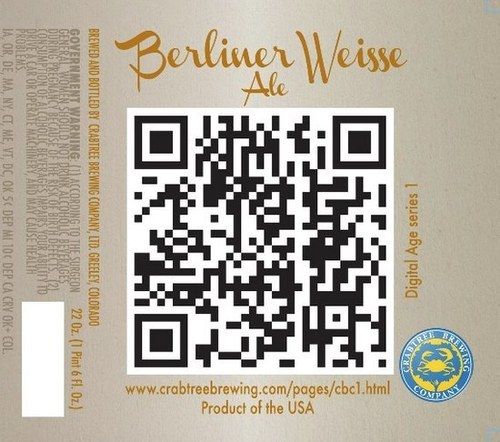
n addition, using a QR code – the boxy thing you scan with a cellphone – instead of actual ingredient labels solves most of the cost problems. The can or bottle code doesn’t have to change when ingredients do; rather, the QR code sends people to a website where changing the ingredients and nutrition information is as simple as a couple of keystrokes and mouse clicks.

Beer drinkers responded enthusiastically. Three-quarters in the above linked survey said alcohol beverages should have nutrition labels, while 77 percent would support wine and liquor companies providing this information to consumers.

Is anyone in wine listening?

And, because the Wine Curmudgeon appreciates irony: Even though Constellation Brands’ beer unit (a host of Mexican brands) added labels, its wine unit – including Robert Mondavi– doesn’t use them.

More about ingredient and nutrition labels:
• Leading wine experts call for ingredient and nutrition labels
• Clean wine: Has the Winestream Media finally figured out why we need nutrition and ingredient labels?
• Bud Light debuts new and improved ingredient labels

Wine’s generation gap may be even bigger than we think

gen zThese influencers matter to Gen Z – who in wine knows who they are?

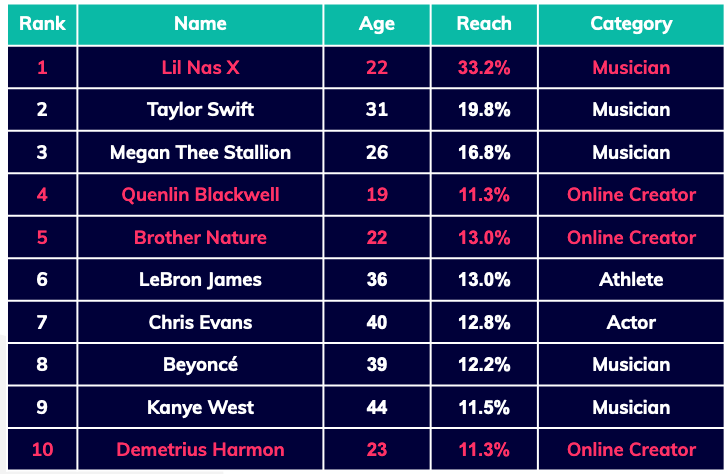
Gen Z is the demographic coming up behind the Millennials – born after 1996 and who are just becoming old enough to drink wine. Given the bang-up job wine has done reaching Millennials (yes, sarcasm), is there any hope it can reach Gen Z?

Not really, if the chart at the top of page is as important as it seems to be (chart from Helixa, via Wine Industry Insight). These are the 10 most important influencers for Gen Z, the people they follow most on social media.

Not one wine critic, wine magazine, sommelier, or wine personality on the list.

Yes, we can have a long, academic discussion about influencers and their role – real or imagined, necessary or marketing hype – but that doesn’t change the fact that Lil Nas X reaches one-third of those ages 24 and younger. And when’s the last time you heard anyone in wine talk about Lil Nas X? (Go on, Google him. You won’t be the only one.)

In fact, look at the entire list, and you’ll notice not only how young they are, but how little they match any wine demographic. The closest is probably basketball superstar LeBron James – and when he’s the closest, you know how little the list has do with wine drinkers as they are today.

The one constant about wine over the past 20 years, the thing that has been overlooked in all of the rest of the foolishness, is that wine it isn’t cool anymore. Because it used to be. Damn, it was cool – Jessica Lange drinking wine in “Tootsie” cool.

But then wine got hung up on scores and $100 bottles and snottiness and all the rest, and it barely held on to Gen X and it lost the Millennials. Cool turned into bougie, and younger people switched to hard seltzer.

And you don’t have to know who Lil Nas X is to know he isn’t bougie.

Welcome to the terrors of ultra-premiumization

wine as opera
Wine? Opera? What’s the difference?

Is ultra-premiumization – where wine becomes a luxury and not something to drink everyday – the next logical step in the evolution of the wine business?

This is the second of two parts looking at premiumization’s grip on the wine business. Today, Part II: Is ultra-premiumization the next logical – and terrifying – step? Part I: Higher prices are strangling wine to death, so that we may have lost a generation of wine drinkers

My in-basket has been overflowing with the news, updates, and offers: A startup has raised $1 million to compete with Liv Ex, the wine stock exchange. A cellar management app will now offer wine investment advice, since “investment-grade fine wine has performed very strongly against most major asset classes.” A wine consultancy, meanwhile, has formed a limited edition wine club, which will only sell “one of a kind” wines in small numbers. And how about luxury wine glasses, which start at $34 each? Or the $5,000 Napa wine trip?

These days, it seems, hardly anyone sends me a news release about a wine or wine product that most of us can afford.

And why should they? Wine has embraced premiumization for a decade, targeting more expensive wine, more expensive wine products, and the affluent consumers who can afford them. Which raises a most terrifying question: Is ultra-premiumization the next logical step in this process?

I hope not. And I know that my email is a small sample size, with all that means about predicting what’s next for wine. One wine writer’s spam does not a trend make.

But I’m reminded of a couple of predictions that wine economist Mike Veseth has made: First, what he calls juice box wine, in which mega-producers will make cabernet sauvignon not from one region or even one state, but from different countries, just like juice is made. A carton of orange juice often lists two or three or more countries of origin. So why not cabernet from California, Chile, and eastern Europe, in which economies of scale and mass production give us the wine equivalent of juice boxes – both in price and quality?

Second, that wine will become like opera – too expensive and too pretentious for most people to appreciate, even if they wanted to. Opera was popular entertainment in Mozart’s time; today, it’s barely a blip on the cultural register.

These two forecasts offer a glimpse of ultra-premiumization: Juice box wine for those of us who still care about wine, and wine as opera for the one percent, complete with expensive glasses, wine investment advice, and one-of-a-kind wine clubs. Yes, there are still hundreds and hundreds of inexpensive wines, but they’re owned by a handful of companies. And these companies have the technical and supply chain expertise to turn those products into juice box wine while focusing on their most expensive wines. Is it a coincidence that those producers have been investing heavily in brands costing $20 or more over the past several years?

Again, I write this not because I’m certain it will happen, but because it seems ever more possible as the wine business continues to push aside the ordinary wine drinker in favor of the more affluent. My job is to warn those of us love wine about the possibility.

Photo: alevision.co on Unsplash


10 years of premiumization — and all the damage that has been done

heimlich
Is there a Heimlich maneuver for premiumization’s stranglehold on the wine business?

Higher prices are strangling wine to death, so that we may have lost a generation of wine drinkers

This is the first of two parts looking at premiumization’s grip on the wine business. Today, Part I: A decade of higher prices has chased away wine drinkers. Friday, Part II: Is ultra-premiumization the next logical – and terrifying – step?

More than once over the past decade, I’ve predicted the end of premiumization – and I’ve been wrong every time. Today, as we mark a decade (more or less) since premiumization took hold of the wine business, we can see the results.

It is strangling wine to death.

The numbers are as stark as they are depressing. The Wine Intelligence consultancy reports that in 2020, only 18 percent of those aged 18-34 in the U.S. were “regular” wine drinkers. That compares to 28 percent in 2010. In other words, wine may have lost an entire generation, if not more.

Meanwhile, the company that owns the Wine Spectator – and which never fails to gloss over what it doesn’t want to be true – has finally admitted that “the wine industry in the United States is expected to suffer a 0.5% volume decrease this year … volume growth has been modest at best in each of the past ten years due to fierce competition from whiskies, hard seltzer, and other ready to-drink brands.“

Yes, there are dozens of reasons why that’s the case. But, in the end, it’s difficult not to believe that price matters the most. People don’t buy something if it costs too much, and wine’s average price has increased by about one-half, from $6 or $7 a bottle in 2010 to close to $10 today.

We can argue all we want whether quality has improved by that much (and no, it hasn’t). But when you can buy a six-pack of decent beer for less than $10 or a more than adequate bottle of whiskey for $15, why pay $10 for supermarket plonk? Who pays $10 for a fast-food hamburger?

No one, and certainly not if they’re younger and have less money – and especially in today’s corporatized economy, when they have fewer prospects than their parents and grandparents did. So bring on the hard seltzer!

This is about the point, on the old blog, when people would send emails or leave comments telling me I knew nothing about wine, and that $20 or $30 or whatever was affordable and to shut up because you’re hurting wine and I’m canceling my free subscription.

Of course, if they were paying attention, they would have noticed that I was about the only one left who was drinking wine with them.

Photo: “CPR in J’bad” by Todd Huffman is licensed under CC BY 2.0

Liquor law face-off 2: More state law silliness

voting
“Wow — it was so hard to choose between so many silly state liquor laws,”

Once again, it’s time to vote for the silliest liquor law in the U.S.

Despite the Wine Curmudgeon’s cynicism, the three-tier system continues to astound me with its foolishness. Just when I think I’ve seen it all, I obviously haven’t, as these six state laws demonstrate. Click on the law to vote for it. Voting runs through Sunday and I’ll post the results on Monday. And not to worry — even though I live in Texas, I won’t make you produce three kinds of identification to vote.

Or, sadly, as the laws in the blog’s first poll demonstrated. The winner was Indiana and its ban on selling cold beer. So, once again, a poll: Choose the silliest state  liquor law from among these six.

Once again, the choices are hardly complete. If I did miss one, leave it in the comments. It’s difficult to pick my favorite: How can I choose between Maryland’s Robert Parker law and South Carolina’s Frances Willard day? I find it past ironic that the state had to certify Parker as “an alcohol beverage writer” so he could get samples. And I know about Willard from my college days, when I lived down the street from Willard’s Women’s Christian Temperance Union headquarters in Evanston, Ill.

Photo: “Voting” by SarahPAC-USA is licensed under CC BY-ND 2.0