Tag Archives: expensive wine

Mini-reviews 142: Dueling Pistols, Grgich, Frenzy, Louis Jadot

dueling pistolsReviews of wines that don’t need their own post, but are worth noting for one reason or another. Look for it on the fourth Friday of each month.

• Dueling Pistols Red Blend 2016 ($50, sample, 14%): Surprisingly restrained red blend from California’s Paso Robles, with more juiciness than sweet fruit. Look for cherry fruit, a long, almost stony finish, and and fine, almost earthy tannins. Very nicely done.

• Grgich Hills Cabernet Sauvignom 2014 ($72, sample, 14.5%): This red from one of California’s most respected long-time producers is everything it should be – fruity (dark berries?), rich, complex, and age worthy.

• Frenzy Sauvignon Blanc 2019 ($12 purchased, 12.5%): Typical “meh” supermarket New Zealand sauvignon blanc – lots of grapefruit and not much else. Imported by Wilson Daniels

• Louis Jadot Beaujolais-Villages 2019 ($12, purchased, 13%): This French red might taste better when and if you try it; I found it fruity (cherries?), but so tart as to be unpleasant. This producer’s quality control has become notoriously inconsistent. Imported by Kobrand

Expensive wine 141: Besserat de Bellefon Blanc de Blanc Grand Cru Brut NV

Besserat de BellefonYes, it’s pricey, but the Besserat de Bellefon is Champagne the way it should be

The Champagne business is suffering during the pandemic. A couple of weeks ago, it reported that sales fell by some $1.2 billion in 2020, dropping 18 percent in volume. Who would have thought?

Hence, the Besserat de Bellefon Blanc de Blanc Grand Cru ($90, sample, 12.5%) – and just in time for The Holiday that Must Not be Named.

The Besserat’s price is purely a function of premiumization; Champagne has managed to avoid the Trump wine tariffs. The region’s sales decline is a function of this surge in prices, as well as the pandemic’s hit on restaurant wine sales. Not many of us want to spend this much money on a bottle of Champagne for dinner at home.

The Besserat’s quality has nothing to do with premiumization. This is top-notch sparkling wine from the Champagne region of France, offering everything one would expect of a high-priced bubbly. Look for some citrus and floral notes mixed with the almost toast-like aroma that high-end Champagne is known for. The fruit is a little softer than chardonnay; thank red apple and stone fruits. The bubbles, of course, are quite tight..

It’s not often I get to taste a wine that costs this much, but the Besserat de Bellefon was worth waiting for.

Imported by Winesellers Ltd.


Expensive wine 140: WillaKenzie Estate Chardonnay 2018

Willakenzie Estate ChardonnayWillakenzie’s Estate Chardonnay is a top-notch, New World-style Oregon white

Oregon is best known for pinot noir; chardonnay has traditionally been an afterthought. In fact, pinot gris has been the state’s main white wine for years.

That approach, though, has been changing. One reason, according to a long-term Oregon winemaker: High-end chardonnay has a bigger market than high-end pinot gris – depending, of course, on quality.

Which is where WillaKenzie’s Estate Chardonnay ($72, sample, 13%) comes in, even with the hefty price tag. This Oregon white is an impressive New World-style chardonnay that shows that Oregon producers can do for chardonnay what they’ve done with pinot noir.

In this, the Willakenzie estate chardonnay isn’t too ripe or too oaky, as might be expected from a similar California product. Look for green apple fruit and some lemon zest, more minerality than I expected in a New World charrdonnay, and even some brioche and yeastiness for those of you who want noticeable oak. The wine should become rounder and more full as it ages; it’s ready now, but will likely be that much better with a couple of more years in the bottle.

Winebits 679: Nutritional guidelines, expensive wine, wine taxes

wine and health
Damn, I’m good — I’m suffering from “quarantine 15” even though Americans are drinking less alcohol.

This week’s wine news: The WC’s beloved New York Times screws up a wine and health story, plus the eminent Jancis Robinson laments overpriced wine and wine tax relief

• Even the Times: The Wine Curmudgeon has nothing but respect and admiration for the New York Times, which regularly reminds us what great newspapering can be. But the Times, apparently, has the same weak spot as the rest of the media – wine and health stories. In a story last week about new federal nutrition guidelines, Roni Caryn Rabin writes: “Confined to their homes, even those who have dodged the coronavirus itself are drinking more and gaining weight, a phenomenon often called ‘quarantine 15.’ ” I can’t speak to the weight part, but as we’ve noted on the blog since the pandemic started, Americans are probably drinking less. U.S. alcohol sales, as near as can be told, have declined during the pandemic, which would make it difficult for us to be drinking more. How this unsubstantiated sentence got into the Times – and past its topflight copy desk – is beyond me.

• Too expensive: Jancis Robinson, one of the most respected wine critics in the world, agrees with the Wine Curmudgeon that wine costs too much money. She writes: “I’m not thrilled that prices for the established trophy wines of France, Italy and California have skyrocketed in recent years, putting them out of the reach of most wine drinkers, but I understand why. They are in relatively short supply and there are more and more billionaires in the world who need billionaires’ drinks. … But it does stick in my craw to see four- and even five-digit prices being asked for bottles with hardly any reputation at all.” When Jancis Robinson and I agree – and our wine worlds and perspectives have little in common – then wine really is messed up.

• Tax relief: The wine business did get some good news in 2020. At the end of the year, Congress passed a law extending excise tax cuts that would have expired otherwise. The bill makes permanent a variety of credits and reductions aimed at helping the small producers who make up some 90 percent of the more than 10,000 wineries in the U.S. These days, these producers can use all the help they can get. I’ll do a podcast later this month with Michael Kaiser of the Wine America trade group, who was instrumental in getting the legislation passed.

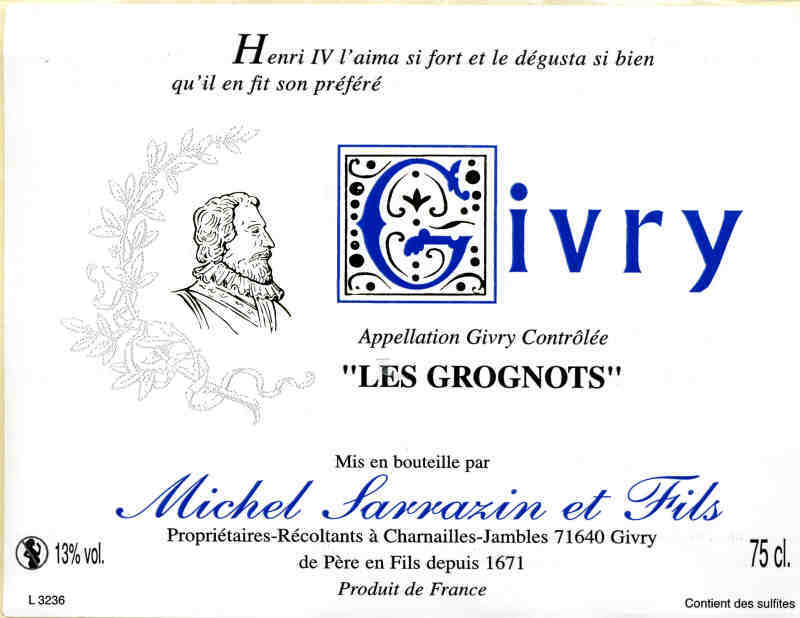
Expensive wine 139: Michel Sarrazin et Fils Givry Les Grognots 2018

Michel Sarrazin et Fils Quality white Burgundy for less than $40? Meet the Michel Sarrazin et Fils Les Grognots

Regular visitors know that white Burgundy, France’s high-end version of chardonnay, is the Wine Curmudgeon’s guilty pleasure. But I get to drink even less of it these days, what with the Trump wine tariff and continually rising prices for all Burgundy. Which is why I was so excited to see the Michel Sarrazin et Fils Les Grognots.

The Big Guy bought a sale bottle of the Michel Sarrazin et Fils Les Grognots 2018 ($32, purchased, 13%) as a Thanksgiving gift, for which I was most grateful. It was all I had hoped for: top-notch white Burgundy, which includes o ak so delicately used that it’s difficult to describe. You know it’s there, but you don’t worry about where it is.

This is a more fresh and fruit-forward white Burgundy than others. Hence, it’s ready to drink now, but should also improve over the next three or four years, as the fruit moves to the background. Look for lemon zest, almost ripe pear fruit, some white pepper, and quite a stony finish.

Highly recommended; even at its normal price, this is what passes for bargain white Burgundy these days. This is holiday wine, perfect with roast turkey.
Imported by North Berkeley Imports

Expensive wine 138: Panther Creek Pinot Noir Winemaker’s Cuvee 2017

 Panther Creek Pinot Noir Winemaker's CuveeThe Panther Creek Pinot Noir Winemaker’s Cuvee offers quality and value in time for Thanksgiving

One thing we can count on this year, despite all of the disasters and sadness, is quality and value in Oregon pinot noir. Yes, premiumization made some inroads, and I tasted some disappointing wine.

But, for the most part, wines like the Panther Creek pinot noir are all they have always been.

The Panther Creek Pinot Noir Winemaker’s Cuvee 2017 ($28, purchased, 13.5%) has long been a Wine Curmudgeon favorite, but I haven’t always been able to find it on store shelves. So when I saw it this summer, I bought it immediately.

The 2017 is typical of the producer’s style: An earthiness that I like and that is almost Old World; restrained berry fruit, so not quite brambly but not California, either; and refined tannins. The latter are noticeable, but don’t get in the way and are not easy to do with pinot noir. Too many wines, even at this price, either forgo the tannins entirely or boost them so it seems like they sould be in cabernet sauvignon.

Highly recommended, and more than a fair value. This is on its way to being quite complex, and should be even more interesting in a couple of years. Yes, Thanksgiving wine, but a red wine for any occasion that calls for something well-made and a step up.

Expensive wine pricing and snobbery have been institutionalized, legitimized, and even admired

expensive wineCan’t afford to buy one of the world’s great wines? Then lump it

This is the second of two parts looking at the conundrum that is wine pricing today – we’re awash in cheap, often crummy wine, while the prices of the world’s great wines are at all-time highs. Today, part II: How we got to the point where no one but the ultra-rich can afford the world’s great wines. Part I: The grape glut, and what it means for consumers.

The problem with expensive wine prices is not that they are expensive or that wine snobs are eager and willing to pay them. We’ve always had both. Rather, it’s that never before in the history of wine has pricing and snobbery been institutionalized, legitimized, and even admired. We’re at a point where people buy the world’s great wines not to drink them, but to keep them in a vault and watch them appreciate in value, using their acquisitions to prove their superiority to the rest of us.

How screwed up is that?

But that’s where we are, and it’s the reason why the world’s great wines cost thousands of dollars a bottle. Consider: I can pay for a place to live for a month, or I can buy a  2016 Harlan Estate cabernet sauvignon for $1,450 at a Dallas retailer. By one estimate, prices of the finest wines have increased eight-fold since the early 1990s, even after inflation.

On the other hand, the price of decent everyday wine, despite premiumization and inflation, is probably about where it was when I started the blog in 2007. I could buy Domaine Tariquet for $10 then, and it’s more or less $10 today.

So how did we get to this point?

Much of it has to do with the seismic shift in U.S. wealth distribution over the past 40 years, where we’re approaching disparities not seen since the Depression. More millionaires mean more people with more money to spend, so why not spend it on wine? Isn’t that what rich people do? Or, as Sports Illustrated’s Jonathan Wilson has called it, the greed of late-period capitalism.

Besides, as one California winemaker told the San Francisco Chronicle’s Esther Mobley: “I’m starting to come to terms with the fact that wine has always been a luxury commodity. Unfortunately, it’s a beverage of privilege.”

And what better way to leverage that privilege than with Liv-Ex, the stock market for wine? Buy a bottle, put it away, and watch it appreciate in value. Who cares if it spoils or goes off? The point is not to drink it, but to use it to amass even more wealth. And, since the supply of fine wine is limited, the more it’s in demand, the higher the price will go. And, as Eric Asimov pointed out in last week’s New York Times, demand is increasing thanks to all that wealth.

How sad is that? Great wine reduced to a share of stock.

The irony, of course, is that legitimate stock markets serve an economic purpose, to help companies raise capital. Amassing wealth is a benefit, and not a stock market’s reason for being (as it is with Liv-Ex). The other irony? Liv-Ex is a lousy way to amass wealth. Its Fine Wine 50 index has increased 26 percent in five years, or about what an ex-sportswriter who writes about wine could do with a mediocre mutual fund. The Dow Jones Industrial Average, on the other hand, has increased about twice that much.

Long-term effects

So why does this matter to the rest of us? Shouldn’t we happy with our Tariquet and leave it at that? Let the snobs waste their money. And don’t we have more important things to worry about, like the increasing disparity of wealth?

Yes, obscenely expensive wine prices are a result of the disparity, not a cause. But know two things: First, that these prices work their way down to the bottom, so every $1,000 bottle of Harlan ends up raising all prices. The Mulderbosch rose, a pleasant enough wine, now has a suggested retail price of $17 for no good reason at all, save rising prices elsewhere. In fact, that’s the sham of premiumization — we’re paying more money for the same  quality wine and not a better bottle.

Second, and more important, can you imagine a world where only the most wealthy are allowed to look at great art and to read great books? You’re not rich enough for Picasso or Rembrandt or Shakespeare or Jane Austen, so lump it.

That’s not a world I want to live in. Do you?

Photo: “Wine Auction” by alans1948 is licensed under CC BY 2.0