Category:Uncategorized

Six things you probably don’t know about wine

There are so many misconceptions about wine in the United States — often perpetuated by the industry itself — that the Wine Curmudgeon sometimes wonders how we can enjoy wine at all. Let’s clear up six of the most common.

1. What’s the average price of a bottle of wine sold in the U.S.? $6.22, reports Nielsen, tracking sales from March 2010 to March 2011. In fact, one out of every four bottles of wine sold costs less than $3. That percentage has fallen by about half over the past 20 years, but we are still — overwhelmingly — a country that appreciates cheap wine. Nine out of 10 bottles of wine sold in the U.S. cost less than $12.

2. How many Americans drink wine? Not enough. About 40 percent of Americans say they don’t drink, a figure that has remained remarkably consistent for years. Meanwhile, 20 percent of Americans drink 91 percent of the wine sold in the U.S.

3. Where does the U.S. rank in per capita consumption of wine? 57th. Through 2009, Vatican City was first at 70 liters per person, which is about 8 cases. France, at 45 liters per person, is the leading major country. The U.S. is at 9 liters per person, about 12 bottles a year — a number that has not changed much since 1980. More of us enjoy wine, but most of us, despite the hype over the last couple of years, aren’t all that interested. Even though French consumption has fallen by a quarter over the past decade, the average Frenchman still drinks five times more wine than we do.

4. What’s the most popular wine in the U.S.? Chardonnay, by about 5 to 3, over cabernet sauvignon, says the same Nielsen study. One out of every five bottles of wine sold in the U.S. is chardonnay. However, this is marked changed from the last decade, when chardonnay outsold cabernet by as much as 2 to 1. Merlot is third, pinot grigio is fourth, and white zinfandel is fifth.

5. How long does the average American keep a bottle of wine? Not very long at all. As much as 90 percent of the wine bought in the U.S. is drunk within 24 hours, even though the Wine Magazines make it seem like buying wine to age is quite common. And, depending on the study, some 95 percent of all wine purchased in the U.S. is consumed within a week.

6. How important are the biggest wine companies? Hugely important. Fewer than two percent of U.S. wineries account for 84 percent of all wine production. Most wineries, whether in California or not, are small — about six in 10 make less than 4,200 cases a year. The company that owns Kendall-Jackson, on the other hand, makes more than 5 million cases a year. And it’s not even the biggest.

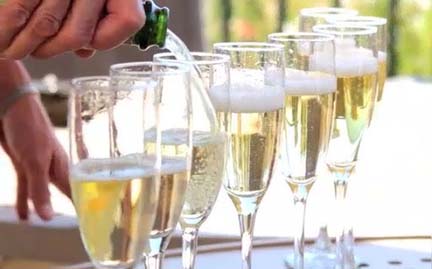
The photo is from Microstock Photography, via stock.xchng, using a Creative Commons license

2011 $10 Wine Hall of Fame

$10halloffame
This should have been a grand and glorious $10 Wine Hall of Fame. The recession forced consumers to drink down, and we’re buying more cheap wine than ever before — and, hopefully, learning that we don’t have to pay too much money or attention to scores to find quality wine. In fact, I added six wines to the fifth annual Hall this year, because there was that much great $10 wine to find.

But I also tasted way too much flabby and dull $10 wine in 2010, and especially from California. Producers, apparently, were throwing anything in a bottle that they could sell for $10 or less, regardless of quality, in order to attract customers. The result was wine that tasted as if it had been made to a formula, and a cynical one at that. Call it the white zinfandel style — lots of sweet fruit and not much else. So it should be no coincidence that no California wines made the Hall this year.

That’s why the 2011 Hall of Fame a mixed bag. Yes, six wines were added, but four dropped out: La Ferme de Gicon, a red blend from the Rhone, which was lacking this year; vini merlot from Bulgaria and the Lockwood sauvignon blanc, which apparently aren ?t available in the Dallas area any more; and Meridian ?s chardonnay, which tasted nothing like last year ?s vintage. In this, the Meridian seemed to demonstrate what was wrong with California’s approach to wine last year — dumb it down, spend less on it, and figure no one will notice.

One other 2011 note: I’m establishing a special place in the Hall — call it the Asterisk Wing — for the Vitiano red, white and rose made by the great Riccardo Cotarella. These Italian wines are sometimes $10 and sometimes $11, and it’s kind of silly to keep moving them in and out of the Hall because the dollar fluctuates against the euro or because retailers are playing with margin.

The new members are:

? Chateau Barat, a French rose and an incredible wine. It started with lots of strawberry fruit and then morphed into something with a long, minerally finish — and does it with only 12 percent alcohol.

? Casamatta Toscana, perhaps the best cheap sangiovese I’ve ever had. Price note: This wine, like the Vitianos, is apparently $10 in places other than Dallas.

? Chateau Boisson, a white French wine that is “about as close as I have come to finding older-style white Bordeauxs that don’t taste like New Zealand sauvignon blanc.”

? Ch teau Parench re Bordeaux Blanc Sec, a white Bordeaux that is pleasantly floral and fruity (lime and melon?), but with a firm backbone.

? Marqu s de C ceres Rioja Rosado, a grocery store Spanish rose that “is full of strawberry fruit, is bone dry, offers great value, and is barbecue friendly on a 100-degree Texas afternoon.”

? Anne Aimee Muller-Thurgau Cuvee A, an Oregon white wine that is “somewhere between an off-dry German riesling and an old-style gewurtztraminer — sweetish but also spicy.” A tip o’ the Curmudgeon’s fedora to Jennifer Uygur, who sold me this wine and then gave up retail in 2010 to open a restaurant with her husband. Good luck, Jennifer and David.

The holdover wines are:

? The chenin blanc, CNW, and a chenin blanc-viognier blend, Chenin Vio, from Vinum Cellars in California. One caveat: These wines are not $10 everywhere, and the CNW seems to be in short supply.

? Notorius, a white wine from Sicily. This was just one of almost a dozen Sicilian wines that cost $10 or less and offer spectacular value, almost all of which are worthy of inclusion.

? The $10 wines from California ?s Bogle Vineyards, and especially the petite sirah.

? Cristalino, the Spanish sparkling wine, which comes in brut (dry), extra dry (sweeter than brut) and rose.

? California ?s Toad Hollow pinot noir rose.

? The Yellow+Blue box wines, and especially the malbec, about $12 for a 1-liter box.

? Domaine Tariquet, a white blend from Gascony, which is the representative for several other Gascon wines made with obscure grapes that deserve to be better known.

Previous $10 Wine Hall of Fames:
? 2010
? 2009
? 2008
? 2007

Winebits 160: Holiday sparkling wine

A look at what some of the rest of the wine world is recommending that we drink as bubbly season nears its zenith:

? French bubbly that's not from Champagne: Eric Asimov of the New York Times lists 10 French sparklers made elsewhere in the country, and his choices include some of the Wine Curmudgeon's favorites — several from Alsace and the Bonnard from Burgundy. What's really interesting about these is that many of them are less than $20, and represent real value.

? Wine Spectator recommends Cristalino: Yes, the world's greatest value bubbly is listed in the magazine's sparkling wine story, albeit it at the very end and with an 85. Even Korbel is in there, and with an 86 (yet another example of why scores are silly, since there is no way Korbel is more interesting than Cristalino). In fact, I'm beginning to worry about the Spectator, since the list had several wines that I regularly recommend. if the Spectator and the Wine Curmudgeon find common ground, the world must be upside down.

? 10 great Champagnes: From Jon Bonne at the San Francisco Chronicle, and don't be surprised if you haven't heard of most of them. This is a truly a Champagne-ophile's wish list, and some of them will be almost impossible to find (assuming you can afford them).

Barefoot wine, because you’re searching for it

The Barefoot post that ran on the blog more than two years ago is attracting tremendous traffic this holiday season — about 10 percent of the visitors over the past week, a number that has been consistent for a month or so and is pretty amazing for a two-year-old post. It looks like wine drinkers want some Wine Curmudgeon advice before taking Barefoot to the office party or serving it to the in-laws.

So if you’re here looking for the Barefoot post, you should know that I wrote another Barefoot post in September — Barefoot wines (again): Value or just cheap? It updates the original post and offers some thoughts on the Barefoot merlot. There is also a review of the Barefoot riesling, written last December.

Birthday week 2010

Wc 2010 A colorful graphic as we start Birthday Week. The chart shows where we started almost three years ago (I didn't keep stats for the first six weeks of the blog's history), and where we are today. All told, the number of visitors has increased 1,640 percent from that first January, and we're up 44 percent so far this year.

Which, basically, is why I'm still here. You're reading this; if you weren't, I wouldn't be doing this. So thank you, because this truly does beat working for a living.

A few notes from the first three years of the blog. On Thursday, I'll count down the top posts of the past 12 months:

? You like wine reviews — a lot. More than half of the top 10 posts each year have been wine reviews.

? Red wine beats white wine every time. No white wine review has ever made the annual top 10. I have absolutely no idea why this is, since the reviews are split almost 50-50 between white and red (and no sparkling or rose has ever made the top 10, either). Any thoughts about why? Leave a comment.

? Save for my series of Costco posts, which discussed whether the national chain was buying wine based on scores, you don't care much for the non-review items. Which is too bad, since those are the ones that I usually enjoy writing the most.

? Your focus has shifted as the blog has become more popular. A Texas wine post made the top 10 in 2008, but no regional wine story has made the top 10 since.

DrinkLocalWine.com and regional wine week 2010

This is DrinkLocalWine.com's third annual Regional Wine Week, in which we highlight regional wine throughout the United States. Who would have thought, when Dave McIntyre and I came up with the idea 3 1/2 years ago, that it would have led to DLW, wine week, and our annual conferences?

The funny thing, as passionate as I am about local wine? I'm still surprised that so many other people care as much as they do about regional wine. During my time at the State Fair of Texas over the past couple of weeks, the crowds were good, lively and asked intelligent questions. And we got the usual questions from people about how to start a winery or a vineyard.

What is even more encouraging is that the next generation of wine professionals is so enthusiastic about regional wine. Just two examples from the Fair: Hunter Hammett, the 30-something sommelier at the Fairmont Hotel in Dallas, told how he served Texas viognier to a group of French guests — and how much they enjoyed the wine. Devon Broglie, the equally youngish wine buyer for Whole Foods in Texas and the Southwest, said that regional wine sales have flourished at Whole Foods during recession, despite the slowdown in the rest of the wine business.

There is more demand and more interest in regional wine than ever before. This week on the blog, I'll highlight regional wine — the good and the bad, because nothing gets better unless you understand what the obstacles are.

Indy International Wine Competition 2010

? What is it? One of the top competitions in the United States and perhaps the preeminent competition for regional wine.

? When and where: Aug. 4-6, 2010, West Lafayette, Ind.

? Biggest surprise: How many grape varieties we judged that even I wasn’t familiar with. I thought I was on top of this stuff, but then they threw grapes like fredonia at us.

? What’s different: The atmosphere. We were on an expedition, traveling to places where we had never been. Judge most competitions, and it’s pretty straightforward — cabernet sauvignon, chardonnay, and the like. But at Indy, you never knew what was going to come next. That was damned exciting.

? Who I judged with: My pal, sommelier Rene Chazottes of Los Angeles; distributor Michel Pascal; and retailer Donna Lattanzio. We had great fun, though I’m still not quite sure what Rene and Michel were saying to each other when they spoke French. (“That Siegel — sacre bleu, what an awful palate.”)

? Compensation: An honorarium (have not received it yet), plus travel, meal and lodging expenses.

? Overall: This is not just a well-run competition (and thanks to Carmen Branson and Sharon Harper, our pit cru — who brought the wines to our table and did a marvelous job). But It’s also a well-executed one. Indy has a point, and that is that terroir matters, and that wine is wine regardless of the grapes that are used. That is a refreshing approach in today’s wine world, where every sample that arrives seems to be another wine just like the previous one. Does fredonia make wine that tastes like cabernet? No. But it’s not supposed to, is it?

,