
Tag Archives: zinfandel

Father’s Day wine 2022

Father's Day ties
Once more, the Father’s Day tie picture — call me corny, but I love it.

Father’s Day wine 2022: Bring on the well-made and value-oriented wine for Dad

Yes, despite economic uncertainty and all the rest, we found wine for Dad for Father’s Day that fits what we do here — price and value, and not silliness. And don’t forget the blog’s wine gift-giving guidelines — don’t buy someone wine that you think they should like; buy them what they will like.

Father’s Day wine 2022 suggestions:

Carol Shelton Wild Thing Zinfandel 2018 ($18, purchased, 14.5%): Spot-on California old vine zinfandel (60 years at least) that is somehow jammy (berries and berries and more berries), but not heavy or hot. Having said that it’s a big wine and a mouthful, and needs lots of red meat. Highly recommended.

Domaine Bousquet Brut NV ($13, sample, 12%): Argentine bubbly with surprising structure, tight-ish bubbles, not too sweet, and apple and lemon fruit. Imported by Origins Organic

Jean-Pierre Boisson Rose Domaine du Pere Caboche ($11, purchased, 12.5%): Full, rich and surprisingly complex $10 French rose, with almost cranberry fruit and what one tasting note calls grenadine. Highly recommended. Imported by Monsieur Touton Selection

Chateau La Maroutine Blanc 2020 ($13, purchased, 13%): French white Bordeaux blends sauvignon blanc and semillion; the latter, though only 20 percent, is noticeable, and gives the wine a rounder, less citrsusy feel. Lots of stone and minerality. Imported by Frederick Wildman and Sons

More Father’s Day wine:
Father’s Day wine 2021
Father’s Day wine 2020
Father’s Day wine 2019
Expensive wine 154: Frank Family Merlot 2018
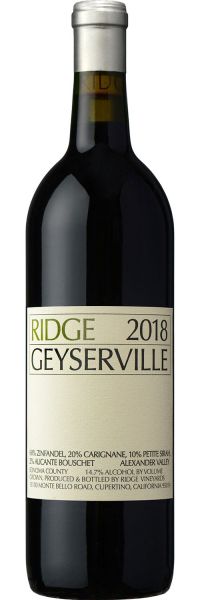
Expensive wine 157: Ridge Geyserville 2018

Ridge Geyserville 2018 bottle
Ridge Geyserville 2018/ $34-$60

One more reason why Ridge may be the best red wine producer in the U.S.

Has it been three years since a Ridge review appeared on the blog?

There’s really no excuse for that, given how much regard I have for Ridge and that it may be the finest U.S. red wine house. Which is even more impressive given that Ridge mostly makes zinfandel and red blends with zinfandel. (Yes, and Monte Bello.)

Case in point: The Ridge Geyserville 2018 ($47, purchased, 14.7%).

The Geyserville is not my favorite Ridge; that’s either the Lytton Springs or the Three Valleys. The former is usually a bit more restrained, while the latter is less expensive (though still a fine wine). I bought this because it’s all that was available in Dallas at the height of the pandemic.

And, of course, I was not disappointed. The wine is a blend of about two-thirds zinfandel, fleshed out with carignane, petite sirah, and alicante bouschet. It was very young when I tasted it last year, but was also very rich — and the two don’t usually go with each other.

Needless to say, there is lots and lots of black fruit — plums, an odd descriptor for zinfandel – as well as blackberries, plus so much else. Maybe some spice, maybe some cedar, maybe some herbs, certainly refined tannins. And even a savory thing.

This is a very pretty wine that should age well, getting more savory as it does. One review said to let it rest for 10 years; if you do, you’re more patient than I am. This is Father’s Day wine, either as a gift or for a holiday dinner or barbecue. Highly recommended.

The Golden Age of Zinfandel

zinfandel
“Man, I wish I could find some of those quality, cheap zinfandels the WC wrote about.”

Or, how we almost had a cheap, well-made every day California red wine like Chianti and Beaujolais – and then we didn’t

One of my first great crusades as a wine writer in the mid-1990s was California zinfandel. There were any number of cheap, well-made, and delicious labels, and it seemed like zinfandel had the chance to become the U.S. equivalent of Italy’s Chianti and France’s Beaujolais – a quality, every day red wine that everyone could afford.

How different would the wine world have been if that had happened?

But, of course, it never did. Because, wine.

So check out this freelance piece for Pix.wine, where I discuss how and why that happened. Needless to say, it was a great joy to write (despite the crummy, SEO-oriented headlines) and reminded me that California can make the best wine in the world — and even the best cheap wine. Among the highlights:

• Talking to Joel Peterson, one of the nicest guys in the wine business and a terrific winemaker, as well as the always entertaining Carol Shelton, another top-flight zinfandel maker.

• Recounting the history of zinfandel in California, where vines planted more than a century ago are still used to make wine.

• Ranting about high-alcohol wine and how Robert Parker not only destroyed quality, affordable zinfandel in the U.S., but didn’t much help Australian shiraz in the long run, either.

• Finding a connection between overpriced Napa cabernet sauvignon and what became too many overpriced California zinfandels. Or, as one long-time wine guy told me, “Follow the money.”

Wine of the week: Cavaliere d’Oro Primitivo 2017

Cavaliere d'Oro PrimitivoThe Cavaliere d’Oro Primitivo is an Italian red that tastes like an Italian red and not a California wannabe
Primitivo is an Italian red grape, usually identified as zinfandel even though they’re not exactly the same thing. But that hasn’t stopped countless Italian producers from hopping on the California zinfandel bandwagon, producing wines that don’t taste much Italian but do please a certain Baby Boomer palate. So where does the Cavaliere d’Oro Primitivo fit into this?

It tastes like primitivo.

Which, honestly, was the last thing I was counting on when I picked up the Cavaliere d’Oro Primitivo ($12, purchased, 13.5%). I bought the wine because I buy wine, even though I’m not sure I’m going to like it. Such are the demands of the blog.

But the Cavaliere d’Oro Primitivo was all it should be, and probably even a little more. It’s easily one of the best primitivos I’ve tasted, in that it didn’t taste like badly-made zinfandel. It was fruity (dark berries, plum), but there was much more – a touch of cocoa, some nicely done oak, tannins that offered just enough structure, and all in a well-rounded whole. Highly recommended.

Imported by TWE Imports

Pricing note: All prices are suggested retail or actual purchase price before the October 2019 tariffs unless noted

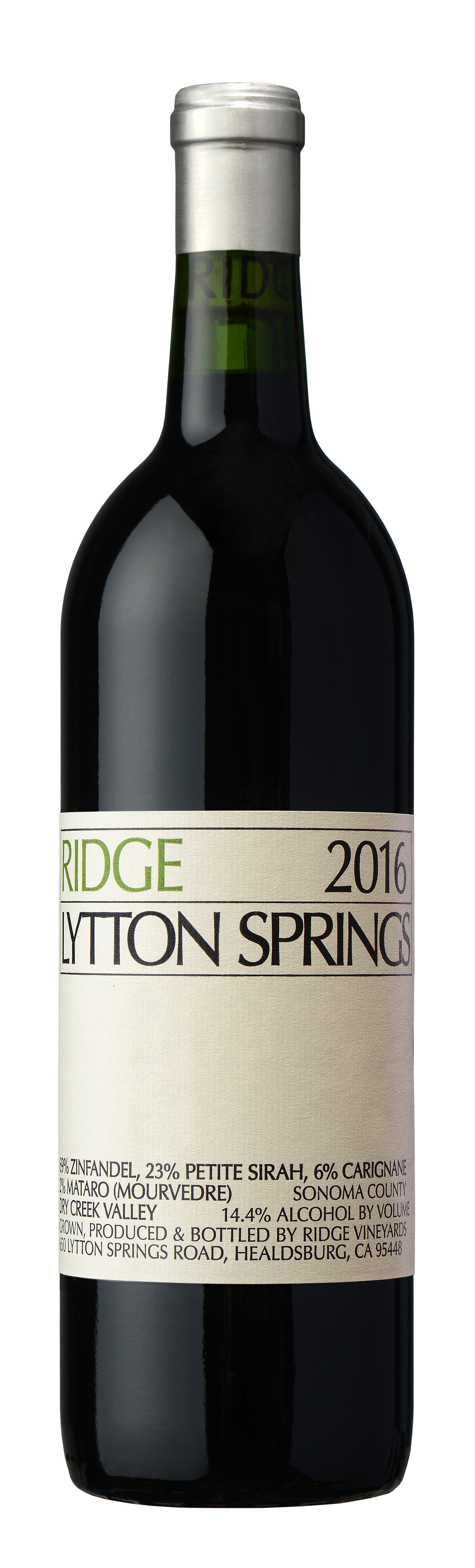
Expensive wine 122: Ridge Lytton Springs 2016

ridge lytton springsThe Ridge Lytton Springs zinfandel blend speaks to quality and value in the finest California tradition

The premiumization debate should not obscure the fact that there are expensive wines that deliver value and quality. Perhaps the foremost of those is anything from Ridge, the California producer that has been the watchword of the faith for anyone who believes in value and quality. As evidence, we have the Ridge Lytton Springs.

The Ridge Lytton Springs ($45, purchased, 14.4%) reminds us of everything that is possible with California wine. It speaks to terroir and to Sonoma’s Dry Creek Valley and its particular style of earthiness. It speaks to aging – this wine, ready and delicious now, has at least a decade of life in it, when it will become rounder and less ripe and much more interesting.

Best yet, as with all Ridge wines, it shows the rich, ripe style of California, but done with structure and and almost elegance. Look for dark fruit (black cherry? black raspberry?), a wonderfully peppery middle, and one of best uses of oak I’ve tasted in years on the finish. Plus, the tannins are not an afterthought, as with so many zinfandels (even expensive ones), but an integral part of the wine.

This isn’t a swaggering Lodi zinfandel. The fruit and alcohol aren’t piled on for show, like frat boys seeing who can chug the most beer. Rather, the Ridge Lytton Springs is rich and ripe because zinfandel produces rich and ripe wine. And because it’s a blend (four grapes, including some two-thirds zinfandel and one-quarter petite sirah), winemaker John Olney can use the blending process to make the sum greater than the parts.

Highly recommended. I decanted this about a half hour before dinner, which seemed about right. It’s a food wine, but not just red meat. I served it with roasted pork shoulder studded with rosemary and garlic, which worked more than well.

Winebits 558: Kent Rosenblum, North Dakota wine, Australian prosecco

kent rosenblumThis week’s wine news: Zinfandel icon Kent Rosenblum dies, plus North Dakota wine and a tussle over Italian-style sparkling wine made in Australia
Kent Rosenblum dies: One of the country’s greatest zinfandel winemakers died last week; the Rosenblum zinfandel, along with Ridge and Ravenswood, paved the way for today’s zinfandel boom. But that was not Kent Rosenblum’s only legacy. He was one of the most humble people I’ve ever met in the wine business. I rode an elevator with Kent, who was a vet long before he was a winemaker, shortly after he sold the company to Diageo in 2008 for $105 million. He was schlepping wine boxes to a trade tasting. “Dr. Rosenblum, I said, “why are you carrying your own boxes? Don’t you have people to do that for you now?” He looked a little sheepish, and said, “Why would I ask anyone else to do this?”

Bring on North Dakota wine: Researchers in North Dakota want to boost the state’s wine business, in another victory for Drink Local. “”Everyone is interested in expanding our industry in North Dakota for wineries and for tourism,” said one state official. Which, of course, is just what the WC likes to hear. The biggest problem in North Dakota, not surprisingly, is the weather, which is too cold for most wine grapes. But state researchers are working with a variety of cold climate hybrids to find the best for the climate. Currently, the state has 16 wineries.

How do you say Prosecco in Aussie? Australian bubbly may be one of the sticking points in trade negotiations between their country and the European Union. The Australians sell a wine called Australian Prosecco, which is illegal under European trade rules – the same law that prohibits California producers from calling their wine Champagne under a U.S.- European Union agreement. Why the Australian objection to the name rule for something that’s settled in much of the world? More wine labeled Australian Prosecco is sold in Australia than the Italian kind, and the former don’t want to lose that market.

Expensive wine 102: Mauritson Rockpile Zinfandel 2014

Mauritson Rockpile Zinfandel The Mauritson Rockpile Zinfandel is California zinfandel with an intriguing approach

You never stop learning in this business, and anyone who says differently is either lying or doesn’t understand wine. The Mauritson Rockpile Zinfandel is a red wine from California’s Sonoma Valley that proves the point.

Regular visitors here know that the Wine Curmudgeon prefers subtlety, and that many California wines view subtlety as something to be avoided. But since I am always learning, I took a lesson to heart several years ago judging TexSom. My panel had to judge zinfandel – lots and lots of California zinfandels from throughout the state. Yes, some of them were excessive, but as my colleagues showed me, the best wines were tasty and interesting, even if subtlety wasn’t their reason for being.

Hence the Mauritson Rockpile Zinfandel ($41, sample, 14.75%), a classic example of the Napa style – lots and lots of sweet black fruit, black pepper, a little more sweet black fruit, a dash of oak, and then some sweet black fruit for good measure. But the wine is so so powerful, so overwhelming, that it works. And this comes from someone who doesn’t like this style of wine.

This is a fall wine for stews, sausages, braised beef, and the like. And remember to never judge the wine until you taste it.