

Tag Archives: Prohibition

Wine history lesson 8: The evils of drinking

anti-drinking poster from ProhibitionHistory tends to repeat itself, and especially when it comes to booze

Consider these two quotes:

• “The fight against evil is always an uphill one, and the hill is never steeper than when you fight the liquor interests.”

• “Alcohol consumption and its associated harms are reaching a crisis point in the United States.”

The first? William Jennings Bryant in 1910, advocating for state-wide prohibition in Nebraska. The second? A 2022 study, advocating for more explicit anti-drinking warnings on wine, beer, and spirits.

Not much difference in the two statements — despite the century-plus difference in when they were made, as well as the philosophies behind the people who made them. Bryan, an ardent Prohibitionist, believed drinking was a moral weakness, while the study’s authors are respected researchers who are focused on science.

In this, I’ve always been surprised at how much the original and the current group of anti-drinking crusaders have in common. It’s the same message, but couched in just enough of a different style. That way, we won’t be quite as offended when they tell us that drinking is evil. Which, to give the Neo-Prohibitionsts their due, is damned clever. It’s still offensive, but at least they understand the morality bit is probably too dated to work any more.

More wine history lessons:
Wine history lesson 7: When drinking alcohol was a good thing
Wine history lesson 6: Was this California fortified wine one of the state’s first post-Prohibition efforts?
Wine history lesson 5: Big Wine’s forebear — the infamous California Wine Association
Wine history lesson 7: When drinking alcohol was a good thing

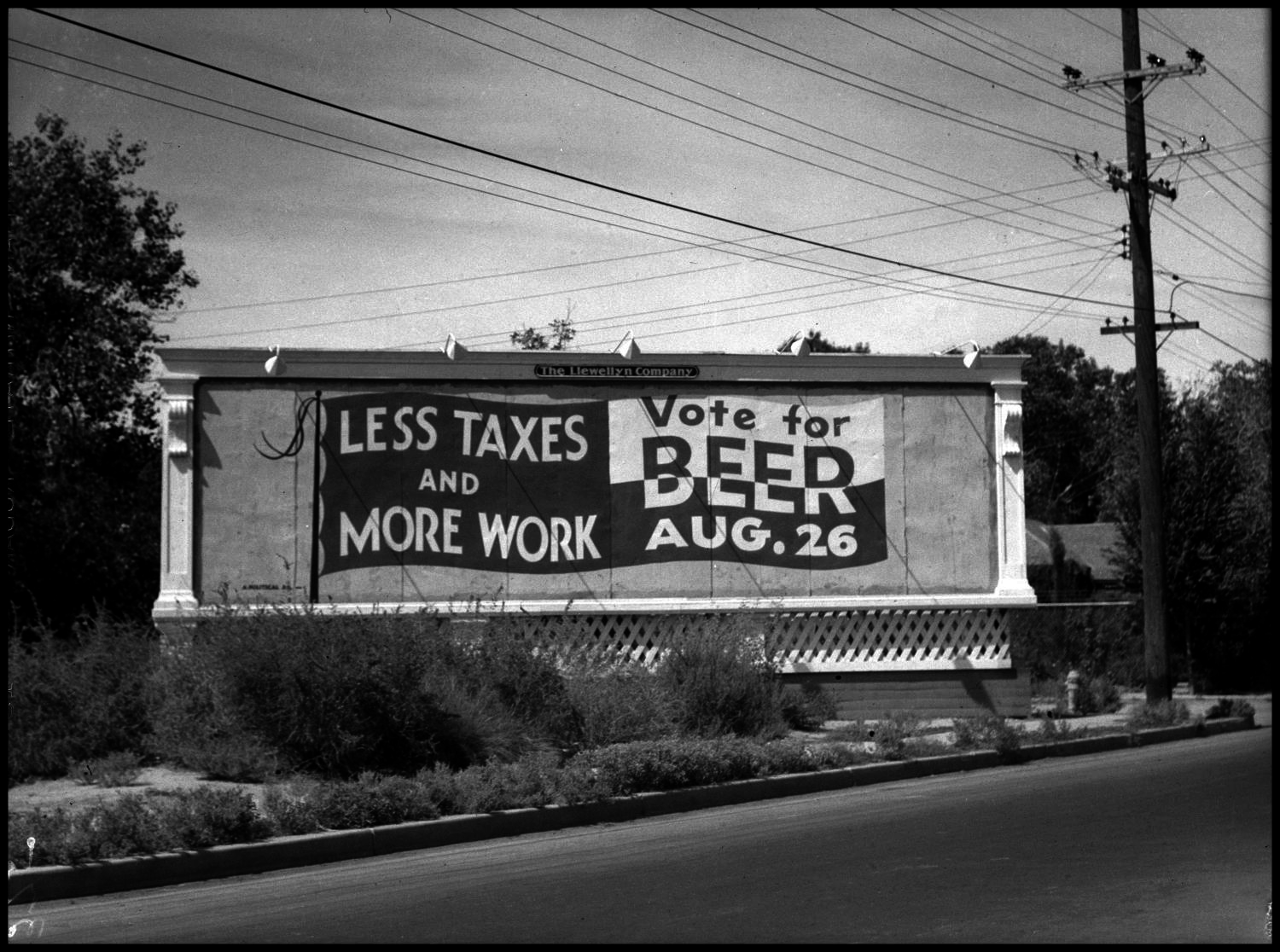
Billboard urging a vote for beer
This billboard pretty much says it all.

Yes, once upon a time, drinking was a good thing

This billboard, from El Paso in 1933, speaks to a time when the argument against Prohibition was more clear cut. The election it notes came as Texas counties voted whether to remain dry after the end of Prohibition.

Most states held similar wet-dry elections after the 21st Amendment repealed Prohibition, and the arguments then were much the same that they are today. The difference? Everyone who had just endured the previous 14 dry years knew what a failure Prohibition had been, despite its intent — and despite what its apologists claimed.

So the next time someone tells you that it’s a great idea to force the rest of us to stop drinking in moderation, show  them this.

A tip o’ the WC’s fedora to John Bratcher, who sent this along from the Texas Reader history newsletter.

More wine history lessons:
Wine history lesson 6: Was this California fortified wine one of the state’s first post-Prohibition efforts?
Wine history lesson 5: Big Wine’s forebear — the infamous California Wine Association
Wine history lesson 4: Those damned high prices

“Prohibition wasn’t a failure”

al capone
“Of course Prohibition was a success — I made millions.”

The neo-Prohibitionists are reframing history to convince us that Prohibition worked – so we can do it again

“For instance, the St. Valentine’s Day massacre, in which seven men were gunned down in a Chicago garage, may have been carried out to avenge an earlier killing and had no connection to Capone or to bootlegging.”

Bill of Rights Institute

Welcome to the Alice in Wonderland inhabited by the neo-Prohibitionists in their attempt to convince us that Prohibition was a success and that we should – and can – do it again.

How anyone can argue that the Valentine’s Day Massacre had nothing do with bootlegging and illegal liquor is past astounding. It’s a rejection of almost 100 years of historical analysis – Al Capone and Dion O’Banion fought for control of the Chicago liquor business, and Capone won by murdering as many of O’Banion’s gang as possible (including O’Banion). The seven murders on Feb. 14, 1929, finished the job.

It’s also worth noting that Capone thought the 1932 film “Scarface” was about him, wrote screenwriter Ben Hecht. Any why not? Hecht’s script revolves around Italian gangster Tony Camonte, who blows away his Irish North Side enemies in a St. Valentine’s Day-style massacre.

Yet search Google for “Prohibition was a success” and the results are mind-boggling — a mix of facts and wishful thinking. Which, come to think of it, is not all that different from the infamous cigarette study: Drinking one bottle of wine a week is the equivalent of smoking 10 cigarettes a week for women and five cigarettes for men.

So consider this, from a couple of studies in Scotland that looked at the results of alcohol minimum pricing. The idea was that raising the price of booze would cut crime, reduce drinking, and improve the public health. None of which seems to have happened.

Of course, the Iranians could have told the Scots that would be the case. Who knew AA would be so popular in Iran, a country where alcohol is illegal?

Winebits 659: The “They want to bring back Prohibition” edition

Prohibition
“That’s too much wine — back up the paddy wagon.”

This week’s wine news: Reaction from the cyber-ether to proposed federal guidelines that take us closer to banning drinking in the U.S. – just one glass of wine a day for women and two for men

The banker’s perspective: Rob McMillan of Silicon Valley Bank is one of the smartest people in the wine business, and he sees the threat clearly: “What science is behind the recommended change? The report cited only a single study that examined the difference between men consuming one or two drinks per day. My question is how can an unbiased group conclude that a single study should outweigh and counter the weight of decades of prior work?” McMillan also points out, yet again, how remiss the wine business has been in addressing the threat.

The retail perspective: The National Association of Wine Retailers is blunt: “It appears to the NAWR that there is much more at work here than reasonable recommendations based on a solid body of evidence. It appears to the National Association of Wine Retailers that a significant anti-alcohol agenda is at work in devising the proposed new guidelines on alcohol consumption.”

Even the Wine Institute: The Wine Institute, a trade group for the California wine business, is notorious for its refusal to have anything to do with wine and health. That it finally issued a statement criticizing the new guidelines – as milquetoast as it was – speaks volumes about how the wine business finally sees the Neo-Prohibitionist threat. For it is a threat, as I’ve noted many times — equating moderate drinking with cigarette smoking is past science and is about Prohibition.

15 years since Granholm, and how much hasn’t changed in the three-tier system

GranholmThe Supreme Court’s Granholm decision was supposed to make it possible for us to buy wine from out-of-state retailers and on-line. So why didn’t it?

This is the first of two parts looking at how the century-old three-tier system still prevents us from buying wine on-line or from out-of-state retailers. Today, part I: The Supreme Court’s 2005 Granholm decision, and why it didn’t change three-tier as much as everyone hoped. Friday, part II: Dear Supreme Court: Please fix three-tier.

Fifteen years ago this spring, the Supreme Court made it possible to buy wine from an out-of-state winery in its Granholm decision. The court ruled that states had to treat wineries in- and out-of-state the same way. So, if residents could buy directly from an in-state producer, then they had to be allowed to buy wine from an out-of-state producer as well. This opened the direct-to-consumer wine market, which is worth about $3 billion today

Many smart people also thought Granholm would open the retail wine market, so that consumers could buy wine over the Internet and from companies like Amazon. But that never happened (save for the rare exception like Wine.com), and I explain why in a freelance piece I wrote for Meininger’s Wine Business International.

And why didn’t Granholm do that? Because state lawmakers, regulators, and the courts still go by what’s called the “public health and safety” standard that was set up by the political compromise that ended Prohibition and gave us three-tier. The doctrine says that if a liquor regulation protects the public health and safety, then it’s constitutional. And each group – and particularly the courts in almost every decision since Granholm – still insists it isn’t safe for wine drinkers in one state to buy wine from a retailer in another state. So it remains illegal.

Yes, this is silly and outdated in the second decade of the 21st century – but that’s three-tier for you.

More about three-tier, Granholm, and direct shipping
Tennessee residency law: Did the three-tier system come crashing down yesterday?
Is the coronavirus pandemic the beginning of changes to the three-tier system?
Direct shipping loses a big one

Winebits 629: Prohibition, SVB report, wine consumption

ProhibitionThis week’s wine news: It’s the 100th anniversary of the repeal of Prohibition, plus insight into the SVB wine report and why the U.S. still drinks more wine than anyone else

Happy anniversary – or not: Reports the BBC: “A century on, a small group of Americans are fighting to keep the dream of the so-called ‘noble experiment’ alive.” The story looks at those who think repeal was a mistake, and why they’re still optimistic about stopping alcohol sales in the U.S. Because, as the story also notes, “The drinking age of 21 is higher than in other nations where drinking is legal. Dry counties and dry towns – where alcohol sales are restricted or barred outright — are dotted throughout the country. And Gallup polling from last year shows that nearly one fifth of respondents said drinking alcohol was “morally wrong.”

Keep the faith, baby: Rob McMillan, whose Silicon Valley Bank wine industry report made such depressing reading last week, tells the Wine Business International trade magazine that one should not abandon hope. He says the industry needs more professional management, which is usually missing given so many family businesses; that wine needs to understand younger consumers and not assume they’re like their parents and grandparents; and that wine needs to focus on health and not premiumization.

Still No. 1: The U.S. remains the world’s biggest consumer of wine, despite all the doom and gloom. That’s the latest data from a study by International Wine and Spirit Research commissioned by Vinexpo. Intriguingly, Chinese consumers drink more red wine than anyone else, some 155 million cases. By comparison, the French drink 150 million cases of red wine. No, I have no idea what this means, save the Chinese prefer red wine.

Prohibition didn’t work then, and it still doesn’t work today

ProhibitionBanning booze has failed in Iran, where you can be whipped for drinking. So why does anyone in the U.S. still think it’s a good idea?

The neo-Prohibitionists, arguing for stiffer laws and higher taxes to stop us from drinking, need to widen their world view. If Prohibition hasn’t worked in Iran, where drinking is punished with floggings and even death, why does anyone think it will work in countries with less repressive governments?

Because, as the New York Times reported (in one of those stories that reminds us how good the best reporting can be), the Iranians realize that almost 40 years of Prohibition has failed. By some estimates, “drinking [among the urban middle class] has become as normal as it is in the West. The Iranian news media have reported that those Iranians who do drink tend to do so more heavily than people even in heavy-drinking countries like Russia and Germany.” In addition, “alcohol is relatively easy to procure. There are alcohol suppliers anyone can call, and they will deliver whatever you want to your doorstep. Dealers receive their goods through a vast illegal distribution network that serves millions with alcohol brought in from neighboring Iraq.”

In other words, Prohibition in Iran ran into the same obstacles that it did in the U.S. – bootlegging and corruption on the supply side, and increased demand that led to excessive drinking and even abuse. Drunkenness has become so widespread, in fact, that the government now permits Alcoholics Anonymous chapters – a stunning reversal of policy in a country where officials always insisted no booze meant no alcoholism.

Said one AA group leader: “These days there is so much alcohol available, simply punishing everybody and using force is no longer working. Drinking and bootlegging used to be viewed as equal crimes, and people would be lashed for being abusers. Now, security officials, the municipality, they all view alcoholics not as criminals, but as patients who need treatment.”

In other words, the key to reducing alcohol abuse is education, not tougher laws like Utah’s two-drink limit. What puzzles me about the neo-Prohibitionist trend in the U.S. is that we’ve seen education work – fewer drunk driving deaths and less underage drinking, and especially over the past 20 years. Yet that hasn’t seemed to make an impression with the Neos.

Hopefully, it will. Otherwise, they’re going to waste time and money on something that they can’t fix. If the Iranians can figure this out, why can’t we?

Images courtesy of the BBC, using a Creative Commons license