

Tag Archives: French wine

Wine of the week: Le Cirque 2010

image from featherfiles.aviary.com

The Wine Curmudgeon has finally figured out why Americans don’t drink more rose, and it’s not what I thought — that we confuse rose with sweet pink wines like white zinfandel. The real reason? It doesn’t taste like red wine.

How else to account for the odd reviews for the Le Cirque ($11, purchased) on CellarTracker, the blog’s unoffical wine inventory tracking software? Several of the writers complained that the wine was too light, and they were exactly right — if they were reviewing cabernet sauvignon. But since the Le Cirque is rose, that’s a good thing. Roses are supposed to be light and refreshing.

In fact, my only complaint about this rose, which is from southern France, was price — I thought it was $9 and not $11 when I bought it. Having said that, it was very nicely done: Bone dry, with lots of cranberry fruit that gave it a pleasant acidity to balance the fruitiness. In this, it is a good example of what a grape like grenache can do for a rose. Pair this with salads and even lightly spicy foods, since there’s enough fruit to handle the spice.

And yes, chill it and drink it on its own and ponder the metaphysical question of why more Americans don’t appreciate rose.

Wine review: Chateau des Romains 2009

My friend The Big Guy is very demanding about his wine. If he can’t drink expensive white Burgundy, he prefers $10 red Bordeaux, and he wants to try as many different $10 red Bordeauxs as possible. Which, given our location in the middle of the country, is not always easy — most of the retailers here have a limited selection, and this makes him cranky.

The Romains ($10, purchased) is the kind of red Bordeaux that The Big Guy would appreciate. It’s a simple, sturdy, red blend with a fair amount of tannins, some red fruit, and just 13 percent alcohol, but not much else. This is the kind of wine to have for dinner in the middle of the week when all you want to do is to open something without fretting about pairings or the quality of what you’re opening, and it would probably go with almost anything that doesn’t have a cream sauce.

In this, the Romains seems to be descended from the red Bordeauxs of my beginning wine days, which choked you with their rough tannins and unripe fruit and made you wonder if wine was really such a good idea after all. It doesn’t have those, of course, and is much better made than those wines from 20 and 30 years ago. But there is something about it that reminds me of the old days, and no doubt The Big Guy will notice it, too.

One wine geek note, since that seems to be the theme in recent wine reviews: The Romains’ appellation is Bordeaux Superieur, which is different from plain old Bordeaux. In the old days, wines from Bordeaux Superieur were higher in alcohol (hence the superieur), and there are still several other production requirements differentiating it from regular Bordeaux. But in terms of quality and cost, it’s not appreciably different from Bordeaux, especially for this kind of wine.

Wine of the week: G rard Bertrand Cr mant de Limoux 2009

Cremant

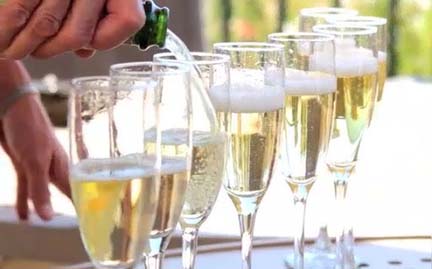
The holiday that must not be named is next week. You want to buy sparkling wine. But sparkling wine, being sparkling wine, is expensive and confusing.

Not to worry. The Wine Curmudgeon is on the job, as always, looking out for everyone caught between bubbly's rock and hard place. The Bertrand ($15, sample) is sparkling wine from France that isn't made in Champagne, which is why it's one-third the price of entry-level Champagnes. Better yet, it has much more than one-third of the quality, and is a tremendous value.

It's made using the same method as Champagne, and it uses more or less the same grapes (including pinot noir, which is not common in sparkling wine made in France outside of Champagne). That's one reason why it delivers so much value; its grapes are grown in the Limoux region in the Languedoc, where land is a fraction of the price of Champagne.

This is not as simple a wine as its price would indicate; the pinot noir gives it an edge that others don't have. Look for very crisp apple fruit and an impressively long finish (lemon zest, maybe?). And you can impress everyone with your bubbly knowledge: If the wine says Cremant on the label, as this does, that means it's sparkling wine made in the traditional method but not in Champagne. Highly recommended, and sure to impress whoever needs impressing next week.

Wine of the week: Chapoutier C tes du Rh ne Belleruche 2009

Chap

White wines from France's Rhone region aren't particularly well known and, at least in this country, don't get all that much respect. You don't see many of them on store shelves or restaurant wine lists, and you don't see many of them reviewed, for that matter.

Which is a shame, given that white Rhones are usually different and interesting, and that's something the Wine Curmudgeon is always looking for. The Belleruche ($12, purchased), from one of the Rhone's largest producers, has always been one of my favorite wines for just that reason (when I can find it, of course).

This is a previous vintage, and the extra year of bottle age has given the wine, a blend of grenache blanc, clairette and bourboulenc, a little more character. There is lots of white pepper, some oiliness and just a hint of a green fruit, like lime or apple. This is a not a white wine for people who need something fruit forward, like sauvignon blanc or chardonnay, but it's not supposed to be.

And don't worry that you haven't heard of the grapes used to make it — almost no one who isn't in the wine business has heard of them, either. Which is another reason why the wine is so interesting, and that's three more grapes for your Wine Century Club effort. Chill this and drink it on its own or with something like goat cheese; roast pork with apples would be terrific, too.

Wine of the week: Ch teau Font-Mars Picpoul 2010

The Wine Curmudgeon has always enjoyed picpoul, a white wine from southern France made with the picpoul grape that is grown, believe it or not, in the Picpoul region. Which is a weird naming convention even for the French. Picpoul is cheap and food friendly, one of those wines that you can keep around the house in case you want a glass of wine and don’t want to have to worry about what you’re drinking.

The catch, of course, is that it’s difficult to find quality picpoul in Dallas. Those that I’ve had have mostly disappointed — either sweet or too citrusy or overpriced. Hence my delight in finding the Font-Mars ($10, purchased), which is everything picpoul is supposed to be. And I did I mention that it’s only $10?

It’s a simple wine, but not in the way that too many cheap wines are simple, with one flavor or characteristic dominating all. Look for apricot and stone fruit in the front and a very nice stony finish with acid to balance all. I drank it over the New Year’s holidays when I wanted something for dinner that wasn’t overwhelming, and I was truly surprised at how well made it was. It’s one of the early contenders for the 2013 $10 Hall of Fame, and highly recommended.

A personal note: The Wine Curmudugeon does not write about politics here; that’s what political sites are for. But I do want to mention the controversy surrounding two proposals in Congress that would limit Internet speech, the SOPA and PIPA legislation. Copyright is one thing, and as a writer I certainly understand that. But free speech is even more important than copyright, especially as the Internet changes the way the world communicates. The New York Times explains what’s going on today here. If you’d like to support those of us who believe that SOPA and PIPA are wrong-headed, you can sign this on-line petition.

Wine of the week: Chateau Bonnet Blanc 2010

chateau bonnet blancThis white blend from Bordeaux has been in and out of the $10 Hall since I started it for a Dallas magazine 10 years ago — but not because of quality. Rather, what once was a $10 wine has been as expensive as $15 in Dallas, and though I like it a lot, it’s not a $15 wine.

The good news is that Spec’s, the largest retailer in Texas, has opened in Dallas, and they carry the Bonnet (purchased) for $10. So it’s back at a good price and eligible again for the $10 Hall of Fame — the newest version of which will be announced in two days. Have a suggestion for the Hall? Leave it in the comments or send me an ">" target="_self">email.

But I’m not sure this vintage of the Bonnet is a Hall of Fame wine. This is not to say that it’s not well made, because it is, crisp and fresh with lots of citrus fruit like lemon and grapefruit, and there is nothing off about it. It just doesn’t taste very Bordeaux-like. Call me picky (that’s a harsh charge for the Wine Curmudgeon, no?), but when wine is from Bordeaux I want a little minerality and not quite so much fruit. If I want this style of wine, I’ll buy any of the equally fine $10 sauvignon blancs from New Zealand.

This doesn’t mean the Bonnet isn’t a fine $10 wine, and it doesn’t mean that I won’t buy it again. I will, and drink it chilled on its own or with almost any white wine dish that doesn’t have a big sauce. What it does mean is that wines that make the Hall have to better than this; it is the Hall of Fame, after all.

Expensive wine 34: J.M. Boillot Puligny-Montrachet Premier Cru Les Referts 2003

10190135One of the myths about the wine business is that wine needs to age. Most wine doesn't, of course. Buy it and drink it and neither the drinker nor the wine will be worse off. That's something that most people, and even those who drink a lot of wine, are often confused about.

Hence it's always a treat to taste wine where aging is part of the wine's makeup. Generally, these are expensive, Old World wines; California high-end producers have a love-hate relationship with aging wine, though there are certainly some California wines that age well and producers who care about it.

The Boillot ($30, purchased) is a good example of how aging works (and comes from a solid, if lesser known, producer in Burgundy). It's chardonnay that is ready to drink now, and doesn't seem tight or jumbled the way younger wines that are made to age sometimes do. In other words, you can taste all the flavors — they're distinct and one doesn't dominate the mix. In this case, that means pears and some apples, even a little honey, and the minerality that is so crucial to these wines. There was a little more oak than I expected, but it still had all of Puligny's rich and lush fruit and character.

The other thing about aging? Wines can fade, and get worse, not better. The Boillot is ready to drink now. Hold it for much longer, and the fruit will go away and the wine will, literally, lose flavor. Now, though? A great gift or something to serve for a fancy holiday dinner where you pull out all of the stops. Cream sauce, even.