Tag Archives: expensive wine

Expensive wine 168: Ceretto Blange 2021

Ceretto Blangé 2021
Ceretto Blange 2021/$19-$22

Italian white wine shows off the arneis grape

Italian wine, which is full of ironies to begin with, gets especially ironic when it comes to white wine. Most of us don’t think of Italian whites as the equal of the reds, and the most popular varietal is pinot grigio, which is usually used to make vast amounts of indifferent supermarket wine.

But that doesn’t mean there aren’t Italian whites that deserve our respect, whether it’s the less expensive grillo from Sicily or arneis from the Piedmont.

Case in point is the Ceretto Blange 2021 ($22, purchased, 13.5%), which I bought as part of the recent expensive wine week experiment. I’ve long enjoyed arneis, and look for it when I want to spend a little more money. It’s both food friendly and a welcome change from the citrus fruit driven white wines that I usually drink.

Hence, the Ceretto, made by a producer best known for making $100 and $200 Piedmontese reds. Which, in this case, means we’re getting a top-notch winery for our $22.

Most arneis is floral and almost nutty – the tasting notes say hazel nuts, but it always seems more almond-like to me. The wine is not quite as rich as a California chardonnay, but always round, with stone fruit flavors.

The Ceretto is a little fresher with less almond and more citrus and apricot than others I’ve tasted. This doesn’t mean that it’s not worth drinking, but just that it’s different. And, frankly, it was head and shoulders above the quality of the other pricey wines I tasted during the expensive wine week effort.

Highly recommended, and just the thing for Mother’s Day – as a gift or for a leisurely Sunday dinner.

Imported by Heritage Collection
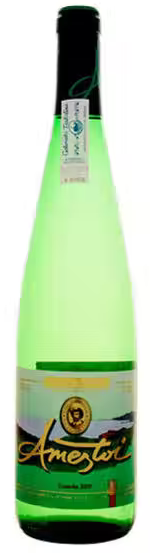
 

Expensive wine 167: Ameztoi Hondarrabi Zuri 2021

Ameztoi Hondarrabi Zuri bottle
Ameztoi Hondarrabi Zuri 2021/$18-$32

Calling all wine geeks – a sweetish, fizzy Basque white

Regular readers know – for all of my wine practicality – that there are a couple of grapes and regions that make the Wine Curmudgeon geek out.

One of which is Basque wine from northern Spain and a region called Getariako Txakolina, featuring the hondarrabi zuri grape. It’s used to make whites and roses, but it’s not for all tastes. Anyone who likes lots of oak or lots of too ripe fruit or lots of smoooth will probably find these wines lacking. But that’s OK; that’s the way wine works.

The Ameztoi Hondarrabi Zuri 2021 ($22, purchased, 11%) is from one of what seems to be a number of smallish producers, in this case Ameztoi (which I’ve not seen before). Having said that, the wine does everything it’s supposed to do – a bit of spritz, a bit of citrus, a bit of sweetness, and maybe even a bit of savory. Because that’s how these geeky wines work – a bottle of contradictions. My only complaint is the price; if you pay much more than $20, you may be disappointed.

I suppose, if one is looking for a comparison, it would be the Portuguese vinho verde. But wines from Getariako Txakolina are more complex and more interesting, in the way cru Beaujolais is more interesting than the supermarket versions.

This is warm weather wine, perfect as spring starts to unfold. Highly recommended, and especially for anyone who aspires to wine geek-dom.

Imported by De Maison Selections


Expensive wine 166: Drouhin-Vaudon Chablis 2020

Drouhin-Vaudon Chablis bottle
Drouhin-Vaudon Chablis 2020/$21-$30

Once more with feeling – white Burgundy for the Big Guy

The weather in Dallas was porch-like for a couple of days last week, and of course I thought about Mack Turner. It was just the kind of Sunday afternoon that he would have brought a bottle to the house and we would have sat on the deck, sipping and enjoying.

So, though we can’t do that any more, I can still write about the kinds of wines he loved to share with me – like the Drouhin-Vaudon Chablis 2020 ($26, purchased, 12.5%).

Chablis is part of Burgundy; though the wines are made with chardonnay, the style is much different – crisper, leaner, less oak. The Drouhin-Vaudon fits firmly in that style, though it does lean toward a rounder, fuller approach. That means it’s less austere Chablis, so softer (almost stone fruit instead of green apple) and a little less minerally. It’s still well made, of course – just an interestingly different take on the subject.

It’s Saturday night dinner wine, the kind to serve when you want to drink a better quality bottle but don’t want to spend $50.

Mack would have liked this, too. Our only disagreement would have been over price. I would have said it was a better value closer to $20 – since it Chablis, after all – and he would have given me one of his looks and said he enjoyed it a lot and why were we quibbling over a couple of dollars.

Imported by Dreyfus Ashby


Expensive wine 165: Roederer Estate Brut NV

 Roederer Estate Brut bottle
Roederer Estate Brut NV/$25-$35

Can a $27 wine deliver value? Yes, if it’s this Roederer bubbly

Buy this wine for $27, as I did, and you’ve found one of the world’s great values in sparkling wine.

How can this be, WC, some of you are asking – a $27 wine? Trust me. When I wax poetic about a $27 wine, it’s a value.

Now, some of the reason for this is that sparkling wine prices, including many previously affordable cavas and Proseccos, have gone wacko for reasons I won’t whine about now. Just know that it’s difficult to find a quality bubbly for less than $20 any more. Hence, $27 isn’t as ridiculous as it used to be.

The other thing to know? Roederer makes terrific sparkling wine, and California’s Anderson Valley is a terrific place to make sparkling wine. And it doesn’t hurt that a major Champagne house owns Roederer, so there isn’t much of a learning curve.

This bottle ($27, purchased, 12.5%) is an example of all of that, a blend of more chardonnay than pinot noir. So look for firm, tight bubbles (and lots of them), as well as lots of fruit (lemon, green apple). It’s also very fresh – much fresher than I expected – with a hint of yeast in the back.

Highly recommended, and especially if you can find it for around $25. And yes, this is the perfect wine for The Holiday that Must Not be Named next week.


Expensive wine 164: Albert Bichot Fleurie La Madone 2019

Abert Bichot Fleurie La Madone 2019 bottle
Abert Bichot Fleurie La Madone 2019/$25-$40

Beaujolais offers nuance and subtlety in an age of fruity and alcohol-ixh red wines

There has been a lot of Beaujolais on the blog in the past couple of years, but not just those costing $15 and less. They have been cheap wine staples since the WC’s on-line adventure started.

Rather, there has been more high-end Beaujolais – what the wine geeks call cru Beaujolais. So what’s with their more or less sudden appearance? Because these are among the last French red wines that can still offer value at $25 and more.

Like the Bichot Fleurie La Madone 2019 ($26. purchased, 13.5%). Bichot is a quality Burgundy house, so when I saw this on a store shelf before the holidays, I snapped it up. (And yes, Beaujolais is kind of, sort of, a part of Burgundy). The wine did not disappoint.

This is a delightful, layered, and top-notch red made with gamay from Fleurie in Beaujolais. Fleurie wines tend to be lighter and more delicate, and the La Madone is exactly that. I was even a little surprised at how well made it was; not so much because it didn’t taste like ripe banana $10 Beaujolais, but because it wasn’t simple. Dare I use the descriptor “perfumed,” which typically ends up in snotty-sounding tasting notes?

There is balance, certainly (amazing tannins) and structure to go with the perfectly nuanced red berry fruit. Highly recommended. Pair this with almost any red wine dish that doesn’t seem to lend itself to a pairing. I drank it with roasted pork shoulder, and it was spot on.

Imported by Albert Bichot USA

Expensive wine 163: Domus Aurea Cabernet Sauvignon 2019

Domus Aurea Cabernet Sauvignon label
Domus Aurea Cabernet Sauvignon 2019/$65-$90

This Chilean red speaks to tradition and Chile’s history of top-notch wine

Twice in my career, wine experts have told me that Chilean cabernet sauvignon could be the best in the world. It would combine the traditions of France with the technology of California to produce wine that outdid both.

This never really happened. Chalk it up to market trends, consolidation in Chile, or just the fickleness of the wine business. But the Peña family’s Domus Aurea Cabernet Sauvignon 2019 ($80, sample, 14.9%) shows what might have been possible.

This is a top-notch red wine, layered and subtle and complex. And though it’s certainly drinkable now, it’s nowhere near close to its potential; maybe a decade left of aging?

Since it’s more traditional in style, it leans more toward red Bordeaux than Napa cabernet. That means lots of green herbs, a bit of black pepper, and the tannins pushed back but still doing their job. Meanwhile, the acidity is in balance with the barely ripe black fruit, and the alcohol doesn’t get in the way. It’s a surprisingly nuanced wine given that the alcohol is almost 15 percent.

This is holiday prime rib wine, as well as a gift for someone who likes cabernet but understands that it doesn’t always have to rich and fruity. And though I’m not sure an $80 wine can be a value, its price compares favorably to similar labels from France and California.

Imported by Global Vineyard Importers

Expensive wine 161: Garnier et Fils Petit Chablis 2020

Garnier et Fils Petit Chablis label
Garnier et Fils Petit Chablis 2020/$23-30

Believe it or not, less than $30 buys top-notch white Burgundy

One of the biggest ironies in the almost 15 years that I’ve written the blog is that it has almost become more difficult to find expensive wine to review than cheap wine. One would think the problem should be just the opposite.

But this is the wine business, so common sense doesn’t often apply.

Why the contradiction? Shouldn’t it be easier to find a quality $40 wine than a quality $10 wine? Not these days, when $40 doesn’t buy the quality it used to (thanks, premiumization). In addition, since I buy most of the wine I review – and I’m not part of the 1 percent – quality expensive wine is increasingly out of my reach. One Dallas wine shop advertised value red Bordeaux the other day – for $45. Gulp.

Which is a roundabout way of introducing the Garnier et Fils Petit Chablis 2020 ($28, sample, 12%), chardonnay from Chablis in the Burgundy region of France. It’s everything a wine at this price should be, and then some — one of those wines that reminds me why I started doing this and why it can still be enjoyable.

The Garnier is a delightful, thoughtfully crafted and fairly priced white Burgundy in an age where there don’t seem to be any. Look for almost tart lemon fruit, as well as some apple and pear, and that wonderfully almost flinty finish that marks a Chablis.

Highly recommended — chardonnay for those of us who want to taste the wine and not the oak, and to appreciate paying more for a wine that is worth paying more for.

Imported by Martine’s Wines