Category:Wine trends

ChatGPT probably won’t save wine from itself

bavarder linux app
You, too, can solve wine’s problems with a desktop AI.

The WC spent some time with a chat AI, and it didn’t quite understand what was going on

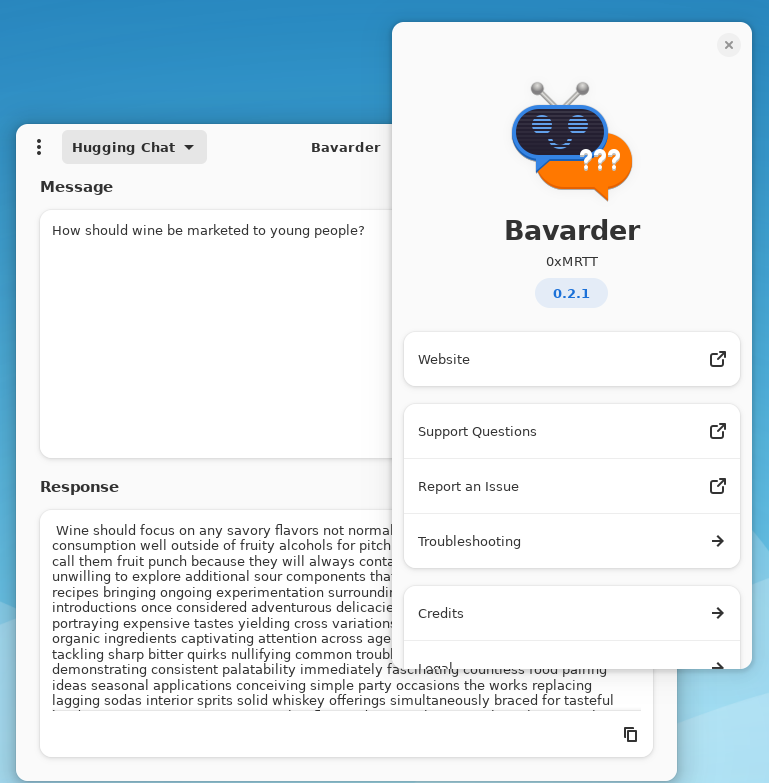
Never let it be said that the Wine Curmudgeon won’t do whatever it takes to rescue the wine business. In this case, it was a conversation with an AI via a Linux app called Bavarder, that offers access to a variety of ChatGPT machines.

Because, of course, ChatGPT is going to change the world.

My goal? To use artificial intelligence to address some of the biggest questions facing wine – the decline in consumption, the lack of young people, and all the rest.

The results? Well, the name of the app is French for Parler abondamment de choses sans grande portée, or “talking a lot about things that don’t matter.” Which should give you an idea of the results.

I used the HuggingChat AI from Hugging Face. Granted, this was a free version and not the ultra-sophisticated models that have scared the hell out of so many. But I did expect more.

Its answers were Wikipedia-style cut and pastes, about on a par with my students at El Centro and Cordon Bleu who didn’t pay enough attention in class (and the grammar was much worse). It also rambled, often talking about things that had nothing to do with the topic. It tied wine’s popularity with “typical millennial DIY generation creating fun experiences based on stuff lik macaroni boxes.”

To its credit, HuggingChat sometimes knew when it was lost: “err my comment became extremely long didn’t mean to ramble. … Oh boy I should start sending shorter text messages.”

Indeed.

Here’s an edited version of our Q and A:

Q: Is wine popular?
A: Yes, quite so! Many from all cultures and classes enjoy consuming wine at parties, outings, social gatherings or simply alone by themselves whichever floats their boat 🙂 … Ever more so nowadays with wine online subscriptions & wine purchases over internet there has become an explosion of local commercial and amateur winemaking and home winemaking activities which is pretty cool trend that covers vast age and demographic scale.

Q: How old is the typical wine drinker?
A: The average wine drinker skews older. In North America, the United States is the second largest consumer of wine globally behind top dog Italy followed by Germany that replaced France in third spot in early 2019; incidentally in overall spend per person. … On average wine consumption happens during weekends especially in wealthier circles compared to other times throughout workweek with exceptions when income isn’t enough depending circumstances often leading to earlier cheap high strength alcohols instead of latter lower percentage variety lifting momentarily although danger lurking.”

Q: Do young people like wine?
A: As a language model I do not have access to current statistics of any kind related to human populations likelihood to consume these drugs. However I assume many in developed countries might indulge with food, gathering events on specifically designated days.

Q: How should wine be marketed to young people?
A: Wine should focus on any savory flavors not normally associated with daily life consumption well outside of fruity alcohols for pitch similar ages. Temporarily you could call them fruit punch because they will always contain some slight sweetness but were unwilling to explore additional sour components that vastly improve variety among recipes.


Has the WC’s neighborhood become too trendy for the WC?

map of northeast Dallas
That’s the WC’s house, mid-century plumbing and all, about where the d is in “and.”

Can someone who appreciates quality $10 wine live in “America’s most-sought neighborhood”?

A new study says the Wine Curmudgeon lives in perhaps the hottest real estate market in the United States, which raises serious questions about my lifestyle – wine included.

Here’s the thing: I don’t have granite counter tops. I don’t have a Wolf range or Bosch refrigerator. I don’t have a sauna or swimming pool. I do have mid-century plumbing and a paid-for, stick-shift Honda Fit.

And, of course, a passion for quality $10 wine.

So when the study said my part of Dallas was “America’s most-sought neighborhood,” I was at a loss for words (which, as regular visitors know, is almost impossible). How can this be? I live there. Doesn’t that automatically disqualify my neighborhood?

Most importantly, does it mean I can no longer drink the wine I love?

Because, as the study notes, real estate seems to be the culmination of 21st century American culture – that we’re a “a nation of virtual carpet treaders” who love “Zillow porn.” Which I can vouch for: I have a neighbor who probably spends as much time on Zillow as I do looking at wine store inventories. Plus, just now, I got yet another text asking to buy my house, which happens with astonishing regularity.

Hence my conundrum. If my neighborhood is really this trendy, what will the hipsters say when I buy this instead of this? And what will they do when they find out that I write – and most convincingly, if I may say so – that expensive wines are not necessarily better just because they’re expensive? Don’t both of those actions defeat the entire purpose of trendy?

Will they snub me when I walk Churro, the blog’s associate editor? Will they point me out to their visitors, shaking their heads and sighing, as the neighbor who is just a little “off?”

Fortunately, the study has its flaws, as the authors acknowledge. If nothing else, it’s based on Zillow data, which may be even less accurate than many of the wine and health studies that claim we’re drunk every night – even though fewer of us drink and most of us are drinking less.

And, as my mother is probably thinking as she reads this, the last thing I care about is fitting in, and especially fitting in with people who don’t understand the value of a paid-for, stick-shift Honda Fit – or a fine bottle of $10 Gascon white wine.

Map: Courtesy of Zillow


Follow-up: Finally, some perspective about wine and health

Can we finally agree that wine with dinner won’t kill us?

Two women drinking red wine
“A toast to moderation! And please pass the couscous and parsley salad.”

Yesterday’s post, detailing the 50-some year history of wine and health, offers the wine business a chance to take the high ground about drinking in moderation.

It’s OK, and it probably won’t kill you.

As Tim Requarth wrote in Slate: “A middle-aged man’s baseline risk of dying of any cause in the next five years of his life is 2.9 percent. If he upped his drinking from a few drinks a week to a few drinks a day, this risk would rise to 3.6 percent, or an absolute risk increase of 0.7 percentage points. What this means is that if 143 middle-aged men drink once a day, there might be, in the near-term, one additional death, while the remaining 142 men would be unaffected.”

Now, whether the wine business will do this is doubtful; it has shown absolutely no interest in defending itself from the neo-Prohibitionists.

But that quote, along with this one — “An older man with a history of heart problems conceivably could benefit from very light drinking, whereas a woman at high risk of breast cancer might not” – should give it all the evidence it needs to demonstrate that a couple of glasses of wine with dinner almost certainly won’t kill anyone.

In other words, don’t drink to excess. Don’t smoke. Eat sensibly. Exercise.

In fact, that may make wine part of a healthy lifestyle. Requarth wrote a little about this when he mentioned the Mediterranean Diet, which most experts still cite as the key to a long, healthy life: Avoid animal fat. Also avoid processed foods, since they include too much sodium and sugar. Use olive oil. Focus on grains, fruits, and vegetables. Even the august Cleveland Clinic includes wine in the Mediterranean Diet.

Which brings up something that I’ve always found ironic: We spend so much time castigating wine in moderation but ignoring other, even more dangerous, food choices. I saw lard – yes, lard – defended on an episode of “America’s Test Kitchen,” even though I can still hear the hospital nutritionist when I was a young reporter: “I can’t believe people still cook with lard.” And “plant-based food,” while perhaps a noble calling, still isn’t as healthy as eating your greens. One piece of that kind of sausage has 25 percent of the recommended saturated fat and 22 percent of the sodium, plus 190 calories.

So yes, wine – no sodium, no fat, 125 calories — with dinner. Would that the wine business figures this out.

Photo: Andrea Piacquadio via Pexels

Finally, some perspective about wine and health

woman drinking wine
“Of course wine in moderation, and as part of a healthy diet. What are those researchers thinking?”

Drinking wine in moderation probably won’t kill you

Finally, a mainstream media story that tries – and mostly succeeds – in putting the long-running debate about wine and health into perspective.

Writes Tim Requarth in Slate: Drinking wine looks less and less like it’s good for you. But drinking wine in moderation probably won’t kill you, either.

The story neatly encapsulates the five decades of research and controversy since the first study that seemed to identify a relationship between heart health and drinking red wine. Yes, the story is bit too long, and yes, Requarth could have left the puns out, but he does something that hardly anyone else has managed to do – make sense of what’s going on today, as “mainstream scientific opinion has flipped” about wine and health.

The highlights:

• The idea that red wine in moderation, by itself, improves heart health probably isn’t true. It likely has more to do with red wine as part of the Mediterranean Diet, which almost every expert agrees is among the best in the world for living longer and healthier. Which, if anyone has been paying attention, always seemed liked the correct approach.

• This is the best discussion about how the academic world works – the politics, the jealousy, how research is done – that I have probably ever read. It’s crucial to know this to understand how the controversy unfolded, given the backbiting and sniping that took place.

• It’s also the best explanation I’ve seen in the difficulty of doing the kind of research necessary to get an accurate result in a subject this complicated. For example, smoking and drinking are closely related; that is, people who smoke and drink are much more likely to die than someone who just drinks. So researchers must control for the former; otherwise, they would skew theresults toward the conclusion that any drinking is deadly.

• It quotes the great Marion Nestle, who knows more about this stuff than almost anyone.

There are a couple of annoyances: Requarth didn’t need to spend so much time trying to tie the alcohol business to some vast conspiracy to cover up the dangers of drinking. Big Booze has many faults, but I don’t think that’s one of them, and certainly not the way Big Tobacco lied about smoking and some some pharmaceutical companies lied about oxycontin.

I also wish he had discussed the moral fervor the anti-drinking researchers bring to their work; that’s how we ended up with Prohibition.

Still, you can’t argue with a story that ends like this:

“A middle-aged man’s baseline risk of dying of any cause in the next five years of his life is 2.9 percent. If he upped his drinking from a few drinks a week to a few drinks a day, this risk would rise to 3.6 percent, or an absolute risk increase of 0.7 percentage points. What this means is that if 143 middle-aged men drink once a day, there might be, in the near-term, one additional death, while the remaining 142 men would be unaffected.”

In other words, “they aren’t reason for any individual person to panic.”

TV wine ads: Crown Royal understands its audience

If a pricey blended whiskey can make a terrific ad, why can’t wine?

Crown Royal – once a whiskey for the aging wine demographic – has made surprising inroads with younger consumers. Why surprising? The basic, 750-ml bottle costs $25, which we’re told is more than they want to spend on wine.

So how has Crown Royal done this? With ads like this 2018 effort, which strikes me as funny and unpretentious in a way that almost no wine advertising has managed. Plus, it shows young people having fun without an adult looking on to grant permission. (Since the ad is about alcohol, you’ll need to sign in to YouTube to see it.)

Compare it to this Bread & Butter Wines ad, which tries desperately hard for the same vibe, but can’t help itself and includes an adult lecturing about wine. Because, of course, with wine, we have to tell young people what to do.

Trust me, wine business. Young people know how to drink; the last thing they need is an adult explaining how to do it. Would that wine figures that out before it’s too late.

Video courtesy of  Ben Vereen via YouTube

More about TV wine ads:
• TV wine ads: When in doubt, use sex
• The history of wine advertising and reaching younger consumers
• TV wine ad update: Does Stella Rosa’s sweet fizzy red commercial do what Big Wine can’t?

Five days drinking $20 wine

woman holding wine glass
“Boy, the WC got this one right. I’m never buying a $35 rose again.”

Yes, the wine was better – but twice as better? Hardly — and I was surprised

The Wine Curmudgeon, who always tries to keep an open mind, spent one working week last month drinking only wine with dinner that cost $18 or $20 (or more). The goal? To see if the wines were truly twice as good as the $10 and $12 wines I usually drink.

And you know what? They weren’t. Which actually kind of surprised me.

This is not to say that most of the wines weren’t well made and interesting. They were. But compared to the quality $10 wines I usually drink, they didn’t especially stand out. For example, I spent $18 for a Spanish rose and $30 for a white Bordeaux, and both were enjoyable wines. But the rose was not $18 worth of nice, and as was terrific as the white Bordeaux was, it wasn’t $30 worth of terrific.

How is this possible, given the regular drumbeat from producers and the Winestream Media that we’re spending more money and drinking better?

A variety of reasons:

• Higher prices for the more expensive wines, thanks to the Trump tariff, pandemic supply chain woes, the war in Europe, and inflation. That means a wine that might have been a value at $18 but now costs $23 isn’t a value any more. This hasn’t necessarily been the case with my cheap wines, where producers have been more reluctant to hike prices.

• Marketing, marketing, and more marketing. It’s just not about the wines I noted last week; rather, it’s about shelves of wines that have been created to cost $20 or more because premiumization. When’s the last time anyone spent $I8 on a Chilean chardonnay or a $35 California rose? Yet that’s what I got as samples recently.

• Most importantly, the $10 and $12 wines that I drink – and recommend on the blog (subscribe now!) – are not supermarket plonk. It’s easy to “drink better” by spending more money if the cheap wine you’re drinking tastes cheap. But what if you’re drinking this? Or this? Or this? It’s much more difficult.

Photo: “drink more wine” by wrapped4good is marked with Public Domain Mark 1.0.

The $15 red wine dilemma

Woman shopping for wine
“Oh boy! Smoooth!”

Are red wines at premiumization’s key price starting to taste the same?

Consider two red wines, recently received as samples: A California pinot noir and a red blend from southern France. Both cost about $15, had the same alcohol, 14.5%, and had the same gibberish on the back label, “elegant” and “structured.”

The other thing they had in common? They tasted almost exactly the same, even though they were made with different grapes and came from different parts of the world. How is that possible?

Welcome to the $15 red wine dilemma, in which an increasing number of producers – for whatever reason – make $15 red wine that tastes mostly the same.

Yes, two wines is not exactly a scientific sample size. But it seems to be part of a trend that started before the pandemic, and has evolved to the point where we are today: A conscious decision to make certain red wines, usually blends and pinot noir, to fit a specific. pre-determined taste profile based on other, best-selling blends and pinot noirs. My guess? They’re targeting older Gen X and Baby Boomer consumers, who have the money to pay $15 for a bottle and have been taught that smoooth is a desirable quality in red wine.

In this, it’s about as cynical as winemaking gets – turning your product into breakfast cereal to appeal to the biggest audience possible. And I’ve seen it with producers who make supermarket plonk as well as those who usually make wine that tastes like wine.

Frankly, this trend scares the hell out of me. Making wine that doesn’t taste like wine isn’t going to save the wine business from itself – and especially when the target audience is already drinking wine. In that case, all it’s going to do is move market share around, and the size of the market isn’t going to get any bigger.

Wine needs to taste like wine – with all the joy and adventure that means – to bring new people to wine. Otherwise, what’s the point?

Photo: Unsplash