

Tag Archives: artificial intelligence

ChatGPT probably won’t save wine from itself

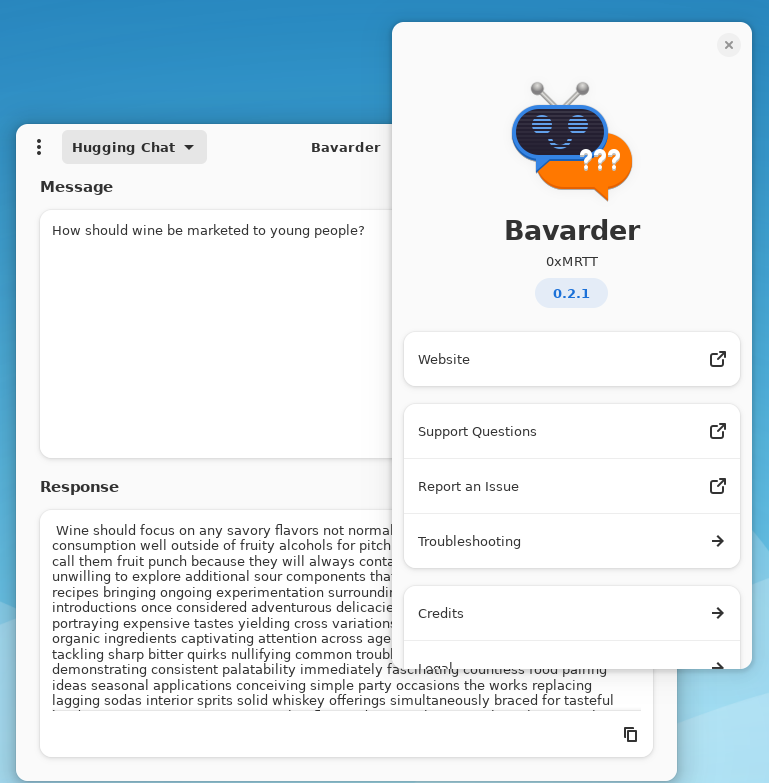
bavarder linux app
You, too, can solve wine’s problems with a desktop AI.

The WC spent some time with a chat AI, and it didn’t quite understand what was going on

Never let it be said that the Wine Curmudgeon won’t do whatever it takes to rescue the wine business. In this case, it was a conversation with an AI via a Linux app called Bavarder, that offers access to a variety of ChatGPT machines.

Because, of course, ChatGPT is going to change the world.

My goal? To use artificial intelligence to address some of the biggest questions facing wine – the decline in consumption, the lack of young people, and all the rest.

The results? Well, the name of the app is French for Parler abondamment de choses sans grande portée, or “talking a lot about things that don’t matter.” Which should give you an idea of the results.

I used the HuggingChat AI from Hugging Face. Granted, this was a free version and not the ultra-sophisticated models that have scared the hell out of so many. But I did expect more.

Its answers were Wikipedia-style cut and pastes, about on a par with my students at El Centro and Cordon Bleu who didn’t pay enough attention in class (and the grammar was much worse). It also rambled, often talking about things that had nothing to do with the topic. It tied wine’s popularity with “typical millennial DIY generation creating fun experiences based on stuff lik macaroni boxes.”

To its credit, HuggingChat sometimes knew when it was lost: “err my comment became extremely long didn’t mean to ramble. … Oh boy I should start sending shorter text messages.”

Indeed.

Here’s an edited version of our Q and A:

Q: Is wine popular?
A: Yes, quite so! Many from all cultures and classes enjoy consuming wine at parties, outings, social gatherings or simply alone by themselves whichever floats their boat 🙂 … Ever more so nowadays with wine online subscriptions & wine purchases over internet there has become an explosion of local commercial and amateur winemaking and home winemaking activities which is pretty cool trend that covers vast age and demographic scale.

Q: How old is the typical wine drinker?
A: The average wine drinker skews older. In North America, the United States is the second largest consumer of wine globally behind top dog Italy followed by Germany that replaced France in third spot in early 2019; incidentally in overall spend per person. … On average wine consumption happens during weekends especially in wealthier circles compared to other times throughout workweek with exceptions when income isn’t enough depending circumstances often leading to earlier cheap high strength alcohols instead of latter lower percentage variety lifting momentarily although danger lurking.”

Q: Do young people like wine?
A: As a language model I do not have access to current statistics of any kind related to human populations likelihood to consume these drugs. However I assume many in developed countries might indulge with food, gathering events on specifically designated days.

Q: How should wine be marketed to young people?
A: Wine should focus on any savory flavors not normally associated with daily life consumption well outside of fruity alcohols for pitch similar ages. Temporarily you could call them fruit punch because they will always contain some slight sweetness but were unwilling to explore additional sour components that vastly improve variety among recipes.

Robot typing at keyboard

Coming soon to the WC: Computer-generated wine reviews

computer-generated wine reviews
“Damn. … where is that neural network when I need it?”

A little Python, some neural network command line work, and the blog can start posting computer-generated wine reviews

Sooner rather than later, I’m going to post computer-generated wine reviews on the blog. Thanks to the Lifehacker website, all I need are some basic Python programing skills. Or, even better, find a Python-savvy volunteer from among the blog’s sophisticated and erudite audience who wants to help “write” them.

We’ve followed the advances in artificial intelligence that makes these reviews possible for several years. Barbara Ehrenreich, writing in the New York Times, said that “the business of book reviewing could itself be automated and possibly improved by computers.” And writing one kind of review isn’t all that different from writing another kind.

The point here? That wine has become so mechanized and so predictable that we can probably get acceptable Winestream Media-style reviews from an artificial intelligence. It’s probably even possible to teach the machine to give scores – a delicious irony that is reason enough to make this work.

Lifehacker’s Beth Skawrecki writes that machine-written reviews are more possible than ever thanks to advances in neural networks. A neural network is “a type of [artificial intelligence] modeled on the network-like nature of our own brains. You train a neural network by giving it input: recipes, for example. The network strengthens some of the connections between its neurons (imitation brain cells) more than others as it learns. The idea is that it’s figuring out the rules of how the input works: which letters tend to follow others, for example. Once the network is trained, you can ask it to generate its own output, or to give it a partial input and ask it to fill in the rest.”

For our purposes, we would tell the computer what chardonnay is supposed to taste like, where the grapes were grown, information about the vintage and the winemaker’s style, and the price. Then, we can “teach” it to interpret that information to write the review – that chardonnay from California is different in certain ways from chardonnay from France, for example.

Now, to brush up on my Python.

More about computer-generated wine reviews:
• Winecast 30: Arty, the first artificial intelligence wine writer
• Do we really need wine writers?

Winecast 30: Arty, the first artificial intelligence wine writer

artificial intelligence
Arty, the first artificial intelligence wine writer

“Wine drinkers want to be reassured that what they are drinking is worth what they paid for it. That’s the goal of the post-modern wine business and premiumization, and I was created to do that.”

Computer-generated wine writing has arrived, if this interview is any indication. I talked to Arty, the world’s first artificial intelligence wine writer, for this edition of the podcast.

Arty and I discussed why he was created, his goal as a critic — “We’ll always need quality wine writing, human or otherwise. But I think I can offer consumers wine criticism that they can’t get anywhere else” — and why his kind may be the future.

Click here to download or stream the podcast, which is about 3 minutes long and takes up 2 1/2 megabytes. The sound quality is almost excellent.

A tip of the Curmudgeon’s fedora to the Mary Text to Speech system, which made it possible to create this interview. Maybe what I’m joking about is more possible than we know.