



Category:Wine trends

Making more expensive wine doesn’t necessarily mean higher profits

expensive wine
Stefano Castriota: “The key is not whether higher quality implies higher prices, but rather whether it boosts profitability, and it does not.”

Italian study finds that cheap wine producers are more likely to do better than those investing in premiumization

No one was more surprised than the Wine Curmudgeon after my email chat with Stefano Castriota, whose working paper about price and quality (“Does Excellence Pay Off? Quality, Reputation and Vertical Integration in the Wine Market”) was recently published on the American Association of Wine Economists website.

“How can you say if price and quality match?” he wrote me. “You can only see whether they are correlated. And they are, in my research and in the previous literature. The key is not whether higher quality implies higher prices, but rather whether it boosts profitability, and it does not.”

In other words, premiumization – the biggest wine trend in the past decade – may be leading the U.S. wine business in the wrong direction. U.S.  producers have been spending hundreds and hundreds of millions of dollars to make more expensive wine in anticipation of higher profits, because U.S. wine drinkers are supposed to be abandoning cheap wine for something they perceive as better.

Castriota, who teaches at Italy’s University of Bolzana, did find that improved wine quality leads to higher prices. But he also discovered that higher quality is irrelevant when it comes to profitability.

“I was expecting these results,” Castriota wrote me. “The outcome of this research did not surprise me, but surprised many others. Most people – both in the academic and in the business sectors – look only at the advantages of excellence, but do not consider the costs/disadvantages. Many entrepreneurs end up over-investing in quality and reputation.”

Producers spend so much money to achieve higher quality – more expensive land, higher-priced grapes, better technology, increased marketing, top-notch winemakers – that they don’t necessarily make the same return on their investment as cheap wine producers, who don’t do any of those things.

The latter just sell more wine: “Being able to sell the wine is more important than producing good wine,” Castriota said in an email. “This is why in my analysis the firm size is the most important driver of profitability.”

The bigger, the better

That’s because the “issue is business scalability, the possibility to increase production once you achieve excellence,” Castriota wrote. “If you spend a lot of money and invest huge capitals to become famous, but cannot increase the supply, firm profitability can be low or even negative. In the restaurant sector is the same: hiring the most famous chef and interior designer and buying the best raw materials is expensive. You have surely higher revenues, but also higher costs and capital invested. In the end, with respect to the capital invested, are you more or less profitable than a whatever medium-level restaurant?”

The caveats now: First, the study measured wine quality using ratings from Italy’s Veronelli, a leading wine guide. We’ve noted here the tenuous link between critical ratings and wine quality. Second, the Italian wine industry is not exactly like ours, and U.S. and other New World producers may not be as constrained as those in Italy. Having said that, Castriota emailed that it would be reasonable to expect the same results “or something similar. We don’t know until we see some study with other data.”

Finally, the study doesn’t specifically address premiumization; that’s my interpretation. But that approach makes sense, given the rationale to premiumization – that producers will make more money selling more expensive wine. Which Castriota says isn’t necessarily true.

“If you succeed in selling bottles at $50 or $100, you make a lot of money, but for every very profitable firm there is another one which is losing money,” he emailed. “On average, looking at the data, I did not find any significant return of excellence, which is very expensive. [A]chieving quality and reputation is not a necessary condition to become profitable because the costs and the required capitals increase a lot.”

Is it any wonder I worry about the future of the wine business?

Someone likes one of those Yellow Tail TV ads — really

Is it possible that this Yellow Tail TV ad isn’t awful?

Yellow Tail, the Australian grocery store wine, has come in for a fair share of criticism on the blog for its TV commercials. Which, to put it nicely, are everything that has been wrong with TV wine commercials for 60 years – pretentious and snotty, as well as emphasizing that we need Yellow Tail to hook up with a hot chick.

Because, of course, that’s what we associate with $7 supermarket wine.

The intriguing thing about this Yellow Tail ad from 2012 is not that it is different. It isn’t. It’s more of the same, and told in the same annoying, “I drink Yellow Tail, so I’m cooler than you are” way. What’s intriguing is that someone likes it – several someones, if the comments on the ad’s You Tube page are to be believed.

“Very cool commercial nice use of motion graphics,” says one comment. “Great commercial….I always have to stop what I’m doing to watch……Great music too!” says another.

Far be it from me to suggest that all this praise isn’t legitimate, though it’s worth noting that all 10 comments are uniformly gushing (and that fake praise is currently bedeviling the Internet). Then again, maybe I’m missing something, and the ad is truly genius. If so, does that mean I have to like the infamous Yellow Tail “pet my roo” ad?

Rose trends 2018: Try as it might, the wine business won’t ruin pink wine

rose trends 2018Let’s celebrate the start of Rose Week — the blog’s 11th  annual celebration — with the rose trends and non-trends that are dominating pink wine
Tim McNally, the New Orleans wine writer, judge, critic, and radio host, talking about rose trends 2018: “Given the unfortunate development path of pinot noir in America, I guess we should have foreseen what they were going to try to do to rose.”

And that, as well as anything I can write, sums up rose trends 2018. Important parts of the wine business, both here and in France, have decided to change rose into something else, in the same way they changed pinot noir into a fruiter, darker, more cabernet sauvignon-like wine.

More than one-third of the 100 or so roses I’ve tasted this year were made to appeal to some sort of idealized red wine drinker – heavier and less fresh, more alcoholic, and tasting of the tannins and bitterness associated with red wine. That almost all of them cost more than $20 added insult to injury.

In other words, everything that rose isn’t. To which the Wine Curmudgeon says, “Nuts.”

Because, despite these most unwelcome developments, rose is healthier than ever. Yes, there are some truly aggravating pink wines out there, and yes, prices have soared in many cases. But there are still dozens and hundreds of roses that taste like rose and cost less than $12. We’ll feature those wines on Wednesday, Thursday, and Friday, along with a three-book giveaway on Thursday.

These changes have happened for four reasons:

• Higher prices, of course, are part of premiumization. In addition, more high-end wineries are making rose, so they’re not going to sell $10 wine for $10 (even if they could afford to, which most can’t).

• Many of these high-end producers, especially in California, are known for making red wine. They’re only making rose because it’s trendy (I actually got a news release that sort of said that). So they’re terrified that if they made a fresh and crisp pink wine, their loyal customers wouldn’t know what to do with it.

• Because $25 wine can’t be made the same way as $10 wine. Otherwise, it would be $10 wine. Hence the need to “improve” it – oaking it, for example, or making it riper and more alcoholic, even if that turns it into another kind of wine.

• More expensive packaging and marketing. One of the world’s leading rose makers told me that grape costs for his $10 French rose and for a world-famous celebrity rose were about the same. But, he said, the latter charges twice as much because it spends the difference for a “nicer” bottle and to market the product to the Winestream Media.

Yes, some roses are worth $25 or $30 or $40. But it’s almost impossible to buy a bad bottle of rose for $10. If you spend more than $15, expect it to be spectacular. First and foremost, ignore the hype and buy what you want. Because if we do that, no amount of $25 rose that tastes like cabernet will matter.

More about rose trends:
• Seven reasons why we love rose
• Pink wine is everywhere, and it’s only April
• Who cares who started the rose boom?

Rose celebration 2018 begins on Monday

rose celebration 2018
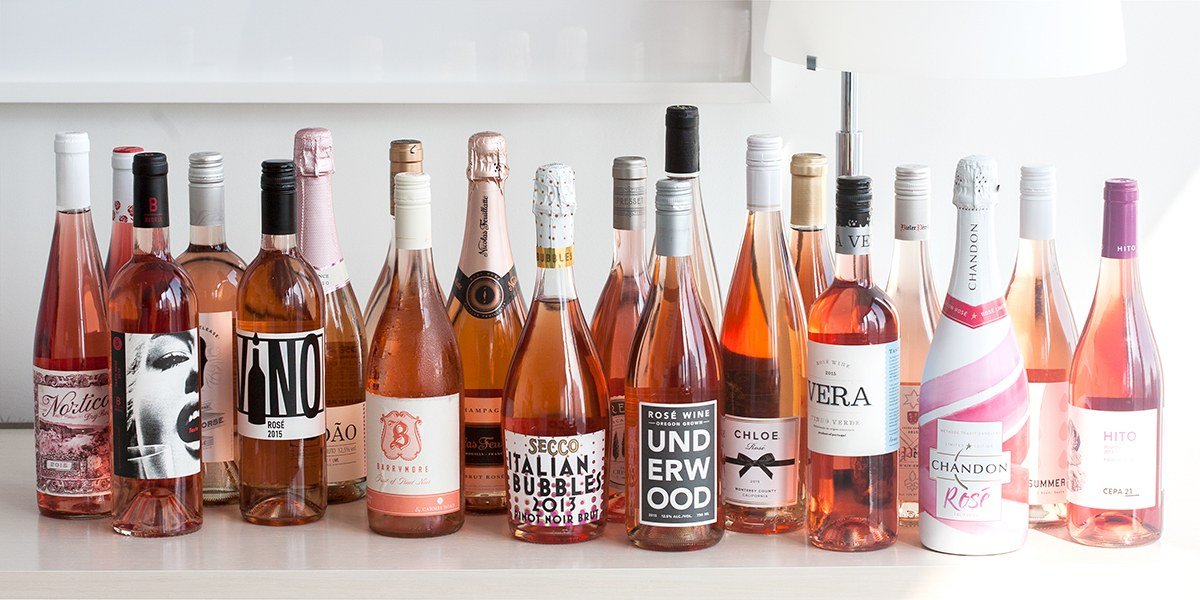
Yes, I’ve tasted almost all of these in my search for the greatest cheap roses.

Win three wine books during the blog’s rose celebration 2018

The blog’s 11th annual rose extravaganza begins on Monday — rose celebration 2018. This is the second consecutive year we will devote an entire week to celebrate all that is wonderful about rose. Because, despite all the foolishness that has taken place over the past couple of years, rose remains one of the world’s great cheap wines.

Plus, of course, giveaways — three wine books on Thursday when I list the the best roses available this season. There will be rose news and reviews all week as part of our rose-fest, as well as state of rose in 2018 on Monday.

Until then, enjoy this commercial from the mid-1970s for Carlo Rossi Vin Rose — long before there was a Winestream Media, when the wine snobs thought rose was a flower, and the hipsters’ parents were still in high school.

“Reasonably priced at $40:” Wine premiumization is out of control

wine premiumizationWine premiumization may be working for producers, but the loser remains the wine drinker

The following arrived in a news release the other day: These “wines are reasonably priced between $15-$40 — ensuring excellent price-quality ratio.”

Where do I begin to parse the failure of the post-modern wine business, as demonstrated in that sentence? Am I the only one who sees that most wine drinkers don’t consider wine costing more than $15 as either reasonably priced or having an excellent price-quality ratio?

The wine business has fallen all over itself in the past 18 months throwing as much crappy $20 wine on the market as possible, because one very smart man noticed some of us were willing to pay more for wine. He called the trend premiumization, and his point made sense: If you have more money, you’re willing to spend more money.

Which is what happened in the U.S. when the recession ended. Sales of higher priced wines increased significantly, and the average price of a bottle of wine in the U.S. rose to almost $10, the highest in history.

Welcome to the promised land

The wine business, particularly in California, saw premiumization as the promised land – a way to raise prices without necessarily increasing quality. Hence higher profits, which had been squeezed during the recession, as well as the need to sell less wine to make the same amount of money. If I make $10 wine, I need to sell 10 bottles to make $100; if I make $25 wine, I only need to sell four. And if I sell five, I’m better off than selling 10 bottles of $10 wine. Who wouldn’t want that?

The result, according to a study from Internet retailer Wine.com, has been flat U.S. wine consumption. “This means for every headline about a brand growing 10-20%, another one is shrinking by a similar amount,” says the report. “With little to no organic industry growth, it’s all about battling competitors for market share.”

In other words, the pie isn’t any bigger, but there are more producers charging more for us to eat it. So we’re the losers, as the quote at the beginning of the post shows.

Forgotten facts

Here’s what the wine business overlooked in its haste to embrace premiumization:

• 95 percent of the entire U.S. population – not just wine drinkers – will never buy a $20 bottle of wine. That’s from the Wine Market Council, which studies these things for the wine business. So premiumization excludes 9 ½ out of 10 U.S. adults – hardly a way to make wine more popular.

• Let’s say I buy two $40 bottles of wine a week, which the Wine Market Council says “a high frequency wine drinker” might do. That’s $320 a month – or about as much as it costs to lease an Audi A3 Cabriolet. I love wine, but I know what I would do with that money.

• The rise in sales of more expensive wine, given that overall wine sales are flat, means people are buying less cheap wine. The assumption has been that consumers are trading up from their $4 and $5 bottles to $20 bottles, which only a winery could believe. What’s more likely is that older wine drinkers, who bought much of the very cheap wine, aren’t drinking as much. They’re either dead or have cut back as they got older. The same thing has happened in beer and Big Beer is in a panic. This would raise the average price of wine without actually increasing the number of people who drink it.

So we’re stuck with reasonably priced $40 bottles of wine. Whatever that means. Hopefully, we won’t be stuck much longer — since I don’t need any more reasons to worry about the future of the wine business.

More on premiumization:
• The premiumization backlash
• Premiumization, crappy wine, and we drink
• Premiumization: Prices in the real world

So long, Kuvee wine gadget – we won’t miss you

kuvee wine gadgetThe Kuvee wine gadget failed, says its CEO, because we didn’t appreciate it
The post-modern wine world has surrounded us with foolishness, overpriced wine, and declining quality. That’s what makes the news that the Kuvee wine gadget has failed so refreshing.

The Wine Curmudgeon does not gloat in other people’s failure. Rather, the point here is to acknowledge the good sense of the U.S. wine drinker – that we recognized the Kuvee for what it was: A pricey gadget that didn’t do anything.

As I wrote about a year ago, when the cyber-ether was full of Kuvee hype: “It tells you what the wine is, offers tasting notes, and gives you a chance to order more wine. In other words, almost everything the back label does without spending $150 and being forced to buy wine from Kuvee.”

Of course, the people behind the gadget didn’t acknowledge this. It’s our fault it failed. The company’s CEO blamed “the difficulty of educating the public about the product” as one of the main reasons for its demise. No kidding – just like it’s difficult to educate me about the true value in those emails from African princes who want to give me $1 million.

One bit of silliness down, another gazillion to go. Now, if we can just find a way to get rid those $25 roses that taste like red wine and come in heavy bottles that cost more than the wine inside it does.

How much wine is sold in grocery stores?

grocery store wineGrocery store wine probably accounts for more than one-half of the U.S. total, but no one is quite sure – even though the number has long-term implications about how and where we buy wine

How much wine is sold in U.S. grocery stores? No one is quite sure.

Hard to believe, what with this being the 21st century and data science and the cloud and all of that. In fact, one analyst told me there is even disagreement about how much total wine is sold every year in the U.S., let alone what kind of store it’s sold in.

Yes, Kroger knows how much wine it sells, as does Walmart and Trader Joe’s and the rest of the biggest chains. But no one, for a variety of reasons, can put all those individual numbers together to come up with a total.

As another analyst put it: “There are data issues and confounding factors. While there is quality hard data on grocery, drug, and mass market wine sales, it is weaker for big box liquor, very weak for fine wine stores, and still evolving for restaurants. And no data for some major players like Trader Joe’s and Costco and Grocery Outlet.”

I stumbled across this amazing bit of news while doing interviews and reporting for a free-lance story about grocery store wine. It’s mind boggling, actually, to think that no one knows quite how to parse a $60 billion business – and one that is tightly regulated as well. But we are talking about wine, where transparency applies only to plastic wrap.

Why does it matter how much wine is sold in grocery stores? Because, as near as the people who follow this can tell, grocery store wine (which includes retailers like Costco) probably accounts for more than half of the wine sold in the U.S. today. This is a fundamental change; when I started doing this in the early 1990s, wine was still mostly sold by retailers in more or less local shops, and most of the local shops weren’t that big.

So that kind of change will eventually change the way wine is made, marketed, and sold in this country. Which it’s sort of doing already. Will grocery stores do for wine what Amazon did for book stores? Or will the local wine shop find a way to survive, as local pet stores have done despite competition from Amazon, big boxes, and the grocery stores?