Category:Wine trends

O, Canada: How did your Supreme Court screw up the Free the Beer case?

free the beer case
“Honest, officer. I’m not transporting beer from Alberta to British Columbia.”

Canadians get a taste of U.S. three-tier laws in the Free the Beer case decision

The Canadians have always seemed so much more sensible than those of us south of the border. In fact, many of my Canadian readers delight in pointing that out – our politics, our devotion to four-down football, and our liquor laws. So how to explain the decidedly U.S.-style legal decision last week in Canada’s infamous Free the Beer case, where the dominion’s top court said laws similar to the U.S. three-tier system are OK in their country?

Or, as the blog’s unofficial Canadian correspondent wrote: “And the court’s decision was unanimous, no less. It’s ridiculous. I have a cabin in British Columbia and I always bring my Alberta-bought beer and wine with me since prices in BC tend to be much higher. I guess I’m officially a bootlegger now.”

To which the Wine Curmudgeon can only smile and say, “Welcome to the club.”

The Free the Beer case revolved around a New Brunswick law that limits the amount of alcohol that can carried across its provincial borders. In 2012, Gerald Comeau was stopped and fined for bringing more than the 12-pint limit of beer from neighboring Quebec, where beer was less expensive.

In other words, just like a host of U.S. laws. It’s not unusual for state troopers at the Texas-Oklahoma line, for example, to stop cars for beer checks – to see if motorists are bringing beer from one state into the other in violation of the same sort of law in the Free the Beer case.

The same argument

Comeau’s argument will sound familiar to any U.S. wine drinker frustrated at the inability to buy wine in another state because of three-tier. His lawyers argued the New Brunswick law violated their client’s constitutional rights because it conflicted with a section of the constitution that says Canadian goods shall “be admitted free into each of the other provinces.”

In other words, the same argument used in the U.S. to challenge similarly restrictive laws, citing the commerce clause of our constitution. And which usually fail.

Which is the same thing that happened here. Canada’s Supreme Court ruled that the country’s provinces can regulate liquor any way they want, regardless of federal law, given the provinces’ autonomy under the Canadian constitution. I laughed when I read it: It’s practically a word for word reading of many U.S. three-tier decisions.

So listen up, Canada. Here’s what you have to look forward to: No Amazon wine. No Internet wine at all, in fact. Probably increased restrictions on direct shipping from Canadian wineries. Plus higher prices and less competition.

Wrote the blog’s unofficial correspondent: “For years, the Mounties would have a check stop on the May long weekend in BC and pull over any car or van full of young people from Alberta. They would take all their Alberta bought booze and pour it out on the side of the road. I can still remember the looks of dejection on their faces. I thought those days were over.”

Ain’t three-tier grand?
2018 rose season preview: Pink wine is everywhere, and it’s only April

2018 rose seasonThe 2018 rose season looks exceptional, but beware older vintages and skyrocketing prices

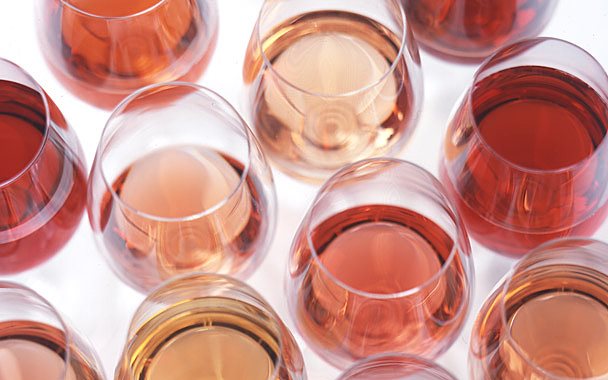
The 2018 rose season doesn’t start for another month or so, but I’ve already been inundated with pink wine. How does almost four cases of samples sound? Or the 25 percent off sale at a Dallas retailer earlier this month? Or more roses on store shelves than I have ever seen, including a number of southern hemisphere wines? I’ve tasted at least 60 roses since the beginning of the year, and it’s only the middle of April.

Best yet, the quality has been exceptional. I’ll have the details and lots of reviews at the end of May for the blog’s annual rose-fest. Until then, know that:

• I haven’t tasted a badly made wine yet. Some weren’t quite worth what they cost, but there is always wine like that. The Provencal Bieler Sabine ($10) and the Washington state Charles & Charles ($10) are up to their usual high standards, while the Angels & Cowboys ($15) is as good as the exceptional 2015 vintage. Even the oft-maligned La Vielle Ferme rose ($7), with the rooster on the label, was brighter and fresher, much more enjoyable than usual.

• The bad news: Prices are through the roof, as producers try to cash in on premiumization. Most of the usual $10 and $12 wines are still that price, but the market is being flooded with roses from $15 to as much as $30. Frankly, there’s just no need to pay $30 for quality rose. In addition, many of the $15 to $18 wines would be priced much lower if rose wasn’t so trendy.

• The other bad news: Distributors and producers are cleaning out their back rooms to take advantage of rose’s popularity, and I’ve seen lots and lots of old rose on store shelves – even a couple dating to 2013. Yes, five-year-old rose — a recipe for vinegar, not wine. Remember, unless you know the producer, don’t buy rose more than two years from the harvest – this season, that means nothing before 2015. Too old roses are almost always faded, funky, and a waste of money.

Back label wine descriptions: What the jumble and winespeak on the back label really means

Back label wine descriptionsBack label wine descriptions can be as confusing as anything written by wine critics

The recent post about wine critics and their almost indecipherable wine descriptions reminded me that they aren’t the only ones whose goal is confusion and obfuscation. We also have back label wine descriptions for that.

In fact, back label wine descriptions may be more annoying, since their job is to help sell the wine. Who wants to buy a wine where the back label promises something that isn’t there? I’m not the only one flustered by this; a marketing official for one of the largest wine companies in the world told me it bothers good marketers, too. But many of the biggest producers contract the back label writing to third parties, so they’re stuck with what they get.

The other annoying thing? Yes, many of the worst examples come from cheap wine, but many also come from wine costing as much as $25. And what does that say about the $25 wine?

The following are taken from actual back label wine descriptions, with my explanation of what they really mean:

• Silky mouth feel: “We’ve removed the acidity and tannins and added sugar to cover up anything remotely resembling either, just in case any is still in the wine.”

• Unusual fruits like lychee nut and guava: Most wine drinkers probably haven’t tasted those, so the description does two things – first, shows that even a $6 bottle of wine can be exotic. Second, that the wine is deep and complex, even when it only costs $6. So shut up and buy it already. But then there is the other side of the descriptor.

• An alluring hint. … : “The flavor isn’t actually there, but if we suggest it, you’ll probably taste it and think the wine is better than it is.”

• Robust, with intense, dark fruits: “We’ve added as much Mega Purple as humanly possible.”

• A mocha finish with lingering oak: Regular readers here know what that is without any help from me – scorching amounts of fake oak, and then even more. And maybe even a little bit more just to be on the safe side.

• Freshly picked peaches (or apricots or even red fruit like cherries): “You’re damn right it’s sweet. But we’re not going to say that, are we?”

• A long, stony finish: “We couldn’t get rid of that odd, bitter taste in the wine, and we didn’t want to add any more sugar. So we want you to think that the bitterness is a good thing.”

Wine sales in Texas after the Walmart lawsuit

Walmart lawsuit
Oh no! These shelves will be empty! Poor, poor pitiful us.

We’ll still be able to buy quality wine in Texas after the Walmart lawsuit, no matter what the panic mongers are telling us

Yes, it’s doom and gloom here in Texas after last month’s ruling that ended the unconstitutional monopoly that the state’s liquor store owners have enjoyed for more than 40 years. How will we ever be able to buy something besides Barefoot ever again?

“So while these new rulings, if enacted in Texas, might free up the market and lower prices they could ultimately harm the overall quality of the Texas wine market by lessening the overall total wine selection.”

Which, of course, we will. The naysayers, prominently quoted in the Wine-searcher.com piece quoted above, make it sound like allowing Walmart to open liquor stores is the beginning of the end: “Some of the most-legislated markets – such as New York and Texas – also have the most vibrant wine markets because these laws have forced owners to specialise and have steered fine-wine buyers to wine-focused independents and chains.”

Excuse me while I reach for my hyperbole eraser.

Nothing will change in Texas if and when Walmart, Kroger, and any other national chain opens standalone liquor stores. Yes, I’ll be able to buy a fifth of bourbon when I go to the grocery store, but that’s about it. I’m not even sure prices will go down; has anyone noticed the foolishness behind supermarket wine pricing?

Some independent retailers, shorn of the monopoly that has protected them since the state’s retail lobby “convinced” the Legislature to pass unconstitutional legislation in the early 1970s, might go out of business. But it’s difficult to feel sorry for any business that stays afloat because a law was designed to stop it from failing.

Know three things about Texas wine sales after the Walmart lawsuit:

• Supermarkets sell spirits in Florida and California; I haven’t heard anyone complain they can’t buy a quality bottle of wine in either state. Right, Kermit Lynch?

• Some small Texas retailers don’t need the monopoly – they have thrived selling quality wine and offering quality service, knowing those are more effective weapons than an unconstitutional law. Pogo’s in Dallas, the not-related Wine Merchants in Austin and Houston, and Put a Cork in It in Fort Worth don’t need the Legislature to protect them.

• The independent pet store was supposed to go out of business in the early 2000s, thanks to national chain retailers like Walmart and PetsMart and more pet products in grocery stores. Sound familiar? But there may be more independent pet stores in the U.S. today than there were then.

So no, I’m not worried about Walmart or Kroger or Target or whatever opening a liquor store and destroying my chance to buy quality wine. And anyone who reads the blog knows that if there was a reason to worry, I’d be the first one to write about it.

The other thing to know? If and when three-tier reform hits your state, you’ll read and hear the same dire warnings. And there won’t be any reason to believe them, either.

The Guzzle Buddy: One more reason to worry about the future of the wine business

The Guzzle Buddy takes wine drinking to another level – or not, as the case may be

The Wine Curmudgeon can’t decide what’s most annoying about the Guzzle Buddy, a wine glass that screws into the top of a wine bottle. So, yes, one can drink directly out of the bottle. Because, of course, that’s always a tremendous amount of fun.

Is it the $25 price for what looks to be $2 or $3 worth of glass? Is it that the Guzzle Buddy made an appearance on the TV show “Cougar Town?” Or is it that the video (courtesy of Insider, via YouTube) describes one of its advantages as a wine aerator? Because, of course, if you’re going to drink wine out of the bottle, it’s important to aerate it first.

Frankly, if you want to drink wine out of the bottle, drink it out of the bottle and save the $25. You can use it for two or three more wines.

Three-tier system failure: A tale of three wines

three-tier system failure
Three-tier system failure has turned U.S. wine regulation upside down, and the wine drinker can’t buy even the most ordinary wines.

Three quality cheap wines readers aren’t able to buy, thanks to three-tier system failure

Sometimes, even I’m surprised at the screwed up three-tier system, which regulates booze sales in the U.S. And we know how screwed up I think it is. But three things happened over the past couple of weeks that demonstrate, with even more finality, three-tier system failure: That in the 21st century, three-tier has nothing to do with safety or law enforcement, but instead mostly prevents wine drinkers from buying even the most ordinary bottle.

• A reader in Sacramento – the capital of California, with one-half million people – couldn’t find a $10 Italian wine that I bought in Dallas. Know that the importer is one of the largest in Europe, and the distributor is the fourth-largest in the country, with $3 billion in sales. Finally, after back-and-forth emails with the importer’s brand manager (who is a certified sommelier), he found it at one store for one-third more than it cost here.

• I bought an $8 Italian red in Dallas, and it was $10 Hall of Fame quality. But, because I know about three-tier system failure, I checked on availability. The red is imported by a winery in Sonoma, and apparently mostly sold through its tasting room; it shouldn’t be in Dallas at all. So the Sacramento reader couldn’t buy a wine from a huge importer and an even bigger distributor, but I was able to buy this?

• Southern Glazers is the biggest distributor in the world, with $17 billion in sales, and it controls one-third of the U.S. market. So why does it distribute a $10 French sauvignon blanc in Texas but not in Illinois? I know this because my mom wanted to buy the wine, and I assured her it would be no problem. Because, of course, Southern Glazers. But as the sales guy at her local retailer told her in disgust, that sort of thing happens all the time.

And, of course, because it’s illegal in most states under three-tier to buy wine from an out-of-state retailer, you can’t use the Internet to buy any of these wines.

The three-tier system, as it exists today, benefits no one but Big Wine, retailers like Kroger and Walmart, and the biggest distributors. Or, as any number of small and medium-sized retailers have told me over the past couple of years: Three-tier failure in the 21st century means higher prices and less selection for wine drinkers, and we pay that price so the supply chain will be more efficient for multi-billion dollar companies. What the consumer wants is irrelevant.

Is it any wonder I worry about the future of the wine business?

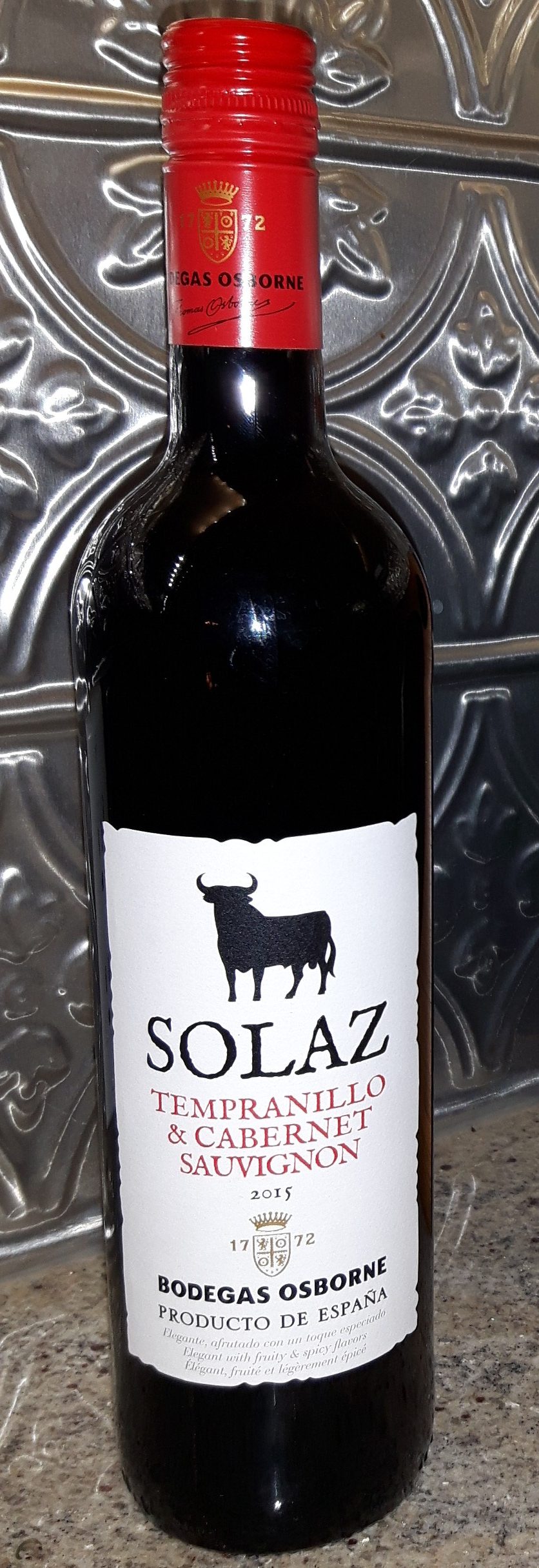
Is it possible? Are we near the return of the legendary Osborne Solaz?

Osborne Solaz
Can it be? A bottle of Solaz just across the border?

The Osborne Solaz, one of the great cheap wines of all time, has been spotted in Canada. And if Canada, why not a little farther south?

Can it be possible? The Wine Curmudgeon is not sure, given the wine vagaries of the 21st century. But as the cheap wine gods as my witness, I’ll do what I can to bring back one of the greatest $10 wines ever, the Osborne Solaz.

That’s because the Spanish wine has been spotted in Canada, in provincial stores and Costco. An astute reader sent the picture that accompanies this post, and which leads to the question: If a Costco in Calgary, why not on this side of the border?

Hence, my efforts to convince Osborne, which makes Solaz, to bring it back. I contacted an importer who works with Osborne. I emailed the company’s one-time marketing contact in the U.S. My message: Let’s make this happen!

Some of you might wonder why all the fuss. Ah, if you had only tasted Solaz. Regular visitors here have heard the story many times. In 2009, the Osborne company said it would stop selling Solaz in the U.S. Oh, the gnashing of teeth, the rending of garments. The Osborne Solaz was one of the great cheap wines of all time, ranking with California’s Big House Red under Bonny Doon; the French Jaja de Jau, and the Hogue family’s original sauvignon blanc.

Or, as I wrote in 2010, when I drank what might have been the last bottle in the U.S.: “I don’t remember when I first tasted the Solaz, but I remember what I did. I went out and bought more, and I have been buying more for at least a decade.”

Having written all this, I am a realist. Why should Osborne, which didn’t listen to me when it discontinued the wine 10 years ago (and I did some wailing then), listen now? How do we know it’s as tasty today as it was in 2010? But I am also cranky and stubborn. And the Osborne Solaz is worth the effort, and especially in today’s cheap wine wasteland.