Category:Wine rants

“You don’t love our wine? That’s not possible. … we had a meeting about it”

woman writing on notebook
“How can I work the the marketer’s notes about affordable and smooth into this review for a $25 too tannic red wine?”

In the world of post-modern wine marketing, we’re all partners and we’re all part of the team – even if we’re not supposed to be

Some wine marketers, after sending a wine sample, will follow up with an email asking if I liked it. Or, as one email recently asked, “Would love to know your thoughts about the wine. …”

Yeah, right.

In fact, they didn’t actually want to know what I thought about the wine. They already knew, because it was decided in a meeting at the start of the marketing campaign. In the world of post-modern wine marketing, there’s no such thing as objectivity. Everyone, whether marketer, influencer, or cranky ex-newspaperman who reviews wine, is part of the team partnering with the client.

Yeah, right.

That this is a contradiction in terms doesn’t seem to bother anyone; in fact, it doesn’t even seem to occur to anyone. Which is bad enough. But why would the marketers assume that I’ll play along? Aren’t wine writers supposed to be objective? Oh, wait a minute. We’re not, are we?

In this case, I did share my thoughts about the wine – politely, but also honestly, explaining that it wasn’t anywhere near what the producer claimed it was. No doubt I’ll get a note thanking me for my objectivity.

Yeah, right.

Having said that, many of the PR people I deal with are top-notch. They know what I’m looking for, and will be honest with me about the wine they’re flogging. Some even know not to offer me something, because it’s too expensive or too focused group or too whatever. Needless to say, I cherish those marketers, which is the reason no names are being mentioned. The last thing I want to do is get them in trouble with the client for being really good at their job.

And I turn down a lot of samples, too, probably more than anyone in the wine writing business. What am I going to do with a $30 Italian sauvignon blanc, other than to sigh and write something about the sad future of the wine business?

I wonder: Did that possibility come up in the meeting? I doubt it.

Photo: Photo by J. Kelly Brito on Unsplash
It’s official: Cheap wine is irrelevant, part III

rose wine
“Is there anything better than $100 rose?”

If you thought the first two cheap wine is irrelevant posts showed how screwed up wine is, wait until you read this one

Just in time for the blog’s 15th annual rose extravaganza next week – 12 “must have” roses for this summer, from a group of leading “restaurant professionals.” And not one of them costs less than $46 on a restaurant wine list, and two cost $100 or more.

For rose? Rose??? Rose?????

Yet there it is, from one of the wine business’ most important trade websites: These are roses “that sommeliers and beverage directors across the U.S. clamor for. … what they’re stocking up on as rosé season kicks off once again.”

Obviously, retail pricing wouldn’t be nearly as ridiculous; those that list for about $50 would cost about $35 at your local wine shop. But it’s not like $35 isn’t ridiculous, either. How many of us are going to pay $35 for a bottle of rose?

In this, one more piece of evidence – after this and this — that the wine business doesn’t much care about those of us who aren’t the one percent. Consider: I can get a bottle of actual Champagne from a good producer at one of Dallas’ leading high-end restaurants for $90. I love rose, but if I’m going to spend that much money, I’ll buy the bubbly. Who wouldn’t?

So what’s going on here? Two things, I think:

First, restaurants are restaurants, and if the pandemic didn’t change restaurant wine pricing, nothing will. I’m supposed to talk to someone who did a study about the pandemic’s effect on restaurant wine this week, and I’ll be sure to ask about these prices. They seem counter-intuitive if you’re trying to lure diners back.

Second, snobbery. It pains me to write this, after all the years I’ve spent trying to de-snobify wine. But that seems to be where we are in the second decade of the 21st century. It’s hip and cool or whatever to put a $100 rose on a wine list, and those of who don’t understand that it’s hip and cool or whatever don’t matter.

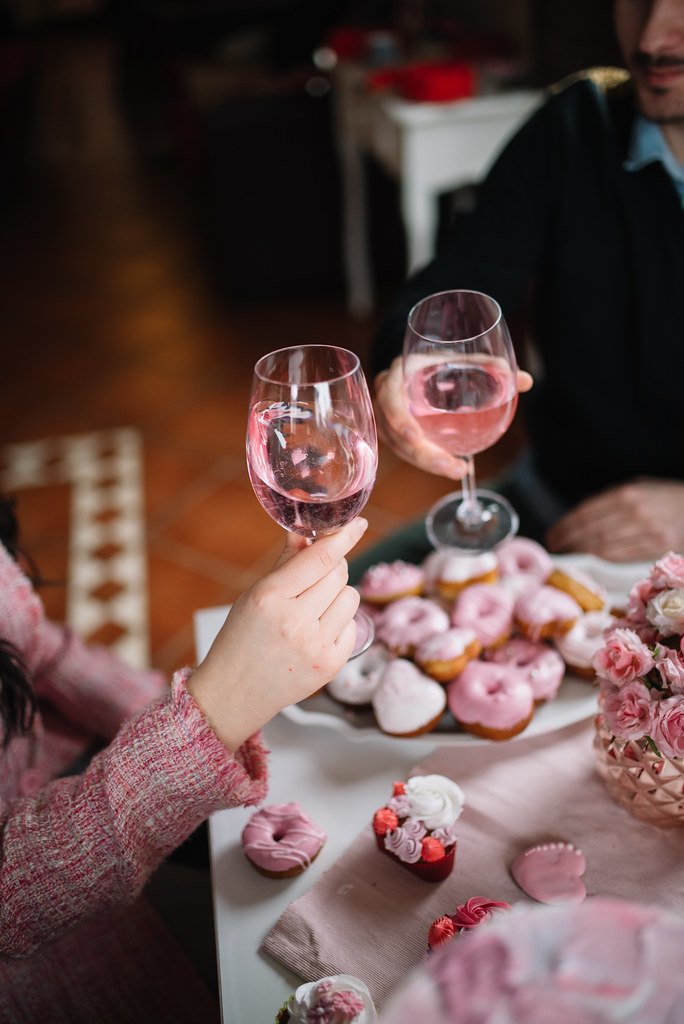
Photo: “Boyfriend and girlfriend drinking wine closeup. Pink colors for Valentine day” by shixart1985 is licensed under CC BY 2.0.

Are machine-written wine reviews closer than ever?

AI wine reviews
“Come on, already. What’s taking so long? It’s only a bunch of crummy chardonnay reviews.”

Dartmouth researcher: “We couldn’t tell them apart from human reviews”

A group of Dartmouth researchers have apparently taken the next step in machine-written wine reviews. Their study, published earlier this year in the International Journal of Research in Marketing, takes the work we’ve seen with artificial intelligence and brings it to a terrifying new place: The results “show strong support for the assertion that machines can write reviews that are indistinguishable from those written by experts.”

Keith Carlson, a doctoral research fellow at Dartmouth’s Tuck School of Business, didn’t say that the algorithm he and four others developed would show up as part of Wine Spectator tasting notes anytime soon. Some work still needs to be done, including further research into how similar the machine reviews are to human reviews.

Which is what I noticed: The examples were close, but not quite there – one machine rose review mentioned vanilla, which isn’t all that common in rose.

Still, Carlson told me, advancements in machine neural networks allowed the group to apparently come closer than anyone has before in making AI-generated wine reviews practical. Their algorithm used thousands of tasting notes from wine magazines to come up with a way that a machine could “teach” itself to write reviews.

Take that as you will. Regular readers will know how I feel. Wine has enough problems without some marketing guru — or, even worse, some media type – using AI reviews to flog product on the cheap. If this is practical, I can see AI reviews trolling sites like Vivino and Cellar Tracker, making consumers think the wines are more popular than they are – or taste a certain way when they may not.

That the study was published in a marketing journal is especially bothersome, as if the only use for technology is to sell stuff. And the Dartmouth news release even used the word “disrupt,” which is tech speak for “this will make us a gazillion dollars and aren’t we smarter than everyone else.”

Carlson emphasized that the last thing the group wants is for AI reviews to replace people. Rather, he says, they can be used to make wine reviewing easier, as a starting point for human reviewers. Perhaps. But I don’t know that the machine’s cabernet sauvignon review – dry, with blackberry fruit – is going to tell me anything new about cabernet.

But what do I know? I’m not out to disrupt anything.

More about AI wine reviews:
• “Crisp and fresh:” AI wine writing strikes again
• Artificial intelligence and wine recommendations
• AI wine writing: Maybe it’s not around the corner after all

“Prohibition wasn’t a failure”

al capone
“Of course Prohibition was a success — I made millions.”

The neo-Prohibitionists are reframing history to convince us that Prohibition worked – so we can do it again

“For instance, the St. Valentine’s Day massacre, in which seven men were gunned down in a Chicago garage, may have been carried out to avenge an earlier killing and had no connection to Capone or to bootlegging.”

— Bill of Rights Institute

Welcome to the Alice in Wonderland inhabited by the neo-Prohibitionists in their attempt to convince us that Prohibition was a success and that we should – and can – do it again.

How anyone can argue that the Valentine’s Day Massacre had nothing do with bootlegging and illegal liquor is past astounding. It’s a rejection of almost 100 years of historical analysis – Al Capone and Dion O’Banion fought for control of the Chicago liquor business, and Capone won by murdering as many of O’Banion’s gang as possible (including O’Banion). The seven murders on Feb. 14, 1929, finished the job.

It’s also worth noting that Capone thought the 1932 film “Scarface” was about him, wrote screenwriter Ben Hecht. Any why not? Hecht’s script revolves around Italian gangster Tony Camonte, who blows away his Irish North Side enemies in a St. Valentine’s Day-style massacre.

Yet search Google for “Prohibition was a success” and the results are mind-boggling — a mix of facts and wishful thinking. Which, come to think of it, is not all that different from the infamous cigarette study: Drinking one bottle of wine a week is the equivalent of smoking 10 cigarettes a week for women and five cigarettes for men.

So consider this, from a couple of studies in Scotland that looked at the results of alcohol minimum pricing. The idea was that raising the price of booze would cut crime, reduce drinking, and improve the public health. None of which seems to have happened.

Of course, the Iranians could have told the Scots that would be the case. Who knew AA would be so popular in Iran, a country where alcohol is illegal?

The Julia Child renaissance

Pop culture – which means younger people – has re-discovered Child’s greatness


Julia Child’s contribution to wine has long been appreciated on the blog. It took the courage of her convictions to advocate for California labels in those long ago days before the Fighting Varietals, when opening a bottle of American-made chablis or something called mountain red was not to be taken lightly.

So imagine my surprise — and joy – to learn that young people have taken to Child, and that social media is atwitter with praise for her accomplishments. It’s one thing to appreciate what Child did to change the way we eat, cook, and drink wine if you’re old enough to have watched “The French Chef” with your mother. It’s another if all you know is an exhibit in a museum.

But there it is. A new documentary. A new HBO series. There’s even a TikTok channel.

“The real Child, in my time with her, she certainly struck me as suffering absolutely no fools, and she was whip smart and even sharp-tongued,” says Doug Frost, MS, MW, who worked with Child at the American Institute of Wine & Food, which she helped start. “She was an admirable person, don’t get me wrong. But there was no room for foolishness in her world. I thought her to be canny and shrewd; she could be charming, sure, but she knew what she wanted at any given time. You did not screw around with Julia Child.”

Which, come to think of it, is a fine role model for young people and especially young women — and one that, sadly, is still not common enough in today’s world.

Child was someone who came to American food when it was mostly women’s magazine recipes that used canned cream of mushroom soup, and she taught us about fresh ingredients and that there was something other for dinner besides beef, a baked potato, and an iceberg lettuce salad with rubber tomatoes. Perhaps most importantly, she tried to teach us we didn’t need to fear wine or food – a lesson too many of us, even in the wine and food business, still haven’t learned.

In addition, she crashed into the male-dominated world of both professional cooking and TV in a way no one had ever quite seen before. Can you imagine a 6-2 woman with that hair being a media star today?

So bring it on, young people, and pay attention to what Child has to say about wine and its place in our food and culture. And then watch the video at the top of the post, where Child puts one over on David Letterman (with maybe a twinkle in her eye, and maybe not). How often did anyone else do that?

It’s official: Cheap wine is irrelevant, part II

wine snob
“Frankly, $30 is cheap wine. Even the WC should know that.”

Can’t afford expensive wine in our “post-pandemic, world is a mess” era? Never fear. There’s plenty of $30 wine out there

Just when the WC thinks the wine business can’t get any more foolish, it does. Witness this, which I got from a PR agency the other day:

“Inflation seems to be hitting consumers across a broad range of everyday items from Kleenex tissues to the bottles of wine. With prices on the rise, savvy shoppers should be seeking out and stocking up on values over the coming months to offset the pressures of inflation. In the wine world, there are still a number of secret bargains available. …”

Those secret bargains? Wines costing $20 and $30, since they don’t cost $45 and $250. Honest.

It’s just as bizarre as the previous cheap wine is irrelevant post, which said $10 wine was only good for cooking and getting drunk.

Let’s count everything that’s wrong about that email and its pitch for coverage:

• Most Americans will never pay more than $20 for a bottle of wine. Really.

• So Kleenex is more expensive. What does that have to do with the price of wine?

• Secret bargains? This is a secret bargain, not a $30 bottle of wine.

• The following phrase appeared in the email: The wines “provide some serious QPR points for those who want to drink like a King, but on a Prince’s budget.” If I ever wrote anything like that, Dick Hainey would get out of his grave, smack me in the head, and tell me to never darken professional writing again.

All together now: “Is it any wonder we worry about the future of the wine business?”

Photo: Pavel Danilyuk from Pexels

What do the neo-Prohibitionists want?

wine and health
This is the WC’s favorite “we’re all drunk and passed out because all drinking is evil” picture.

Yes, they want us to stop drinking, but is there more going on than that?

Consider the following, which a fellow wine writer received after a recent column:

“There’s no appropriate level of alcohol consumption given that even an infrequent glass of wine or beer will spike cancer and more than an infrequent glass will do lasting liver and brain damage. Fortunately, consumption is falling in America & the best thing would be for it to fall further, faster.”

Hard to read, yes? The absolutes. The certainty. The righteousness. But read it, and know that’s where we are when it comes to alcohol in the the U.S. As a blog reader noted in a comment the other day: “An otherwise trenchant writer in my field (psychotherapy) told his readers that anyone who drinks more than a glass of wine at Christmas dinner is an alcoholic.”

The neo-Prohibitionists have taken control of the discussion, and until the wine business – and its colleagues in beer and spirits – take it back, we’re going to see more and more of this. And yes, it could come to the point where – as one very smart wine writer told me not long ago – drinking will be as much anathema as cigarette smoking.

The irony is that Prohibition was perhaps the greatest social failure in U.S. history. Which, of course, doesn’t matter to the neo-Prohibitionists because they know absolutely and certainly of their righteousness. History won’t dare repeat itself with them.

Frankly, I don’t understand why so many in the wine business are so terrified to call out the neo-Prohibitionists. What are they going to do? Cast a spell and turn everyone into frogs?

Because there are reasons to call them out. A German nutritionist, reported a British trade magazine, said that those of us who drink in moderation are being “stigmatised” by flawed alcohol studies. Nicolai Worm, PhD (who also consults for wine trade groups) was especially critical of research used to show that any alcohol consumption was evil.

Hmm. Think we’ll see that in the mainstream news media? I doubt it.

Also note that I mentioned Worm consults for wine trade groups. This is called being objective, which is something that every peer-reviewed scientific study should aspire to and so few seem to care about these days.

So turn me into a frog if you want. I’ll continue to drink in moderation; walk Churro, the blog’s associate editor, every morning; watch how many eggs and how much red meat I eat; avoid fried foods; and fill out my diet with grains, beans, and vegetables. Which seems like a damned healthy lifestyle, yes?

More about wine and health:
• Once more, how not to report a wine and health story
• One more reason to be wary of alcohol health studies
• Health alert! Does the CDC know how dangerous Starbucks’ pumpkin spice latte is?