



Category:Wine news

Winebits 801: New York, Circle K wine, Villa Maria

women holding wine glass
“Do we really want to buy wine at a supermarket?”

This week’s wine news: Once more, the New York wine and supermarket puzzle. Plus, Circle K chain debuts its own wine and the legendary Villa Maria may close

• New York and supermarket wine: New York doesn’t allow supermarkets to sell wine; that’s reserved for liquor stores (which can’t sell potato chips, but that’s another story). The state’s big grocers have been trying to change the law, left over from the repeal of Prohibition, for even longer than I’ve been writing about wine. Another bill has been introduced in the state legislature, and though the story in the link is reasonably optimistic about its chances, the Wine Curmudgeon would not bet on its passage. The package stores have powerful allies in the legislature, and have successfully fended off challenges not only from supermarkets but from big box wine retailers like Total Wine. I used to think the answer to this was easy – let supermarkets sell wine and be done with it. If it works in Texas, why not? But as consolidation has overwhelmed wine retailing, I’m beginning to wonder if it would only benefit the grocers and not consumers.

• Circle K wine: Regular readers know that the WC keeps a close eye on the convenience store wine business, but even I was surprised to see this: Circle K is selling its first private-label wines in 3,000 U.S. stores. They include Sunshine Bliss (under $8) and Fine Wines ($10 to $25). The story doesn’t go into much detail about who makes the wine or where they’re from, but there’s a Circle K near WC world headquarters, so it’s worth a trip. I’ll report back if the store has the wines and what they taste like.

• The end of Villa Maria? Villa Maria, one of the legendary names in New Zealand wine, may be close to the end, reports New Zealand’s Newsroom website. The company, which went through mysterious bankruptcy proceedings several years ago, may move many of its operations to the United Kingdom, and the story hints at layoffs and the sale of the winery. If so, it’s the end to a winery that helped make New Zealand a key part of the world wine business.

Winebits 800: Another milestone for the blog

Ansari X-Prize 10 Year Anniversary Celebration
“Way to go, WC! 800 weekly news briefs!”

This week’s wine news: We celebrate the 800th installment of the weekly wine news with buyouts, squabbles, and layoffs

• Stag’s Leap sold: Ste. Michelle Wine Estates will turn over its share of the legendary Stag’s Leap to Italy’s Marchesi Antinori. Ste. Michelle, in partnership with Antinori, bought the winery in 2007 for $185 million. No terms of the turnover were disclosed, but Ste. Michelle has made a number of cuts, layoffs, and closings since it was bought by the Sycamore Partners hedge fund in 2021. Stag’s Leap, of course, is best known for its victory in the Judgment of Paris, where California wines beat France’s best in a blind tasting. And its founder, Warren Winiarski, is one of the giants of the California wine business.

• Prosecco or prosecco? The long-running dispute between Australia and Italy over the former calling its sparkling wine “prosecco” may be coming to a head (pun sort of intended). Several reports say a free trade agreement between Australia and the European Union is being held up because the Aussies still want to use the term for their wine; the EU, of course, says they can’t. The U.S. and the EU have a similar agreement, and it’s why California sparkling wine can’t be called Champagne. The Australian version of the wine is one of the most popular styles Down Under, and since almost none of it is sold outside of Australia, its producers don’t see why they need to change the name.

• Treasury layoffs? More bad news for Big Wine. Treasury Wine Estates will “implement cost-cutting measures” aimed at its brands costing $10 or less, including Lindermans and 19 Crimes. No details were released, but the company cited declining sales and premiumization. It’s worth noting that 19 Crimes is one of the great successes in wine over the past several years, so what does Treasury do? Cut back on it, of course. Is it any wonder why I worry about the future of the wine business?

Photo: “Ansari X-Prize 10 Year Anniversary Celebration” by jurvetson is licensed under CC BY 2.0.

Winebits 799: Champagne corks, David Trone, damp drinking

This week’s wine news: Make cooking safer with Champagne corks, plus Total Wine’s David Trone is running the U.S. Senate and young people discover moderation

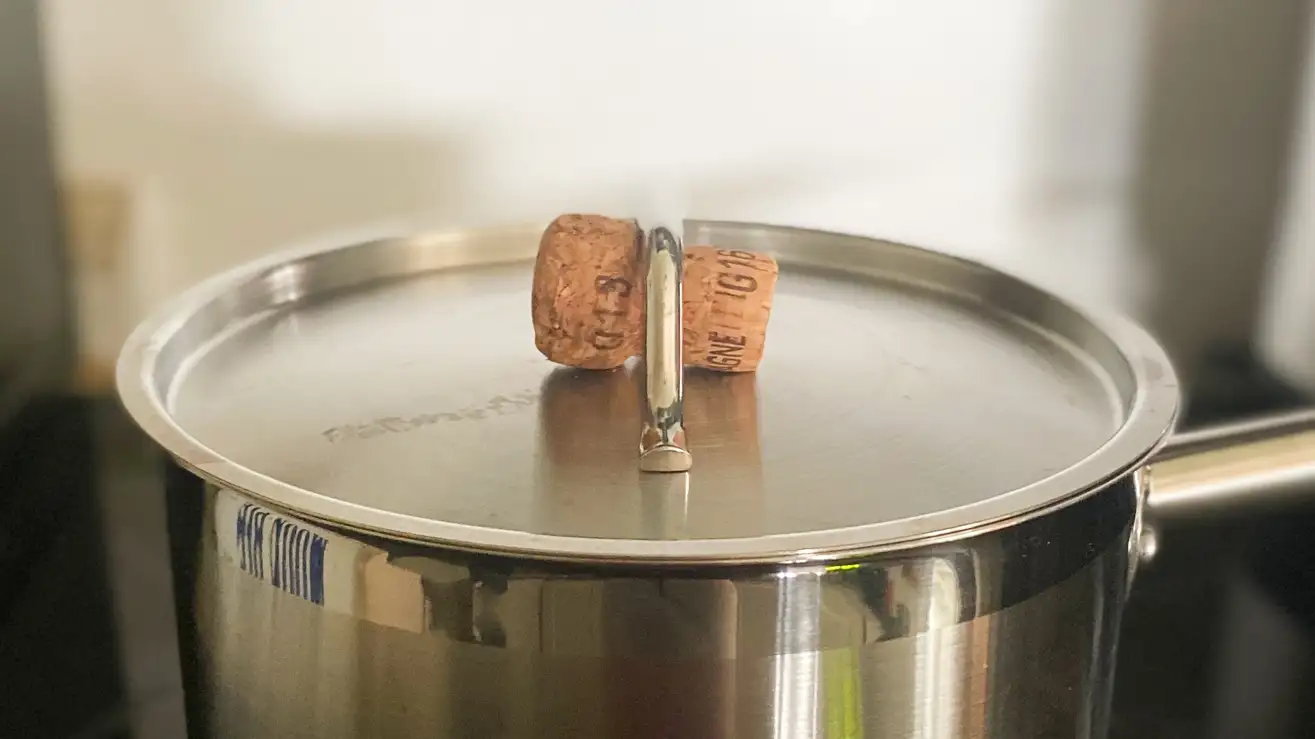
Champagne cork as a potholder
Corking it!

• Call it a potholder: Claire Lower at Lifehacker found a terrific use for all of the old Champagne and sparkling wine corks sitting around the house: Use them as potholders. “Instead of using a kitchen towel or pot holder to grab the hot, metal lid of a sauce pan or stock pot, wedge a sparkling wine cork under the handle. The cork acts as an insulator, allowing you to lift the lid without burning fingers.” I have not tried this yet, but Lower – who is pretty good at these things – swears by it.

• Trone for Senate: David Trone, whose family owns the Total Wine retail chain, will run for the U.S. Senate from Maryland. Trone, a Democrat, currently represents the state’s Sixth Congressional District in the U.S House. He is well known for spending personal money on his campaigns; CNN reports that he loaned himself $12.5 million when he was reelected in 2022. I’ve interviewed Trone, and he is one of the sharpest people I’ve met in the wine business. If nothing else, the family managed to create a national liquor retailer where many others had failed and many thought it couldn’t be done.

• Call it damp: Want to know what young people call drinking in moderation? Damp. The WC doesn’t do much with TikTok, since I live in Texas and the bosses here could arrest me for being a Chinese spy, but it’s worth noting: “Roughly 1 in 3 Gen Z and Millennial drinkers have heard of ‘damp drinking’ and, when prompted, over half are interested in trying it.” Note to the wine industry: Ask one of your kids about this. It sounds like something that might be good for business.

Photo: Claire Lower via Lifehacker

Finally, some perspective about wine and health

woman drinking wine
“Of course wine in moderation, and as part of a healthy diet. What are those researchers thinking?”

Drinking wine in moderation probably won’t kill you

Finally, a mainstream media story that tries – and mostly succeeds – in putting the long-running debate about wine and health into perspective.

Writes Tim Requarth in Slate: Drinking wine looks less and less like it’s good for you. But drinking wine in moderation probably won’t kill you, either.

The story neatly encapsulates the five decades of research and controversy since the first study that seemed to identify a relationship between heart health and drinking red wine. Yes, the story is bit too long, and yes, Requarth could have left the puns out, but he does something that hardly anyone else has managed to do – make sense of what’s going on today, as “mainstream scientific opinion has flipped” about wine and health.

The highlights:

• The idea that red wine in moderation, by itself, improves heart health probably isn’t true. It likely has more to do with red wine as part of the Mediterranean Diet, which almost every expert agrees is among the best in the world for living longer and healthier. Which, if anyone has been paying attention, always seemed liked the correct approach.

• This is the best discussion about how the academic world works – the politics, the jealousy, how research is done – that I have probably ever read. It’s crucial to know this to understand how the controversy unfolded, given the backbiting and sniping that took place.

• It’s also the best explanation I’ve seen in the difficulty of doing the kind of research necessary to get an accurate result in a subject this complicated. For example, smoking and drinking are closely related; that is, people who smoke and drink are much more likely to die than someone who just drinks. So researchers must control for the former; otherwise, they would skew theresults toward the conclusion that any drinking is deadly.

• It quotes the great Marion Nestle, who knows more about this stuff than almost anyone.

There are a couple of annoyances: Requarth didn’t need to spend so much time trying to tie the alcohol business to some vast conspiracy to cover up the dangers of drinking. Big Booze has many faults, but I don’t think that’s one of them, and certainly not the way Big Tobacco lied about smoking and some some pharmaceutical companies lied about oxycontin.

I also wish he had discussed the moral fervor the anti-drinking researchers bring to their work; that’s how we ended up with Prohibition.

Still, you can’t argue with a story that ends like this:

“A middle-aged man’s baseline risk of dying of any cause in the next five years of his life is 2.9 percent. If he upped his drinking from a few drinks a week to a few drinks a day, this risk would rise to 3.6 percent, or an absolute risk increase of 0.7 percentage points. What this means is that if 143 middle-aged men drink once a day, there might be, in the near-term, one additional death, while the remaining 142 men would be unaffected.”

In other words, “they aren’t reason for any individual person to panic.”

Winebits 798: It’s all about the grapes

Red grapes hanging on a vineThis week’s wine news: Odd and unique grape varieties are popping up around the world

• Hybrids: Kate Dingwall, writing in InsideHook, offers a fine analysis of hybrid grapes and their role in the future of wine: “Hybrid grapes aren’t particularly cool. They boast names like Montreal Blues, Kay Gray, Cayuga, La Crescent and Chambourcin. … But weird names be damned; in a climate-ravaged world, these lesser-known, non-name-brand grapes offer a whole lot of potential.” This is a point we tried to make during the Drink Local Wine days, and it’s good to see that the next generation of wine writers are picking up on it. It’s also interesting to see that Dingwall found lots of mainstream wine people to quote in the story. Maybe there’s hope we can finally convince the wine world there is more than cabernet sauvignon and chardonnay.

• Saving Swiss grapes: Slow Foods, the artisan food group, has launched a project to help save two native Swiss grapes, bondola and its close relation bondoletta, which are near extinction. Bondola, a red grape, was predominant in the Swiss Ticino region for the first 50 years of the 20th century before it was replaced by merlot. Today, bondola and the related bondoletta are the only native varieties still being produced in Ticino, with just 1.5 percent the surface under vine.

• New in Peru: Decanter reports that six new Peruvian wine grape varieties have been identified by researchers in southern Peru, and two — the white Jaén and the red Cantarilla — may have potential as wine grapes. The grapes were found in the isolated and desert-like Caravelí region, about 5,500 feet above sea level. Peru, though not known for wine, shares a winemaking heritage with its Spanish-colonized South American neighbors.

Not so fast, Miller High Life

Monty Python as twits
“Where’s that Champagne of Beers? It has to be around here some where.”

The Champagne of Beers isn’t welcome in Europe

The Wine Curmudgeon was in a top level meeting the other evening when a colleague took a sip of his beer and asked: “Do they still call Miller High Life ‘the Champagne of Beers?’ ”

I took a sip of mine and pondered. “I can’t imagine they do,” I said. “There are all sorts of European Union regulations to prevent just that sort of thing. I’ve written about it on the blog many times. Haven’t you subscribed?”

My colleague said he had heard something about that, so we moved on to other topics. This included the future of our meeting site, given that Dallas real estate developers have been going crazy closing long-time businesses because they don’t have nearly enough money. Highest and best use, baby!

So imagine my surprise when I saw this headline the next day: “Miller High Life has fallen afoul of strict European laws on ‘champagne.‘ ”

Turns out my colleague had been right to ask.

Reported CBS: “Customs officers in Belgium seized a shipment of 2,352 cans of the beer in February, after it landed in the Belgian port of Antwerp, on its way to Germany. Officials seized the cans ‘because they used the protected designation of origin “Champagne,” and this goes against European regulations,’ said a Belgian customs official.” The Champagne trade group, long known to blog readers for its fanatical devotion to intellectual property, asked that the shipment be seized and destroyed.

Miller High Life, owned by Molson Coors, isn’t sold in the European Union, likely for just this reason. Hence, the shipment to Germany was probably illegal to begin with, even before the Champagne business. It’s also worth wondering why anyone in Germany – home to some of the world’s greatest beer – would want Miller High Life. It’s perfectly acceptable for a weeknight business meeting, but for serious beer drinkers? Hard to believe.

Finally, a note to CBS: The word champagne in the headline should have been capitalized. It’s a proper noun, referring to the Champagne region in France. For your sake, I hope the Champagne trade group didn’t notice that. Otherwise, you’ll get a nasty cease and desist letter.

Winebits 797: Wine delivery, wine competitions, wine demographics

man passed out on bench
“Man, I love alcohol delivery.”.

This week’s wine news: Wine delivery and alcoholism, plus analyzing wine competitions and a few thoughts about the wine demographic and the theater

• Not all drunk? A common refrain during the pandemic – though not from statisticians – is that we were passed out every night. One of the reasons given is that alcohol delivery, which was previously not all that legal, made getting drunk that much easier. Now, writes C. Jarrett Dieterle in “Reason,” “there is no demonstrable link between alcohol delivery laws and our heightened pandemic drinking.” Further, he writes, “claims about alcohol delivery and increased overall drinking have been largely conjured out of thin air.” The piece, which analyzes government data, makes several telling points: Media scare headlines based on little actual data and serious flaws in the drinking research. As Dieterle notes, one of the most important studies didn’t “clarify whether the respondents who had alcohol delivered during the pandemic also drank more pre-pandemic than the non-delivery crowd. In other words, these respondents might have merely shifted their drinking from the corner bar to their home, rather than increasing their drinking.” Again, alcoholism is a serious problem, and it deserves serious research – not fear mongering.

• Whither wine competitions: The wine business has been wringing its hands for years about the efficacy of wine competitions, and now there is one more wondering voice. Writes Sean R. Sullivan: “Wine competitions have long been a dubious side of the industry. … The situation, however, has gotten considerably worse. Many competitions have started converting the medals they have traditionally given into scores on the 100-point scale. The results would be comical if they weren’t so harmful.” The post discusses score inflation, the dubious use of scores to give medals, and how the results seem less than legitimate. It’s well worth reading given Sullivan’s stature among the Winestream Media.

• Oh those, demographics: The Wine Curmudgeon loves the theater; seeing a play is one of the great joys of life (musicals, even). So I read with with interest Andrew Lloyd Webber’s take on his “Phantom of the Opera” closing on Broadway after 35 years. That’s because he wonders about the future of the theater for reasons all too familiar to wine drinkers. Ticket costs, for one, averaging $130 and “unaffordable for too many people.” And, he adds, it’s not surprising that young creators – the next Lloyd Webbers — go “anywhere other than Broadway to make a living.” Imagine that: live theater becoming as irrelevant as wine, both as loss leaders so huge multi-nationals can sell other products.