Category:Uncategorized

California secedes from U.S. — becomes its own wine country

California wine map“I’ll drink to that,” says The Guvinator

Call it the Cabernet Republic. California, which produces 90 percent of the wine made in the United States and 99 percent of the hype, announced today that it was, for wine purposes, no longer part of the U.S.

“Frankly,” said a California spokeswoman, “we got tired of being lumped in with Oregon and Washington as American wine — and God forbid places like Texas, Missouri and Virginia. It’s bad enough that Napa and Sonoma have to share the state with Lodi and the Sierra Foothills.”

Effective immediately, the state’s wineries and negociants will stop using U.S. labeling and appellation laws, and will no longer have to abide by the three-tier system. The state’s producers will be able to call their wine whatever they want and sell it to whomever they want. “Given that California is so much better than everyone else, we didn’t see why we needed to play by rules designed to benefit our inferiors,” said the spokeswoman.

In addition, the new California wine czar, O.V. Extracted, announced that it will be illegal to use the term terroir in connection with the state’s wine. The penalty will be exile to Bordeaux. “If they want to spew crap about That Word,” he said, “then let them go somewhere and make green wine with unripe grapes. It’ll serve them right.”

Reaction was swift. The Wine Magazines announced they would give all California wines a five-point bonus in future scores to reflect the state’s new status. Fred Franzia, who heads Bronco Wine Co., said he was seceding from California, but would continue to say his wines were made in California. “I don’t want to belong to any wine country that will have me as a member,” said Franzia, “but I do want to take advantage of it.”

The spokeswoman also noted that California would remain in the U.S. as a state. “Hey, we’re broke,” she said. “You think we’re going to pass up the stimulus money? We’re not that stupid.”

The 2009 $10 Wine Hall of Fame

2008 was a banner year for cheap wine. Excellent cheap wine was plentiful in 2008. In fact, it was one of the best years for $10 wine since I started tracking cheap wine almost 10 years ago.  I ?m not quite sure why, since the weak dollar and producers who focused on $15 wine were two of last year ?s most dominant trends.

The Hall added five labels: Yellow+Blue malbec (about $12 for a 1-liter box), which puts most other malbecs in its price range to shame; Meridian ?s chardonnay, which can be found for as little as $6; the Les Jamelles wines from southern France, which deliver surprising quality for $10; another Gascon wine, Domaine du Tariquet, to join the three that entered the Hall last year; and Lockwood sauvignon blanc, perhaps the most pleasant surprise of any wine I tasted in 2008.

Truth be told, I could have picked two or three times those five wines this year. Almost every rose I tried was worthy. Two Italian wines, Tormaresca Neprica from Puglia and Ajello Bianca from Sicily, were fabulous, but are difficult to find ? and one of the rules is that if wines aren ?t available, they can ?t get in the Hall. The same is true for the various Tortoise Creek wines, which disappeared from store shelves this year.

In fact, the wines that were dropped from the Hall this year did so not because of quality, but availability. The Benziger fume blanc (the winery ?s version of sauvignon blanc) and Jewel ?s unoaked chardonnay and petite sirah weren ?t readily available this year. (In fact, even the winery ?s web site disappeared.)

Here is the rest of this year ?s Hall of Fame:

? The $10 wines from California ?s Bogle Vineyards, and especially the petite sirah.

? Osborne Solaz, Spanish reds and a white. Look for the cabernet-tempranillo and shiraz-tempranillo reds and a white made with a grape called viura, which may be the best of the three. There is also a rose, but I have yet to find it in the Dallas area.

? Italy ?s Falesco Vitiano, which produces a solid rose, an even more solid white blend, and a stunning red blend made of sangiovese, cabernet and merlot.

? Cristalino, the Spanish sparkling wine, which comes in brut (dry), extra dry (sweeter than brut) and rose.

? California ?s Toad Hollow pinot noir rose.

? The Gascon musketeers — Domaine Duffour, Domaine des Cassagnoles, and Domaine D ?Uby. Michel Duffour, in fact, could well be the poster boy for the Hall of Fame.

In the special, ?If you can find them for $10, buy them ? section of the hall (thanks to the weak U.S. dollar):

? Chateau Ducla and Chateau Bonnet, white blends from Bordeaux. Andre Lurton, whose company owns Bonnet, is part of the powerful Lurton clan, whose holdings include Cheval Blanc and d ?Yquem.

? Domaine Pichot, a French chenin blanc.

? Cinquante-Cinq sauvignon blanc and chardonnay, two French wines.

For previous $10 Wine Hall of Fames:

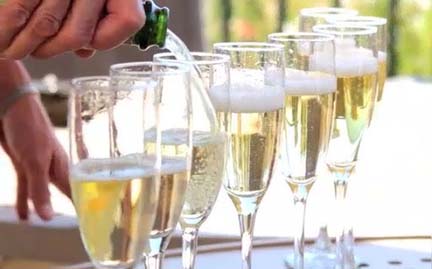
Champagne and sparkling wine basics

Keep four things in mind when you shop for sparkling wine.

? Please, please try something other than the same old French labels like Veuve Clicquot and Nicolas Feuillatte. Quality bubbly is made in most of the world’s great wine regions. Yes, it doesn’t taste like Champagne, but it’s not supposed to.

? Only sparkling wine made in the Champagne region of France can be called champagne, thanks to a 2005 trade agreement (though some California brands like Korbel are grandfathered in). But if the label says methode champenoise or m thode traditionelle, it was made in the Champagne style. The other production technique, called charmat, generally produces less bubbly, sweeter wines. Most Italian sparkling wine is made in the charmat style

? Vintage isn’t especially important. NV on the label stands for non-vintage ?- that is, the grapes used to make the wine come from different harvests instead of just one. It ?s a common practice, even for the most expensive brands, to ensure quality.

? Most bubbly sold in the U.S. says either brut or extra-dry. Brut means the wine is dry, while extra-dry means it ?s sweeter than brut. Rarer are wines labeled sec, which is more sweet than extra-dry, and doux, which is dessert-style champagne.

Holiday wine schedule

Here ?s what the Wine Curmudgeon will be writing about over the next couple of weeks, so you can keep those holiday shopping lists handy:

? Nov. 24: Thanksgiving wine suggestions (and only one is pinot noir!)

? Nov. 26: Thanksgiving wine of the week, Osborne Solaz.

? Nov. 28: Holiday wine and gift shopping guide.

As always, suggestions, thoughts and comments are welcome.

The Wine Curmudgeon’s Bordeaux adventure

press

The wine business on Bordeaux ?s Right Bank is thriving. The wines are uniformly good and the people making the wines seem to be aware of the challenges facing their industry. The tales of doom and gloom facing French wine ? including overproduction, sinking sales, and a declining reputation — seemed quite distant during a string of gorgeous fall days.

This is not to say that there aren ?t problems, or that my 5 1/2-day visit made me an instant expert. Overproduction, especially in the south of Bordeaux in the Entre-Deux-Mers region, must be dealt with, and that means pulling up vines. The weak U.S. dollar is clobbering mid-tier producers, whose $12-$15 wines in Europe cost $30, $40 and $50 in the States. In addition, many less well-known producers, whose wine is more than acceptable, are finding it increasingly difficult to get import and distribution deals in the U.S. There are so many wines from so many parts of the world that just being from Bordeaux isn ?t good enough any more.

But these problems don ?t necessarily mean the world is ending. They mean Bordeaux competes against the world, just like everyone else. And the winemakers and chateaux owners that I met seem capable of handling the challenge.

They understand what ?s going on, and they know they must change the way they do business. Gerard Milhade, whose family operates six chateaux, uses screw tops for his inexpensive white wine and his labels are modern (though, thankfully, they don’t have any livestock or bad puns). When I asked him about this, he made the point that his competition is not just from Bordeaux or even France, but from the rest of the world. And that means doing things differently than his father and grandfather did them. Though the Milhades are fairly young in the business — they’ve only been doing it for 70 years.

Progressive ideas abound. Emeric Petit, whose family owns several properties, including Chateau Tournefeuille, peppered me with questions about wine growing in the States. His solution for the oceans of wine flooding southern Bordeaux? Create the French equivalent of a company like Kendall Jackson, which can turn those grapes into acceptable wine at a fair price. (The French call wines like K-J technical wines; that is, wines made to certain specifications, instead of wine made by what the grapes will give. This is not a pejorative term, by the way, which made the Wine Curmudgeon quite happy. Yes, the French do appreciate cheap wine.)

Anabelle Cruse Bardinet, the winemaker at Chateau Corbin, told me that another problem, often overlooked, is the Wine Magazine hype that sends prices for the elite chateaux into the stratosphere. If wine drinkers think that the only good wine from Bordeaux costs $400, who is going to pay $40 for a bottle of Chateau Corbin?

It’s a point well taken. We tasted the 2001 Cheval Blanc, which (if you can find it) costs around $400. This, incidentally, is a bargain for Cheval Blanc, one of the top 10 producers in Europe, if not the world. The 2005 will run around a grand.

The 2001 was fabulous wine. The finish went on and on, and the tannins were fine and delicate. There were layers and layers of flavors — a subtle cedar, a bit of blueberry and even dust (thanks to the great Robert Whitley for the last one). It’s one of the best wines I’ve ever tasted, and in 20 years it will be even better. But who can buy it? Only the wealthy. I’ll be lucky to ever taste it again, and I do this for a living. Hence the possibility that Bordeaux is pricing itself out of existence.

What about the wine?

As noted, it was almost uniformly excellent. We tasted red wine from more than three dozen producers (including 13 in an epic three-hour Sunday afternoon banquet that’s probably worth a short story in its own right). Only a couple were less than satisfactory, an impressive percentage.

A couple of things struck me about the wines. First, that they did reflect Bordeaux and the right bank in style and taste. That means less fruit, less oak, and less jammy flavors. (In fact, trying to explain what jammy meant was beyond my almost non-existent French.) This is not a bad thing, no matter what some people in California might think. Second, that the wines were modern; that is, that the winemaker had adopted a variety of New World techniques to improve the quality. They weren’t stuck in the “We’ve been doing this for 500 years and we’re never going to change” mindset that the French are so often accused of.

The following are the highlights of what we tasted. Prices for almost all of them will start at $20 or $25, and go up from there, unfortunately. I also can’t vouch for vintage or availability in the U.S., so check with your local retailer:

? Chateau Guibeau. World class cheap wine (8 1/2 euros), which is the highest compliment the Wine Curmudgeon can pay.

? Chateau Mazeris. The business has been in the family since before the French Revolution. Jean de Cournuaud is the ninth generation of his family to make wine on this property.

? Chateau Tournefeuille. I stayed on Petit’s property for a couple of days, and it was as lovely as the wine.

? Chateau Canon. It’s owned by the same people who own Chanel, which means that not only was the wine excellent, but it was the most beautiful winery I have ever seen.

? Chateau Lyonnat. Milhade opened a bottle of the 1964 for our group to taste, and it was splendid — a wonderful Bordeaux nose, lots of fruit left, and fine-grained tannins.

? Chateau Beauregard. One of the most pleasant surprises. It has a fine reputation, and the wines we tasted (especially the 1998) will only add to that.

? Chateau Junayme. A good example of what’s happening in Bordeaux — a classic wine, but clean and fresh, made with New World techniques.

? Chateau Clos Fourtet, Chateau Beau Sejour Becot, and Chateau Figeac. These were the banquet’s final three wines, and illustrate an important point. Each is a classic Saint Emilion label, and each tastes different from the other. You might like one better than another (I preferred the Figeac), but that doesn’t mean one is actually better than the other. They’re just different. I dare anyone to taste these three wines together and then to score them — it’s not possible. It’s just another example of why scores are useless.

2009 State Fair of Texas wine seminars

John Bratcher, my partner in the Two Wine Guys, wine guru Dan Peabody, and I will hold wine seminars at the State Fair of Texas through Oct. 18. The classes, held in the Wine Garden in back of the Food and Fiber building, are free. They last 15 or 20 minutes, plus questions. The first talk each day is Texas Wine 101; the remainder are Wine 101.

Here ?s the schedule:

? Sept. 25: John, 3, 5 and 7 p.m.

? Sept. 26: John, 2, 3:30 and 6 p.m.

? Sept. 27: Jeff, 3, 5 and 7 p.m.

? Sept. 28: John, 3 and 5 p.m.

? Sept. 29: Jeff, 3 and 5 p.m.

? Sept. 30: Dan, 3 and 5 p.m.

? Oct. 1: John, 3 and 5 p.m.

? Oct. 2: Dan, 2, 4 and 6 p.m.

? Oct. 3: John, 2, 4 and 6 p.m.

? Oct. 4: Jeff, 2, 4 and 5 p.m.

? Oct. 5: No shows

? Oct. 6: No shows

? Oct. 7: Dan, 3 and 5 p.m.

? Oct. 8: Jeff, 3 and 5 p.m.

? Oct. 9: Dan, 2, 4 and 6 p.m.

? Oct. 10: Jeff, 1, 3 and 4:30 p.m.

? Oct. 11: Jeff, 2, 3:30 and 5 p.m.

? Oct. 12: Jeff, 3 and 5 p.m.

? Oct. 13: Jeff, 3 and 5 p.m.

? Oct. 14: John, 3 and 5 p.m.

? Oct. 15: Jeff, 3 and 5 p.m.

? Oct. 16: John, 2, 4 and 6 p.m.

? Oct. 17: Dan, 1, 4 and 6 p.m.

? Oct. 18: John, 2, 3:30 and 5 p.m.