
Tag Archives: wine glasses

Enough with the Champagne glass conspiracy already – can’t we just drink and enjoy?

Champgne glass
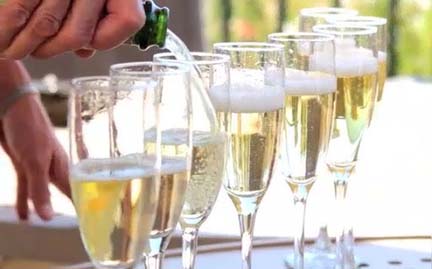
$60 will buy two Reidel Veritas Champagne glasses — and won’t we sleep better at night after that purchase?

Once again, we’re being told that we aren’t drinking bubbly from the correct glasses, and we’d better stop – or else

A couple of months ago, when I wrote about the most recent Champagne glass conspiracy, I thought we were done with worrying about what a Champagne glass should look like. The glass in that post was so over the top that only the geekiest among us would pay attention. And the rest of us could enjoy our bubbly in whatever glasses we had, content that the wine business has passed us by.

Silly me.

Once again, we’re being told that we aren’t drinking bubbly from the correct glasses, and that we must spend $30 a glass to do it the proper way. It’s called the Veritas glass from our friends at Reidel – with a wider middle and narrow top, two design changes that are supposed to help us enjoy more aromas and flavors. No, this isn’t as bizarre as the cement mixer glass from the previous post (which also needs to be dusty to work most efficiently), but it’s overkill nonetheless.

Most of us spend less than $15 a bottle for sparkling wine. Why do we need to pay twice as much for the glass? Why can’t we enjoy our bubbly in whatever glasses we have and be done with it?

Because this is wine, and if they aren’t telling us what to do, they’re reminding us that what we do is wrong. And, by the way, spend more money.

I wrote this in the previous Champagne glass post, and it’s worth repeating: “What difference does the design make to the vast majority of wine drinkers? Can we tell the difference between the bubbles in a flute glass and in the cement mixer glass? Isn’t the wine just as enjoyable in the former? The answers: Almost certainly not, and of course. And I can’t imagine most of us want to drink wine out of a dusty glass.”

But then again, what do we know? We’re just the slobs who pay for everything.
Calling all conspiracy buffs: The sparkling wine glass plot

sparkling wine glass

Do we really need a sparkling wine glass that looks like a cement mixer? Of course not

The Wine Curmudgeon is old enough to remember 1960s-style sparkling wine glasses, the bowl-shaped kind that were supposed to resemble Marie Antoinette’s breasts. Then the experts told us we needed to switch to the flute-shaped glasses in use today, so we did.

But over the past couple of years, that hasn’t been good enough for the experts. First, we were supposed to switch to traditional white wine glasses. Then Riedel, which never met a wine it couldn’t create a glass for, said we needed a sort of white wine glass designed for bubbly.

And now, as Felicity Carter reports in Wine Business International, we need a glass that looks like a cement mixer. And the glass needs to be dusty.

Enough already. This is only sparkling wine, not a cure for cancer. Can’t we just drink and enjoy?

Nevertheless, Carter reports that the experts say there is scientific evidence that the cement mixer glass, and especially if it’s dusty, produces more and better bubbles. And more and better bubbles mean more enjoyable wine.

Which is all well and good, save for one thing (which doesn’t include the cost of replacing your glasses). What difference does the design make to the vast majority of wine drinkers? Can we tell the difference between the bubbles in a flute glass and in the cement mixer glass? Isn’t the wine just as enjoyable in the former?

The answers: Almost certainly not, and of course. And I can’t imagine most of us want to drink wine out of a dusty glass.

I taste lots of sparkling wine, using flutes and white wine glasses, and it’s not the glass that matters. It’s the quality of the bubbly, and all the glass does is let me determine the quality. Crappy wine is crappy wine, regardless of what it is served in.

In other words, don’t spend more on the glass than the cost of the wine. If you drink $100 wine regularly, then by all means buy a $100 wine glass. But for the 99 percent of us who drink wine that costs $10 or less, a glass that costs about $10 is more than sufficient. And the one in the link is more difficult to break. Can the Champagne people say that about their glass?

 Photo courtesy of the Wine Business International, using a Creative Commons license

riedel

Thursday Birthday Week giveaway: Six Riedel wine glasses

riedelWin six Riedel wine glasses

And the winner is: DLB, who selected 45; the winning number was 42 (screen shot to the right).
Thanks to everyone who participated. Tomorrow’s giveaway and the last of birthday week: four autographed copies of the cheap wine book.


Today, to celebrate the blog’s 10th anniversary, we’re giving away six Riedel wine glasses — two Vinum sparkling glasses and four O red wine glassescourtesy of Banfi Wines. Thanks to Banfi, which has been a Birthday Week supporter many times over the years. This is the the fourth of five daily giveaways; check out this post to see the final prize.

Complete contest rules are here. Pick a number between 1 and 1,000 and leave it in the comment section of this post. You can’t pick a number someone else has picked, and you need to leave your guess in the comments section of this post — no email entries or entries on other posts. Unless the number is in the comments section of this post, the entry won’t count.

If you get the blog via email or RSS, you need to go to this exact post on the website to enter (click the link to get there). At about 5 p.m. central today, I’ll go to random.org and generate the winning number. The person whose entry is closest to that number gets the glasses.

2,500 posts and free wine glasses

free wine glassesLast week, between preparing for my El Centro class, working on a couple of free-lance pieces, and overseeing the Wine Curmudgeon empire’s day-to-day operations, I didn’t notice that the blog ran its 2,500th post. Which, if it doesn’t make me Ty Cobb, puts me in Hall of Fame company. And since I believe in rewarding the people who have kept this thing going for 2,500 posts — you, the readers and visitors — it’s time for free wine glasses.

Yes, a wine glass giveaway — four Lori Dennis Home Unbreakable Wine Glasses, stemless and made with premium acrylic to work like glass. That means they won’t shatter, stain, or or dull; they’re heavy in the hand like glass; shatterproof, because they’re plastic; and easy to clean (top shelf dishwasher safe). Plus, says Dennis, a portion of the proceeds from every sale benefits Habitat for Humanity.

The usual contest rules apply. That means pick a number between 1 and 1,000 and leave it in the comment section of this post to wine the free wine glasses. You can ?t pick a number someone else has picked, and you need to leave your guess in the comments section of this post ? no email entries or entries on other posts. Unless the number is in the comments section of this post, the entry won ?t count.

If you get the blog via email or RSS, you need to go to this exact post on the website to enter (click this link to get there). At about 5 p.m. central today, I ?ll go to random.org and generate the winning number. The person whose entry is closest to that number gets the free wine glasses.

Finally, you’ll see several changes to the blog over the next week or so — updating its look, making it more mobile friendly, and faster loading times. The site should still be just as easy to use, but a little more 21st century in how it works. Many thanks to Kermit Woodall of Woodall Design for his patience and perseverance through this process, given all the hand holding he had to do.

Winebits 384: Odd grapes, wine glasses, wine lawsuit

wine lawsuit ? Only seven percent: Regular visitors here know the Wine Curmudgeon’s passion for odd grapes, and it’s good to know that I’m not the only one. By one estimate, eight grapes account for 93 percent of the annual harvest in California — chardonnay, cabernet sauvignon, zinfandel, merlot, pinot noir, syrah, sauvignon blanc, and cabernet franc. A group of winemakers, reports Marcy Gordon at Come for the Wine, wants to focus on the other seven percent, and is holding a couple of tastings this week to show off those grapes. This is most welcome news for those of us who care about diversity and variety in wine, as well as style and taste. That someone who makes wine isn’t intimidated by chenin blanc is some of the best news that wine drinkers can have.

? The right way: Sommelier Stephanie Miskew writes about how to hold a wine glass correctly, which always makes me smile It’s about the only thing in wine that I’m a snob about; I can’t stand to see a wine glass held by the bowl, and when I see it in TV shows and movies I want to throw something at the screen. Miskew’s piece hits all the highlights, and it also gives me a chance to link to this: Wine Curmudgeon video, in which I demonstrate how to hold a wine glass.

? Calling all lawyers: Wine’s legal experts are at it again, with a Champagne house suing a top California producer over the name of a wine. Lew Perdue at Wine Industry Insight has all of the wonderfully silly details about this wine lawsuit, including that the side are fighting over the name “Delice.” Imagine all of the time and money being spent on what seems to be a very ordinary, if not lousy, name for a wine. At least the Cristalino lawsuit was over a name that mattered.

Winebits 351: Wine glasses, wine laws, and economic growth

wine news wine glasses ? Do wine glasses matter? The answer is no, says the Vinepair website in a post that includes the sentence, “Any industry that marries the existence of experts, the spending of cash, and the words ‘acquired taste’ as exquisitely as the wine industry does is bound to intimidate the uninitiated.” Which was a guarantee the Wine Curmudgeon would write about it. The post dismisses the idea that different shapes matter — a Bordeaux glass, a Burgundy glass, and so forth — and cites several studies and zings Riedel, the big glass company, repeatedly. Most of which makes sense, since I’ve never been convinced spending $100 for a glass is going to make all that much difference. The difference comes, I think, in whether you use well-made glasses instead of poorly-made ones. I buy the Forte from Schott Zwiesel, about $10 a glass, and am content. That’s about the twice the price of Libbey glasses, but the expense seems worth it.

? Hell no, we ain’t reformin’: Pennsylvania’s state-controlled liquor store system has been the subject of much controversy as well as repeated demands for privatization. Reform seems as far away as ever, despite all the effort, and I’ve discovered the reason: Money. The Pennsylvania Liquor Control Board, which runs the stores, is a $2.24 billion business. Which is damned big — almost twice the annual sales of Crate & Barrel and only one-sixth the total of Whole Foods, even though the upscale grocer is a national company with more than 360 stores. How many state legislators, regardless of political persuasion, are going to throw away that much money? I’m not even sure I would.

? Not just rich people drink wine: There’s a long and surprisingly boring post on Forbes discussing whether wine sales can predict economic growth. If someone can figure out what it actually says, let me know. As near as I can tell, it says that high-end wine sales are a predictor of U.S. economic health, which is not true and seems a silly thing for someone at Forbes to say. Because only five percent of the U.S. population buys wine that costs $20 or more, and the average price of a bottle of wine is about $10. So what the price of vineyard land in Napa Valley has to do with economic growth is beyond me. Which is probably why I do this and don’t write for Forbes.

Winebits 318: Wine glasses edition

Winebits 318: Wine glasses editionBecause, frankly, who knew there would be so much news about wine glasses?

? Smaller glasses: Scotland’s government, as part of its campaign to urge what it calls more responsible drinking, wants the country’s bars and pubs to promote the sale of smaller measures of wine, including 125-milliliter servings. That’s about one-sixth of a bottle, or only twice as much as a tasting pour. The BBC, in its wonderfully BBC way, reports that the Scottish health minister said that “tackling Scotland’s difficult relationship with alcohol was one of the government’s key priorities.” Difficult relationship with alcohol, indeed. Isn’t that like being only a little pregnant? Either you drink too much or you don’t. In this country, the NeoDrys don’t hem and haw like that.

? Riedel and Coke: Yes, the world’s premier wine glass manufacturer has devised a glass for the most insidious of beverages, Coca-Cola — at $20 each, no less. This raises all sorts of questions, starting with why: There is absolutely no reason for anyone to ever drink Coke, which has no nutritional value, no health value, rots your teeth, and is too sweet. Or not sweet enough, depending on your point of view. I write this as someone who gave up soft drinks when he started drinking wine, and I don’t miss the former at all.

? No more glasses? A government in a leading New Zealand wine region wants to ban glassware from winery concerts and tasting events. Not surprisingly, this has the wineries furious. Producers in the Hawke’s Bay say using plastic cups instead of glasses would diminish the experience, and that wine in wine glasses makes wine more enjoyable. The ban is apparently part of a wider proposal to limit drinking in Hawke’s Bay that includes closing bars an hour earlier, from 3 a.m. to 2 a.m., and reducing the hours retailers can sell booze from 7 a.m.-11 p.m. to 9 a.m.-9 p.m.