

Tag Archives: wine business

SVB report follow-up: What? The wine business worry?

what me owrry
Is Alfred E. Neuman the new poster boy for the wine business?

Want to see how little the wine business understands its existential crisis? Follow the headlines

The Wine Curmudgeon has a stock photo he uses for stories likes this – a man with his head in a hole in the ground, based on the myth about ostriches burying their head in the sand when there’s danger. They supposedly do this because, “if they can’t see the predators, then the predators can’t see them.”

Ostriches don’t actually do that, but it’s a useful metaphor when someone or something acts in ignorance of the facts. The assumption is that if they hide from the crisis, then the crisis won’t happen.

Cue the wine business.

Wednesday’s Silicon Valley Bank report, an annual survey of the state of the wine business, says wine may well be facing an existential crisis thanks to climate change and water shortages in California, as well as what looks to be the continuing collapse of the restaurant wine business.

Most importantly, the report notes, people younger than 50 aren’t especially interested in wine. That means, as the Baby Boomers die off, fewer people will drink wine – a lot fewer people. Which, the report says, “poses a primary threat to the business. That issue has yet to be addressed or solved, and the negative consequences are increasingly evident.”

So how did the wine business react? Save for the San Francisco Chronicle, which didn’t pull any punches – “New report rings a desperate alarm for wine” – it was business as usual for news coverage of the report, as well as similar, wine-related news.

Call it the perfect Alfred E. Neuman storm:

• U.S. wineries report bumper year

• Global Wine Market Size Expected to Reach $456 Billion In 2028, for a release issued the same day as the report and which noted wine’s “increased consumption pattern.”

• Wine’s Premium-Plus Tier On The Rise As Total Market Slips, from our friends at the company that owns the Wine Spectator.  My favorite bit: “premiumization remains a key driver of value for the industry, with higher-priced segments significantly outperforming less expensive categories.” In other words, nuts to everyone who doesn’t buy $40 wine.

• Survey: After robust 2021, winery owners face long-term challenges

Know something else here. The report’s author, Rob McMillan, is a banker. Bankers typically don’t call out their clients for – to be polite – acting like ostriches. That Rob did speaks to how serious the problem is. And, frankly, it took guts. One person, who knows how the report is compiled, told me that Rob may face intense criticism for what he wrote: “That’s the price of a widely released report and trying to provide leadership for change. People resist change, so he’ll get a few arrows over this.”

In which Rob shows more concern for the wine business than it shows for itself.

Full disclosure: I wrote a trade piece about the report, but I didn’t gloss over the issue. The second paragraph said: “The bad news? Wineries may well need those two banner years to offset the aging of the industry’s Baby Boomer base, the continued decline in on-premise sales, and the beginning of climate change-related water shortages and restrictions.”

Wine trends 2022

Look into the Future
“Yes, yes.. mindful drinking.. I can see that.”

Welcome to “mindful drinking,” as consumers re-examine how much — and what kinds — of wine they drink

This is the second of two parts looking at wine prices and wine trends in 2022. Today, Part II: Wine trends 2022. Thursday, Part I: Wine prices 2022.

Call wine trends 2022 more of the same, as the wine business struggles to return to some sort of pandemic-era equilibrium. Of course, this prediction comes with the caveat that we’re in an unprecedented economic environment, where everything going on hasn’t happened at the same time before. So forecasts, usually iffy, are even more iffy this year:

• “Mindful drinking,” in which wine drinkers – any alcohol drinker, for that matter – make a conscious effort to drink less. The catch here is the definition of less: It’s just not the low- and no-alcohol and “healthy” wines that have popped up over the past couple of years. It’s also drinking less when they do drink, like two or three glasses with dinner instead of an entire bottle, as well as drinking wines that aren’t as boozy. That means lighter reds instead of 15 percent California bombshells, more 12 percent whites, and more sparkling wine – not because it’s sparkling, but because it’s less alcoholic.

• The beginning of the end of the way varietals dominate the wine business. I’m working on a trade magazine story, trying to figure out what the next big wine will be, the way it was once white zinfandel and has been sweet red blends for almost a decade. And every expert I talked to said the same thing: Wine trends aren’t necessarily about varietals any more – they’re about what one analyst called “specific consumer segments.” So while people will still look to buy cabernet or chardonnay or whatever, more and more wine drinkers will buy a wine because it’s organic or “healthy” or no-alcohol or lower in sugar. And no, I don’t necessarily believe this. But that’s what some really smart people think.

• The beginning of the end of the heavy glass wine bottle. Again, a lot of really smart people say this will happen. I’m more skeptical. This is not to say it shouldn’t happen, but I know how the wine business works, and solving the “bottle crisis” is not high on its agenda.

• More three-tier reform, as well as continued efforts from the second tier to block as much of it as possible. I’m not expecting as much here as others are; been burned once too often. But incremental progress is progress nonetheless, and I’ll settle for that.

Photo: “Look into the Future” by Reiner Girsch is licensed under CC BY-ND 2.0

studio microphone

Winecast 65: Fred Peterson on owning a winery, making wine in California, and staying in business

fred peterson
Fred Peterson: “This is the golden age for the wine drinker. It’s more challenging for small wineries.”

Fred Peterson has either made wine, grown grapes, or owned a winery in California for about as along as there has been a modern California wine business. Which leads to some funny stories and an interesting look at how the wine world has changed.

Fred Peterson’s self-named California winery, today run by his son Jamie, is about as typical as a U.S. winery gets. It makes about 7,000 cases a year, has limited distribution outside of California, and sells about half of its wine out of the tasting room. In other words, challenging economics: It costs about $60 a case to produce one of its reds, but the wine sells for $90 a case. Most experts recommend that it should sell for $120 a case for the business to be successful.

So the winery starts in a hole even before it sells anything.

“Making the wine, growing the grapes, that’s the enjoyable part,” says Fred, who has spent almost 50 years in wine. “It’s hard work, but it’s definitely fun. Selling the wine is the real work.”

We talked about the upside down economics of the wine business, in which the only real profit for small producers comes when they sell. Included in our discussion:

• The value of his property in Sonoma’s Dry Creek Valley was about $10,000 an acre in the early 1980s. Today, it’s worth as much as $150,000 to $200,000 an acre — but there’s no way to get the money out without selling.

• The price of quality, old vine zinfandel has quadrupled in 30 years, but so has the cost of growing the grapes. So, despite that increase, growers are essentially in the same place they were in the 1980s — breaking even unless they farm thousands of acres.

• Big Wine makes money because it sells tens of millions of bottles, and can settle for lower margins. Small producers don’t have that luxury — Peterson’s 7,000 cases a year may be fewer than some of the biggest producers give out annually as samples.

So why does Fred keep doing it? “Because I can connect to people who love wine, which is why we all really want to do this,” he says.

Click here to download or stream the podcast, which is about 18 minutes long and takes up 12.5 megabytes. Quality is excellent (and overlook Fred’s couple of slips with words we don’t usually use on the blog).

Please, wine business, don’t market your product like this

wine ads
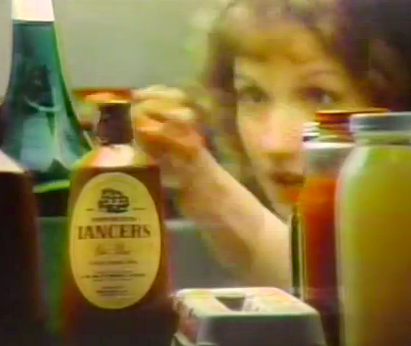
“You don’t need Lancers to catch that cute guy — cook him some vegan eggs.”

These three ads are templates for how to alienate the people you want to attract

Dear Wine Business:

I’ve seen a variety of TV ads recently that struck me as both awful and exactly the kind of thing you’d think was oh so hip and just what wine needed to reach younger people. So, because one of my reasons for being as the Wine Curmudgeon is to try to save the wine business from itself, I’m writing you this note:

Don’t do it! Wasn’t the Roo bad enough?

• Kelly’s vegan eggs: The irony here (other than the idea of vegan eggs) is that the series of ads for a product called Just Egg got a glowing review in Adweek. Now, the review did use words like tropes, hunky, and multi-tasking, so I may not be cool enough to understand it. Still, any ad that says a woman can get that hunky guy by cooking vegan eggs for him, as the Kelly ad does, is pathetic and sexist – aren’t we past the “My wife, I think I’ll keep her” stage?

• The Geneisis SUV: Some woman jumping off a cliff. Fashion models. Sex. More fashion models. More sex. I thought car ads were supposed to feature the car, but I guess not. This is exactly the kind of image ad that wine has traditionally loved, and which has given wine a reputation as aloof, bougie, and snotty.

• UNTUCKit: This commercial solves the greatest problem facing the republic today – “I couldn’t find a shirt that looked good un-tucked.” How do we know it’s the greatest problem facing the republic today? Because the ad tells us so. Again, the sort of arrogance that the wine industry loves to promote, and about as silly as it gets. Does this guy actually think men worry about what their shirt looks like un-tucked?

I hope this advice helps. As always, let me know what else I can do.

The Wine Curmudgeon

studio microphone

Winecast 63: Chris Keel and the independent retailer during the pandemic

chris keel
Chris and Deedra Keel of Fort Worth’s Put a Cork in It

Chris Keel’s small wine shop in Fort Worth, Put a Cork in It, evolved and adapted over the past 18 months, offering a number of retail lessons

Chris Keel’s wine shop is tiny, and it isn’t in a typical retail location. Yet, somehow, his Put a Cork in It shop has thrived for more than 15 years and emerged from the pandemic battered but unbowed.

Chalk that up to Chris and wife Deedra, who have terrific wine sense, a great business knack, and know what their customers want. In this case, it’s a small but excellent inventory, priced properly, and absent of the fads and foolishness that propel the wine business.

“We had to shift from more people coming in to less people coming,” says Chris. “But we’re so small, we adapt quickly and chaos is normal.”

I’ve known Chris almost since the store opened; he let me do a couple of cheap wine book signings. So when Chris talks about wine retail, he’s worth listening to. He mentions several top-notch value wines in the podcast: Gonnet Le Reveur”Cotes du Rhone red; the Italian Banfi Col di Sasso red, and a 1-liter rose from Spain, called Arco.

We also discussed:

• Change in approach: The Keels went from three tastings a week to none — and haven’t had one in the past 18 months. Given that tastings drove purchases, they had to find a different way to drum up business. That meant special orders, something most retailers dislike, and then dislike some more. But that has paid off in increased customer loyalty.

• Delivery mattered: Chris never thought his shop would be able to offer delivery, but he was able to find a group of people to help. At its height, the store made as many as 15 deliveries every day. Which is impressive for an operation staffed by a husband and wife and one employee.

• Keeping focus: Put a Cork in It has always focused on less expensive wines,, and that didn’t change. Yes, it was harder to find quality wines costing less than $12 or less, what with the Trump tariff and the pandemic. But Chris added more Italian wines, and that helped bridge the gap.

Finally, we talked about bringing younger consumers to wine, since the store is near the TCU campus. Chris said tastings were especially successful, and he hopes to resume his outreach to 20-somethings once tastings resume.

Click here to download or stream the podcast, which is about 14 1/2 minutes long and takes up about 10 megabytes. Quality is very good.

studio microphone

Winecast 62: Kimberly Johnson, Philosophy Winery

Kimberly Johnson
Kimberly Johnson: Local wine has to make itself part of local food and local agriculture

Kimberly Johnson and the challenges of running a new, small regional winery during the pandemic — and when your daughter doesn’t drink wine

Kimberly Johnson and Denise Roles Matthews picked a terrific time to start Philosophy Winery. a small regional producer in Maryland — just before the beginning of the pandemic.

Which, oddly enough, wasn’t a problem. Their first wine, a 2019 rose, sold out.

“I have to say, we did very well,” says Johnson, Philosophy’s winemaker. “Everyone was home, they had nothing to do, but to buy on-line, whether it be wine or from Amazon. … We also hand delivered.”

So good news for Drink Local, despite the circumstances. In this podcast, we talked about the challenges facing small and regional producers these days — as well as what do when your daughter doesn’t like wine”

• It’s not enough to start a winery with good intentions. Johnson says she and Matthews treated the process like any other startup, complete with detailed business plan. Which, as she found out, is not necessarily a common practice.

• Local wine needs to make itself part of the local agriculture and food movements. The goal, says Johnson, is to convince consumers that wine is as local as eggs, cheese, and vegetables.  This means using local grapes.

• One key to Philosophy’s success: Selling at festivals, farmer’s markets, and the like — just like other local food products. You have to give consumers a chance to taste different things, she says.

Click here to download or stream the podcast, which is about 13 minutes long and takes up about 8 megabytes. Quality is good — I’m kind of muted, but  Johnson is loud and clear.

Convenience stores to the rescue!

convenience store wine
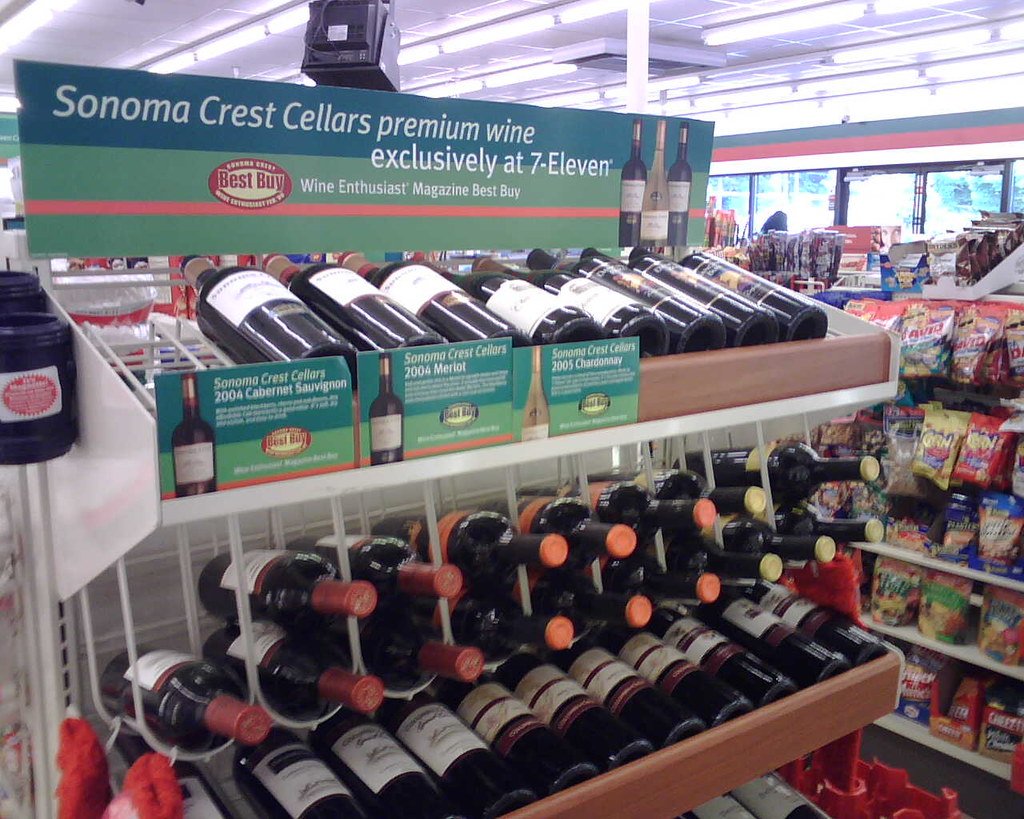
“Hey, honey, pick up some of that 7-Eleven wine when you get the diapers and the milk.”

Forget all the bad wine news – convenience store wine sales are surging

You know all that gloom and doom in the wine business?

Forget about it.

Wine sales at convenience stores surged in 2020, the fourth consecutive year of increases at 7-Eleven, QuikTrip, and the like. Wine sales, as a percentage of store revenue, increased some 20 points, as did average wine sales per store. Plus, more stores than ever sold wine, about 54 percent.

This is impressive enough. But given that overall wine sales remained flat in 2020, despite the pandemic surge, it’s even more impressive. So what’s going on?

First, since restaurants and bars were closed, we bought more wine at convenience stores, says Jeff Lenard, vice president, Strategic Industry Initiatives, for the National Association of Convenience Stores. The numbers come from the trade group’s 2020 “State of the Industry Report.” Plus, says, Lenard, the pandemic changed shopping behavior – so that buying wine at a convenience store didn’t seem nearly so odd.

Which, of course, we’ve seen before. The convenience store business has noticed this change; a recent trade magazine story urged store operators to stock more rose and canned wine, and to consider adding biodynamic and natural wine. Most wine shops don’t even carry much of the latter two. Also worth noting: A nearby  7-Eleven is selling Kendall Jackson chardonnay and Nobilo sauvignon blanc for the same price as several neighborhood supermarkets. When’s the last time a convenience store cared about competitive pricing?

In fact, wine’s growth, though starting from a smaller base, showed more or less the same percentage increases as beer. Which, given the way the convenience store business works, is amazing.

And the best news? “It’s too early to predict where things will go in 2021,” says Lenard, “but so far sales are strong, with stores holding on to some of the gains from changes in behavior in 2020, plus increasing sales from the regular customers returning to everyday life.”

Which, for wine, is even more amazing. Who knew 7-Eleven could be the wine business’ savior?

Photo: “IMG00003.jpg” by patientfox is licensed under CC BY 2.0

More about convenience store wine sales:
• Convenience store wine sales 2019
• Jerry Jones and 7-Eleven wine
• Convenience store wine sales 2018