Tag Archives: three-tier system

Winebits 327: Pennsylvania, wine prices, women winemakers

Winebits 327: Pennsylvania, wine prices, women winemakersThe wine notes that usually appear on Tuesday are posting today because tomorrow is April 1 — and that’s time for the blog’s annual April Fools’ Day post.

? More screwed up than ever: Pennsylvania has been trying to reform its horribly messed up state store system — where the state owns the liquor stores — since as long as I have been writing the blog. Nothing has been done, despite widespread political and consumer support, and the latest proposal shows just how corrupt the system is. Supermarkets would be able to sell wine under the proposed law, but only four bottles per customer per visit. Nevertheless, a spirits trade group immediately denounced the plan, claiming that those four bottles would give the wine business an unfair advantage, since spirit sales would still be limited to state stores. It’s almost impossible to understand what’s going on here, other than to note that this is just another example of the many failings of the three-tier system.

? Britain’s wine pricing: Jamie Goode at the Wine Anorak has an excellent account of the wine pricing controversy in Britain, where most retailers substantially discount wine. And then don’t. And then discount it again. This must seem odd to those of us in the U.S., where discounting is accepted as a normal part of doing business, and where savvy consumers are eager to buy wine when it’s on sale. But British consumer advocates see this as nefarious — “[T]hese fake promotions are bad for wine, and a bad deal for customers, and I won ?t stop talking about them until supermarkets do the right thing and stop them,” writes Goode — and have spent the past couple of years fighting the biggest retailers over the practice.

? You’ve come a long way, baby: Jordan Salcito at The Daily Beast has discovered that women have broken through the glass ceiling and are now important winemakers. I’ll try not to be too cranky about this, but Salcito is about a decade late with this revelation. I wrote the same story for the American Airlines in-flight magazine in 2006, quoting many of the same women she quotes in her story. She also focuses on celebrity women winemakers, and misses the more important change, that Big Wine did most of the glass ceiling work, hiring women where they had never been hired before. Barefoot’s Jennifer Wall is responsible for 13 million cases of wine a year, which may make her the most important woman winemaker in the business. And her boss is Gina Gallo, whose company makes 80 million cases a year. Also, if Salcito doesn’t mind some writing advice, never, ever use a phrase like “pushing the envelope.” I expect more from the Beast.

Winebits 324: WC favorites edition

Winebits 324: WC favorites edition
Will empty tables force restaurants to change the way they approach wine?

Because the things that fascinate me about wine and that consumers need to know — and which rarely include toasty and oaky — keep making news:

? Distributor clout, once again: When in doubt, they get out the checkbooks, reports an Ohio newspaper group. The state’s beer and wine wholesalers donated $146,000 to Buckeye state lawmakers around the time the Ohio legislature passed a bill — apparently, without anyone knowing — that made it illegal for the world’s biggest brewer to buy more distributorships in the state. In addition, said the story, “both Republicans and Democrats benefited from the wholesalers’ cash. And donations sometimes rose noticeably around the time a key vote was scheduled.” My favorite part of the article is the quote that says the distributors, who have a constitutionally-protected monopoly that all but guarantees them profits, were saving Ohioans from the nefarious actions of an evil multi-national beer company. Talk about the pot calling the kettle black.

? Restaurant sales still slow: The restaurant business continues to struggle, says this story from Nation’s Restaurant News, and no one is quite sure why. Is it the result of the worst winter in 40 years? Is it a hangover from the recession, which never really ended for all but the most high-end restaurants? Is it a fundamental shift in the way Americans eat? The restaurant business matters in wine, as regular visitors here know, because restaurants go out of their way to hurt wine. And the slump in restaurant sales, which has lasted more than five years, may force changes in the way restaurants deal with wine, which means better quality and lower prices. Or so some very smart analysts have told me.

? The biggest wine companies: Mike Veseth at the Wine Economist looks at disintermediation, an economic term that refers to the specialization of labor. In this case, it’s about the number of employees needed to to make a case of wine. Not surprisingly, the formula is not as simple as it sounds, and speaks to the way post-modern business works — outsourcing, contractors, and the like. Many of the biggest wine companies don’t own vineyards or even wineries; one company, Castle Rock, produced 550,000 cases with just nine employees. “With product chain disintermediation, the number of people actually employed by a winery can be surprisingly small with that tiny workforce specializing in coordinating the various firms and contractors that make up the links in the chain,” wrote Veseth. What this means for consumers? Less expensive wine, of course, since disintermediation lowers the cost of production.

Image courtesy of Berenika, via stock.xchng, using a Creative Commons license

Winebits 323: Sweet wine, three-tier, high alcohol

Winebits 323: Sweet wine, three-tier, high alcohol
Where do we go? Obviously, not anywhere where three-tier doesn’t exist

? Bring on the Apothic: E&J Gallo, one of the biggest wine companies in the world, is making a play for the British market, and is using its sweet red wine to do the job, reports the Harpers trade magazine. The article describes Apothic as a blend of five grapes, though doesn’t mention that it helped pioneer the sweet red movement in the U.S. Rather, it quotes a Gallo official, who says the wine is “very different from previous Gallo brands, and very polarizing.” Still, he says Apothic is selling better than expected, and has been picked up by most of the country’s major grocery stores. It’s odd that Harpers doesn’t mention that Apothic is sweet; its stories are usually better reported than that. Did the writer leave it out on purpose or just not know? Or figured no one in the UK wine business would care?

? Play that dead band’s song: The Wine Curmudgeon has often noted that Alabama can be in a completely different universe when it comes to wine distribution and sales, even allowing for the eccentricities inherent in the three-tier system. Like this. And this. But this one is nifty, even for Alabama. The state legislature wants to pass a law that would make it more difficult for retailers in Montgomery County, which includes the city of Montgomery, to switch distributors. Imagine the clout that’s required to get a bill like that through, which benefits just a handful of companies. It speaks to the immense power of distributors and why three-tier remains so well entrenched in the supply chain.

? But it’s in Scientific American: Those of us who write about wine regularly argue about high alcohol, often to no effect other than name calling and snarkiness. But consider this — a report in a respected journal that’s not about wine headlined “Wine Becomes More Like Whisky as Alcohol Content Gets High” and that includes news of a new yeast that allows winemakers to produce fruity wine without high alcohol. Plus, there’s Latin in it, which always impresses me. More importantly, does an article in something as prestigious as Scientific American help mend the rift between the pro- and anti-high alcohol factions? Almost certainly not, unfortunately. The two sides just don’t like each other, and personality — and not wine — has become all.

Winebits 322: Availability, lawsuits, wine writing

Winebits 322: Availability, lawsuits, wine writing ? Invisible wines: Mike Veseth at the Wine Economist weighs in on availability and the three-tier system, writing off the recent Eric Asimov column. “Asimov uses the article to respond to readers who are frustrated that the fabulous wines he often praises turn out to be nearly impossible for them to actually experience. … Asimov is sympathetic to his readers ? frustration and explains how the almost hopelessly fragmented US wine market (a lasting legacy of Prohibition) makes it nearly impossible to talk about important wines if you limit your list to only those that can be found in all the nation ?s many marketplaces.” In this, he puts Asimov in perspective, noting that there are tens of thousands of wines that are made around the world, most of which we’ll never get a chance to buy. I’m not so sure Veseth is defending the three-tier system as much he is reminding us that there is more to wine than what we find in the grocery store, and that there is a certain joy in that.

? Bring out the attorneys: Because, frankly, the Wine Curmudgeon takes an almost unhealthy glee in reporting that wine companies are suing each other. This time, Veuve Cliquot, the French Champagne giant, is suing Ciro Picariello, a tiny Italian producer that makes spumante. The former says the latter’s label is the same color as Veuve’s, and that’s illegal. That the wines have nothing else in common save bubbles is apparently irrelevant. And, as Diana Goodman notes in the linked article, the colors don’t look that similar, either. Isn’t it reassuring to see Big Wine spending its money to make a better product?

? “Depths that need to be stirred:” The Italian Wine Guy is one of the best writers in wine in the world today, and I almost always want to leave a comment on one of his posts. And I’d say that even if he wasn’t a friend of mine. So, the next time the wine world leaves you frazzled and worn out, and you’re tired of the foolishness that too often passes for wine writing and criticism, read this post. It will make you feel better. It did me.

sweet red wine

Eric Asimov and the dilemma of wine availablity

Eric Asimov and the dilemma of wine availablity
Eric Asimov loves wine, but not the dilemma of wine availability

The Wine Curmudgeon sometimes feels alone and overwhelmed in the middle of the country, battling away at the nefarious forces that confuse and confound wine drinkers. But on one crucial topic, I am not alone — even the great Eric Asimov of the New York Times, perhaps the best wine writer in the country, must contend with the dilemma that is wine availability.

“I fervently wish all drinkers could find what they want,” he wrote in Tuesday’s Times. “I sympathize with those who can ?t. But the simple solution ? choosing only wines that are easy to find ? is worse than the problem.”

Which is the exact same problem the rest of us have. Get two wine writers together (and sometimes it doesn’t take that many), and the topic that comes up over and over is availability. As in, “I really want to write about this wine, but it’s not for sale in my area. Damn you to hell, three-tier system.”

And somehow, as Asimov notes, the problem — despite technology and the Internet — never seems to get any better. I received an email the other day from a reader in a Dallas suburb, who buys wine at the same two chains where I buy wine. But he shops at different locations, which don’t carry the same wines that the stores near me carry. How much more screwed up can the system be?

Asimov describes the availability nightmare well, from why it exists — the 50 laws in 50 states forced on us by three-tier as well as the whims and wishes of retailers — to why most of the obvious solutions for those of us who write about wine aren’t obvious or solutions. And he realizes that consumers, so used to being able to buy anything else anywhere and at any time, don’t understand why wine is different — and maybe don’t want to understand.

So know this, everyone who has ever been overwhelmed in their search for a specific wine: If someone in Manhattan, the center of the universe, can’t find a wine that Asimov writes about in the Times, which caters to the center of the universe, then what hope is there for the rest of us? That’s the dilemma of wine availability.

More about the dilemma of wine availability:
? Wine availability: Whose fault is it anyway?
? Wine availability: How to find what you ?re looking for when it ?s not on the shelf
? Wine availability, and why it matters to you

The Postal Service’s plan to get into the wine business

Postal service wine delivery

I can deliver wine. Really.

Which ultimately may make about as much as sense as the Postal Service ?s sponsorship of a professional cycling team.

Nevertheless, a top postal official floated the idea last week that the agency, facing a gazillion dollar deficit and not having any other real ideas, should get into the booze delivery business. ?There’s a lot of money to be made in shipping beer, wine, and spirits, ? said the official, who estimated it could be worth $50 million a year to the agency.

This was big news, given that it ?s currently illegal to ship alcohol via the mail. A Dallas TV station was so enamored of the idea that it ran the story, complete with video of drunken college students. One regular blog visitor asked, hopefully, if this was the beginning of the end of the three-tier system.

Of course not. It may not even be especially lucrative. First, very little in the way of spirits is shipped in the U.S. each year, says Jeff Carroll of Ship Compliant in Denver, which helps wineries automate the compliance process. That’s because spirits can’t be shipped to consumers across state lines — laws that eliminate one part of the Postal Service ?s potential market. Beer, apparently, is still trying to figure out direct shipping, and is hampered by even higher shipping charges than wine. So that eliminates the second potential part of the market.

Which leaves wine. And, according to my calculations, the Postal Service would have to capture one-third of the wine direct shipping market to make that $50 million ? an ambitious target for a startup competing with UPS and FedEx. That number is based on the Postal Service charging $4 a bottle (a standard price) and that 38 million bottles of wine were sold via direct shipping in 2012.

More worrisome is that the Postal Service doesn ?t seem to understand the legal niceties involved. Why would someone be quoted as saying they would ship spirits and beer when there was no market for it? It’s also not clear from the stories I saw whether the anyone at the Postal Service understands the three-tier system and its restrictions — that 10 states don’t allow direct shipping and that licenses and approvals would be needed in most of the other 40 for the Postal Service to get legal status as a shipper.

And finally, given that gazillion dollar deficit, what difference is $50 million going to make? Better to sit down with Congress to figure out its future in the Internet Age than waste time and money on something that seems so hit and miss.

Wine terms: Three-tier system

Wine terms: Three-tier systemBelieve it or not, in almost seven years and more than 1,700 blog posts, I ?ve never written a post explaining the three-tier system. There are lots of posts about three-tier and even some explanation, and I ?ve written about it for others. But nothing here.

So what you need to know about the three-tier system, which regulates how everyone in the U.S. buys wine, beer, and spirits:

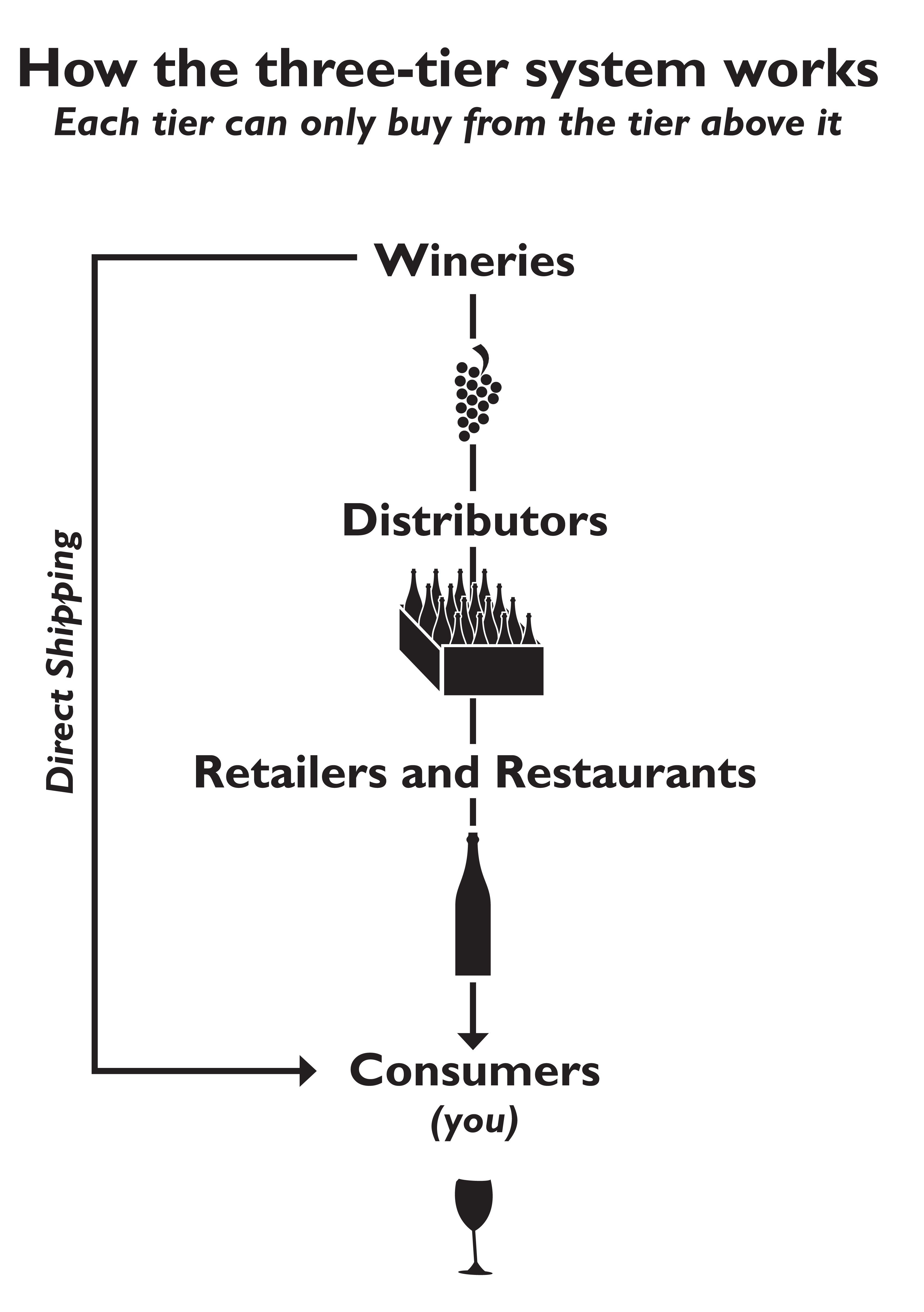
Prohibition, the 18th Amendment to the U.S. Constitution in 1920, outlawed the sale, manufacture, and transportation of alcohol in the U.S. until it was repealed 13 years later by the 21st Amendment. Repeal gave us the three-tier system, so named because it has three parts: The first tier are the producers, the wineries, breweries, and distilleries. They can only sell their product to a distributor, the second tier. Only the distributor can sell to retailers and restaurants, which are the third tier. Save for limited exceptions, like direct shipping, and which total less than 10 percent of all wine sales, the consumer can only buy wine from the retailer or restaurant.

This makes wine different from almost every other consumer good in the world. If you want to buy a computer from Dell or shoes from Nike, each is only a couple of mouse clicks away from the manufacturer’s website. And Amazon has become a $61 billion company by serving as the ultimate retailer, crossing state lines to sell its customers everything from books to underwear.

But ordering wine from an out-of-state producer is a crime in much of the U.S., and it’s a crime in every state to order wine from an out-of-state retailer. On-line retailers like Wine.com, which is in 42 states, have to legally qualify as an in-state retailer (by setting up an office or a warehouse, for example) to be allowed to do business in those states. And even Amazon, with its new Wine Marketplace, has to abide by these rules. Technically, it doesn ?t sell wine, but serves as a conduit to retailers and producers that are legally allowed to sell it.

How did we get to this point? Why is alcohol different from running shoes? Because the political compromise that ended Prohibition allowed each state to regulate alcohol in its own way. Three things are important about this:

? Every state ended up using some form of the three-tier system, and every state has modified the three-tier system to what it thinks works best for it. Which means there are 50 laws for 50 states, and sometimes different laws within states. Pennsylvanians can only buy wine from retailers owned and operated by the commonwealth. New Yorkers can’t buy wine in grocery stores. Montgomery County, Md., residents can’t buy wine at retailers like Cost Plus World Market, but residents of adjacent Prince George’s County can.

? Three-tier was designed to keep organized crime out of the booze business, which is understandable given the role organized crime played in bootlegging during Prohibition. Every liquor law attorney I have ever talked to says that ?s an important reason why three-tier has endured. State attorneys general and state liquor control boards, given three-tier ?s success in keeping the mob out of booze, don ?t see any reason get rid of it.

? The distributors, and especially those that deal in beer and spirits, don ?t want three-tier to change, and spend millions and millions of dollars annually lobbying state and federal legislators to preserve the system. This is understandable, too, given that the end of three-tier would mean the end of distribution as they know it. Their allies, surprisingly, are often independent retailers, who don ?t want their chain competitors to be able to buy wine directly from the winery, since that would give the bigger companies better pricing.

The worst part about thee-tier? We ?re stuck with it. A variety of federal court decisions, including Siesta Market in 2010, have said that three-tier is constitutionally protected, just like freedom of speech and freedom of religion. The 21st Amendment, say the various rulings, shelters three-tier from court challenges and state and federal legislation to alter it.

Yet none of this means three-tier is relevant in the 21st century. Prohibition ended 80 years ago, and organized crime has moved on. It ?s difficult to believe that rum running would be as profitable as today ?s pastimes, like credit card and bank fraud. In addition, we ?ve made tremendous strides in combatting alcoholism and drunk driving in the U.S., and these abuses are always given as a reason for three-tier.

For wine drinkers, three-tier limits consumer choice. Do you live in Illinois and had a wine you liked at dinner in Wisconsin? Did you try to buy that wine in Illinois only to find that it isn’t available? That’s the fault of three-tier. Just because a distributor in Wisconsin carries the wine is no guarantee that a distributor in Illinois will carry it. The Illinois distributor may not like the wine or the person who makes it or how much it costs. So they decide not to carry it, and you can’t buy it ? even though it’s available in another state just a half-hour drive away.

This is an especially acute problem for cheap wine. Distributors, all things being equal, prefer to deal with the biggest producers. They can get better pricing, the supply chain is more efficient, there is money for marketing, and they’ll have more wine to sell since big producers deal in tens of thousands of cases.

But much cheap wine ? perhaps the most interesting cheap wine ? is made by smaller companies that don’t produce tens of thousands of cases, can’t offer the best prices, have less efficient delivery systems, and whose wines are more quirky. So they have more difficulty finding a distributor ? and often can’t.

This is such a problem that there are trade events for wineries that don’t have distributors, held in the hope that a distributor will sample their wines and then take them on. It’s kind of sad, actually. Meanwhile, smaller wineries that do have distributors usually have to settle for smaller distributors that have less clout with retailers, which means the producer’s wines are limited in availability and may even cost more.

I ?m resigned to three-tier, given the court rulings. But that doesn ?t mean I have to be happy about it.