



Tag Archives: sparkling wine

Mini-reviews 93: Barefoot bubbly, red Loire, Ridge, red Cahors

Barefoot bubblyReviews of wines that don’t need their own post, but are worth noting for one reason or another. Look for it on the final Friday of each month

• Barefoot Bubbly Brut Cuvee NV ($10, sample, 11.5%): One of the most frustrating things about reviewing wine is consistency of the product. I’ve written glowing reviews of this wine, but when I tasted the most recent sample, it was almost flat and devoid of flavor and character. Is this a flaw with this specific bottle of wine? Is it a problem with the current “vintage?” Or is it a problem in the supply chain, where the wine sat in a warehouse or delivery truck? I think the last, since I’ve had this problem with sparkling wine from many producers at many prices over the past 18 months. This is one of the disadvantages of non-vintage ones; you don’t know how long it has been sitting and getting worse.

• Domaine de la Chanteleuserie Cuvée Alouettes ($17, purchased, 12%): This red wine, from the French region of Loire, is an excellent example of what the Loire can do with cabernet franc – red berry fruit, freshness, graphite, spice, and length. It’s clean through the palate with surprisingly soft tannins. Highly recommended.

• Ridge Geyserville 2014 ($35, purchased, 14.5%): This California zinfandel red blend isn’t anywhere near ready to drink, and needs at least another year (if not longer). Until then, look for ripe black fruit and a lot less of the style and elegance that Ridge is known for.

• Château Lafleur de Haute-Serre 2014 ($10, purchased, 13%): This French red, made with malbec from the Cahors region, is not what I’d hoped given that it’s from Georges Vigouroux, a fine producer. It’s just ordinary, 1970s style wine with too much unripe fruit and a rusticity that isn’t as much charming as annoying.

Winebits 475: Italian wine and sparkling wine

This week’s wine news: The Italians regained the top spot as the word’s biggest wine producing country in 2016, plus sparkling wine in France and England

• No. 1: Italy became the world leader in wine production during 2016, according to the Italian farmers association Coldiretti. Italy, Spain, and France take turns producing the most wine in the world; the Spanish have been first the past couple of year. Also worth noting: Italian wine exports to the Champagne region of France grew 57 percent last year. If the story in the link is correct, this meant that people in Champagne were buying Prosecco, the Italian sparkling wine. This raises all sorts of Python-esque questions, especially given the Champagne region’s take no prisoners attitude toward other sparkling wine.

• Sparkling legal battle: What happens when two French wine regions disagree about who should be allowed to make sparkling wine (and neither of them is Champagne, to continue our Python theme)? There is a lawsuit, of course. Wink Lorch at Wine-Searcher.com reports that the Clairette de Die appellation has been given permission to make rose sparkling wine using a little known technique called methode ancestrale. This has drawn the ire of the Bugey-Cerdon appellation, which is currently the only region allowed to make rose sparkling using methode ancestrale. Not to worry if you’ve never heard of methode ancestrale or either region; Lorcher says very people in France have. The dispute, in fact, may not be about those regions or the technique as much as it is about establishing a precedent to allow better known appellations, like Beaujolais, to make methode ancestral rose sparkling.

• It’s good to be the queen: The Queen of England has sold out her winery’s first release of sparkling wine. This is newsworthy because it’s English wine, and there isn’t that much of it; second, because it shows English bubbly has overcome many of the obstacles facing regional wine regardless of where it’s from; and third, because the article includes a quote from someone who didn’t taste the wine saying how wonderful it is. And people wonder why there will always be an England.

new year's sparklng wine 2018

New Year’s sparkling wine 2016

New Year's sparkling wineFour New Year’s sparkling wine recommendations that combine value and quality

If you want Champagne recommendations for the New Year, you’ll have to go here. Champagne? We don’t need no stinkin’ Champagne.

In fact, even without the Wine Curmudgeon’s Champagne boycott, the sparkling wine from the Champagne region of France keeps getting more expensive and doesn’t show any real improvement in quality to match the higher prices. And the bargain Champagnes on the market, the ones that cost around $20 or $25? When a $20 wine is touted a bargain, that’s all you need to know.

Hence my sparkling wine 2016 recommendations, which focus on affordability and value.

Also handy: The blog’s annual wine gift guidelines and the sparkling wine primer.

• Camino Calixo Brut NV ($10, purchased, 11.5%): Very lemony dry Spanish bubbly with tight bubbles and crisp finish. Think of it as a softer version of Hall of Fame standby Cristalino. It’s more of a food wine than I expected, so consider this for a New Year’s brunch.

• Carpene Malvolti 1868 Extra Dry NV ($16, sample, 11.5%): This Italian Prosecco isn’t as sweet – extra dry means sweeter than brut, which means dry – as some brut Proseccos. Very well done, with lemon fruit and a creaminess you don’t usually find in this price of wine.

• Valdo Prosecco Brut NV ($12, sample, 11%): This year’s bottle was more Champagne-like than last year’s, which wasn’t a bad thing. It was firmer, with more structure, less sweet citrus fruit, and an appealing character that said, “This is more than a cheap Prosecco.” Highly recommended.

• Gérard Bertrand Brut Rosé Cuvée Thomas Jefferson 2013 ($16, purchased, 12%): This French cremant (a sparkling wine from a region that isn’t Champagne) had tight bubbles and cherry fruit. It’s an intriguing wine, made with chardonnay and pinot noir just like Champagne. I would have preferred less chardonnay, which made it rounder, and more chenin blanc, the third grape in the blend.

More on New Year’s sparkling wine
• New Year’s sparkling wine 2015
• New Year’s sparkling wine 2014
• New Year’s sparkling wine 2013
• Wine of the week: Segura Viudas Brut Rose NV
• Wine of the week: Vega Barcelona Seleccion NV

Wine of the week: Perelada Brut Rosado NV

Perelada Brut RosadoWant value and quality? Then the Perelada Brut Rosado is a holiday must

The wine business, and especially the Champagne part of it, has taught us that sparkling wine matters only if it’s made with chardonnay or pinot noir. The Perelada Brut Rosado is here to say otherwise.

It’s made with garnacha, the Spanish version of the grape that produces a wonderfully ripe, cherry-ish flavor, less subtle than pinot noir’s more elegeant cherry. But it’s perfect for the Perelada Brut Rosado ($10, purchased, 11.5%).

That’s because cava, the Spanish sparkling wine, can be a little tonic-like in the wrong hands. The traditional cava grapes offer freshness, some lemon, and not much else if the winemaker isn’t careful. But the way the garnacha is used here fills out the wine, and makes it even fresher and more fun.

Drink this chilled anytime you want bubbly, whether to celebrate over the next week, or because it’s Tuesday night. Highly recommended, and a candidate for the 2017 $10 Hall of Fame when it debuts next week.

Christmas wine 2016

Christmas wine 2016Four choices for Christmas wine 2016 to help you enjoy the holiday
Suggestions for Christmas wine 2016 – either for a last-minute gift for a wine person, or to drink with all those upcoming holiday dinners and leftovers. As always, keep our wine gift giving tips in mind:

• Farnese Fantini Rose 2015 ($10, purchased, 13%): An Italian pink wine that is fruity (very red cherry) and fresh. It’s not quite in the New World style, but it’s not quite Provencal, either. Very nicely done, and the sort of wine to enjoy at a holiday party and marvel at its cost and quality.

• Olivier Leflaive Bourgogne Blanc Les Sétilles 2013 ($22, purchased, 12.5%): Top-quality white Burgundy (made with chardonnay) at a remarkable price and that has all the things it should have — apple fruit, white pepper, that certain amount of oak. This wine is still young and a little tight, making it a fine value if you want to buy a couple of bottles to hold, either as a gift or for yourself.

• Campo Viejo Cava Gran Brut Rosé NV ($10, sample, 12%): This grocery store Spanish sparkler can be inconsistent, but this bottle was everything I hoped for – varietally correct, tight bubbles, and fresh, cherryish fruit. A nice value, whether you want an aperitif or something to toast with.

• Bonny Doon Le Cigare Volant 2012 ($45, purchased, 13.5%): This California Rhone-style blend from the irrepressible Randall Grahm shows why his wines are so interesting. It’s both earthy and refined, for one thing, with a wonderful foresty aroma and dark but not forbidding fruit. Plus, it will age for at least another decade, and get even more intriguing as it does. Highly recommended. If you know someone who wants to venture outside of their California cabernet sauvignon comfort zone, give them this.

More about Christmas wine:
• Christmas wine 2015
• Christmas wine 2014
• Christmas wine 2013
• Expensive wine 88: Penfolds Bin 407 Cabernet Sauvignon 2013
• Expensive wine 86: Louis Latour Corton Grand Cru 2004

Wine and food pairings: One Thanksgiving turkey, five dinners, five wines

five dinners, five wines
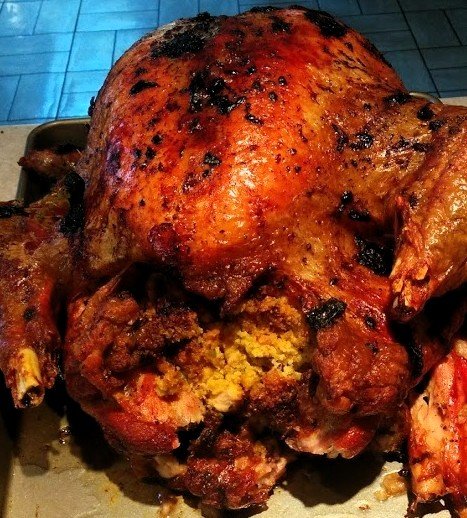
Who knew this turkey would lend itself to five dinners and five wines?

What do with a 20-pound turkey? Use it to for five dinners paired with five wines

This year, the Wine Curmudgeon’s Thanksgiving turkey weighed 20 pounds. My old pal Jim Serroka, who shares holiday cooking duties with me, wanted lots of turkey for leftovers. Needless to say, we got them – as well as another post in the blog’s wine and food pairings series: One entree that can be turned into five dinners with five wines.

The goal here was to pair quality cheap wine with the leftovers as simply as possible – no wine geek for advice, no examining the turkey’s entrails for wines to drink. My wine and food pairings:

• The Thanksgiving turkey. Roasted with lots of herbs and vegetables, and stuffed with the Kleinpeter family’s traditional chicken cornbread dressing. I picked three wines; two were disappointing, proving that even I can over-think wine and food pairings. But the third was an old pal, the $16 Clos de Gilroy grenache from Bonny Doon. How winemaker Randall Graham gets cherryish fruit, a little earthiness, some white pepper, and a delightful freshness from California grenache is beyond my understanding, but I’m glad he does.

• Turkey rice cake. One of my great cooking discoveries was that rice freezes. Make eight cups in the rice cooker, divide it into 2- or 3-cup packages, freeze, and thaw when necessary. This was chopped leftover turkey, some of the roasted vegetables, and an egg mixed with rice; basically the same thing I did with noodles for the roast chicken post. The wine was a sample, the $25 Markham merlot – dependable and high quality and what California merlot is supposed to taste like – lighter and more approachable than cabernet sauvignon, with dark fruit and subtler tannins. And it didn’t overwhelm the rice cakes.

• Turkey sausage okra gumbo. I’ve been making this with leftover Thanksgiving turkey since I moved to Dallas, so long ago the city had two newspapers. It’s more or less the classic recipe – make the roux, add chopped onions, celery, bell pepper, and garlic, stir, add the stock, stir, add the okra, let it simmer, and finish with the sausage and turkey. And no tomatoes – absolutely, positively no tomatoes. The wine was an $8 Rivarey Crianza, a tempranillo from the Rioja region of Spain. It was simple and fruity, but with enough structure and backbone for the dark, smoky gumbo.

• Baked turkey Reubens. This is a Siegel family tradition; my Dad made these when I was a kid using Pepperidge Farm brown and serve rolls and leftover Thanksgiving turkey. It’s sliced turkey breast, quality Swiss cheese, canned and drained sauerkraut, and my Dad’s thousand island dressing (his secret ingredient was lime juice). Make the sandwich, wrap in foil, and bake until crusty. And what better wine than rose? The Ned, a $12 New Zealand pink wine, did the trick, and it will be even better in six months. This was a 2016, and had only been in the bottle for six or eight weeks.

• Turkey torte. This sort of baked Spanish-style omelette is usually made with potatoes, but turkey (with sauteed onions and peppers) works well, too. I drank a bottle of cava, a $10 Spanish sparkler called – believe it or not – Lady of Spain. The wine has been inconsistent, but this bottle was very cava-like, with tight bubbles and lemon fruit. And, of course, Spanish wine with a Spanish dish, one of the ways to make pairings work with less trouble.

More on five dinners, five wines
• One chicken, five dinners, five wines
• One pork shoulder, five dinners, five wines

Wine of the week: Segura Viudas Brut Rose NV

Segura Viudas Brut RoseThe Segura Viudas Brut Rose can make even a curmudgeon happy.

There are days when even I am worn out by my whining and carping and complaining, about trying to save the wine business from itself, about beating my head against Google’s Internet Iron Curtain. That’s when I buy a bottle of the Segura Viudas brut rose and appreciate some truly great cheap wine.

The Segura Viudas brut rose ($8, purchased, 11.5%) is one of the handful of cheap wines that shows what happens when a producer – even a gigantic one like Segura owner Freixenet – cares more about quality than focus groups. I’ve been drinking this Spanish sparkling wine (as well as the Segura brut) since before I started the blog, and it has never let me down.

It has changed over the years, becoming a touch softer and with less acidity than other cavas, but it remains cava and not some bastardized knockoff. Look for bright red fruit, a rich, bubbly mouth feel, and that particular fresh and minerally cava finish. How this is done for less than $10, when much inferior Prosecco costs $12 and $15, is something that even baffles me – and I’m supposed to know these things.

Highly recommended, and it will take its rightful place in the 2017 $10 Hall of Fame in January. Drink this chilled on its own, or with almost any food imaginable, including big red meat.