

Tag Archives: drink local

Winebits 537: Good news – and a conundrum – for regional wine

regional wineThis week’s wine news: A regional wine roundup, featuring more deserved good news and one intriguing conundrum

• Bring on the regional wine: Jessica Dupuy, perhaps the top regional wine writer in the country, tells Sommelier’s Guild readers that “While California, Washington, and Oregon continue leading in both sales and overall familiarity, an exponential increase in wine production and vineyard plantings in New York, Virginia, Pennsylvania, Michigan, and beyond has started to paint a more definitive picture of the future of American wine.” Her best bests for top regional wine? Texas, Michigan, Arizona, Colorado, and New York.

• Bring on Michigan wine: Paul Vigna, another top regional wine journalist, agrees about Michigan: “Now I’m a believer, having tried samples of everything from still wines to sparkling, including Cabernet Sauvignon, Syrah and Gewurztraminer.” This is no surprise to those of who have followed the state’s success, despite weather that doesn’t always cooperate and the state’s up and down economic climate.

• But not at Cooper’s Hawk: I met Tim McEnery about the same time we started Drink Local Wine; Tim had a restaurant in suburban Chicago called Cooper’s Hawk that made wine. But it wasn’t Illinois wine – it was made in Illinois using grapes from California. Tim’s business model was based on the assumption consumers didn’t especially care where the wine was from. Needless to say, we had a discussion or two about the idea. Today, as Mike Veseth notes in the Wine Economist, Cooper’s Hawk is the 34th biggest winery in the country (bigger than Hall of Fame regular McManis) with 30 locations in 30 states. Cooper’s Hawk has always been a conundrum for those of us who support regional wine, since there’s nothing particularly local about the product. What does its success say about the drink local movement, which has also had its share of successes?

Eight years of Texas wine and the Kerrville Fall Folk Festival

Texas wine
Yes, that’s the Wine Curmudgeon in the hat on the left.

Talking about Texas wine to Texas wine consumers for almost a decade at the Kerrville Fall Folk Festival

In 2008, about nine months after I started the blog, I made my first appearance at the Kerrville Fall Folk Festival to talk about Texas wine. I didn’t do it this year; the event was canceled in the wake of Hurricane Harvey.

But in those eight years (I missed 2016 because of a conflict), I’ve seen two things: the growth and maturity of Texas wine, and the increasing enthusiasm for it from the audiences at the wine seminars.

I’ve been hard on Texas wine over the past couple of years, and deservedly so. But that shouldn’t obscure the improvements over the past decade, which have been on display at the wine seminar every Labor Day weekend. The wines are more professional and are made for wine drinkers, and there are fewer of the home-schooled wines made because the winemakers liked them that dominated the industry at the end of the 1990s and the beginning of the 2000s. That’s why there are so many Texas wines on store shelves, another change from 2008. Better quality means more retail outlets.

All of which has been terrific. But the audiences have been even more fun – smart, curious, and eager to embrace Texas wine. All they wanted was quality wine at an affordable price. This always reminded me that there was an audience for local wine, and that it was up to the winemakers to reach that audience. If you don’t make something people want, they don’t have to buy it, no matter what the Winestream Media implies.

We didn’t sell out every year, but we had large crowds most of the time. This included our regulars, people who came to the seminar every year. We had our hecklers, too, including one man who gave the panel moderator, John Bratcher, such a hard time you’d have thought we were discussing something important, like the survival of the republic.

And the best part came when the audience booed the one person every year – and there was always one person – who said Texas wine and local wine didn’t matter.

The other three things I’ll never forget about the festival? The legendary Rod Kennedy, who made the entire thing possible. The music, of course – Cook a chicken! And the traffic police, because you’re not supposed to drive faster than 5 mph, no matter how difficult that is to do.

Image courtesy of the Kerrville Folk Festival, using a Creative Commons license

three-tier failure

Regional wine update: Virginia, Texas, Lake Erie

regional wineFour regional wines that show just how far Drink Local has come in the past decade
Regional wine has come a long way in the decade-plus of the blog’s history, from an afterthought in most of the country to an important part of the wine business in a dozen or so states. How far has it come? Consider these four regional wines:

• Breaux Vineyards Cabernet Franc Lafayette 2015 ($26, sample, 13.5%): Virginia wine quality is so much better than the first time I tasted it, more than 20 years ago, that it’s almost hard to believe. The Breaux is a case in point: A well-made, bright, and approachable East Coast cabernet franc in a fruit forward (cherry?) style without flaws, oddities, or regional wine goofiness. Plus, structured tannins to offset the fruit and lots of balance. And, even at this price, a fair value.

• McPherson Cellars Reserve Roussanne 2015 ($18, purchased, 13.5): This may be McPherson’s best reserve roussanne, which is saying something since it has traditionally been among the finest wines in Texas. Impeccably made, with lime fruit and just enough oak to balance the acidity. This is not a one-note wine, but is still very young and tight. It will age for at least three or four years, if not longer, and will open up and become more expressive with fruit and aroma. Highly recommended.

• Fall Creek Sauvingon Blanc Vintners Selection 2016 ($21, sample, 13%): It’s too hot in Texas to make quality sauvignon blanc, but Fall Creek’s Sergio Cuadra has found a way to do it. This wine is more Chilean in style, not surprising since Cuadra is Chilean — tropical and lime fruit, as well as herbal (mint and lemongrass?), but still crisp and fresh. In this, as befitting its price, it’s more elegant than most one-note sauvignon blancs.

• Presque Isle Eskimo Kisses 2016 ($30/375- ml bottle, sample, 12%): This ice-style wine from the Lake Erie appellation (parts of Ohio, Pennsylvania, and New York) is a tremendous value, about half the price of traditional ice wine. Yet it still hits most of the ice wine highlights – rich, luscious, honeyed, with a just a tiny bit of lemon. This vintage is still quite young, and probably needs another year in the bottle. The bad news? Very limited availability, still a problem for the regional wine business.

Winebits 499: Rose’s popularity, Yellow Tail, Texas wine

Instagram
No need to put this on Instagram. We’re not drinking rose.

This week’s wine news: Instagram made rose popular – who knew? Plus Yellow Tails’ profitability and a Texas wine overview

• Hipster rose foolishness: The reason for rose’s surge in popularity? It’s not quality or price or improved availability. It’s Instagram, the social media network that is popular among young people. The Wine Curmudgeon does not dispute the power of social media, but I will point out one thing that the woman who wrote this post apparently didn’t know. The people who buy the most wine in the U.S. are older than 40 or so. Nine out of 10 Instagram users are younger than 35. That’s a contradiction that needs to be explained. Until then, I will settle for quality and and price.

• Yellow Tail profitability: Want to know how the family that owns the Australian Yellow Tail brand makes so much money selling cheap wine? David Morrison has one answer on his Wine Gourd blog: Look at the exchange rate between the U.S. and Australian dollars. Every one penny movement in the currency equated to around $A2 million in higher sales revenue for Yellow Tail. Hence, a weak Aussie dollar means more money for the Casella family. That Yellow Tail and Barefoot can make money – lots of money – selling $6 wine in the age of premiumization speaks volumes about how well they understand the wine business and how well so many of their competitors don’t.

• Spot on on Texas: The Wine Curmudgeon regularly laments the poor coverage regional wine gets from the Winestream Media, as well as from the non-wine press. But that’s not the case this time, with a well done piece from Courtney Schiessl on Vinepair. Other than the very tired “things are bigger in Texas” opening (where was an editor?), she gets Texas right – what has happened here, what is happening, and what we need to continue to do to improve quality. That’s not always easy for someone not familiar with a region to do, but good to see when it happens.

Six things to ponder after judging Colorado Governor’s Cup 2017

Colorado Governor’s Cup 2017Colorado Governor’s Cup 2017: Top-flight wines and top-flight judges

1. Why the quality of the judges at this competition is always so good – especially since it’s a regional event and not very big. This year, the judges included Doug Frost, the Godfather of regional wine; Wayne Belding, a fixture at most of the country’s major competitions; Dave Buchanan, who has been writing about Colorado wine almost before there was any; and Andrew Stover, who runs the country’s premier regional wine wholesale company.

2. Why the Rocky Mountain Dart Association was holding an event at the same hotel at the same time. I saw more darts in two days than I’ve seen in my entire life.

3. Why the first day of judging, when we did about 80 wines, was so lackluster given that quality had improved in the past couple of years. Though, oddly, we did give a gold medal to a chardonnay, traditionally the worst regional wine varietal. But the second day, when we picked the 12 best wines in the competition, was completely different. Two wines – a cabernet franc and an albarino sparkling – were stunning. The cab franc was so complex and so terroir driven that I wondered for a minute if it was made with Colorado grapes.

4. How a 17-year old wine from Colorado, the 2000 Terror Creek pinot noir, could have lasted this long. Belding brought a bottle from his cellar for us to taste, and it still smelled like pinot noir, earthy and mushroomy, and still tasted like pinot, with herbs and cherry fruit.

5. How long I’ll be on the screen – or if I will be at all – for the Colorado wine video that was being shot during the competition. I did an interview for it, but given the way these things works, the 10 or 12 minutes that I taped could turn into one head shot and a quote lasting a couple of seconds.

6. If anyone knows how to get the lights in a Springhill Suites room to go on and off with some sort of coordination. I always end up having to hit three or four light switches to get the light in the part of the room where I need it.

Winebits 494: Wine Spectator, Warren Buffet, song royalties

warren buffetThis week’s wine news: A compliment for the Wine Spectator, plus Warren Buffet takes on three-tier and more wineries can legally play music

• Well done, Dr. Vinny: The Wine Spectator gets a lot of well-deserved abuse in this space, but when the magazine does something right, that should be mentioned, too. In its Dr. Vinny wine advice column, the doctor told a reader to stop being such a wine snob: “Most wines sold here are on the sweet and simple side and cost less than $10 – and I think that’s OK. I want wine to be accessible and part of our culture. I love that I can turn on the television and regularly see characters holding a glass of wine. As much as I’d like to share my passion with everyone I know, I don’t feel a need to dictate style. There are styles to appeal to every palate. It would be boring if we all had the same thing in our glass.” Dr. Vinny, that’s a 100-point answer.

• Taking on three-tier: Warren Buffet’s Berkshire Hathaway holding company owns a Texas food distributor, and the distributor wants to sell alcohol in Texas. To do so, it needs a state wholesalers license, but the state doesn’t want to give it one. Hence, legal wrangling and perhaps a lawsuit. The story describing all this, written by long-time journalist Liza Zimmerman, does a good job explaining a very complicated subject, though I wish she had been a little more even-handed in assessing the need for three-tier. Still, the point is well taken: If even Buffet, long regarded as one of the great capitalists and entrepreneurs in the history of the world, thinks three-tier is obsolete, why are we still messing with it?

• Solving the royalty problem: Anyone who has heard recorded or live music at a winery, and especially a small winery, may have been party to a copyright law violation. That’s because many wineries were playing music without paying royalties. This is another controversial and complicated topic that has been going on for years; it’s enough for us to note that the companies that collect royalties for musicians are notorious for their diligence and that many of the wineries couldn’t afford to pay the royalties even if they knew about them. Finally, though, a compromise, brokered by the Wine America trade group, which should solve the problem – affordable royalties. I mention this because music, live and recorded, is key to the survival of many local and regional producers, and anything that helps Drink Local is welcome.

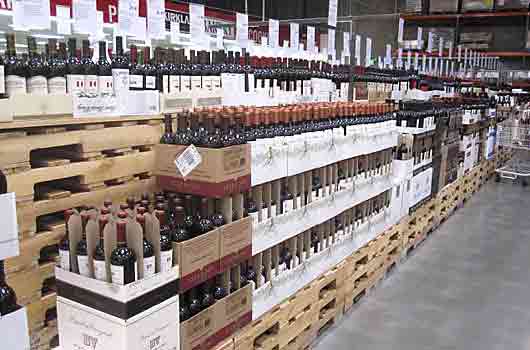
Costco wine: Let’s drink local

costco wineCostco, perhaps the most influential wine retailer in the world, wants to sell regional wine

How does Costco – perhaps the most influential wine retailer in the world – decide what to carry? It wants to drink local.

Annette Alvarez-Peters, who oversees the chain’s wine buying, said half of the its wine labels change regularly and that its 12 regional buyers look for local wine to help fill in those blanks. Or, as she told a California trade seminar: “It really has to be, ‘Why is your item so compelling, and why does your item fit in our section?’ ”

This is one of the few times that Costco and Alvarez-Peters have defined publicly what the chain is looking for; Costco has traditionally been reluctant to discuss its wine buying practices. This matters because it sells so much wine, almost $2 billion worth in 2015, equal to about four percent of the U.S. total – and in just 412 stores.

And that Costco wants to drink local is another reason to declare victory in the battle for regional wine recognition. The retailer can carry any wine it wants, and even the biggest producers make tremendous price concessions to get on its shelves. Which means that Costco is saving space for bottles not from Big Wine, but from small, local producers.

I learned about this recently when the Costco buyer for Texas approached one of the state’s wineries. The winery, its sales person told me, was flabbergasted. Why would Costco want to sell its wine? If nothing else, it didn’t make enough to fill one of Costco’s huge displays. But quantity doesn’t matter as much as quality, part of what the chain’s founder/guru Jim Sinegal told me years ago when I was lucky enough to interview him for an airline in-flight magazine. The retailer wants shopping to be like a treasure hunt, where its customers run across something they didn’t expect to find. In this case, quality local wine.

So pay attention, all those retailers and restaurants that don’t want to drink local. If Costco can do it, why can’t you?

More on Costco wine:
• Costco wine and its retail domination
• Costco and its role in the wine business