







 The latest Bordeaux wine marketing plan will probably fail, just as the others did, because it doesn’t understand that price is all – and Bordeaux costs too much for most of us to buy
Dear Bordeaux wine business:
I understand your current difficulties, what with the pandemic and the Trump tariff. I also understand how desperately you want to reach younger wine drinkers, since that will help with many of your current difficulties. Hence, once again, I take keyboard in hands to offer advice you don’t seem to be getting elsewhere – why Bordeaux is in such trouble with everyone under 35. Or even 40.
It’s price. Your wine costs too much, and anyone who isn’t a wealthy Baby Boomer probably isn’t going to buy it. There’s less and less quality $10 Bordeaux for sale in the U.S., and no one looks harder for these wines than I do.
And you have no one to blame but yourself. To most wine drinkers, Bordeaux means high prices and exclusivity, and you have been perfectly happy with that for years. Hence, I get offers from retailers pitching $650 bottles – on sale. And emails about academic studies touting your wine as an investment option – hardly what a 20-something wants to drink with takeout Chinese food.
But now that business is bad, you aren’t happy. But the catch is that you still don’t see price as the problem. Your new marketing campaign, aimed at young people, includes $30 wine. I rarely buy $30 wine, and I do this for a living. So why would someone else, who just wants wine because they want a glass of wine, spend $30?
Yes, yes, I know: Bordeaux makes the best wines in the world, gets the highest scores, and so on and so forth ad nauseum. Which is all well and good for wealthy Baby Boomers, but what does any of that have to do with someone who wants a half-bottle of wine for a Tuesday night dinner of leftover pizza? This is the thing you haven’t understood in years. You assume that all wine drinkers drink wine the same way – plan their meal, find the best wine for the meal, get out the corkscrew, pour the wine, and sit down and eat.
How much more Baby Boomer can you get?
Which leads us back to pricing: You already have the perfect entry level wine, the red Chateau Bonnet. It’s well-made, varietally correct, and offers an idea of what red Bordeaux is supposed to taste like. The catch? It costs as much as $18 in the U.S., which is almost twice its price not all that long ago. And the white is still $10 to $12 in this country, something that makes no sense at all. I love the red Bonnet, but it’s not worth $18.
That it costs $18 speaks to how you’ve lost touch with U.S. consumers, and why younger drinkers opt for a $6 Trader Joe private label from California – if they’re drinking wine at all. Figure out how to fix that kind of bloviated pricing, and you don’t need any fancy marketing plans to sell your wine to young people.
Hope this helps; I’m always ready to do more if need be.
Your pal,
The Wine Curmudgeon
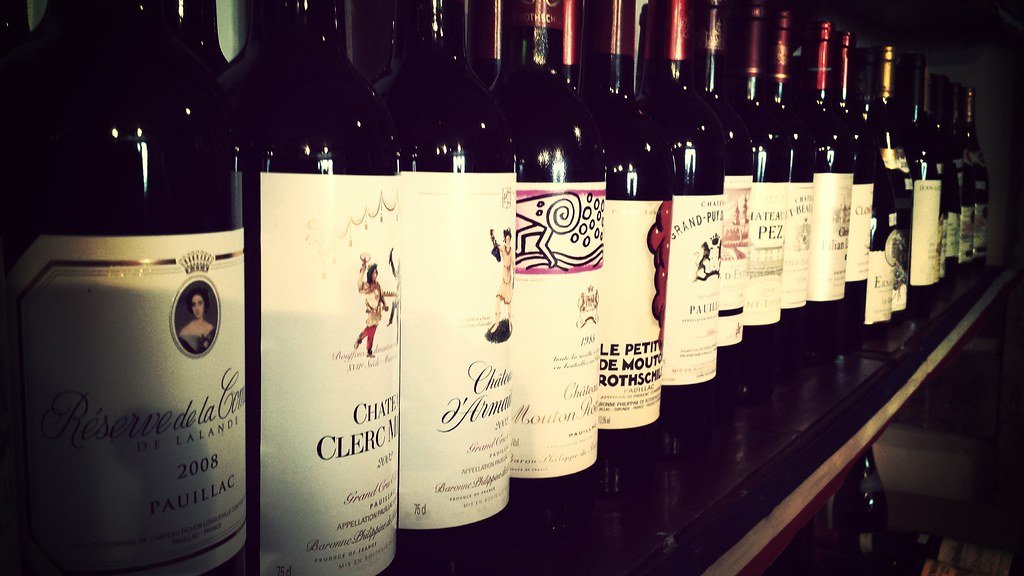
Photo: “Bordeaux Wines at Fareham Wine Cellar” by Fareham Wine is licensed under CC BY 2.0

 Reviews of wines that don’t need their own post, but are worth noting for one reason or another. Look for it on the fourth Friday of each month
 Fourth of July wine 2018: Four bottles to enjoy to celebrate the holiday
 The Wine Curmudgeon grew up when French wine ruled the world, and I have watched with sadness as the French — and especially in Bordeaux — have done everything they can to teach the world to ignore French wine. It’s not just that so much Bordeaux is overpriced and underwhelming, but that the Bordelais are in such denial about it.
  This will sound like damning with faint praise, but it isn’t meant to be. Rather, this review of the Ch teau Moulin De Mallet speaks to how much the wine world has changed over the past couple of decades.
  What better way to describe this wine than with a quote from my pal Jim Serroka. Jim drinks wine, but is not as serious about it as the Wine Curmudgeon. As such, he often provides much needed perspective. Said Jim: "This is what I thought wine was supposed to taste like."