


Tag Archives: Australian wine

Wine of the week: d’Arenberg The Stump Jump Cabernet Sauvignon Merlot Petit Verdot 2019

d'Arenberg The Stump Jump Cabernet Sauvignon Merlot Petit Verdot 2019
Wine of the week: d’Arenberg The Stump Jump Cabernet Sauvignon Merlot Petit Verdot 2019/$10-$18

Yes, that’s really the wine’s name – and it’s worth every syllable

Once again, Australian wine – once the scourge of all we stand for here on the blog – comes the rescue of those of us who are tired of paying too much for wines that are boring and bland.

The d’Arenberg The Stump Jump Cabernet Sauvignon Merlot 2019 ($13, purchased, 14%) may have one of the most awkward names of any wine that isn’t Italian. And, no, I don’t know why it isn’t called something simpler, like “red.” But regardless of name, it’s a tremendous wine – both for quality and value.

Frankly, I have no idea how d’Arenberg did this. Yes, it is a fine producer, and the company’s wines have been on the blog several times over the past couple of years. But this red blend is a stunning wine that somehow — and at this price — is herbal, rich, full, and even a little spicy. It’s made with the grapes used in red Bordeaux in France, but there is an entirely Australian – and enjoyable – spin on the grapes.

Look for lots of red fruit (cherry, currants?) as well as terrific fine-grained tannins. And it’s not hot – the alcohol is not only surprisingly low for an Australian wine, but it’s balanced. And the bit of petit verdot (about 15 percent) seems to be the secret weapon, lending it an edge other wines might not have.

Highly recommended, and certain to make the Hall of Fame next year, as well to be one of the wines I taste again when it comes time to pick the 2023 Cheap Wine of the Year.

Imported by Old Bridge Cellars

Wine of the week: Barossa Valley Estate GSM 2018

Barossa Valley GSM bottle
Barossa Valley GSM 2018/$10-$17

This Aussie red blend speaks to terroir, and at a more than fair price

The last several years have not been kind to the Australian wine business – a tariff wall in China, one of its best markets; drought and oversupply at home; and a continuing lack of interest in the U.S.

So those of us who are looking for value have been able to find more and more of it with Aussie wine.

The latest example is the Barossa Valley Estate GSM 2018 ($12, purchased, 14%), a Rhone-style red blend from a quality Australian producer that has been on the blog before. The 2018, more grenache than syrah and mouvedre, is a step up from the 2017 and takes this style of Australian wine where I haven’t seen it in a long time.

That’s because it’s peppery and spicy, but not all that jammy, something that was rarely the case with Australian wine in year’s past. On the other hand, there’s enough red fruit from the grenache so that it tastes like where it came from. In all this, it’s a substantial, but not a heavy, wine and I enjoyed drinking it a lot more than I thought I would.

Drink this with summer barbecue. Highly recommended, and a candidate for the 2023 Hall of Fame and Cheap Wine of the Year. And who thought they’d ever read that on the blog about a wine from down under?

Imported by Delegat USA

Wine of the week: Barossa Valley Estate GSM 2017

Barossa Valley GSM
Barossa Valley Estate GSM 2017/$10-$16

The Barossa Valley Estate GSM is an Australian red blend that is simple, but still interesting and enjoyable

Before the pandemic, the last Australian red to be a wine of the week was the much appreciated and much missed Pillar Box Red. In 2015. Which should tell you that Australian reds stopped interesting me a long time ago.

So why is the Barossa Valley Estate GSM 2017 ($13, purchased, 13.5%) the third red Aussie to be the wine of the week in the past 15 months? Several reasons:

• Frankly, I’ve tried harder to be a better critic, tasting wines that I might have passed up before.

• More Australian reds in the blog’s price range have been on store shelves. Pre-pandemic, Yellow Tail was most of what I saw from Australia in red for less than $15.

• Many Aussie reds have lightened their approach since the days of the infamous 15.5 percent, squid ink dark, teeth-defiling shirazes that Robert Parker championed.

The Barossa Valley GSM is a fine example of that third point. If nothing else, it’s a simple – but not stupid – red blend with grenache, mourvedre, and syrah from a region that didn’t export many simple, but not stupid, wines in the past. In this, it tastes Australian without being over the top. There is lots of dark berry fruit, but the fruit doesn’t enter Parker Smucker’s territory.

This is despite the presence of grenache, which can turn any wine too jammy with a minimal of effort. In fact, it’s surprisingly balanced – bright even, if that’s to be believed.

Drink this with any weekend barbecue or even takeout pizza during the week.

Imported by Delegat USA

Wine of the week: d’Arenberg The Stump Jump 2017

d'Arenberg The Stump JumpHow about Aussie shiraz that’s high alcohol, but also balanced? Then check out d’Arenberg The Stump Jump
I wrote this a couple of years ago, and it still holds true: “Australian shiraz’s fall from grace should not apply to d’Arenberg, an Aussie producer that makes some of the most interesting red wine in the world. d’Arenberg does it by combining terroir, top quality grapes, and — believe it or not – high alcohol in a fresh and intriguing fashion.”

Witness d’Arenberg The Stump Jump 2017 ($10, purchased, 14.5%), as terrific a $10 Aussie shiraz as you’re going to find. That means balance and varietal quality and a tremendous price on the kind of wine that most of us gave up on long ago.

Look for a fruit-forward (cherries? dark berries?) wine that offers just a bit more, including more acidity than this kind of wine usually has and a bit of peppery spice. And I have no idea how the wine is neither too ripe nor or too hot; I gave up trying to figure it out and just enjoyed it.

Highly recommended, and a candidate for the 2022 Hall of Fame. Pair this with burgers and pizza on a weeknight when you don’t feel like cooking.

Imported by Old Bridge Cellars

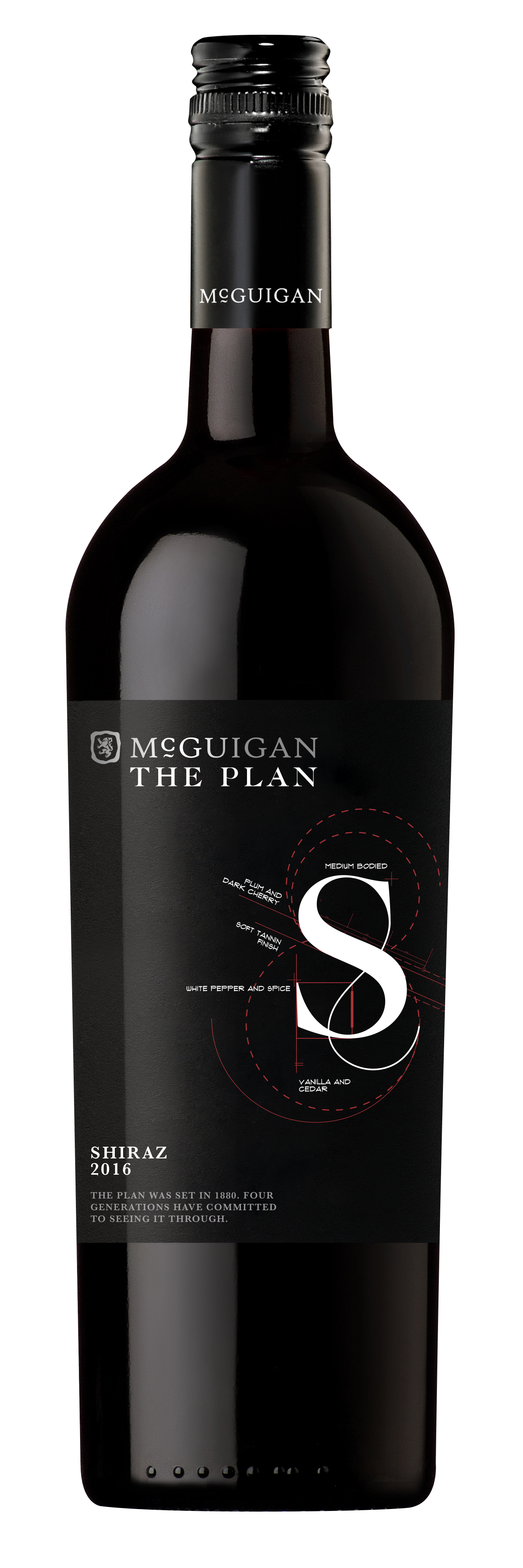
Wine of the week: McGuigan The Plan 2016

McGuigan The PlanMcGuigan The Plan – an Aussie shiraz that shows sense and sensibility

Australian red wines are infamous for high alcohol, jammy, too ripe fruit, and an absence of balance. So what’s the catch with McGuigan The Plan, which clocks in at an almost unbelievable 12.5 percent alcohol?

Chalk it up to the wonderful unpredictability of wine, where we should regularly discover how little we actually know. McGuigan The Plan ($13, purchased, 12.5%), though it’s from a top producer, is about the last thing one expects from an Australian red made with shiraz – it shows sense and sensibility, to steal a phrase. Yes, it’s rich and fruity, with lots and lots of blackberry. But the wine isn’t hot or sweet, the way some too alcoholic wines can be. Plus, there’s a little spice (and maybe even some pepper) in the middle. And I could swear I tasted a tannin or two. Honest.

In this, McGuigan The Plan is one more reason not to judge a wine before you taste it. It needs food, but with summer burgers or barbecue, that shouldn’t be a problem.

Imported by Palm Bay International

Winebits 558: Kent Rosenblum, North Dakota wine, Australian prosecco

kent rosenblumThis week’s wine news: Zinfandel icon Kent Rosenblum dies, plus North Dakota wine and a tussle over Italian-style sparkling wine made in Australia

Kent Rosenblum dies: One of the country’s greatest zinfandel winemakers died last week; the Rosenblum zinfandel, along with Ridge and Ravenswood, paved the way for today’s zinfandel boom. But that was not Kent Rosenblum’s only legacy. He was one of the most humble people I’ve ever met in the wine business. I rode an elevator with Kent, who was a vet long before he was a winemaker, shortly after he sold the company to Diageo in 2008 for $105 million. He was schlepping wine boxes to a trade tasting. “Dr. Rosenblum, I said, “why are you carrying your own boxes? Don’t you have people to do that for you now?” He looked a little sheepish, and said, “Why would I ask anyone else to do this?”

Bring on North Dakota wine: Researchers in North Dakota want to boost the state’s wine business, in another victory for Drink Local. “”Everyone is interested in expanding our industry in North Dakota for wineries and for tourism,” said one state official. Which, of course, is just what the WC likes to hear. The biggest problem in North Dakota, not surprisingly, is the weather, which is too cold for most wine grapes. But state researchers are working with a variety of cold climate hybrids to find the best for the climate. Currently, the state has 16 wineries.

How do you say Prosecco in Aussie? Australian bubbly may be one of the sticking points in trade negotiations between their country and the European Union. The Australians sell a wine called Australian Prosecco, which is illegal under European trade rules – the same law that prohibits California producers from calling their wine Champagne under a U.S.- European Union agreement. Why the Australian objection to the name rule for something that’s settled in much of the world? More wine labeled Australian Prosecco is sold in Australia than the Italian kind, and the former don’t want to lose that market.

Mini-reviews 111: Geyser Peak, Castle Rock, Ranch 32, Tyrell’s

geyser peakReviews of wines that don’t need their own post, but are worth noting for one reason or another. Look for it on the fourth Friday of each month. This, month, a highly recommended white and red:

Geyser Peak Chardonnay Water Bend 2016 ($18, sample, 14.5%): California white that tastes like coconut and pineapple – another example of the post-modern, better living through winemaking approach that dominates so much wine at this price. Coconut and pineapple are ideal for an ice cream sundae, but probably not the way chardonnay should taste.

Castle Rock Pinot Noir Willamette Valley 2016 ($15, sample, 13.5%): This vintage of the Oregon red is not what the 2015 was, unfortunately – a little brambly black fruit aroma, but too heavy and not very interesting. It tastes like it has lots of something in it besides pinot noir, a practice that is legal and not uncommon for less expensive pinot noirs.

Ranch 32 Pinot Noir 2016 ($17, sample, 13.5%) If all $17 wine tasted like this California red, I wouldn’t rant about $17 wine. It’s got actual pinot noir character – almost silky, with precise black fruit and actual oak that lends to the wine and doesn’t dominate it. Highly recommended.

Tyrell’s Semillon 2016 ($22, purchased, 11%): This white is another brilliant Australian wine that was lost in the disaster that was 15 percent shiraz and that the Aussie wine business is still recovering from. It’s somehow balanced, soft and crisp and with lots of fresh stone fruit, and balanced. Highly recommended. Imported by Broadbent Selections