Reviews of wines that don’t need their own post, but are worth noting for one reason or another. This month, four wines after cleaning out the wine closet
• Fancy Flock 2020 ($4, purchased, 13%): Is this Spanish red from Aldi worth $4? Probably not — tart, not especially ripe, and rustic in a bad way. The pandemic has not been kind to Aldi’s wine selection. Imported by Mack & Schule
• Signaterra / Benziger Sunny Slope Red 2016 ($49, sample, 14.8%): I’ve been getting a lot of samples lately that aren’t available. Like you can’t buy them at all. No, I don’t understand that approach, either. This is terrific wine, save for that — fruity, rich. herbal, and with soft tannins.
• Tortoise Creek Mission Grove Pinot Noir 2019 ($12, sample, 14.2%): This red is $15 supermarket-style California pinot noir, with all that means — some heat, not much pinot character, and more rich and fruity than it needs to be.
• Apaltagua Envero Gran Reserva Carmenere 2019 ($16, sample, 14%): Solid, professional carmenere, a red from Chile, with all that means — very herbal (almost bell pepper) and not all that much fruit. Imported by Global Vineyard Importers
Who needs Cage or Travolta? We have Sunshine Bay and Farnese Fantini.
Which of these two about $7 wines offer the best value in this cheap white wine face-off?
A variety of cheap white wines have served the Wine Curmudgeon well over the years, starting with the late and much lamented Hogue fume blanc. These are the kind of wines you buy in quantity, keep chilled, and know that when you drink it, the result will be quality, value, and enjoyment.
My current choice is the Farnese Fantini trebbiano, an Italian white that costs $8. But, with the appearance of Aldi’s Sunshine Bay, a New Zealand sauvignon blanc, that costs $7, is it time to make a change?
Hence, this cheap white wine face-off.
• Price. The Fantini is $7.99, less the 10 percent case discount. That works out to $7.19 a bottle. The Sunshine Bay is $6.95 at my local Aldi, so it’s cheaper – but probably not enough to make a difference.
• Screwcap. Yes to both. This matters a lot, because I don’t want to go through a ritual when all I want is couple of glasses for no particular reason. This kind of wine should be open it and forget it.
• Quality. Are the wines professional and well made? Yes to both. Frankly, I was surprised. For one thing, there is still a lot of cheap, crummy Italian white wine in the world, and so didn’t expect much from the Fantini. But it is clean and crisp, without any off flavors or residual sugar. The Sunshine Bay, given Aldi’s track record in the U.S., was even more surprising. It’s much better made than similarly-priced New Zealand sauvignon blancs.
• Style. Do they taste like they’re supposed to? Yes, again, to both. The Fantini is lemon-lime-ish, simple but not stupid. The Sunshine plays up the New Zealand grapefruit style, but there;s a hint of tropical fruit in the middle, and the citrus doesn’t overwhelm the wine.
My choice? I’ll probably stick with the Fantini, since it’s more food friendly. But for those who like the New Zealand style or want a little more heft in their white wine, the Sunshine Bay is an excellent alternative. And I will keep buying it.
Our Dallas Aldi wine road trip finds some cheap wine gems among the rows and rows of Winking Owl
The good news: Our Aldi wine road trip was not the disaster that I feared. Alfonso Cevola, the Italian Wine Guy, had scouted four other Aldi locations in our part of Dallas, and assured me we could find things worth drinking. And he was right.
We found four during our five-store visit. That was impressive, given that Aldi here has consistently fallen short of its effort in Europe and the United Kingdom. There, its private label wines (labels sold only at Aldi) are cheap and critically praised.
The wines worth buying again:
• Dellara Cava Brut NV ($7, purchased, 11.5%): The first bottle was flat, a worrisome trend I’ve experienced lately with sparkling wine costing as much as $20. But the second had the requisite character for a Spanish bubbly – tart lemon and green apple fruit and some minerality. A step up from other $7 cavas, especially since they’ve been dumbed down to taste like watery Prosecco.
• La Cornada Crianza 2015 ($5, purchased, 13%): This Spanish red made with tempranillo was this close to being a Hall of Fame wine. It has way too much oak for what it is; leave out the oak, and the acidity isn’t pushed to the back and the wine is in balance. Very nice cherry fruit and even a little Spanish orange peel aroma.
• La Rue Cotes de Provence Rose 2017 ($7.50, purchased, 12%): This looks like legitimate Provencal rose (a watery pink), and it smells like one, too (tart berries). The catch is that it finishes a little sweet, and legitimate Provencal rose doesn’t do that. But that might have been me looking for a flaw. Otherwise, it’s mostly what it should be a fair price.
• Bergeron Estates Reserve Icewine 2016 ($12/375 ml, purchased, 10.5%): Quality Canadian icewine should cost three or four times this, and no one will confuse the Bergeron with Inniskillin. But it does taste like icewine – a luxurious honeyed sweetness – and it does taste like the vidal grape it is made with. It needs more acidity to balance the sweetness, but well worth buying again for those who like dessert wine.
I didn’t buy two wines that Alfonso thought would be OK, a German pinot gris and reisling labeled Landshut, which may have been made by Dr. Pauly-Bergweiler, a top German producer. So I’ll try those next next – each was about $7. In addition, a Spanish garnacha, Vina de la Nieve from Catalonia ($6) looked worth tasting but wasn’t available for sale. It was on the shelf, but not in the system.
Having said that, there was still too much Aldi wine in the stores whose reason for being was that it cost $3. And too many of the $10 wines were advertised with 88-point shelf talkers, which is about as helpful as writing a blog post longhand and using magic to put it on the Internet. And there was an amazing lack of continuity between stores, where one store would have one wine, another wouldn’t, and third would have something else.
Still, as Alfonso kept reminding me, “Small steps, Jeff, small steps. Aldi is heading in the right direction.” Which I fervently hope.
Reviews of wines that don’t need their own post, but are worth noting for one reason or another. Look for it on the fourth Friday of each month.
• Palma Real Verdejo 2017 ($10, purchased, 12%): This Spanish white blend is a Total Wine private label that tastes like it’s supposed to — tart and lemony, simple but not stupid. It looks to be some sort of knockoff of the Marques de Cacera verdejo, but is better made and more enjoyable. Highly recommended.
• Provinco Bianco Grande Alberone 2017 ($9, purchased, 13%): This Italian white blend, which includes chardonnay, is more Aldi private label plonk. There is little varietal character, save for some chardonnay mouthfeel. Otherwise, it’s thin and bitter.
• Weingut Berger Grüner Veltliner 2017 ($12/1 liter, purchased, 12%): Yet another Wine Curmudgeon attempt to understand why so many wine hipsters recommend gruner veltliner, an Austrian white. As my pal Jim Serroka said, and he doesn’t pay much attention to wine, “it’s thin and watery.” Look for a little citrus fruit and not much else.
• Familia Bastida Tempranillo 2016 ($10, purchased, 13.5%): Another top-quality Total Wine private label – a Spanish tempranillo that is varietally correct with soft cherry fruit, a hint of spice, not too much oak, and all surprisingly integrated.
This week’s wine news: North Carolina state liquor agency has been wasting taxpayer money for years, plus Aldi says it will upgrade its wine aisle and corks are now perfect
• Are we surprised? North Carolina’s state-run liquor stores have wasted millions of taxpayer dollars through more than a decade of mismanagement, reports the News & Observer newspaper in Charlotte. The state auditor told the newspaper that $11.3 million vanished from Alcoholic Beverage Commission coffers in 13 years. “There was just no overview, no oversight,” she said. “There was no monitoring of that contract. You just had a contractor come up and say ‘I want more money,’ … and whatever the contractor asked for, it was what they got.” The irony here? State-owned liquor stores exist as part of the three-tier system in some 17 places, to prevent organized crime from corrupting the process. But who needs organized crime when you can get away with this? “Every year since 2004, the audit found, the [agency] authorized more state spending than it was allowed to. … The [agency] has four in-house lawyers, as well as a 12-person internal auditing team and multiple levels of management.”
• I’ll believe it when I see it: The Wine Curmudgeon long ago stopped trusting discount grocery Aldi when it came to wine; I’ve spent too much time shopping there to swallow the chain’s wine hooey when the big seller is Winking Owl. But Aldi is at it again, “touting its award-winning wines” as part of a four-year, $5.3 billion remodeling and expansion effort in an interview with Forbes. I’ll repeat the interview I had with my store manager when the remodel and expansion was announced: “Wine? We have lots of wine. Why do we need more?” It would be one thing if Aldi added the cheap, high-quality wines it sells in Europe, but it appears to have taken the path used by most U.S. supermarkets – cheap, poorly made wine, sold because it’s cheap.
• Corks are now perfect: Or so say the cork people, in announcing its latest tech upgrade in cork production. “This will change the wine world,” says the headline, but it doesn’t include the caveat for the worse. It’s good to know that we will still need a special, difficult to use tool to open a wine bottle when more and more people are not drinking wine. That’s sure to do convince them to move over to wine. By the way, those of you will are going to cancel your email or RSS subscription to the blog (because several of you always do when I write about corks): Use the safely unsubscribe button at the bottom of the email.
Why can’t Aldi wine in the U.S. be as cheap and as interesting as it is in Europe?
Aldi, the discount grocery store chain that has wowed Europeans with its quality cheap wine, seemed ready to do the same thing in the U.S. this year. It was facing increased competition in wine from Walmart, Target, and Kroger, as well as the arrival of its European arch-rival Lidl to the U.S.
But the result so far? What a disappointment.
That’s if my weekly ad is any indication (pictured at right), which I think it is. It’s the first time I’ve seen Aldi devote one-quarter of its four-page circular to wine. But there is little there anyone would be interested in buying:
• Just one European wine, an Italian white that looks to be a knockoff of Costco’s private label pinot grigio.
• An 85-point California pinot noir for $13. Someone needs to tell the Aldi marketing types, first, that 85 points is about a special as a new shoelace, and second, that I can buy a dozen $10 grocery store pinot noirs that get more than 85 points. And we all know how I feel about scores.
• A $10 New Zealand sauvignon blanc. Why do I need to buy a $10 New Zealand sauvignon blanc at Aldi? I can do that at Kroger.
Why is the chain settling for so little here? Has it bought into the grocery store mindset that U.S. consumers will drink whatever is put in front of them as long as it has a score and a pretty label? Is it because it doesn’t see wine as important to sales in the U.S. as wine is in Europe? Or is it just not doing a good job?
Regardless, I want more. I want the same $6, $8, and $10 wines their European customers get. Is that asking too much from what is supposed to be one of the world’s great discount grocers?
This week’s wine news, because the blog is off tomorrow for the holiday: Media-induced shortages for Aldi wine, plus more three-tier trends
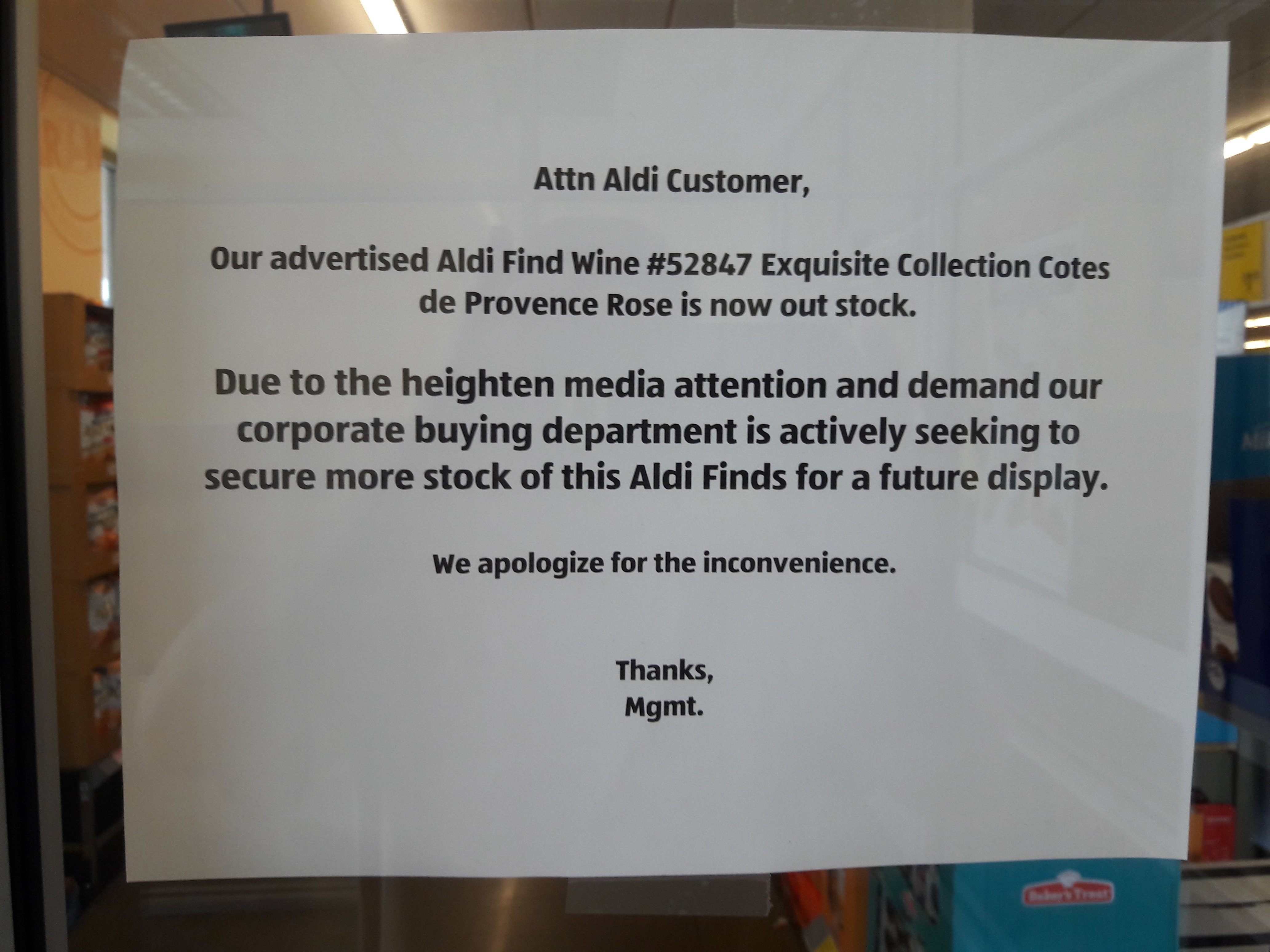
• Cheap rose forever: Imagine the Wine Curmudgeon’s shock when saw this sign (the one at the top of the post) at his local Aldi – a media-induced shortage of rose. As much as I would like to take credit for this, it’s the fault of NBC’s The Today Show, which ran a piece on the $9 Cote des Provence rose at the beginning of June. The clerk at my Aldi said the warehouse has been out of the wine for weeks; hence the sign. What’s most interesting is not that the wine is sold out, because anyone who follows the WC knows cheap pink wine is one of the wine world’s great finds. Rather, that the Provence has been sold in Britain, and that Aldi is bringing it to the U.S. Aldi hasn’t done that with many of the the wines it sells in Europe, instead selling a variety of very ordinary domestic wines in this country. Could it be that the chain is feeling the heat in the U.S. from the debut of its German arch-rival, Lidl? And yes, if and when it ever shows up at my Aldi, I’ll review it.
• Constitutionally protected: The Supreme Court has agreed to decide the constitutionality of a New Jersey law allowing sports betting. Why is this important to wine drinkers? Because the court has never, as far as I know, agreed to decide the constitutionality of the three-tier system that governs the sale, manufacture and distribution of booze in the U.S. But gambling, somehow, gets a hearing? And, if the court sides with New Jersey, it means any state can legalize sports betting – even if they don’t allow you to buy a bottle of wine from Amazon or six-pack of beer on your way to the lake on Sunday morning. If there any constitutional scholars in the audience who can explain why this is not hypocrisy of the highest order, send me an email.
• Only 14 states: Speaking of which, Tom Wark of the National Association of Wine Retailers reminds us that only 14 states allow consumers to purchase wine from out of state retailers. Interestingly, New Jersey is not one of the 14. But if gamblers will soon be able to take the Cowboys and the points in an Atlantic City sports book, perhaps the state will reconsider.








 Reviews of wines that don’t need their own post, but are worth noting for one reason or another. This month, four wines after cleaning out the wine closet


 Reviews of wines that don’t need their own post, but are worth noting for one reason or another. Look for it on the fourth Friday of each month.
 This week’s wine news: North Carolina state liquor agency has been wasting taxpayer money for years, plus Aldi says it will upgrade its wine aisle and corks are now perfect
 Why can’t Aldi wine in the U.S. be as cheap and as interesting as it is in Europe?
 This week’s wine news, because the blog is off tomorrow for the holiday: Media-induced shortages for Aldi wine, plus more three-tier trends