


Tag Archives: Winestream Media

Winebits 727: The “Winestream Media is starting to sound too much like the WC” edition

kafka
“Let’s see. … should I write about a man turning into a roach or  quality$10 wine?”

This week’s wine news: Three major U.S. wine writers agree with the Wine Curmudgeon about what’s going on in wine – and how surreal is that?

• Bring on the ingredient labels! Writes Mitch Frank – a 17-year-employee of the Wine Spectator: “Frankly, why would younger consumers opt for wine? … If you walk through your favorite wine store, how is most wine marketed? Well, most of it comes in a 750ml bottle that is portioned to be drunk over dinner and requires a special device to open it.” And this: “Meanwhile, grab a can of White Claw and look at the back label, and you’ll find something almost no wine label has—nutritional information.” Stunning, yes? When did my rants become mainstream in the wine business? Which, honestly, is more than a little scary.

• Too many phony wine scores! Paul Gregutt, a former contributing editor to the Wine Enthusiast, is shocked at what’s going on with wine scores: “Even a casual walk through the wine section of your neighborhood Costco or supermarket will find it papered with ads for wines scoring 90 points and higher, including many priced well under $10. 95 point wines, which used to be a rare achievement, are more and more common.” So he is not going to use scores anymore. Which, of course, has long been the policy here, as well as the subject of more rants than most readers care to remember. And let’s not forget this, in which the blog took scores and crammed them into their proper place.

• Bring on the $10 wine! And if all of this isn’t surreal enough, Lettie Teague, writing in the Wall Street Journal (where the typical reader is worth $1.5 million), goes in search of quality $10 wine. She doesn’t have much luck, and doesn’t sound like she expected to, but does find three – all of which have been on the blog at one time or another. I’m particularly fond of the Dibon cava, though I haven’t seen it much in Texas lately. Teague would have done well to check out the blog’s Cheap Wine of the Year in January – she would have enjoyed the Scaia rose, as well as the always well done Scaia white.

Photo: Franz Kafka

Winebits 682: Big Wine, wine writing, on-line wine

Big wineThis week’s wine news: The Winestream Media discovers Big Wine, plus a wine writer discovers conflicts of interest and wine drinkers grapple with on-line shopping

• Big Wine, indeed: This post did not come from the Wine Curmudgeon or one of the few independent voices in wine writing who pays attention to these things. Rather, this harsh look at Big Wine came from the trade site for the Wine Enthusiast, one of the gatekeepers of traditional wine writing. It laments the “corporatization” of the U.S. wine business and even uses the M word – monopoly. This news is not new, of course, and regular visitors here have been reading it for years. But that we’re seeing it on a site that is one of the pillars of the current system may speak to a growing sense of unease with the status quo. And a note to the writer: E&J Gallo accounts for almost one out of every four bottles of wine made in the U.S., which should have been at the top of your story.

• Conflicts of interest: Spanish wine writer Miguel Hudin asks the “massive” question that we don’t ask enough in this business: “How objective can you actually be when you’ve been flown somewhere and put up on someone else’s dime who is expecting coverage which should in theory be positive coverage?” His descriptions of the way the wine writing world works these days is past depressing, including the admonition he got for complaining about food he paid for. It’s good to see the subject brought up by someone who isn’t a cranky ex-newspaperman, and that Hudin understands the uphill road he travels in writing about this: “Oh Miquel, relax and enjoy the freebies! You’re being too critical and difficult!” No, Miquel, you’re not.

• Going on-line: We’ve had several mentions on the blog recently of wine drinkers’ reluctance to shop on-line. But, apparently, the wine drinking demographic isn’t worried about buying other stuff over the Internet, reports the Washington Post: “… one of the most significant and unexpected shifts, experts say, was the almost immediate embrace of online shopping by people in their 60s, 70s and 80s.” Which, of course, is the same age group that still dominates U.S. wine purchases. The next question: How soon until this group feel as comfortable buying wine over the Internet as it does toilet paper?

Clean wine: Has the Winestream Media finally figured out why we need nutrition and ingredient labels?

“Quick — bring the wine in so we can get it through the rinse cycle before anyone notices.”

The clean wine uproar in the cyber-ether has been led by the Winestream Media, which usually doesn’t much care about things like that

The recent uproar in the cyber-eher about clean wine, and that it isn’t necessarily clean, may turn out to be a key moment in dragging the wine business into the 21st century. For the first time, a host of wine writers who usually spend their time talking about toasty and oaky and hip and cool are discovering the need for transparency in wine ingredients.

Who knew it would only take 12 years for them to get to this point?

The light bulb moment for me came last week, when Erica Duecy wrote a post for the popular VinePair site, headlined: “The Industry Set Itself Up for a ‘Clean Wine’ Reckoning.” Duecy didn’t mince words: “You might think this would be a wake-up call for wine companies, that they would lean into the problem, looking to engage millennials where they’re at (reading product labels and online), with the messages they want to hear (nutrition and product information). Yet that’s not what’s happening.”

Harsh charges. But what matters is not that Duecy wrote the post or even what she wrote, but that it appeared on VinePair. The site offers lifestyle-oriented wine, beer, and spirits coverage for younger consumers similar to what the Wine Spectator and Wine Advocate offer for their parents and grandparents – and that’s not necessarily Consumer Reports-like insight. Six recent VinePair posts: Cocktail influencers, an interview with a bourbon executive about “drinks innovations,” whether beer tastes better if it’s ”poured correctly,” Thai “moonshine,” and something called West Texas “ranch water” – which, apparently, we’re all drinking.

That VinePair took on the foolishness that is clean wine speaks volumes about where wine reporting may be heading.

Journalism, anyone?

For clean wine is foolish, as the story in the first link in this post documents (full disclosure – it was written by my editor at Meininger’s Wine Business International). Ostensibly, clean wine is made with nothing but grapes, yeast, and pure intentions, but clean wine producers aren’t especially forthcoming about what’s in their wine or how the grapes are grown. They can get away with this because ingredient labels are optional, and there’s no legal definition of clean wine anyway. So wine marketed as clean, a form of greenwashing, could have used the same additives and the same pesticides (or even more of each) as my $10 stuff.

And make no mistake, clean wine is all about marketing. Using the term may allow some producers to charge a one-third premium for their products, even if they aren’t all that different from “un-clean” wine.

In fact, I wasn’t going to write anything about clean wine. My first nutrition and ingredient labels post ran in 2008, about the time the federal government first broached the subject. I’ve been covering it regularly since then: So why irritate myself by pointing out – yet again – that it’s the wine business’ fault that clean wine exists, since it’s opposed to the nutrition and ingredient labels that would show clean wine for the marketing flummery that it is?

But then I saw the VinePair post, and figured I should add my voice. What’s the point of a little irritation if we can actually change something?

Photo: “Hand washing machine and trough National Trust for Jersey” by Man vyi is licensed under CC BY-SA 2.0

More about nutrition and ingredient labels:

• The final “nutrition and ingredient labels for wine are a good thing” post
• Update: Nutrition labels and what the wine business doesn’t understand
• Nutrition labels for booze

Wine premiumization and the Winestream Media

wine premiumization
“Reportin’? We don’t need no stinkin’ reportin’.”

Wine premiumization may be ending, but you wouldn’t know it by reading the Winestream Media

By most measures, the end of premiumization is underway. Wine drinkers have been opting for less expensive wine over the past six months, and, depending on which expert is talking, the trend will continue and perhaps even accelerate. In other words, lower wine prices and better quality cheap wine.

But it would be difficult to know this from reading the Winestream Media.

I don’t write this to be snarky (well, maybe, just a little), but to point out how difficult it is to tell what’s going on in wine from its most important media outlets. Wine-searcher.com somehow managed to run these two stories almost at the same time – “Premium wine falls victim to the coronavirus” and “Wine sales defy doom and gloom.” And this doesn’t include the site’s regular roundup of all things high priced – “Bordeaux’s most expensive wine,” “Napa’s most expensive wine,” and (my favorite), “Brunello 2015: Another perfect vintage.”

At the Wine Enthusiast, meanwhile, one writer was salivating over $40 California gamay, which is about as premiumized as wine gets that isn’t cabernet sauvignon. And the Wine Spectator has reassured us that it will continue to cover the 2019 Bordeaux futures market, despite what the magazine’s Bordeaux reviewer called the pandemic’s “rude interruption.”

So, why?

Why is the Winestream Media treating this almost unprecedented moment in world history – and with all of the changes it looks like it will bring to wine – as just another minor sales blip?

• Because that’s what it does, and to expect more of it is expecting more than it is capable of. Yes, it may well be fiddling while Rome burns, but it doesn’t understand that Rome can burn. Rome is eternal, just like wine scores and $300 Napa cabernet.

• Because it doesn’t want to see what’s going on, as Richard Hemming, MW, explained to us last week. If wine writers write things the wine business doesn’t want written, there’s a good chance the wine writers will find themselves persona non grata. As Hemming said, there’s no reason consumers should necessarily trust wine writers.

• Because there aren’t really any good numbers to describe what’s going on, even if a wine writer wanted to write about it. We’ve noted this on the blog many times, and another example came up last week. David Morrison at the Wine Gourd has made a specialty of parsing wine industry statistics, whether sales or scores, and noted last week about one sales study: “The conclusions seem to vary from quite accurate to wildly exaggerated.”

So what’s a consumer to do? Buy wine you like, be willing to try something else, and wait to see what prices will do. We’ll almost certainly see prices drop before the Winestream Media discovers most of us aren’t all that interested in $40 California gamay.

Follow-up: Expert scores and red wine bias

red wine biasOur red wine bias study has the Internet buzzing – and people are saying smart things about it

This week’s post about red wine bias among wine critics did everything that we hoped it would do: Get people talking about what our study means. There has been some tremendous discussion – not just here, but elsewhere around the cyber-ether.

My biggest surprise? That so many mainstream wine critics picked up on the study and offered serious comment, instead of dismissing it out of hand. That’s my mistake, in assuming the worst. My biggest disappointment? That not enough people saw the study as one more example of everything that’s wrong with wine scores.

Suneal Chaudhary, who crunched the numbers for the study and deserves an award for his efforts, said, “I’m starting to get a sense that there’s something about the scoring system that’s flawed in some way but can’t exactly put it in words at the moment. The other reaction I’ve seen a lot is that red wines are more complex and so they should rightly score higher. Which is a fine argument if it’s true — but I’m not sure if it is. Personally, I think whites have a different aesthetic to them. It’s like saying the smell of roses is more complex than jasmine or something, but does that make the smell of roses better?”

That was a common theme among the comments, emails, and discussions Suneal and I found – that only wines made with serious grapes deserve the best scores, and the only serious white grape is chardonnay (and don’t even think about mentioning rose). So, according to this argument, why should anyone be surprised by any kind of bias? It’s only natural and right.

Which, of course, made me very sad – the some animals are more equal than other animals theory.

A sampling of other reaction from around the Internet:

• A mostly favorable discussion on the Wine Berserkers site, which also surprised me. It’s the Internet – who says nice things?

• Winemakers, not surprisingly, were split. Those who focus on white wine (and several left comments on the blog) disagreed that red was more difficult or more expensive to make. Red winemakers, not surprisingly, said of that course red was more expensive and more difficult, so why shouldn’t it get higher scores?

• Blog reader Patrick Sirridge’s observation was one of the most astute: “In my view, many wine critics/writers follow the herd and provide higher ratings for higher priced reds,” he said in an email. “Even more modestly priced reds get the benefit of the doubt regarding quality and complexity and thus get higher ratings. Bias in favor of reds – sure.”

• Another blog reader, Bob Henry, found several old magazine articles and blog posts discussing this subject, including an interview with Robert Parker in what was then called Wine Times and today is the Wine Enthusiast. In the interview, which is at the link, Parker said that some red wines are indeed more serious than others, and that his scoring system reflects that. I wonder if Parker would disavow that comment today – or if the Wine Advocate still uses that approach.

You can download a PDF of the report here.

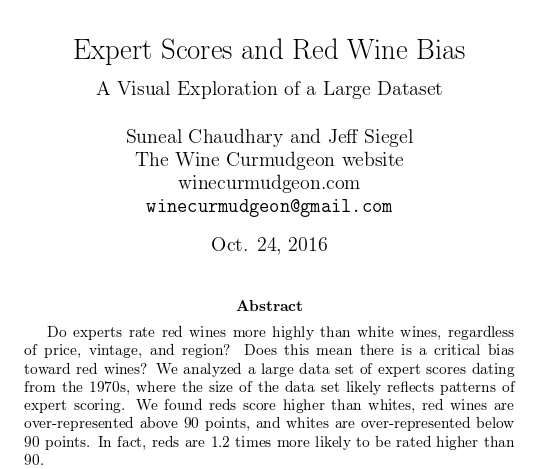
Expert scores and red wine bias

red wine biasIs the Winestream media biased in favor of red wine? Our study seems to show just that

Do experts rate red wines more highly than white wines, regardless of price, vintage, and region? Does this mean there is a critical bias in favor of red wines?

That may well be the case. Data scientist, wine lover, PhD, and former college math professor Suneal Chaudhary did the numbers, analyzing more than 64,000 wine scores dating to the 1970s and taken from the major wine magazines. The results are something I’ve been trying to get a handle on for years, the idea that critics favor reds over whites. The details are after the jump: Continue reading →

Winebits 458: Wine recommendations, alcohol levels, natural wine

Wine recommendations

This week’s wine news: Wine recommendations most of us can’t afford, plus the feds help with alcohol levels and the market for natural wine

• Pricey, pricey, pricey: How about a list of fall and winter wine recommendations where all but four of 20 wines cost more than $20? Sadly, that’s what happens when you ask restaurant wine types for wine advice. It’s not that there aren’t some excellent wines in the post from Bloomberg News (the $22 Domain Berson Chablis, for one) and that these people don‘t know their business, but let’s be honest. I didn’t want to spend $145 for my once in a century wine if the Cubs win the World Series; who is going to do it because the weather is cooler? Making matters worse is the headline: “20 wines you need to drink this fall.” No I don’t. The only one who got the pricing right was Ryan Arnold of Lettuce Entertain You, a restaurant company in Chicago started by one of the world’s great restaurateurs, Rich Melman: a $16, a $17, and a $30 wine.

• More accurate: W. Blake Gray reports that a change in the way the federal government approves wine labels will mean more accurate alcohol percentages on the label, and perhaps the end of the ubiquitous 13.5 percent. “In many cases wineries have to submit the label for approval before the final blend of the wine has been decided,” he writes. “They have to guesstimate how much alcohol the actual wine will have. That means label approval has driven many winemaking decisions, which is bad for everybody.” Now, since they won’t have to list the alcohol percentage to get the label approved, they can make the wine and put the correct alcohol level on the label afterwards. That’s not only better for producers, but consumers as well. One reason we see 13.5 percent on so many labels, even if the wine isn’t really 13.5 percent, is that it’s easier to do that for a variety of complicated and legal reasons.

• Not too many people: The Wine Curmudgeon frequently laments the wine fads passed along as fact by the the Winestream Media, and it’s a pleasure to see a serious discussion about whether natural wine is anything more than one of those. “Are sales in this niche finally starting to have a global impact – or is it just a hipster bubble that could burst as fast as a poorly made pet-nat?” asks the Wine Business International trade magazine (full disclosure: I freelance regularly for the magazine). The conclusion: Assuming one can define a natural wine, since there is no accepted standard other than an organic wine isn’t natural enough, “market share in most countries has yet to reach even the first percentage point.” Case closed. Now we can go back to arguing about something important, like the efficacy of scores.