
Tag Archives: winespeak

Winebits 790: Winespeak, screwcaps, wine history

Students study an equation on a chalk board
“You think this is bad? Did you see the tasting notes for that new 98-point wine?”

This week’s wine news: Winespeak isn’t inclusive (shocking, right?), plus another call for screwcaps and wine may be older than we think

Not inclusive? Nat Sellers, writing in Wine-Searcher, argues that winespeak isn’t inclusive for a new generation of wine drinkers. Which is all well and good, but overlooks the biggest problem with winespeak. It has never been inclusive, catering mostly to wine geeks and confusing almost anyone else who came into contact with it. Even the simple stuff was baffling: I never did a tasting, wine class or seminar when someone didn’t ask, “If the wine tastes like grapefruit, does that mean there is grapefruit juice in it?” And why was winespeak confusing? Because the wine business wanted it that way – it’s easier to sell product to people who are confused, yes?

Bring on the screwcaps: The Robb Report, whose audience would never be mistaken for mine, doesn’t mince words: “Why It’s Time for Fine Wine to Ditch the Cork and Embrace Screw Caps.” Excuse the WC if he does a double take; the wines in the piece cost three figures, and bear no resemblance to my beloved Gascon whites and $10 roses. That a magazine catering to the uber-wealthy is advocating for screwcaps like I do is another sign that it’s time for the cork to go.

New theory: It has been accepted historical fact that grape cultivation and winemaking started in what is modern day Georgia in Eurasia  some 6,000 to 8,000 years ago. Now, new research has found that wine may be even older than that, originating in the Near East as well as the Caucasus about 3,000 years before then. In fact, says the study, published in Science, the origin of wine in Western Europe is associated with cross-fertilization between native wild grapes and domesticated grapes originating from the Near East that were initially used as food sources. If this is true, and the study makes a good case, will change the way archeologists look at how wine influenced the growth of civilization.

Photo: “Students study an equation on a chalk board” by simpleinsomnia is licensed under CC BY 2.0.

Winebits 717: Winespeak, DoorDash, supermarket wine

winespeak
“OK, now let’s make this clear — toasty and oaky are out.”

This week’s wine news: Wine Scholars Guild says it will try to make winespeak easier to understand. Plus, DoorDash expands booze delivery and a look at the supermarket wine store of the future.

No more toasty and oaky? The Wine Scholar Guild, a leading wine education group, says it wants to change the way we talk about wine. Or, at least I think that’s what it wants to do. The story describing the effort is so full of PR-speak, education-speak, and some -speak that I couldn’t decipher, that it’s difficult to say for sure. To quote: The project would “empower the individual to taste and describe wine with an enriched and universal lexicon.” In addition, it would “dive deeper into assessing the qualities of a wine’s building blocks” and look “into the nature of a wine’s personality.” Sigh. This is probably worth a separate post on the blog; I’ll try to follow up and see if I can make any sense of it.

Bring on the booze: DoorDash, the restaurant delivery  service that has branched out to groceries and clothing, is expanding its alcohol delivery effort. Customers will be able to place orders for beer, wine, and spirits (with or without food) from participating local restaurants and supermarkets in select markets in 20 states. We’ll ignore for a moment the company’s infamous reputation (and that the Wine Curmudgeon has all but stopped using it, since half my orders are wrong in some way). Instead, let’s focus on what this news means: Another chink in the armor that restricts alcohol sales in the U.S. That the company would have done this two years ago is doubtful. But the pandemic changed all that, and that DoorDash thinks it can make money with wine delivery speaks volumes.

Even in Iowa: We’ve written a lot on the blog about how important supermarkets are to the future of wine, and here’s one more example — a regional grocer has built an upscale market in suburban Des Moines, Iowa, with “a Hy-Vee Wine & Spirits department offering a walk-in beer cooler, a walk-in wine room and a walk-in humidor.” In Iowa? In addition, the story reports that building the store required a $26 million investment, and that it is its “first entirely reimagined grocery store.” What does that say about what Hy-Vee’s bosses think about selling wine in supermarkets?

Winebits 630: Two-buck Chuck, Italian wine fraud, winespeak

Two-buck Chuck

This week’s wine news: Two-buck Chuck costs $2 again in parts of California, thanks to the state’s grape glut. Plus, a 1-million bottle Italian wine fraud and the 2019 winespeak winners.

Just $1.99: Two-buck Chuck, the Trader Joe’s private label wine, costs $1.99 again in California, just like it did when it debuted in 2002. That’s a drop of about one-third for the wine, labeled as Charles Shaw. Credit the California grape glut for the discount, which has dropped the prices of the bulk grapes used to make the wine. However, the price remains $2.99 to $3.79 a bottle in the rest of the country, thanks to higher transportation costs.

A massive fraud: Italian police arrested five people, including two regional wine officials, and broke up a 1-million bottle wine fraud ring in the Oltrepo Pavese region near Milan in northern Italy. A wine co-operative in Oltrepo Pavese and several winemakers had worked together, combining sugar, additives and grapes from other regions to make fake Oltrepo Pavese DOC (PDO) and PGI wines for the 2018 vintage. This is the second major fraud in Oltrepo Pavese in the past five years; in 2014, police broke up a scam involving 200 people.

Good old winespeak: John Tilson at the Underground Wine Letter presents his annual list of the most stupid wine descriptions of the past year. As always, he brings a chuckle to the Wine Curmudgeon. My favorite descriptors this year are “treacle tart,” a sweet British dessert, and beef blood, which were used by two different writers to assess the same Spanish red wine. How, do you ask, can two completely opposite descriptions be used for the same wine? All I can say is that this is why wonder I wonder about the future of the wine business.

Winebits 585: Playboy wine, Spanish wine, winespeak

Playboy wineThis week’s wine news: Dave McIntyre takes on Playboy wine, plus a potential link between Spanish wine and health and how to avoid winespeak
Buy the bunny? Dave McIntyre at the Washington Post tries Playboy wine (yes, that Playboy) and finds it worth drinking – and in a review written without any horrible puns. Which, of course, is why Dave is one of the best wine columnists in the country. Who else would resist that temptation? Writes Dave: “Were there ‘flavors of cherry and dark fruits’ and spice notes of vanilla and toasty oak on the finish, as the press release boasted? Perhaps. I was impressed by the wine’s balance of fruit and acidity. It was lighter than I expected, rather than the heavy, confected wines all too common these days.”

Of course it’s the wine: Spain, according to several international studies, is the healthiest country in the world. The chart, from Wine Industry Insight, doesn’t discuss why Spain is No. 1 and the U.S. is No. 35, but the Wine Curmudgeon has a thought: Could it have something to do with the quality of each country’s cheap wine? Call it the WC cheap wine and health index; there have been many more more Spanish wines on the blog in its 11 ½ year history than U.S. wines.

Understanding winespeak: Alex Delany, writing for a website called Basically, says “Despite my best intentions, I sometimes hear wine words coming out of my mouth and have an out-of-body experience. ‘Hey, uh, you’re sounding a little insufferable, dude,’ I say to myself. I don’t want to be that guy. And neither do you.” How can I not recommend a piece that starts like that? His advice is good, makes sense, and includes what to do about the dreaded term, “mouth feel.”

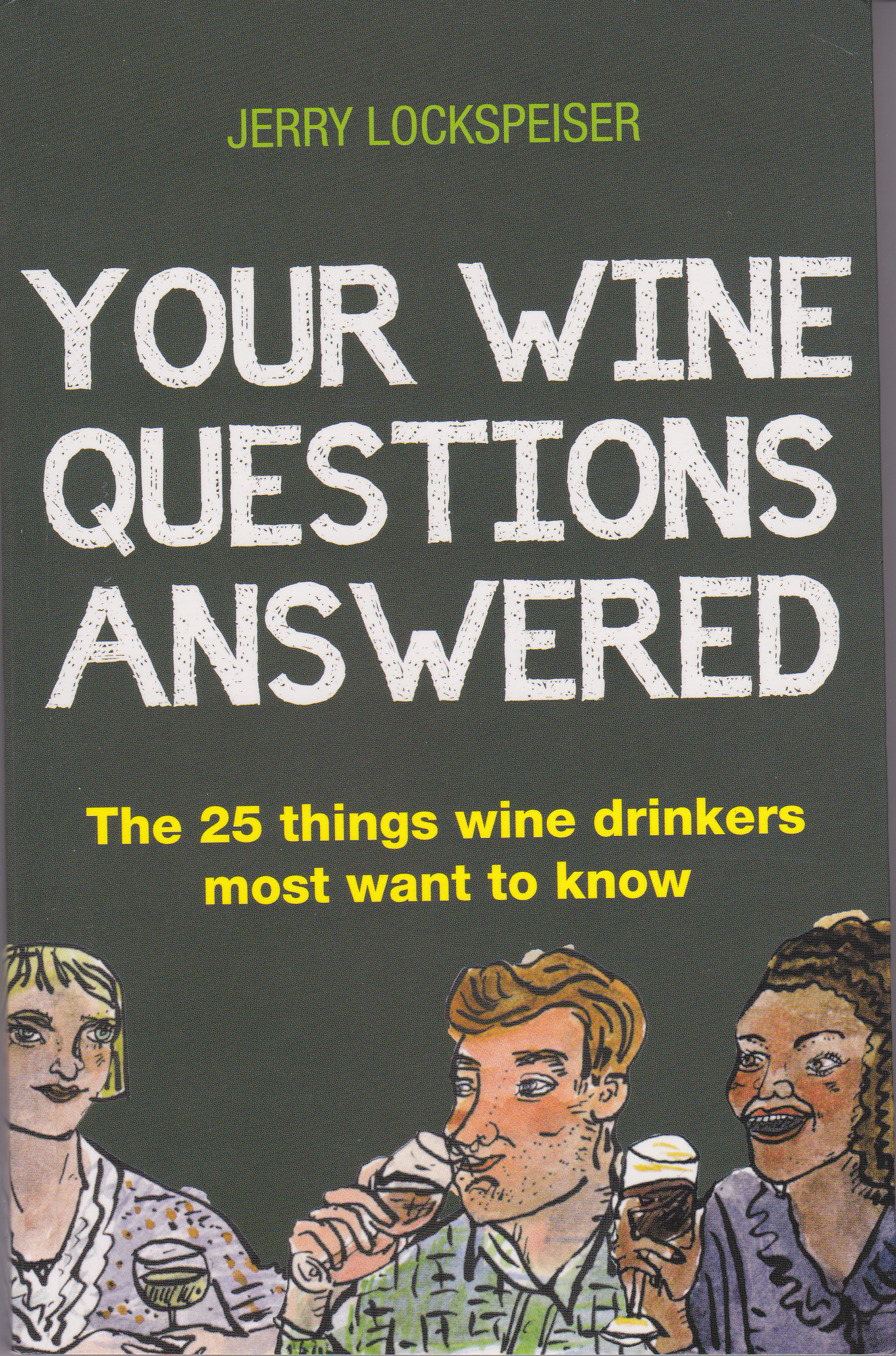
Book review: Jerry Lockspeiser’s “Your wine questions answered”

jerry lockspeiser“We would probably buy more, with greater enjoyment of doing so, if the people who sell wine made it easier to understand.”

Jerry Lockspeiser loves wine. More importantly, he wants to help other people love wine, too, and he knows that means helping them deconstruct the foolishness that is the wine business. Hence, his new book, “Your wine questions answered: The 25 things wine drinkers most want to know.”

Lockspeiser knows what of he writes. He has been a producer, negociant, consultant, and salesman, and has worked with retailers and distributors during his decades-long United Kingdom wine career. His writing, he told me, is a way to use that knowledge to help what he calls the normal wine drinker – those of us who want to buy a bottle for dinner without worrying if we’ve committed a mortal sin.

“Many people find buying wine difficult,” Lockspeiser writes. “This is not because they are stupid. The meaning of the words is not clear, the language is complex, and the flavour is a mystery. It is hardly surprising that confusion and anxiety are common. We would probably buy more, with greater enjoyment of doing so, if the people who sell wine made it easier to understand.”

Which is why he is the Wine Curmudgeon’s kind of guy.

The book has 25 short chapters, each answering a wine question. “What is a corked wine? “Should I trust the medals on wine bottles?” “Do more expensive wines always taste better?” And my favorite: “Why do they say some wines have ‘a hint of gooseberries’? ”

The writing is simple and direct, often with an anecdote that points out just how dumb the wine business can be. Corked wines “are infected with trichloroanisole, or TCA for short, a harmless but miserable chemical that passes a mouldy flavor into the wine. … TCA-infected wines should be returned to the shop or restaurant.” Medals are not a guarantee you’ll like a wine – “it’s much better to trust the recommendation of a friend or reviewer whose taste you agree with.” And the gooseberries? “…this kind of description is incomprehensible to 99% of wine drinkers.”

Highly recommended, and one of the best wine books of the year. We’ll give away a couple of copies of the book during the blog’s birthday week in November, in tandem with the cheap wine book. What more does the normal wine drinker need?

Ask the WC 7: Winespeak, availability, Bordeaux

winespeakBecause the customers always have wine questions, and the Wine Curmudgeon has answers in this irregular feature. Ask me a wine-related question by clicking here.

Wine Curmudgeon:
You use the term structure for wine, which sounds like a lot of jargon to me. What does structure mean?
Confused by language

Dear Confused:
Think of a wine’s structure like the structure of a house. A house has to have a foundation, a floor, and a roof. Leave one of those things out, and you don’t have much of a house. A wine, regardless of price, needs structure, too, and that includes tannins, fruit, and acidity in the proper proportions. Leave one of those out, and it’s like a house with a crappy roof — livable, but why would you want to?

?

Hey Curmudge:
Where do you buy your wine? I know you try to find wines that are available, but how do you do it?
Curious consumer

Dear Curious:
I’m one of the few wine writers in the country who buys wine to review, and it’s probably more than half the wines I do. The rest come from samples that producers send, and that number has fallen significantly since the recession. I shop for wine at least once a week in two or three places. I go to grocery stores like Kroger and Albertson’s, independent wine shops (Jimmy’s and Pogo’s are two of the best), chain wine shops (we have Spec’s and Total Wine in Dallas), and specialty stores like Whole Foods, Trader Joe’s, and World Market. That way, I can compare prices, see who has what, and talk to retailers and customers. I enjoy this, not only because it’s part of a job that I like, but because I come from a long line of retailers, and learned to appreciate this stuff when I was a kid.

?

Jeff:
I have tried a few red Bordeauxs, and most are not very good in the $10-$20 range. I like many California cabernet sauvignons and red blends, and am not put off by the “earthiness” of French wines. But most of the Bordeauxs I ?ve tried are just harsh and bitter. Any suggestions for reasonably priced Bordeaux would be appreciated.
Searching for French value

Dear Searching:
You aren’t alone — Bordeaux has priced most wine drinkers out of its market, whether from greed, infatuation with China, or French stubbornness. It’s almost impossible to find quality red Bordeaux for less than $20 a bottle, as you note (Chateau Bonnet and one or two others being the exception). Instead, we get poorly made wine, whether with unripe grapes or raw tannins — just like the bad old days. Ironically, we talked about this in my El Centro class last week, that the wines that most Americans used to drink to learn about wine are now too expensive for most Americans to drink.

More Ask the Wine Curmudgeon:
? Ask the WC 6: Box wine, wine closeouts, open wine
? Ask the WC 5: Getting drunk, restaurant wine, wine reviews
? Ask the WC 4: Green wine, screwcaps, mold

If you thought winespeak was bad, how does potspeak sound?

If you thought winespeak was bad, how does potspeak sound?The Wine Curmudgeon, whose crusade against winespeak has been a cornerstone of his work, can only shake his head and sigh. Call it an example of the law of unintended consequences — legalized marijuana in Colorado may well bring with it product reviews written in potspeak.

Or, as the humorist Garry Trudeau imagines it: “This limited-edition artisanal cannabis delivers an unexpectedly smooth high, with just a touch of paranoia. …”

I cringe as I edit this. Artisanal? Limited-edition? Where have we read those before? And how did Trudeau overlook the possibility of “boutique” weed? Or that that the toke had hints of cypress and evergreen with spicy overtones?

What’s next for legalized dope? Scores? A terroir debate? The Potstream Media? The Marijuana Spectator? Blogs called Potography and 1 Dope Dude? Or, and let me warn anyone who thinks of this, because I have lawyers on standby, The Maryjane Curmudgeon?