Tag Archives: wine terms

Update: Nutrition and ingredient labels for wine

Nutrition and ingredient labels for wineThe Wine Curmudgeon’s views on nutrition and ingredient labels for wine are well known: The wine business is missing an opportunity to reach younger consumers by stonewalling the labels.

But not everyone shares my view, and my piece in the current issue of the Beverage Media trade magazine looks at the topic from a variety of perspectives. The highlights of the article, as well as a few of my thoughts, are after the jump:

The technical term for the labels is “servings facts,” and they can look like the chart on a can of soup or bottle of ketchup or (oddly enough) the paragraph style on something like ramen noodles. Late last year, the federal government issued a regulation to allow wineries who want to add serving facts to do so, but they still aren’t required.

But that’s just the beginning:

• One of the difficulties in following developments is that different federal agencies have different label responsibilities. The Food and Drug Administration oversees food labels, because they includes nutritional content. The Tax and Trade Bureau, which oversees alcohol regulation for the U.S. Treasury, makes rules for alcohol-related labels and uses different criteria. So what’s required for tomato soup may not be good for wine.

• The wine industry’s opposition to serving facts has not wavered in the decade-plus that the labels have been under discussion. It cites cost, a too-crowded label, burdensome regulation, and the government’s inability to enforce the law on imported wine. One of the best examples of their fear? This article (behind a paywall), written by a couple of lawyers for Vineyard & Winery Management magazine, “Requiring ‘Serving Facts’ on Wine Labels Could Prove Costly.” My favorite part of this article: Since wine is consumed for pleasure, it doesn’t need labels.

• A serving facts label includes serving size, and the industry is worried that its idea of serving size could be radically different from the federal government’s, especially on higher alcohol products.

• There is also the unspoken fear, says Bonny Doon’s Randall Grahm, that wineries “don’t want people to know the various tricks and certain stylistic effects that they use on their wine.” This includes the 60-some ingredients legally allowed in wine that aren’t grapes, including Mega Purple (grape juice concentrate used to darken red wine), oak chips, and things like egg whites and isinglass, a fining agent made from fish bladders, and something called polyvinyl-polypyrrolidone, an industrial adhesive.

• The industry is also worried, says Grahm, a long-time proponent of labels, that any additional sulfite information would “freak out” consumers, given the great urban myth surrounding sulfites.

Bunny becker

How to make wine

No one believes how easy it is to make wine. My Cordon Bleu classes didn’t, and neither do most people when I speak to groups and do cheap wine book promotions. That’s because the wine business has done such a brilliant job of confusing the issue that everyone assumes you need a zillion dollars, a hillside vineyard, and a tortured genius pacing up and down the barrel room. Far from it: Get some juice, add yeast or sugar, shake well, and let it sit.

The only time a Cordon Bleu class believed me came when an ex-con, who was one of the students, vouched for the method. In the joint, he said, the inmates would sneak sugar packets and cartons of orange juice out of the cafeteria to their cells and follow just that recipe.

Now, will this be quality wine? Probably not. I’ve done it, and it reminded me why I like writing about wine more than making it. At best, you get a Kosher-style wine, sweet and grapey; at worst, and I know this first-hand, the fermentation fails and you have a slimy mess to throw out.

Having said that, this is something every wine drinker should know. Knowledge is power, and we don’t have nearly enough knowledge. The video below, courtesy of MiWilderness on YouTube, does the job in all its amateurish glory. The comments, with suggestions for improving wine quality, are also worth reading. My favorite part comes when he shakes the bottle, giving the concept of stirring the lees a completely different perspective.

men judging wine competition

Ask the WC 4: Green wine, screwcaps, mold

Ask the WC 4: Green wine, screwcaps, moldBecause the customers always write, and the Wine Curmudgeon has answers every six or eight weeks or so. Ask me a wine-related question by clicking here.

Mudge:
What’s the difference between organic and biodynamic and regular wine? I know about organic tomatoes, but this is just confusing.
Not sure what any of this means

Dear Not Sure:
It is confusing, because organic for wine doesn’t mean the same thing that it means for vegetables or fruits. Organic wine is made without added sulfites, which is different from wine made with organic grapes. And biodynamic, like wines from Bonny Doon, takes organic farming to another level. And, interestingly, green wines are not as popular, relatively speaking, as other green products.

?

Dear Wine Curmudgeon:
I was at a dinner party the other night, and someone brought a bottle of wine because they liked the closure, which was some kind of screwcap. Do people really buy wine based on whether it has a screwcap? As opposed to how it tastes, because this wine tasted like gasoline.
You’ve got to be kidding

Dear Kidding:
I don’t know that anyone has done a study, but anecdotal evidence suggests just that. I recently had lunch with a 20-something woman who makes expensive wine in California, and she said that she will buy a screwcap wine, all things being equal, if she is in the store looking for a bottle for dinner. I have heard that many times, and I do it myself, too.

?

Dear Jeff:
I recently opened a bottle of wine, and the cork was kind of moldy. My husband said we should throw it out, that we would get some kind of disease. I hated to waste it, since it was an expensive bottle, and I am as cheap as you are. We did drink it, but I have been wondering: Was the wine OK to drink?
Worried about mold

Dear Worried:
You’re safe — mold on a wine cork is a sign the bottle has been stored properly, and is not like mold on bread, which you do want to throw out, regardless of how cheap you are. Typically, moldy corks will only happen to older and more expensive wines that people have been aging, and it’s not a problem with most of the wine we drink.

More Ask the Wine Curmudgeon:
? Ask the WC 3: Availability, prices, headaches
? Ask the WC 2: Health, food pairings, weddings
? Ask the WC 1: Loose corks, cava, unadulterated wine

tarted up

Wine terms: Tarted up

tarted up
“We’re all sweet fruit, baby.”

This is not a term you’ll find in the wine magazines or in any other of the Winestream Media. For one thing, their eyes roll around in their heads like the high school kids in the “Porky’s” shower scene when they taste tarted up wines (and speaks to the number of old white guys who write about wine). For another, it’s something that too many wineries are embracing — including those who know better — in reaction to the recession, increased competition, and the mistaken impression consumers want these wines.

In this, a tarted up wine is exactly what it sounds like, and this definition of tarted up from the Urban Dictionary is spot on:

If you’re going out, most likely to get laid, you get “all tarted up” — in other words, get dressed up, put your best clothes on, wear very few clothes.

A tarted up wine is dressed to sell, which means that it has been stripped of all character save one — lots of sweet fruit flavor, which is often reinforced by adding grape juice concentrate or the dreaded MegaPurple concentrate. This is perfectly legal and very common, and especially in cheap wine (though it’s not unusual in expensive ones, either). The sweet fruit covers up a variety of winemaking flaws and poor quality grapes because it makes the wine taste sweet, even if it’s dry. And since the sweet fruit overwhelms the tannins and acid, it gives the impression that the wine is “smooth” — the ultimate goal of every consumer wine tasting focus group.

The term has its roots in Randall Grahm’s writing; the Bonny Doon impresario has long argued that some wines are made the way plastic surgeons enhance women’s breasts — the more jiggle the better. Peter Bell, the winemaker at New York’s Fox Run Vineyards, also helped me figure this out during a long morning judging grocery store zinfandels, sharing his expertise on the technical skills needed to turn wine into Kool-Aid-style wine coolers.

Ask the WC 3: Availability, prices, headaches

Because the customers always write, and the Wine Curmudgeon has answers every month or so. Ask a wine-related question by clicking here.

WC:
I just returned to the U.S. from a three-year stint in the UK where cheap Bordeaux is a plenty at Sainsbury or Tesco. Before we left, we spent a week in Sicily and I stumbled into the Cusumano wines. Amazing stuff. What is the best way to purchase in the U.S.? We now live in Tennessee where you have to go to a package store to buy wine! Insane. Please advise.
Baffled by the three-tier system

Dear Baffled:
You aren ?t the only one. I get more availability questions than anything else; hence this post and this one, which should answer all your questions. Basically, first ask your retailer, and if that doesn ?t work, start Googling. You ?re spot on with the Cusumano, by the way. Love those wines. And I ?m jealous about the Bordeaux.

?

Dear Wine Guy:
You write a lot about how Americans buy cheap wine, but that no one pays enough attention. But maybe there ?s something you ?re missing. Do we buy cheap wine everywhere that sells wine, or only at certain places? Like do fine wine shops sell more expensive wine?
Wondering about prices

Dear Prices:
That ?s one of the best questions I ?ve ever received, and I don ?t know there ?s an exact answer. I consulted a bunch of really smart wine people, and we came up with these proportions, but there ?s no guarantee to their accuracy: About two-thirds of the wine sold at a mass market retailer like Walmart costs $12 or less and 80 to 90 percent of the wine sold at a grocery store costs $12 or less. At a fine wine shop, the numbers for a mass market retailer are likely reversed, so two-thirds of the wine sold there costs $12 or more.

?

Hey Wine Curmudgeon:
I have a friend who says she can drink beer OK, but wine, white or red, gives her migraine headaches ? and fast. Any clue as to what is the culprit?
My head hurts

Dear Head:
I have written about headaches, perhaps the great urban myth of wine. About one percent of the U.S. population is allergic to sulfites, which can cause the headaches. The rest of it, says one of the leading researchers in the field, is auto-suggestion. So there is a chance it is sulfites, though a small one ? and one she can test with dried apricots, which have 10 times the sulfites of wine. The other culprit might be histamines, common in wine and which can cause allergic reactions. But beer has histamines, too. So this is where I say I ?m not a doctor, and suggest asking one.

Wine terms: Three-tier system

Wine terms: Three-tier systemBelieve it or not, in almost seven years and more than 1,700 blog posts, I ?ve never written a post explaining the three-tier system. There are lots of posts about three-tier and even some explanation, and I ?ve written about it for others. But nothing here.

So what you need to know about the three-tier system, which regulates how everyone in the U.S. buys wine, beer, and spirits:

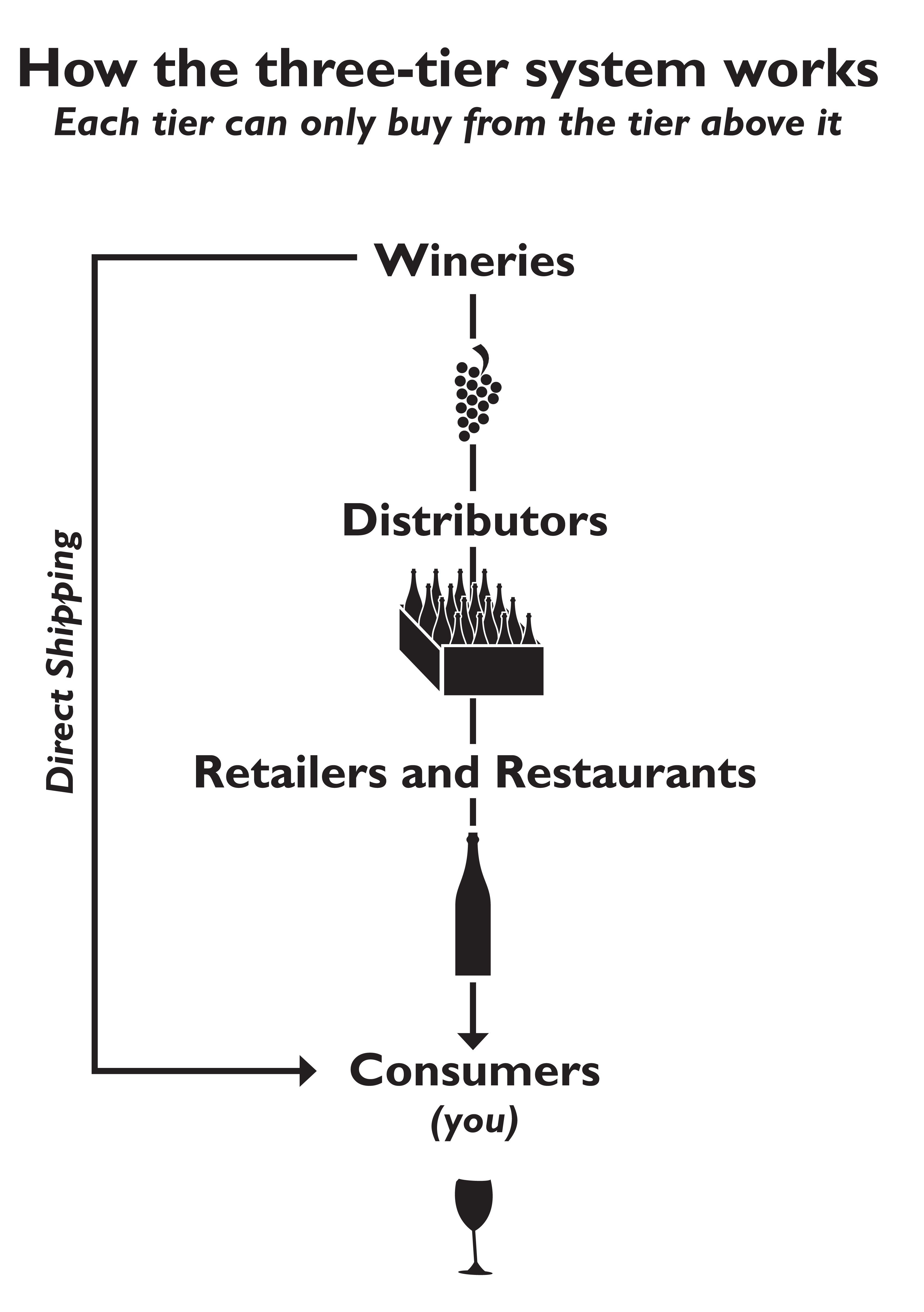
Prohibition, the 18th Amendment to the U.S. Constitution in 1920, outlawed the sale, manufacture, and transportation of alcohol in the U.S. until it was repealed 13 years later by the 21st Amendment. Repeal gave us the three-tier system, so named because it has three parts: The first tier are the producers, the wineries, breweries, and distilleries. They can only sell their product to a distributor, the second tier. Only the distributor can sell to retailers and restaurants, which are the third tier. Save for limited exceptions, like direct shipping, and which total less than 10 percent of all wine sales, the consumer can only buy wine from the retailer or restaurant.

This makes wine different from almost every other consumer good in the world. If you want to buy a computer from Dell or shoes from Nike, each is only a couple of mouse clicks away from the manufacturer’s website. And Amazon has become a $61 billion company by serving as the ultimate retailer, crossing state lines to sell its customers everything from books to underwear.

But ordering wine from an out-of-state producer is a crime in much of the U.S., and it’s a crime in every state to order wine from an out-of-state retailer. On-line retailers like Wine.com, which is in 42 states, have to legally qualify as an in-state retailer (by setting up an office or a warehouse, for example) to be allowed to do business in those states. And even Amazon, with its new Wine Marketplace, has to abide by these rules. Technically, it doesn ?t sell wine, but serves as a conduit to retailers and producers that are legally allowed to sell it.

How did we get to this point? Why is alcohol different from running shoes? Because the political compromise that ended Prohibition allowed each state to regulate alcohol in its own way. Three things are important about this:

? Every state ended up using some form of the three-tier system, and every state has modified the three-tier system to what it thinks works best for it. Which means there are 50 laws for 50 states, and sometimes different laws within states. Pennsylvanians can only buy wine from retailers owned and operated by the commonwealth. New Yorkers can’t buy wine in grocery stores. Montgomery County, Md., residents can’t buy wine at retailers like Cost Plus World Market, but residents of adjacent Prince George’s County can.

? Three-tier was designed to keep organized crime out of the booze business, which is understandable given the role organized crime played in bootlegging during Prohibition. Every liquor law attorney I have ever talked to says that ?s an important reason why three-tier has endured. State attorneys general and state liquor control boards, given three-tier ?s success in keeping the mob out of booze, don ?t see any reason get rid of it.

? The distributors, and especially those that deal in beer and spirits, don ?t want three-tier to change, and spend millions and millions of dollars annually lobbying state and federal legislators to preserve the system. This is understandable, too, given that the end of three-tier would mean the end of distribution as they know it. Their allies, surprisingly, are often independent retailers, who don ?t want their chain competitors to be able to buy wine directly from the winery, since that would give the bigger companies better pricing.

The worst part about thee-tier? We ?re stuck with it. A variety of federal court decisions, including Siesta Market in 2010, have said that three-tier is constitutionally protected, just like freedom of speech and freedom of religion. The 21st Amendment, say the various rulings, shelters three-tier from court challenges and state and federal legislation to alter it.

Yet none of this means three-tier is relevant in the 21st century. Prohibition ended 80 years ago, and organized crime has moved on. It ?s difficult to believe that rum running would be as profitable as today ?s pastimes, like credit card and bank fraud. In addition, we ?ve made tremendous strides in combatting alcoholism and drunk driving in the U.S., and these abuses are always given as a reason for three-tier.

For wine drinkers, three-tier limits consumer choice. Do you live in Illinois and had a wine you liked at dinner in Wisconsin? Did you try to buy that wine in Illinois only to find that it isn’t available? That’s the fault of three-tier. Just because a distributor in Wisconsin carries the wine is no guarantee that a distributor in Illinois will carry it. The Illinois distributor may not like the wine or the person who makes it or how much it costs. So they decide not to carry it, and you can’t buy it ? even though it’s available in another state just a half-hour drive away.

This is an especially acute problem for cheap wine. Distributors, all things being equal, prefer to deal with the biggest producers. They can get better pricing, the supply chain is more efficient, there is money for marketing, and they’ll have more wine to sell since big producers deal in tens of thousands of cases.

But much cheap wine ? perhaps the most interesting cheap wine ? is made by smaller companies that don’t produce tens of thousands of cases, can’t offer the best prices, have less efficient delivery systems, and whose wines are more quirky. So they have more difficulty finding a distributor ? and often can’t.

This is such a problem that there are trade events for wineries that don’t have distributors, held in the hope that a distributor will sample their wines and then take them on. It’s kind of sad, actually. Meanwhile, smaller wineries that do have distributors usually have to settle for smaller distributors that have less clout with retailers, which means the producer’s wines are limited in availability and may even cost more.

I ?m resigned to three-tier, given the court rulings. But that doesn ?t mean I have to be happy about it.

Winebits 289: Terroir, three-tier, Wine.com

? Another view of terroir? Terroir, a French term that has no exact meaning in English, is something wine geeks love to argue about ? does it exist or not? Those of us who believe in terroir believe it lends a sense of place to the best wine, regardless of price. Anti-terroir advocates (yes, just like matter and anti-matter) say we ?re a bunch of old farts and that wine should be made to taste the best it can, regardless of terroir. The eminent Paul Lukacs offers a third view ? that, despite some truth, it ?s mostly a myth perpetuated by French marketers in the first third of the 20th century. That should give us something to discuss the next time Paul and I judge together.

? Another victory for the distributors: It ?s depressing, but someone has to keep track of this stuff. The Illinois legislature, no doubt acting at the behest of some of its biggest campaign contributors, has passed a law that strengthens the state ?s three-tier system. Three-tier are the alcohol regulations left over from Prohibition that prohibit consumers from buying wine almost anywhere but traditional retailers. The legislature passed the law because Anheuser-Busch bought a stake in its biggest Chicago-area distributor. The beer giant will now have to sell its share of the distributor. How silly is this? Like Ford being told by the Michigan legislature that it can ?t own one of its parts suppliers.

? For sale or not? The cyber-ether has been buzzing the past week or so with rumors that Wine.com, the largest Internet wine retailer and a friend of the blog, is for sale. Wine.com ?s boss has denied the rumors, saying the reports exaggerate the company ?s financial woes. Supposedly, Wine.com ?s private equity backer was unhappy with its performance and wanted out. Regular visitors here know the uphill battle legal Internet retailers face, thanks to three-tier, and Wine.com is no exception. It has to become a local retailer in many states in which it does business to comply with state laws, a costly and time-consuming effort. If its financial backers are unhappy, the question is not that they are, but why they expected anything else given the regulatory environment.