We’ve detailed many times on the blog that the FedEx and UPS wine shipping monopoly is only good for FedEx and UPS – and a mess for the rest of us. Which is one of many reasons why we need Congress to pass legislation allowing the U.S. Postal Service to ship wine.
Neither shipping company wants it, and both FedEx and UPS spend millions of dollars lobbying Congress to get their way. In addition, the bill must overcome the objections of a variety of alcohol distributors, including our old pals at the Wine & Spirits Wholesalers of America, who see any from of direct shipping as a threat to their God-given monopoly to sell us wine, beer, and spirits.
Finally, there is the almost incomprehensible hatred that some Republicans have for the postal service, and that makes putting together enough votes for passage difficult to begin with. (This attitude is especially worrisome to the Wine Curmudgeon, since several of my freelance clients still send checks in the mail, and I could tell you stories about how long the checks take to get here.)
You’ll also hear that we can’t let the postal service deliver wine because it wouldn’t be safe – protecting minors and so on and so forth. Which is just more self-serving blarney; the same laws, ID checks, and licensing would apply for using the post office just as it does for FedEx and UPS.
Still, given that the postal service wants to deliver wine, that its unions want it to deliver wine, and that key members of Congress want it to deliver wine, there is always hope. And, frankly, given the postal service’s financial woes, allowing alcohol shipping makes perfect sense. It would help the agency and help consumers. Isn’t that better than protecting a couple of monopolies?
This week’s wine news: Premiumization “is the gift that keeps on giving.” Plus, grocers ask feds to take action and the history of the postal service and booze delivery
• Premiumization strikes again: I wasn’t going to report this, since we’ve had enough depressing wine news over the last several years. But premiumization as “the gift that keeps on giving?” For whom? Certainly not wine drinkers. Yet Richard Siddle, writing in a British restaurant trade magazine, insists it is: “But we are also increasingly willing to pay more for brands that are genuinely different, authentic and make us feel good about buying them.” The rest of the piece is the usual marketing-speak about how consumers won’t pay more money unless they’re convinced the product is worth it and which, with consolidation, has less and less to do with reality. And no, that the story spells premiumization with an s, in the British English style, doesn’t help.
• Supermarket consolidation: Those of us who pay attention to wine consolidation aren’t the only ones who have noticed what’s going on with big companies controlling key parts of the economy. A trade group of independent grocers has accused the largest retailers, including Walmart and Amazon, of “predatory action.” The trade group says the biggest retailers get better pricing, exclusive products, and even better packaging because they have more clout in the market place. The group has asked the Federal Trade Commission to investigate to see if those practices violate federal law.
• Booze and the postal service: Wayne Curtis, writing in The Daily Beast, does a terrific job detailing the history of the U.S. Postal Service and alcohol as there’s a chance the agency might be allowed to deliver wine. “Given the long-standing prohibition against shipping liquor, it may come as a surprise to learn that ordering liquor by mail was once commonplace.” It’s the kind of story I wish I had written, and includes an ironic section about how it was once legal for out-of-state retailers to sell into another state.
If Congress allows the postal service to deliver beer, wine, and spirits, we not have to post signs like this in front of our homes.
Will UPS and Fed Ex — which are notorious for slipshod service and non-delivery deliveries — finally have competition?
Regular visitors here know the wine world’s frustration with UPS and Fed Ex, which view wine deliveries as something they do only when they feel like it. Service has improved during the pandemic, but there’s no guarantee things won’t return to normal – because, as one reader left in a comment, “They like to just beep their horn and take off.”
Now, we may have hope – competition from the U.S. Postal Service. A bill with 19 sponsors was introduced in May in the House of Representatives to allow the postal service to ship wine, beer, and spirits just like UPS and Fed Ex do.
This time, though, says Tresize, the bill has a better chance of success “due to some important changes [in the legislation], more bipartisan support, and the dire financial straits of USPS, which could use some new business. … Wine is a bipartisan beverage, and we want to keep it that way.”
The bill also has the support of 12 trade unions and 14 beer, wine, and spirits groups, including the Distilled Spirits Council. The alcohol industry, what with the pandemic and the Trump tariff, has remained surprisingly united in advancing progressive liquor legislation.
That’s the good news. The bad news? There’s little indication that GOP post office hard-liners in the Senate will back down; the bill did not have a Republican co-sponsor in the upper chamber at the end of May. In addition, the powerful Wine & Spirits Wholesalers Association, which opposes any form of direct shipping, has opposed the bill. And the neo-Prohibitionists will likely lend their support against it, arguing that it will lead to more underage drinking.
So e-mail your member of Congress (both House and Senate) in support of the USPS Shipping Equity Act and hope for the best. We’re not asking for anything special – just competition. And how bad can that be?
“Listen up — we’re going to have to review the wine without tasting it, since Ohio law won’t let us get samples.”
When it comes to the three-tier system, even the First Amendment doesn’t matter
This is how screwed up the wine business, three-tier, and wine shipping is: A PR firm can’t send wine samples to wine writers in Ohio so they can write nice things about the wine so wine drinkers will buy more of it.
Is it any wonder I worry about the future of the wine business?
The samples are part of a virtual tasting set for today. But participants got an email on Monday saying two of the wines can’t be shipped to wine writers in Ohio “due to complications with shipping laws to Ohio.”
Is there any other business in the world where you can’t review a legal product because it’s forbidden to send it somewhere? “I’m sorry, Ms. Critic, but you can’t see the new Marvel Avengers movie in Ohio – there are shipping complications.”
We’ll ignore the First Amendment issue here, which the Ohio “complications” clearly step all over. “Congress shall make no law … abridging the freedom of speech, or of the press. …” The Ohio “complications,” in prohibiting a writer from getting the wine, violate the Constitution. It’s not unlike telling the New York Times its reporter can’t cover Ohio State football because state law forbids non-Ohio reporters from writing about the team.
But, hey, this is three-tier, so who cares?
Rather, this is about the short-sightedness, stupidity, and arrogance of the wine business, as well as the legislators and regulators who are in the pockets of the wine business. Protecting three-tier – and its cash-making monopoly – is apparently more important than letting consumers buy what they want, making wine accessible, and acting like we live in the 21st century.
To say nothing of selling more wine.
I’m purposely not mentioning the wines, the PR firm, or the tasting because I don’t want to get anyone in trouble with the Ohio authorities – they can be especially vindictive.
But I’m here, and I’m happy to discuss this foolishness at length. I want to hear someone from the Ohio legislature, attorney’s general office, or liquor regulators tell me why it’s legal for a wine writer to be denied a sample in the name of three-tier.
Because they can’t.
Photo: OzTypewriter, using a Creative Commons license
“Those poor saps in 2020. They’re stuck with the laws that were designed to keep speakeasies from opening, even though speakeasies don’t exist in 2020.”
Will the success of e-commerce and restaurant delivery during the pandemic eventually make it easier for us to buy wine, beer, and spirits?
This is the second of two parts looking at how the coronavirus pandemic has changed the way we buy wine. Today, will the pandemic lead to changes so it’s easier to buy wine on-line? The first part – finding value when buying wine on-line – is here.
Wine is being shipped to our homes, and we don’t have to sign for it. That used to be a felony in many states. We’re ordering wine from restaurants and liquor stores over the Internet, which was not only illegal in some states, but almost impossible to do even where it wasn’t.
All of this is because of the coronavirus pandemic, as state liquor cops relax enforcement of many of the laws that make up the three-tier system. Their goal is to help restaurants and retailers stay in business, and so the economic benefit outweighs enforcing the law.
Which raises a question about the future of the three-tier system, the set of state laws that govern how we buy alcohol in the U.S.: Will the success of Internet sales and restaurant delivery during the pandemic lead to changes that will make it easier for us to buy wine, beer, and spirits?
The answer, after a week of reporting, is almost certainly. Once the pandemic ends, say those I’ve talked to, it will be difficult for state regulators to return to the strict, Prohibition-era system that defines U.S. liquor laws. And that means more flexible e-commerce and home delivery regulations.
“My crystal ball is not particularly clear on this,” says Jason Haas of Paso Robles’ Tablas Creek Vineyard, one of the most thoughtful and erudite people in the wine business when it comes to discussing three-tier. “But I think it is clear that we as a society are not against lifting the restrictions. The fear was always that, if we did, the unknown might happen, that it would hurt business and alcohol would flood society. And those arguments would sound really silly after all of this.”
E-commerce and home delivery have traditionally been a tiny percentage of U.S. wine sales. Wine.com, the only truly national e-commerce wine retailer, does less than $150 million in sales each year, barely noticeable among the $70 billion U.S. wine market. Even the so-called DTC market, where wineries sell directly to consumers, accounts for just single percentage points of that $70 billion.
And that’s because the three-tier system was set up to make it difficult to do anything other than buy wine in a restaurant or retailer. And that’s because the goal of the three-tier system, which took effect when Prohibition ended in 1933, was to keep Al Capone out of the liquor business. I’ve written extensively about why this happened, on the blog and in the cheap wine book, but the reasons almost don’t matter anymore. It’s enough to know that even though this is the 21st century and Al Capone has been dead for 73 years, we’re still stuck with a liquor regulation system that makes no sense in the Internet age.
But maybe not for much longer.
“The genie is definitely out of the bottle,” says Cameron Hughes, whose self-named winery has been one of the country’s pioneers in DTC sales. “This shows we can operate successfully without ruining the intentions of the three-tier system, so why should have to sign up for it again once the pandemic is over?”
And the wine industry executives I talked to aren’t the only ones who think change is coming. The Wine & Spirits Wholesalers Association, which has lobbied successfully on behalf of three-tier for almost 90 years, is apparently worried, too. It warned U.S. consumers about “black market liquor” shortly after many states eased three-tier delivery restrictions. That the only thing most of us know about black market booze is from old movies is irrelevant to the wholesalers; they’ll do almost anything to save the system that gives them a constitutionally protected monopoly to distribute alcohol.
Coming next
“Relaxing the rules has always been the goal,” says Matt Crafton, the winemaker at Napa Valley’s Chateau Montelena. “So why not make that permanent?”
So what might happen – or not – once the pandemic winds down? Any changes probably won’t happen immediately, but even later rather than sooner will be a welcome change:
• The law that requires every wine sold in the U.S. to have a distributor won’t change, so the wholesalers trade group can rest easy.
• More and easier home delivery from retailers, restaurants, and wineries. It’s possible the rules will be changed in various states so that more wine shops and restaurants can take Internet orders – and how much better would it be to order wine with your takeout food? The catch here is restaurant pricing. Will restaurants realize they’ll have to improve on their three and four to one markups to be competitive?
• The end to signing for wine deliveries, the hassle that the delivery companies hate as much as consumers do. So far, the republic hasn’t ended without signing for wine, and, says Hughes, “in the 21st century, there has to be a better way for Fed Ex and UPS drivers to deliver wine than to check ID.”
This week’s wine news, because the blog is off tomorrow for the holiday: Media-induced shortages for Aldi wine, plus more three-tier trends
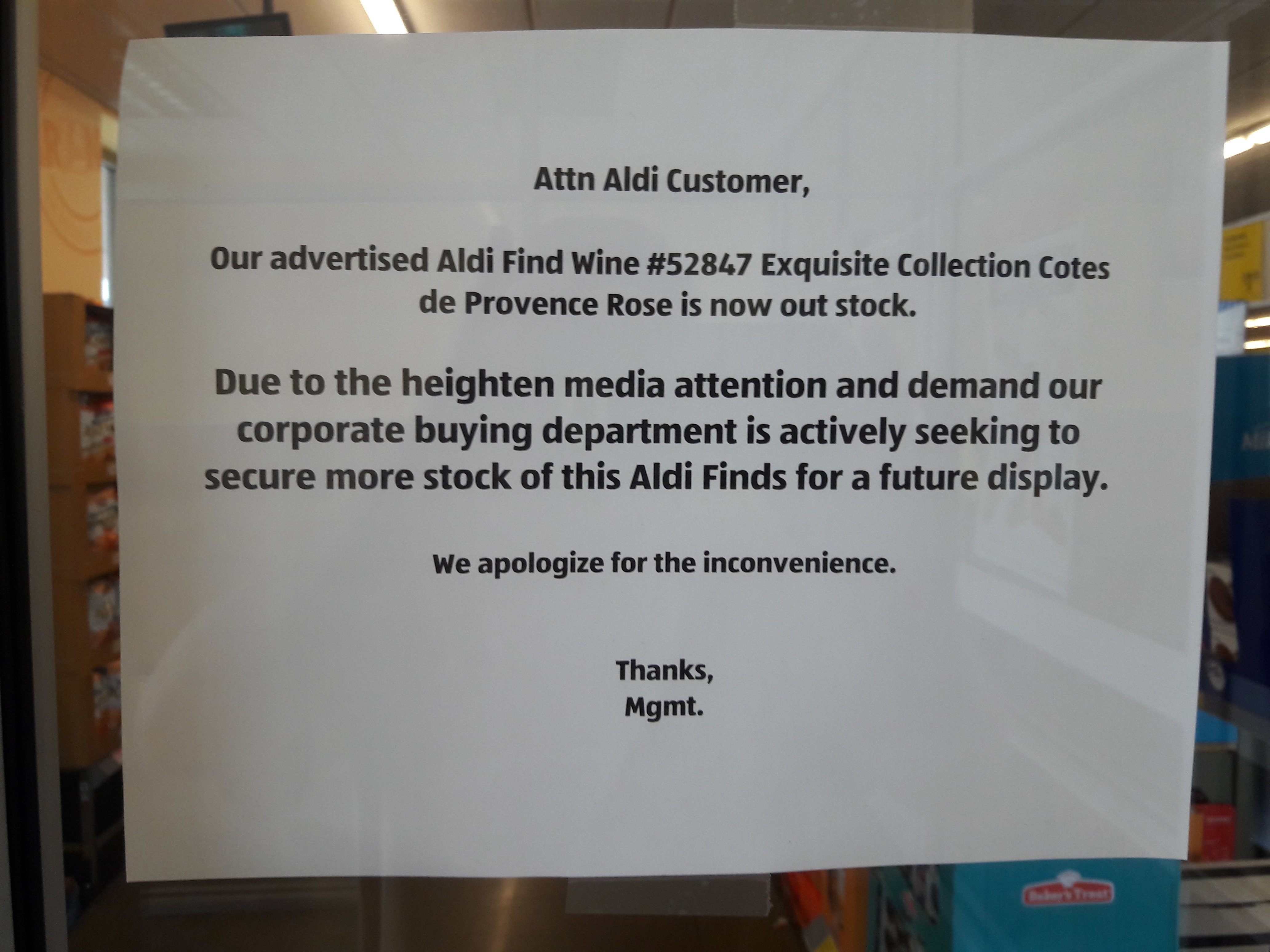
• Cheap rose forever: Imagine the Wine Curmudgeon’s shock when saw this sign (the one at the top of the post) at his local Aldi – a media-induced shortage of rose. As much as I would like to take credit for this, it’s the fault of NBC’s The Today Show, which ran a piece on the $9 Cote des Provence rose at the beginning of June. The clerk at my Aldi said the warehouse has been out of the wine for weeks; hence the sign. What’s most interesting is not that the wine is sold out, because anyone who follows the WC knows cheap pink wine is one of the wine world’s great finds. Rather, that the Provence has been sold in Britain, and that Aldi is bringing it to the U.S. Aldi hasn’t done that with many of the the wines it sells in Europe, instead selling a variety of very ordinary domestic wines in this country. Could it be that the chain is feeling the heat in the U.S. from the debut of its German arch-rival, Lidl? And yes, if and when it ever shows up at my Aldi, I’ll review it.
• Constitutionally protected: The Supreme Court has agreed to decide the constitutionality of a New Jersey law allowing sports betting. Why is this important to wine drinkers? Because the court has never, as far as I know, agreed to decide the constitutionality of the three-tier system that governs the sale, manufacture and distribution of booze in the U.S. But gambling, somehow, gets a hearing? And, if the court sides with New Jersey, it means any state can legalize sports betting – even if they don’t allow you to buy a bottle of wine from Amazon or six-pack of beer on your way to the lake on Sunday morning. If there any constitutional scholars in the audience who can explain why this is not hypocrisy of the highest order, send me an email.
• Only 14 states: Speaking of which, Tom Wark of the National Association of Wine Retailers reminds us that only 14 states allow consumers to purchase wine from out of state retailers. Interestingly, New Jersey is not one of the 14. But if gamblers will soon be able to take the Cowboys and the points in an Atlantic City sports book, perhaps the state will reconsider.
? One person’s inexpensive: One more example of how restaurants are out of touch with their customers when it comes to restaurant wine prices. This new Dallas restaurant is boasting about its reasonably-priced list, because, said a restaurant official, “We have a low mark up on our wines, so we ?re priced fantastic.” That would be a wine list with most wines supposedly costing less than $100 (no website for the restaurant yet, so I couldn’t check). What would the official have said if there had been really expensive wines on the list? Is it any wonder, unless there’s a special reason to go, that the Wine Curmudgeon has all but abandoned Dallas’ restaurants? Besides, it’s more fun eating at home.
? Bigger and bigger: It’s not just wine companies that are getting bigger, but distributors as well. Wine Industry Insight reports that the 10 biggest distributors in the country control more than two-thirds of the wholesale business, which makes the group more or less as dominant as Big Wine. Why does that matter to consumers? Because, thanks to three-tier, every wine sold to a retailer or a restaurant in the U.S. has to pass through a distributor, which tacks on as much as 25 percent to the cost of the bottle for their effort. Fewer and bigger distributors means less competition, which means that percentage won’t get any smaller any time soon.
? Best practices: Want to know how to help your wine survive shipment, whether it comes directly from the winery or from an online or local retailer? This list, from Entrepreneur magazine, hits the highlights nicely, emphasizing how little wine likes heat, vibrations, and being left on a delivery truck all day. One overlooked point: Give the wine, particularly the pricier bottles, a chance to recover from the trip. The bottles need to rest after being bumped across the country, and letting them sit in a cool, dark room for a week or so isn’t a bad idea.











 This week’s wine news, because the blog is off tomorrow for the holiday: Media-induced shortages for Aldi wine, plus more three-tier trends
 ? One person’s inexpensive: One more example of how restaurants are out of touch with their customers when it comes to restaurant wine prices.