Tag Archives: wine sales

The Treasury debacle, masstige wines, and what the consumer is trying to teach the wine business

Treasury debacleThe Wine Curmudgeon, despite his brilliance as a writer, is a lousy businessman. How else to explain that former Treasury Wine Estate CEO David Dearie earned A$2.4 million (about US$2.25 million) for running his company into the ground, while I have been giving away, for free, the wisdom that could have helped Treasury avoid this year’s 53 percent drop in profit?

One more time, for those who still aren’t paying attention: The U.S. consumer buys wine on price. The challenge for wine companies, whether multi-nationals like Treasury, Napa cult wineries, or the thousands of other producers around the word, is to add value so that the consumer gets more than their $10 worth. Some do it with cute labels and marketing; some do it with points and high scores; and the best do it by giving us $12 or $15 worth of wine for our $10. (Go here for almost seven years worth of examples of how the best do it.)

Treasury did none of those. Instead, it looks like it did the absolute worst possible thing — it charged us $12 or $15 or $18 for $10 wines, a technique called masstige that was part of its business plan. I spend some time on this in the Cheap Wine Book, though I didn’t realize what masstige was when I wrote it. Rather, I noted that wines that cost between $12 and $18 seem to offer the least value, “probably because producers don ?t improve the quality of the wine as much as they increase the price and gussy up the label.”

Think of masstige as a cross between mass market products like Two-buck Chuck and Barefoot and luxury labels like high-end Champagne. Masstige is apparently very common in cosmetics, where the added value comes from the prestige a product provides because it costs more money. This approach may still work in cosmetics, where the value difference between Revlon and Clinique remains well established even though the products are quite similar based on what’s in the jar. But in wine, the idea that expensive is always better (as noted here and elsewhere many times since 2008) is something that the consumer has rejected.

Interestingly, I’m not the only one who has realized this. An analyst, discussing Treasury’s problems, said “the underlying problem in the U.S. is not inventory, it’s the health of the brands, because of underinvestment in marketing.” Which, as mentioned above, is one of the three ways for producers to add value.

Want to make money in the wine business? Treat the consumer fairly, and the consumer will reward you. That’s the lesson the recession taught, and it’s really not any more complicated than that. Which is probably why I never thought I needed to charge for the advice.

Retailers and wine prices

Wine-Searcher.com has great news for wine drinkers: ?Increased transparency of wine prices worldwide means retailers are no longer able to charge excessive prices. ?

So how does that jibe with what I saw yesterday ? a national retailer charging $17 for a South African red blend that included pinotage? Wine prices don ?t get much more excessive than that.

The Wine Curmudgeon will sort this all out after the jump:

Continue reading →

Wine terms: Three-tier system

Wine terms: Three-tier systemBelieve it or not, in almost seven years and more than 1,700 blog posts, I ?ve never written a post explaining the three-tier system. There are lots of posts about three-tier and even some explanation, and I ?ve written about it for others. But nothing here.

So what you need to know about the three-tier system, which regulates how everyone in the U.S. buys wine, beer, and spirits:

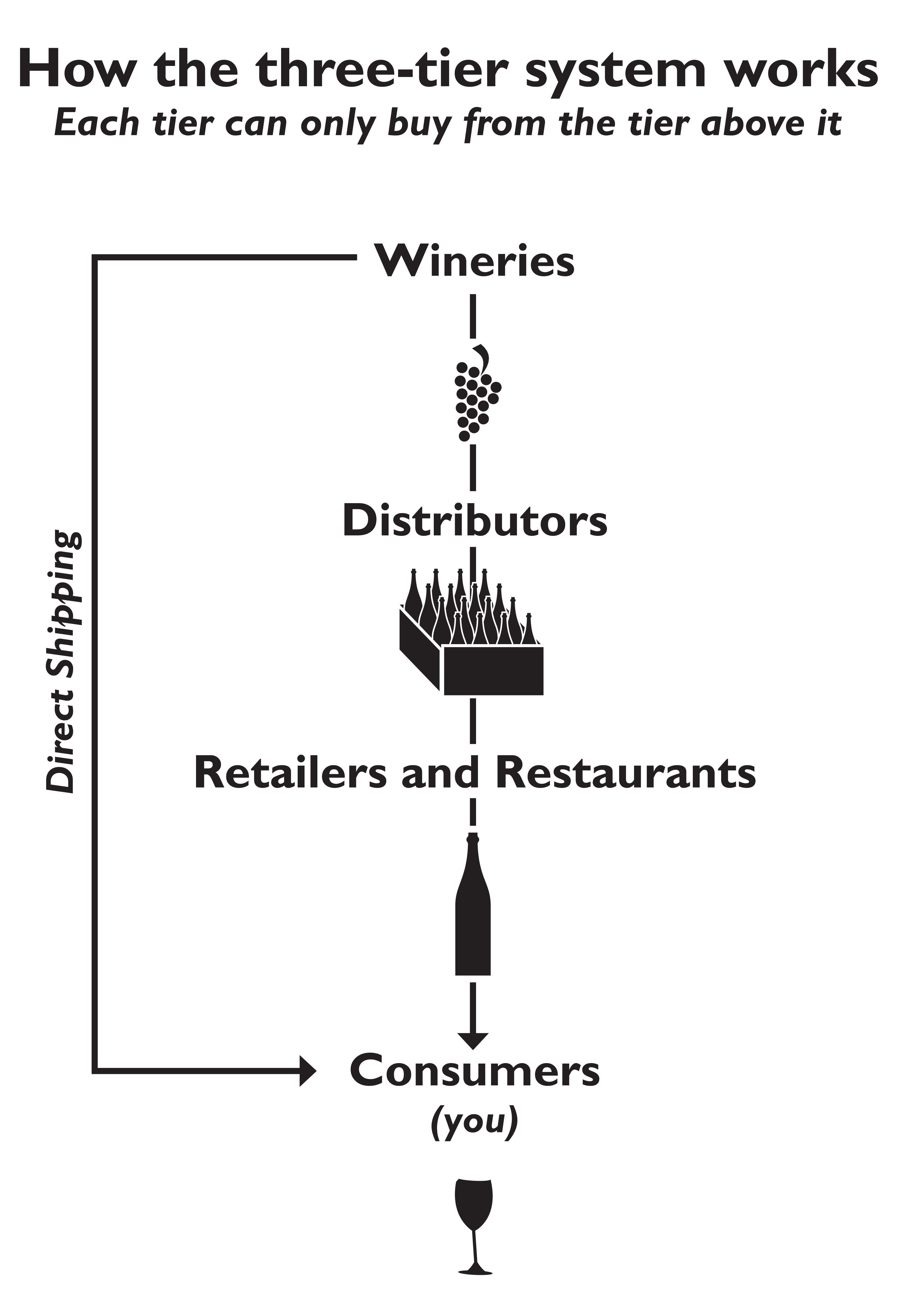
Prohibition, the 18th Amendment to the U.S. Constitution in 1920, outlawed the sale, manufacture, and transportation of alcohol in the U.S. until it was repealed 13 years later by the 21st Amendment. Repeal gave us the three-tier system, so named because it has three parts: The first tier are the producers, the wineries, breweries, and distilleries. They can only sell their product to a distributor, the second tier. Only the distributor can sell to retailers and restaurants, which are the third tier. Save for limited exceptions, like direct shipping, and which total less than 10 percent of all wine sales, the consumer can only buy wine from the retailer or restaurant.

This makes wine different from almost every other consumer good in the world. If you want to buy a computer from Dell or shoes from Nike, each is only a couple of mouse clicks away from the manufacturer’s website. And Amazon has become a $61 billion company by serving as the ultimate retailer, crossing state lines to sell its customers everything from books to underwear.

But ordering wine from an out-of-state producer is a crime in much of the U.S., and it’s a crime in every state to order wine from an out-of-state retailer. On-line retailers like Wine.com, which is in 42 states, have to legally qualify as an in-state retailer (by setting up an office or a warehouse, for example) to be allowed to do business in those states. And even Amazon, with its new Wine Marketplace, has to abide by these rules. Technically, it doesn ?t sell wine, but serves as a conduit to retailers and producers that are legally allowed to sell it.

How did we get to this point? Why is alcohol different from running shoes? Because the political compromise that ended Prohibition allowed each state to regulate alcohol in its own way. Three things are important about this:

? Every state ended up using some form of the three-tier system, and every state has modified the three-tier system to what it thinks works best for it. Which means there are 50 laws for 50 states, and sometimes different laws within states. Pennsylvanians can only buy wine from retailers owned and operated by the commonwealth. New Yorkers can’t buy wine in grocery stores. Montgomery County, Md., residents can’t buy wine at retailers like Cost Plus World Market, but residents of adjacent Prince George’s County can.

? Three-tier was designed to keep organized crime out of the booze business, which is understandable given the role organized crime played in bootlegging during Prohibition. Every liquor law attorney I have ever talked to says that ?s an important reason why three-tier has endured. State attorneys general and state liquor control boards, given three-tier ?s success in keeping the mob out of booze, don ?t see any reason get rid of it.

? The distributors, and especially those that deal in beer and spirits, don ?t want three-tier to change, and spend millions and millions of dollars annually lobbying state and federal legislators to preserve the system. This is understandable, too, given that the end of three-tier would mean the end of distribution as they know it. Their allies, surprisingly, are often independent retailers, who don ?t want their chain competitors to be able to buy wine directly from the winery, since that would give the bigger companies better pricing.

The worst part about thee-tier? We ?re stuck with it. A variety of federal court decisions, including Siesta Market in 2010, have said that three-tier is constitutionally protected, just like freedom of speech and freedom of religion. The 21st Amendment, say the various rulings, shelters three-tier from court challenges and state and federal legislation to alter it.

Yet none of this means three-tier is relevant in the 21st century. Prohibition ended 80 years ago, and organized crime has moved on. It ?s difficult to believe that rum running would be as profitable as today ?s pastimes, like credit card and bank fraud. In addition, we ?ve made tremendous strides in combatting alcoholism and drunk driving in the U.S., and these abuses are always given as a reason for three-tier.

For wine drinkers, three-tier limits consumer choice. Do you live in Illinois and had a wine you liked at dinner in Wisconsin? Did you try to buy that wine in Illinois only to find that it isn’t available? That’s the fault of three-tier. Just because a distributor in Wisconsin carries the wine is no guarantee that a distributor in Illinois will carry it. The Illinois distributor may not like the wine or the person who makes it or how much it costs. So they decide not to carry it, and you can’t buy it ? even though it’s available in another state just a half-hour drive away.

This is an especially acute problem for cheap wine. Distributors, all things being equal, prefer to deal with the biggest producers. They can get better pricing, the supply chain is more efficient, there is money for marketing, and they’ll have more wine to sell since big producers deal in tens of thousands of cases.

But much cheap wine ? perhaps the most interesting cheap wine ? is made by smaller companies that don’t produce tens of thousands of cases, can’t offer the best prices, have less efficient delivery systems, and whose wines are more quirky. So they have more difficulty finding a distributor ? and often can’t.

This is such a problem that there are trade events for wineries that don’t have distributors, held in the hope that a distributor will sample their wines and then take them on. It’s kind of sad, actually. Meanwhile, smaller wineries that do have distributors usually have to settle for smaller distributors that have less clout with retailers, which means the producer’s wines are limited in availability and may even cost more.

I ?m resigned to three-tier, given the court rulings. But that doesn ?t mean I have to be happy about it.


Winebits 288: Wine sales trends edition

? The three-tier system strikes again: How minor a role do on-line sales play in the U.S. wine marketplace? Pretty minor, according to a new French study. One in four Chinese wine sales use the Internet, while as many as one in 10 in Europe are done on-line. In the U.S.? Just two percent, and in one of the more masterly of recent understatements, the study ?s author cited ?legislative constraints ? as the reason. In other words, it ?s mostly illegal in this country, thanks to three-tier and the system that has evolved in the U.S. since the end of Prohibition.

? The Federal Reserve and wine sales: This post, from Silicon Valley Bank ?s Rob McMillan, explains (in English, too!) what ?s going to happen to wine sales now that the Federal Reserve is going to do less to stimulate the economy. The technical term is quantitative easing, and since we ?re going to see less of it, McMillan predicts a stronger U.S. dollar and higher lending costs for wineries who want to expand or make acquisitions. The former is good news for the consumer, since it should lower the cost of imports and keep wine cheap. It may also be bad news for high-end producers, who have higher costs of production and need higher prices to stay in business. And that interest rates will go up probably isn ?t good news for them, either. This post shows why McMillan is one of the really smart people in the wine business, and he deserves to win the Wine Blogging Award for best industry/business blog next year.

? Beware the hype: Steve McIntosh at Winethropology warns us that many of the lower prices we ?re seeing these days have very little do with wine quality and a lot to do with retailers and distributors getting rid of wine that is ?occupying precious warehouse space ? not all of which is worth your hard-earned money – at any price. ? He says he fell for the hype and bought two bottles recently, One of which is nothing more than ?a watered down version of wine. ?

Macaroni Grill’s half-off wine promotion

Screenshot - 06132013 - 07:31:09 AMOr, how not to publicize something good that you ?re doing for wine and your customers. Which makes me wonder: Does anyone in the popularly-priced restaurant business care about wine at all? And what does that attitude say about getting Americans to think of wine as something to drink every day?

Because this was supposed to be a glowing post about how smart and clever the new owners of the Romano ?s Macaroni Grill Italian chain are. This summer, the company is selling wine at its some 200 stores in 36 states for half price. Given the restaurant business ? track record for wine pricing, this is not unlike giving free dinners to customers for no particular reason at all.

And the wine list isn ?t bad. Yes, there is a lot of the usual junk but also Villa Maria, Emiliana, and 14 Hands (at half-price $13.50, practically retail) ? and the Prunotto Barbaresco is a steal at half-price $33.

So you ?d think the bosses at Ignite Restaurant Group would be eager and enthusiastic to talk about this, right? And you ?d be wrong. More, after the jump:

Continue reading →

Winebits 282: Wine prices edition

? Is cheap wine profitable? Jamie Goode, the respected and award-winning British wine writer, argues that cheap wine will never make anyone any money. He compares it to the cell phone business, noting that if one carrier offered cheaper rates instead of what he calls the almost cartel-like pricing structure in use, then ?all profitability will be sucked out of the market. ? That ?s the opposite of the wine business, he writes, so no one must be making any money with cheap wine. His reasoning, though intriguing, misses a couple of points. Wine is not the cell phone business, which is limited by spectrum availability (as one comment to the post points out) and that lack of spectrum raises prices and margins. In addition, Goode overlooks the elasticity of cell phones vs. wine. We ?need ? cell phones; we don ?t need wine. Hence, there is little incentive for cheap cell phone plans. Finally, I think Goode doesn ?t understand the incredible marketing skill of U.S. producers like The Wine Group, which can create demand for cheap wine like Cupcake and still make money.

? Restaurant pricing: Says Chris Nuttall-Smith at Toronto ?s Globe and Mail: ?There is perhaps nothing more galling than flipping open a restaurant ?s wine list to find a $15 bottle that you know and love listed for more than $50. That ?s been happening to me a lot lately; where many Canadian restaurateurs are loath to price their chefs ? cooking at levels that would make it profitable, they show no such restraint with wine prices. It ?s in-your-face enough to make some diners want to stick with Diet Coke. ? The Wine Curmudgeon couldn ?t have said it better. Is it any wonder that restaurant wine sales have never really recovered from the recession?

? When are wine sales illegal? When you ?re in a state that forbids them. Like Wisconsin, which enforces a 1939 law that sets minimum prices for many retail goods. The story does a good job of explaining why Wisconsin wine prices can be 20 to 30 percent higher than in neighboring states, and how the World Market chain had to correct its Wisconsin advertising and sales offer to comply with state law. Note to Wisconsin residents: Drive across the border to Illinois. Wine is much cheaper there, and maybe even worth the price of the gas for the trip.

Why so much wine analysis is so useless

Consider this, from a story about chardonnay's declining popularity:

"In analyzing the report, Napa Technology said the United States ? large
Spanish-speaking population and the growing popularity of Spanish food
seemed to be contributing to the growing popularity of Spanish
varietals."

Yes, chardonnay, though still the best-selling varietal, isn't as popular as it once was. But to give credit to Hispanic wine drinkers, who make up just five percent of the country's core wine drinkers as measured by the Wine Market Council, seems silly at best — and lazy and sloppy at worst.

I don't think Proctor & Gamble, or the analysts who follow the company, stumble through that kind of fuzzy thinking when it looks at the sales of its products.