



Tag Archives: wine research

Winebits 388: The world hates expensive wine

expensive wineThe cyber-ether has been full of vitriol for expensive wine over the past month, so much so that even the Wine Curmudgeon has wondered what’s going on. Some of these posts make me seem like a “bring on the $100 samples” member of the Winestream Media:

? Damn you, Napa cabernet: Something called Vox Observatory, which is part of the company that owns the chi-chi Eater food site and the SB Nation sports blogs, posted a video called “Expensive wine is for suckers.” The results? Not only is expensive wine overpriced, but many of the tasters said they liked the way the cheap wine tasted better than they liked the way the expensive wine tasted. One even went so far as to say that she was glad she had cheap wine taste. I wonder: Would Eater have run a similar post, citing the cheap and simple qualities of grocery store tomatoes over $15 organic, heirloom tomatoes? Of course not. This post speaks directly to the cliches the wine business and the Winestream Media reinforce about wine, and how their approach intimidates people who aren’t wine drinkers.

? Grocery store cheap wine: The cheapest offers the best value, according to a study done among British supermarkets. Almost two-thirds of the wines sold at Lidl and Aldi, known for their low prices, were called a good value; at least half the wine at six other chains was judged a poor value; and three-quarters of the wine at the bottom grocer was called a poor value. This is an amazing result, and not just because so much wine in grocery stores is so ordinary. It speaks to the concept of premiumization, and that producers and retailers aren’t giving us better wine when we pay more money, but the same wine in better packaging and with more expensive marketing.

? The placebo effect: Think your pricey wine tastes better than the cheap wine I drink? That may be because you want it to, says a study in the Journal of Marketing Research. Says the report: “Expectations truly influence neurobiological responses,” and there are even brain scans to prove it. Again, not a surprising result, and especially for those of us who have spent our professional careers trying to educate people on the differences between cheap and expensive wine.
Winebits 383: Taste buds, wine labels, Rudi Wiest

taste buds
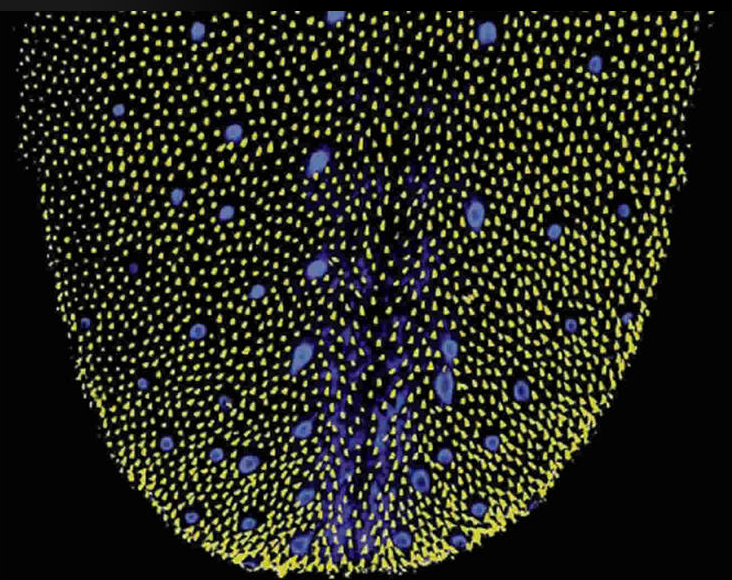
The tongue, and the blue bits are our taste buds.

? Even umami: Researchers for the first time have mapped how the tongue tastes while tasting is going on. CNET reports that the study found that each taste bud contains taste cells for different tastes — sweet, sour, bitter, salty, and umami. But that that was only the beginning of what appears to be ground breaking work. Taste may also be affected by the blood cells surrounding the taste buds, “and involve an interaction between the food taken orally and blood composition,” said one researcher. If true, this work goes a long way toward explaining why wine tastes differently depending on who is doing the tasting. It’s not just that everyone’s taste buds are different, but that our blood is different. The story says more work needs to be done, including mapping the brain while tasting is gong on to see how everything fits together, but one conclusion is obvious: Scores, which didn’t make sense before, make even less sense if blood type and even circulation matter.

? “Honest” wine labels: No, not the Wine Curmudgeon’s other great crusade (though more on that soon), but wine humor from the Huffington Post — what if wine labels identified the wine by what we used it for? Hence, the label would says “Netflix & Pizza Night” or “His Tinder Profile Lied.” Sort of funny, in fact, but more importantly goes to a point we’ve discussed often on the blog: That wine is as much about occasion as it is pairings, varietal, or even what it tastes like.

? Experience matters: The Italian Wine Guy, always alert for an opportunity to teach the young people, shares his time with German wine impresario Rudi Wiest, “I cannot tell you how it feels, at this stage of my life, to sit in front of someone for four days and be tutored by a master. It is humbling. And it is invigorating. To have been on the wine trail for as long as I have and to feel there is something totally undiscovered in the wine world which is deep, intense and engaging, well it ?s as if I turned back the clock and started all over again.” Which, to me, is the point of wine. It’s the hunt; that is, that wine itself is neverending, and that I never know what I will find next. The day we stop looking, the day we’re content with 92-point toasty and oaky is the day we should give up wine and settle for sweet tea.

One more reason why there’s no health news on the blog

The Wine Curmudgeon banned health news from the blog in 2009, after Italian researchers discovered that women who are drunk are easier to seduce. Did the world really need a study to know that?

Since then, I have remained ever vigilant. Wine, for some reason, has attracted the attention of researchers over the past decade in a way that ?s hard to understand. Let ?s cure cancer or AIDs; why all this fuss about wine?

The latest wine research that will make absolutely in difference in anyone ?s life comes from Rhode Island, where a study looked at the effects of red wine and vodka on pigs with high cholesterol. This raises so many questions that I don ?t even know where to begin: How do pigs get high cholesterol? They can ?t be eating too much fatty bacon or sausage, can they? Why vodka and not gin or bourbon?

The best part of the study? That moderate consumption of red wine and vodka may reduce cardiovascular risk, and that red wine may be more effective than vodka in doing so. I could have told you that, and the only medical degree I have is the one my mother wanted me to get.

So, once again, another reason to ban health news from the blog. We don ?t need research to know that drinking wine in moderation is a good thing; Julia Child was saying that 50 years ago.

(And a tip o ? the Curmudgeon ?s fedora to The Italian Wine Guy, who sent this item my way and whose sense of irony may be even more developed than mine.)