

Tag Archives: three-tier system

Free speech? Not with the three-tier system around

free speechPorn and protest is OK, but when it comes to free speech, the three-tier system has its own rules

Perhaps the best thing about this country is the First Amendment to the Constitution – that the government can’t restrict free speech unless there are special circumstances, like national security, public safety, and pornography. Even then, the bar is very high.

Except, of course, when it comes to the three-tier system. I’ve tried desperately over the years to make my peace with the way alcohol sales are regulated in the United States, but a recent federal appeals court decision in California made me realize I may never be able to do so. It is regulatory foolishness run amuck.

The case, involving a California law that forbids payments from alcohol manufacturers to retailers as part of the state’s version of three-tier, is incredibly dense unless you practice First Amendment law. But the outline is simple enough: An advertising network wanted to put digital ads in liquor stores. It would sell the ad space to booze companies, and then split the proceeds with the retailers.

This is common in grocery stores, where you’ll see digital displays touting soup or cereal or whatever. But to sell alcohol? Harrumph, said the California liquor cops. That’s because state law prohibits alcohol producers, importers, and wholesalers from “paying money” or providing “anything of value for the privilege of placing or painting a sign or advertisement…on or in any” liquor retailer.

California needs to keep the digital ads out of liquor stores to “advance a legitimate state interest” – in this case, protecting us from beer, wine, and spirits companies paying retailers to carry their products. In some warped way, the state sees the digital ads as bribes to retailers, where your local liquor store won’t carry Miller Lite unless its owner, the mega-billion dollar beer behemoth Molson Coors, buys an ad.

How silly does that make three-tier sound?

Or, as the blog’s official three-tier legal expert put it:

“This decision means all the three-tier system criers will be emboldened and use this as an excuse to make even more intrusive inroads on commercial and personal liberties. The argument is that the courts clearly favor the three-tier system and uphold anything done in its name, so anything a regulator cares to pull off can be justified by that all encompassing claim of ‘three-tier system.’ It is irritating that such claims and reasoning are so patently bogus and that matter so little. As in many things, the broad justification of ‘three-tier system!’ is an excuse not to think.”

So the New York Times can publish the Pentagon Papers, because that’s protected by the First Amendment. And you can buy and read pornography without fear of being arrested, because that’s protected by the First Amendment. And you can march in protest against the government, because that’s protected by the First Amendment.

But you can’t sell an ad to a wine company to put in a liquor store, because three-tier says no — and without three-tier the republic would collapse.
Winebits 496: Aldi wine, sports betting, wine shipping

Aldi wineThis week’s wine news, because the blog is off tomorrow for the holiday: Media-induced shortages for Aldi wine, plus more three-tier trends

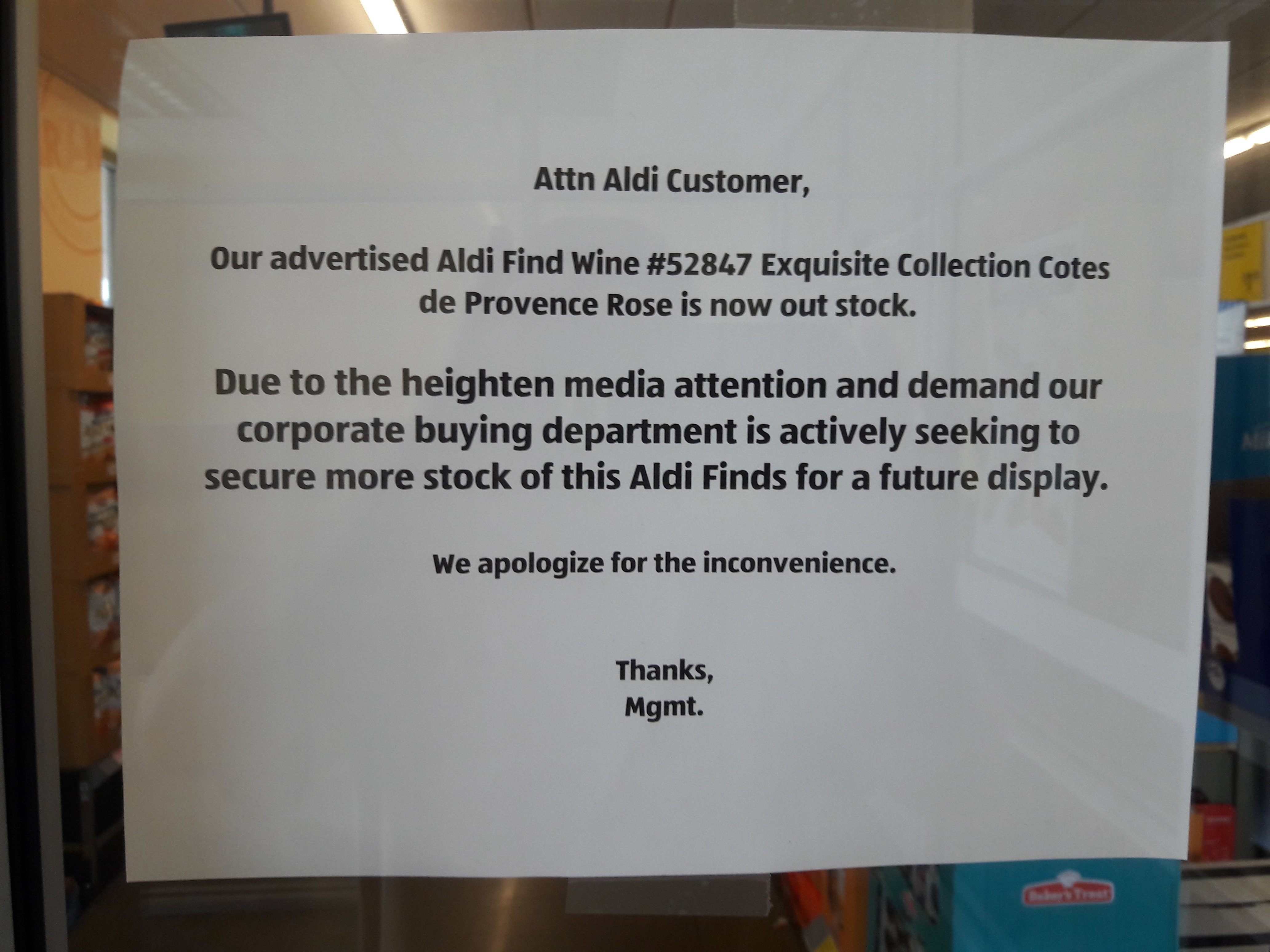
Cheap rose forever: Imagine the Wine Curmudgeon’s shock when saw this sign (the one at the top of the post) at his local Aldi – a media-induced shortage of rose. As much as I would like to take credit for this, it’s the fault of NBC’s The Today Show, which ran a piece on the $9 Cote des Provence rose at the beginning of June. The clerk at my Aldi said the warehouse has been out of the wine for weeks; hence the sign. What’s most interesting is not that the wine is sold out, because anyone who follows the WC knows cheap pink wine is one of the wine world’s great finds. Rather, that the Provence has been sold in Britain, and that Aldi is bringing it to the U.S. Aldi hasn’t done that with many of the the wines it sells in Europe, instead selling a variety of very ordinary domestic wines in this country. Could it be that the chain is feeling the heat in the U.S. from the debut of its German arch-rival, Lidl? And yes, if and when it ever shows up at my Aldi, I’ll review it.

Constitutionally protected: The Supreme Court has agreed to decide the constitutionality of a New Jersey law allowing sports betting. Why is this important to wine drinkers? Because the court has never, as far as I know, agreed to decide the constitutionality of the three-tier system that governs the sale, manufacture and distribution of booze in the U.S. But gambling, somehow, gets a hearing? And, if the court sides with New Jersey, it means any state can legalize sports betting – even if they don’t allow you to buy a bottle of wine from Amazon or six-pack of beer on your way to the lake on Sunday morning. If there any constitutional scholars in the audience who can explain why this is not hypocrisy of the highest order, send me an email.

Only 14 states: Speaking of which, Tom Wark of the National Association of Wine Retailers reminds us that only 14 states allow consumers to purchase wine from out of state retailers. Interestingly, New Jersey is not one of the 14. But if gamblers will soon be able to take the Cowboys and the points in an Atlantic City sports book, perhaps the state will reconsider.

Winebits 494: Wine Spectator, Warren Buffet, song royalties

warren buffetThis week’s wine news: A compliment for the Wine Spectator, plus Warren Buffet takes on three-tier and more wineries can legally play music

Well done, Dr. Vinny: The Wine Spectator gets a lot of well-deserved abuse in this space, but when the magazine does something right, that should be mentioned, too. In its Dr. Vinny wine advice column, the doctor told a reader to stop being such a wine snob: “Most wines sold here are on the sweet and simple side and cost less than $10 – and I think that’s OK. I want wine to be accessible and part of our culture. I love that I can turn on the television and regularly see characters holding a glass of wine. As much as I’d like to share my passion with everyone I know, I don’t feel a need to dictate style. There are styles to appeal to every palate. It would be boring if we all had the same thing in our glass.” Dr. Vinny, that’s a 100-point answer.

Taking on three-tier: Warren Buffet’s Berkshire Hathaway holding company owns a Texas food distributor, and the distributor wants to sell alcohol in Texas. To do so, it needs a state wholesalers license, but the state doesn’t want to give it one. Hence, legal wrangling and perhaps a lawsuit. The story describing all this, written by long-time journalist Liza Zimmerman, does a good job explaining a very complicated subject, though I wish she had been a little more even-handed in assessing the need for three-tier. Still, the point is well taken: If even Buffet, long regarded as one of the great capitalists and entrepreneurs in the history of the world, thinks three-tier is obsolete, why are we still messing with it?

Solving the royalty problem: Anyone who has heard recorded or live music at a winery, and especially a small winery, may have been party to a copyright law violation. That’s because many wineries were playing music without paying royalties. This is another controversial and complicated topic that has been going on for years; it’s enough for us to note that the companies that collect royalties for musicians are notorious for their diligence and that many of the wineries couldn’t afford to pay the royalties even if they knew about them. Finally, though, a compromise, brokered by the Wine America trade group, which should solve the problem – affordable royalties. I mention this because music, live and recorded, is key to the survival of many local and regional producers, and anything that helps Drink Local is welcome.

Winebits 463: Dr. Who and the three-tier system

dr whoThis week’s wine news: One of Dr. Who’s writer slams crappy wine, while three-tier rears its ugly head

Doesn’t the sonic screwdriver help? Yes, there was probably bigger wine news last week. But how often does the Wine Curmudgeon get a chance to write about Dr. Who? Steven Moffat, who writes for the current incarnation of the Doctor, has harsh words for crappy wine served in theaters: “Don’t stop in the middle of a show and send the audience to a terrible bar. That really spoils the evening when they stop the show and give you the worst red wine you have ever drunk in a crowd of people who just want the show to keep going.” Again, not the biggest problem in the wine world, but spot on criticism. I get to a play or two a year, and I always cringe when jug wine is served in plastic cups at prices that are not jug wine served in plastic cups.

Watch your cookies: The details in this story are difficult to follow unless you’re a computer geek or tax lawyer, but it’s enough to know that Massachusetts’ liquor cops want to track your computer use to tax you if you’re buying wine. As the blog post from the always knowledgeable Jeff Carroll notes, this isn’t so much about technology as it is sales taxes. The fear is that the Internet will deprive the states of untold millions in tax revenue, and this is one way around that problem. Of course, the easiest way to solve the problem would be to legalize Internet wine sales, but that’s too easy.

No to Total Wine: A federal court judge has dismissed Total Wine’s suit to overturn the Connecticut liquor law system that sets minimum prices for wine, beer, and spirits. The judge, in what seems like a very conservative decision to avoid being overruled by a higher court, said that the complex Connecticut pricing system cannot be preempted by federal antitrust law, and that the state legislature is the only group that can change the law.

One final word about La Moneda malbec, “the world’s greatest cheap wine”

La MonedaThe La Moneda malbec: “So much publicity, yet no availability” – the bane of the existence of anyone who loves wine

A reader writes:

“I have called Walmart in New Jersey and along the east coast regions. I have called the producer in Chile and the distributor in Minnesota. Unfortunately, and very sadly, no one has been able to help me place an order. I spoke to the corporate heads in Arkansas (Walmart) and they have no clue what I am talking about or what is La Moneda Malbec. I am writing you in hopes that you can simply tell me how can I order a case of this mystery wine that has so much publicity, yet no availability.”

The $6 La Moneda, for those of you who have not been breathlessly following this story, was called the greatest cheap wine in the world after it won a platinum medal at last year’s Decanter World Wine Awards in London. The catch? That the wine was made for a British supermarket chain called ASDA, which Walmart owns. And it wasn’t sold in the U.S.

Nevertheless, as any Google search will show, the U.S. media went silly writing about the wine, mostly because no one could believe Walmart sold the best cheap wine in the world. This ignored the fact that the La Moneda wasn’t for sale in the U.S. — but why let that get in the way of a good story?

Additionally, almost everyone who posted La Moneda stories, including legitimate news organizations, didn’t seem to understand the wine business, the three-tier system, and availability. They didn’t realize that wine is different from every other consumer good; laws restrict how it is sold, so that just because it was for sale in one place didn’t mean it would be for sale in another place. My pal Dave McIntyre explained all of this brilliantly in the Washington Post, not that anyone paid attention.

This led to what the reader wrote – “so much publicity, yet no availability.” Which, of course, never, ever happens in the wine business, does it?

Walmart, to capitalize on the publicity, found enough of the wine last fall (and navigated three-tier to so do, which I wrote about here) to sell it at 577 of its 4,600 U.S. stores. The wine sold out before the end of the year, and there is none left in the U.S. It doesn’t appear there is any left in Britain, either. The ASDA website sells something called La Moneda Premium Collection Malbec, which is not the same thing — and it is only sold in Britain.

The moral in all of this? Wine availability is the bane of the existence of anyone who loves wine. And there is nothing to be done about it until we drive a stake through the three-tier system’s cold, cold heart.

Photo via the Washington Post, using a Creative Commons license

More about La Moneda malbec:
Wine of the week: La Moneda Reserva Malbec 2015

Winebits 486: Dope writing, cold beer, historic wine

dope writingThis week’s wine news: California’s newspapers take up dope writing, plus a historic Spanish wine cellar and three-tier foolishness over cold beer

Just like wine: We’ve written a lot about how legal weed will affect wine, and here is another example: “We think that cannabis has the potential to be more mainstream and be reviewed like wine or beer or other consumables at a really high level with a really discerning and independent perspective.” The New York Times reports that a couple of dozen California newspapers will run pot reviews, including the San Francisco Chronicle – which traditionally has had some of the best wine coverage in the country. Again, anyone who thinks legal dope won’t affect wine consumption isn’t paying attention.

How dare you? An Indiana convenience store owner, who found a loophole in state law so he could sell cold beer, has been targeted by legislators who want to force him to stop. The complete sad story is here; it’s enough for us to know that Indiana’s elected officials are going to tremendous lengths to preserve a silly, three-tier driven law that gives a cold beer monopoly to package stores and restaurants. Everyone else has to sell warm beer for no other reason than the former has a better lobby than the latter.

Really old wine: Rekondo, one of Spain’s great restaurants, has a wine cellar with almost 125,000 bottles. But quantity is not all it has – how about a complete vertical of Château d’Yquem, the world’s greatest dessert wine, dating to 1933 or a vertical of Mouton Rothschild, one of the great Bordeauxs, dating from 1945? The article from Punch magazine goes into even more amazing detail, but what struck me was one of the comments to the story: “Amazing wine list AND reasonable prices.” How often do can we say that for restaurant wine in the U.S.?

Winebits 485: Rose, Chinese wine, three-tier

chinese wine
Apparently, he’s the reason we’re drinking rose.

This week’s wine news: Who knew? Millennials are the reason we’re drinking rose, plus Chinese wine in the U.S. and a Pennsylvania convenience store chain adds wine

So cheap and good doesn’t matter? One of the first things the Wine Curmudgeon learned as a young reporter was not to write something unless there were facts to support it. So this piece, called “It Turns Out Millennials Were Right About Rosé The Whole Time,” made me want to exhume all the cranky, Front Page newspapermen who taught me the business and let them chew out the the writer in their pre-modern, cigar-chomping style. Nothing in the post supports the headline, and most of it is about why we should be drinking rose. Which, of course, is what many of us have been writing for a decade, without the help of Millennials, the Winestream Media, or anyone else. Apparently, the post is on some sort of food blog, so I’m probably expecting too much that it should write intelligently about wine.

Welcome the Chinese: Winemakers in the Chinese province of Ningxia want to sell their product in the U.S., which includes sparkling, riesling, syrah, merlot and cabernet sauvignon. The article, which appears in the U.S. version of the state-run China Daily, is not so much about wine as economic development. And, because it’s about wine, it compares the Chinese vineyards favorably to the best regions in France and California. I’ve yet to see a story about an emerging wine region, even in non-state-owned media, that doesn’t do that.

Rutter’s adds wine: Ordinarily, convenience stores selling wine isn’t news. But when it’s in Pennsylvania, it’s worth noting because the state has ended its monopoly on wine sales. That means that privately-owned retailers like the 47-store Rutter’s chain can, so it will “carry a large selection, including Cabernet Sauvignon, Riesling, Chardonnay, Merlot, Pinot Noir and other varietals.” One can only hope that the wine will be of sufficient quality and not suffer too badly from convenience store markups. Otherwise, what was the point?