

Tag Archives: imported wine

Do younger wine drinkers prefer imported wine?

imported wineOne study says they do – which means the California wine business could be ever more dependent on aging Baby Boomers

Do younger wine drinkers prefer imported wine to that made in California? That’s a tantalizing thought – and one that may be true, given a recent Wine Opinions study.

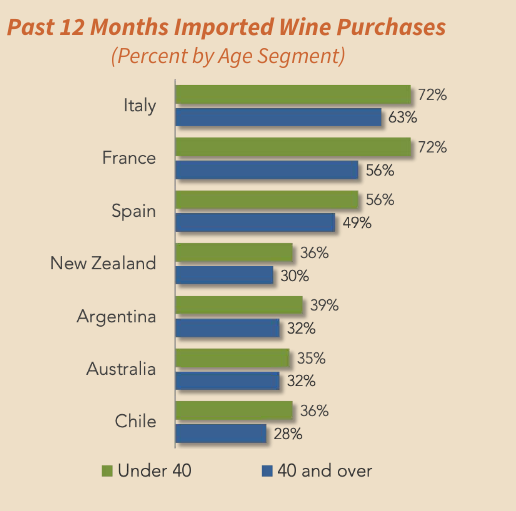
The survey queried more than 1,500 people who are part of the organization’s wine panel, looking for age and gender differences in who buys imported wine. And there may be significant differences based on how old they were. Respondents younger than 40 were more frequent purchasers of imported wine than those 40 and older – and that held true for each of the seven countries in the survey.

Most interestingly:

• France: Almost three-quarters of those under 40 had made “several” or “frequent” purchases in the past year, compared to 56 percent of those older than 40.

• Italy: 72 percent vs. 63 percent.

• Spain: 56 percent to 49 percent.

The point, says Wine Opinions’ John Gillespie, is not that older wine drinkers don’t buy imported wine. Of course they do.

But if younger wine drinkers – who drink less wine overall than their elders – buy more imported wine, then they’re probably buying less California wine. And that’s not a good sign for the future of California wine, if it means its future depends on an aging, Baby Boomer customer base.

“The age differences are more important, in my opinion, than the gender differences we also found, which really weren’t significant,” says Gillespie, who added that Millennials have consistently bought more imported wine, especially from France, over the past several years.

“I think the love affair with California wines among Boomers goes all the way back to their early days of wine drinking, with wines like Hearty Burgundy, Almaden Mountain Red, etc.,” he said in an e-mail. “As the California wine industry grew in the ‘70s and ‘80s, the Boomers were there, trying every new thing that came along, and they are still very loyal.”

The other thing that I find intriguing? It’s easier to buy California wine – the labels are in English and the grapes used in the wine are on the label. This usually isn’t the case for European wines; unless you know what you’re doing, buying a Rioja or a red Rhone can be a crap shoot. Yet younger wine drinkers are doing it anyway. Is there a lesson California is missing there?

Winebits 700: Sunday wine sales, tasting room fees, imported wine

supermarket wine
“Ah, 9:58 a.m. So I can buy wine in just two minutes!”

This week’s wine news: Texans will be able to buy wine at 10 a.m. on Sunday, plus a hike in California tasting room fees and imported wine takes a hit

Bring on the wine: Texans will be able to buy wine at the supermarket at 10 a.m. on Sunday on their way to church, thanks to legislation passed last week. Previously, we had to wait until noon, when church ended. The bill may have been been a compromise to stop Sunday liquor store sales; it’s illegal in Texas for liquor stores to open on Sunday, and has been since 1935. Because, of course, church. A bill to allow liquor stores to open on Sunday failed to pass yet again, at least the fifth bill in the past decade to do so. Still, we have cocktails-to-go if we need a belt of whiskey on Sunday.

Up, up, and up: The average price for a standard tasting fee has almost doubled in five years to $58 in Napa County and $30 in Sonoma County. That’s good news just in time for a revival of wine tourism, yes? Wine-searcher reports the details from Silicon Valley Bank’s 2021 Direct-to-Consumer Wine Survey Report. The average tasting fee in the U.S. is $25, according to the report. Washington state wineries charge the least – just $15. And many wineries report having a higher “reserve tasting” fee, which averages $90 in Napa and $50 in Sonoma.

Down and down: The global pandemic, on-premise shutdowns, and the Trump tariff sunk imported wine shipments to the U.S. last year, reports Shanken News Daily. Imported table wine shipments to the U.S. fell almost nine percent in 2020. Which, of course, is to be expected for anyone paying attention. Italy accounted for more than one-third of U.S. imports, making it the top foreign wine importer.

Photo: Oleg Magni via Pexels

studio microphone

Winecast 57: Patrick Mata of Ole & Obrigado and imported wine during the pandemic

patrick mata
Patrick Mata, right, and Alberto Orte of Ole & Obrigado. “American companies are paying the tariff. How does that punish Europe?”

Patrick Mata:  U.S. companies are paying the wine tariff – how does that punish the European Union for airplane subsidies?

Want to make sense of the European wine tariffs, which seem to make no sense at all? Then listen to Patrick Mata, whose Ole & Obrigado is one of the leading Spanish wine importers to the U.S.

“I thought we might go out of business,” says Mata, whose company specializes in importing quality, $15 or less wine from Spain and Portugal. “Our margin is 30 percent on a bottle of wine, and the tariff is 25 percent. How were we going to stay in business?”

The good news is that Ole & Obrigado did, despite the tariff and the pandemic (which clobbered its restaurant business). Sales fell only 20 percent in 2020, which Mata considered a victory of immense proportions.

Mata, a long-time friend of the blog, was open and honest about how the tariff and the pandemic have hurt the wine business. Among the topics we talked about:

• Why raising prices to cover the tariff doesn’t work, and why it especially doesn’t work for the $15 wines that Ole specializes in.

• How to give back during a crisis, and why there should be more to the wine business than just making money.

• What Americans are drinking during the pandemic, and why it’s a victory for Big Wine at the expense of small producers — another unintended consequence of the tariff.

Click here to download or stream the podcast, which is about 15 minutes long and takes up 9 megabytes. Quality is mostly excellent – Zoom didn’t act up this time.

Winebits 495: Imported wine prices, Justin Beiber wine, Big Wine brands

imported wine pricesThis week’s wine news: Why a strong dollar doesn’t cut imported wine prices as much as it should, plus a rant about too commercial wine and Big Wine’s fastest growing labels

Not so cheap: The strong dollar has finally cut the price of imported wine, but it took surprisingly long and import prices don’t seem to be as falling the way they should be. A working paper in the Journal of Wine Economics may explain why: Laura Werner of Germany’s FernUniversitat writes that as the dollar gets stronger, other pricing pressures and how the supply chain works may slow price cuts. For example, the price of wine already in the U.S. or on its way here won’t fall, so that means a delay in cheaper wine until it’s sold at the higher price. The paper is incredibly complicated for those of us who don’t speak math, but my interpreter, Suneal Chaudhary, explained it to me. In the end, he said, a 25 percent drop in the euro may only result in a 10 to 15 percent drop in retail prices here.

Take that, crappy wine: A top Italian wine type has lashed out at wines that are too commercial, saying that “Winemakers need to gain more confidence and feel more comfortable in doing their own thing and making authentic wines that are true to themselves. Oherwise, you end up with the wine equivalent of Britney Spears and Justin Bieber – commercially focused wines made to suit the market.” That’s not the WC ranting, but Italian winemaker and consultant Alberto Antonini speaking to thedrinksbusiness magazine website. “I don’t like to make wine for the market,” he told the magazine. “I like to go out and make wine that is true to a place and then find a market for it.” Antonini was also scathing about winemakers who make what he called boring and ineffective Bordeaux knockoffs, because they don’t know what else to do.

The big get bigger: We’ve written many times on the blog about how much of the market is controlled by Big Wine, and this chart from the Wine Industry Insight website reminds us of that once again. It lists the 10 fastest growing brands in the U.S. from 2015 to 2016 – five of which are owned by Big Wine, including the top four. How about 1,600 percent growth for Constellation’s Ravage, which seems to be something the WC would write long diatribes about, and 400 percent for E&J Gallo’s Vin Vault boxed wine?

Winebits 380: Wine prices edition

wine prices ? Cheaper imported wine? That’s the question that many people were asking last month at a major European industry trade show, ProWein in Germany. The dollar has gained more than 20 percent against the euro in the past year, and the exchange rate is near 1-1, something that hasn’t happened in decades. This change was welcomed by many foreign producers, since it would make their wine easier to sell in the U.S. Said one Spanish winery official: “Obviously, the exchange rate is helping us very much and gives us a number of opportunities at the moment.” Whether consumers will see lower wine prices on store shelves, though, remains to be seen. Distributors and importers are reluctant to cut prices, not only because it means more profit for them if they don’t, but because the industry seems committed to the idea of premiumisation, trading U.S. consumers up to more expensive bottles of wine.

? Less cheap wine? Maybe, maybe not. This story, from CNBC, is the sort of thing that makes me crazy — a reporter is given an assignment and isn’t quite sure how to do it. The story starts saying that California’s drought will make quality cheap wine more difficult to find, but soon detours into sake, wine writing, the difference between Old World and New World wines, and that drought isn’t necessarily a bad thing for grapes. Blame the editor, who was too busy or too lazy or too indifferent to offer the reporter any direction. How do I know this? The reporter quoted another reporter, which is not something you’re supposed to do. A better editor would have taken that out, with a stern warning not to do it again.

? Lots of effort to little effect? Researchers say they have discovered how to successfully price wine futures, part of a disturbing trend in wine research that focuses on wine that almost no one buys but that gets a lot of attention. It’s one thing to research the futures market in corn, wheat, and pork bellies, because that determines the price of food. But wine futures? Would it matter to anyone but the Winestream Media, very rich people, and a handful of retailers if they went away tomorrow?

Winebits 362: Wine sales, Cava, imported wine

u.s. wine sales ? More wine: We’re continuing to drink more wine than ever in the U.S., up about 1 million cases in 2014 over the previous year, reports Shanken News Daily. The percentage increase isn’t much, just 0.3 percent. But that there is growth, despite the after-effects of the recession, shows that wine may have finally established itself in this country as something more than a niche product. As the Shanken story notes, “consumption has increased nearly 80 percent over the past two decades,” and per capita consumption has finally risen past its 1970s levels.

? Bring on the sparkling: Cava, the Spanish sparkling wine, has long been a Wine Curmudgeon favorite, but it faces intense competition from Prosecco, the similarly-priced bubbly from Italy. The latter is typically sweeter and fruitier, and the Italians have parlayed that into double-digit growth over the past several years. Freixenet, the biggest Spanish producer and the top imported sparkling in the U.S., saw sales fall four percent last year. Why does that matter? Because exports account for around two-thirds of global Cava sales. Hence concerns that competing with Prosecco on price alone could lead to what happened with Australian shiraz and Argentine malbec — lots of cheap wine of varying quality. I’m not sure that Freixenet’s plan to add more expensive wines to differentiate itself from Prosecco is any better, given that Cava quality is so good at $10 and $15 there is little reason to trade up.

? Bring on the imports: How global has the the U.S. wine consumer become? Imports account for about one-third of the wine we drink, and that figure is expected to increase over the next two decades to as much as 45 percent. In the first half of 2014, though, we drank less imported wine than in the previous year (but the dollar value of the wine we drank increased by five percent). The biggest winner in those six months was New Zealand; the biggest loser was Australia. Sales from Italy and France, the top two exporters to the U.S. were mostly flat, though the dollar amount of what they did sell increased eight and six percent.

Winebits 297: Sweet wine, imported wine, regional wine

? The Winestream Media always acts like the Winestream Media: Shanken News Daily, a news service for the wine business, ran an item last week noting that Indiana ?s Oliver Winery was taking advantage of the sweet wine trend to boost sales. What the story missed was that Oliver was selling hundreds of thousands of cases of sweet wine long before it became a national trend, and is actually one of the regional wineries that started the trend (along with Missouri ?s St. James, North Carolina ?s Duplin, and Texas ? Llano Estacado). How did Shanken get this so wrong? Because, as with all members of the Winestream Media, nothing happens unless they say it does, which is why so much wine writing, wine analysis, and wine criticism in this country is so poorly done. I once did a piece for a trade magazine owned by the same company that owns the news service, and had a fight with an editor who insisted that Texas ? liquor laws were so unbelievable that what I wrote couldn ?t be true. She just knew the way the world worked, and wasn ?t going to let the facts disturb her.

? Where ?s all that French wine? W. Blake Gray, who started out to defend the quality of Australian wine, has done yeoman work in analyzing where the imported wine comes from that most of us drink. I think even Blake was surprised to find out how popular Argentine wine, and specifically malbec, was, and how much less popular French wine was. Of course, if you read most mainstream wine criticism, you ?ll get the opposite impression, because who wants to write about $8 malbec when there ?s all that Bordeaux and Burgundy to drool over?

? The problems with regional wine: My pal Kyle Schlachter, long a defender of regional wine, is also smart enough to know that not all regional wine is created equal. This blog post, focusing on how consumers use social media to critique wineries, is pointed, excellently written, and painfully accurate in discussing how too many regional wineries don ?t understand customer service, don ?t care enough about wine quality, and don ?t want to work with anyone else to improve their business. I saw this all the time when I did Drink Local Wine, and it always made me crazy; Kyle has more patience than I do.