


Tag Archives: grocery store wine

Winebits 460: Screwcaps, wine writing, wine prices

screwcapsThis week’s wine news: Screwcaps replaced by glass? Plus thoughts on wine writing and wine prices

Watch the heat: Here’s a reason not to use screwcaps – you can’t tell if the wine has been damaged by heat. This matters with expensive wine, says Penfolds’ Peter Gago, who makes very nice expensive wine. Who wants to buy a bottle of top-end red only to find out it’s off because it has been stored or shipped in conditions that are too warm? thedrinksbusiness website reports that a weeping cork – where some wine has leaked out – may mean the wine has been exposed to intense heat. Also, if the bottle gets too hot, the capsule – the cork covering – is pushed up. Neither happens with a screwcap, because it’s a better seal. In this, says Gago, glass will eventually become a better closure for expensive wine than either cork or screwcap. That’s a unique look at closures, and one that doesn’t apply to almost all the wine we drink since it costs less than $20 and isn’t around long enough to suffer heat damage.

Still awful: Erika Syzmanski is one of my favorite wine writers, mostly because she doesn’t write about wine. This is not damning with faint praise, but that Syzmanski understands there is more to wine writing than toasty and oaky. This piece is an excellent example, discussing not just why wine writing isn’t as good as it should be, but offering her ideas about what needs to be done: “This, fundamentally, is what makes me cringe when someone asks me about whether wine writing is becoming better, or whether we’re helping to make wine more accessible. Adding ramps to buildings is great, especially when we don’t destroy the architectural beauty of a good set of stairs doing so. Appreciate the stairs, keep the highfalutin’ publications, but simultaneously add a ramp for people who need or want to read something written more like Buzzfeed than like The Atlantic.” Which, of course, is what I have been arguing for years, though without her patience.

Grocery store wine: One reason supermarkets are so eager to carry wine is that they make more money on wine and have more control over the price. And that is becoming true for restaurants as well, which helps explain why their prices are so out of line. The grocery business is in the midst of what the experts are calling food deflation, where wholesale prices are decreasing, which means they can’t charge as much, and which means their profits are lower. This is starting to happen with restaurants, too. So how will restaurants prop up the bottom line? Continue to overcharge us for wine, to make up for what they can’t charge us for food.
Cupcake wine review 2016

cupcake wine reviewA cabernet sauvignon that isn’t too bad, but a merlot that really isn’t necessary

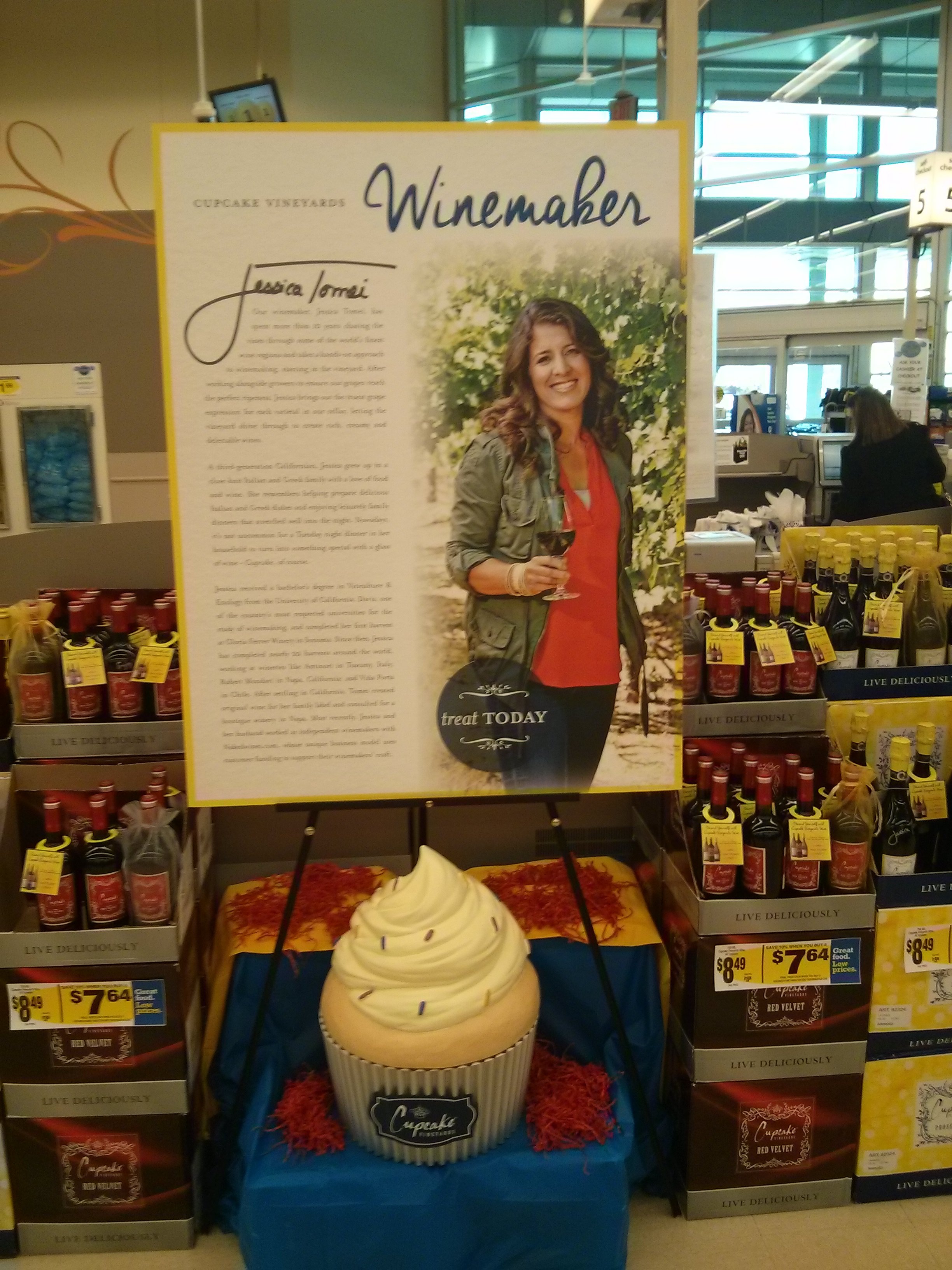
The 2016 Cupcake wine review features the top-selling brand’s cabernet sauvignon and merlot. The cabernet surprised me; it mostly tastes like cabernet, and may be the best Cupcake wine I’ve tasted in the six years I’ve done a Cupcake wine review. The merlot? The less said, the better.

The California cabernet sauvignon 2014 ($10, purchased, 13.5%) smells like boysenberries, not unlike pancake house boysenberry syrup without the sweetness. It’s mostly dark fruit, but barely sweet at all in the way so many grocery store wines are jammed with sweet fruit. The mouth feel is surprisingly full, again not what I expected, and the tannins and acidity are pleasantly noticeable and in balance.

The catch is the finish, which involves some horrible fake oak that can best be described as tasting like cheap, bitter, poorly made cocoa powder. It stayed in my mouth despite my best efforts to get rid of it with repeated rinsing.

The California merlot 2014 ($10, purchased, 13.5%) was thin, bland, dull, and uninteresting. It wasn’t fruity or earthy (though there was a funky aroma that blew off after a minute or so) in the way that most merlots are one or the other. Even more surprising was that there wasn’t any finish, and there’s usually at least a crummy one on this kind of wine. But the merlot vanished the minute I spit it out.

Given how many grocery store merlots suffer from an overabundance of flavor and fruit, the merlot is hard to figure out. My guess? Just poor quality grapes, which may also account for the funky aroma.

For more on Cupcake wine:
Cupcake wine review 2015
Cupcake wine review 2014
Cupcake wine review 2013

Winebits 453: Frose (ouch), wine clubs, Pennsylvania

froseThis week’s news: Rose morphs into frose, wine club calls it quits, and supermarket wine for Pennsylvania

Say it ain’t so: Just when we thought the hipsters were done with frose, someone wants to ruin cheap and delicious rose to make a sweet cocktail with it. This is another example of how people who don’t know anything about wine write about it, since the recipe lists something called “sweet rose.” Which, of course, is not rose but white zinfandel, and if you want to make cocktail with that, all you need is club soda and lemon and lime slices. Also infuriating: The concoction requires three other kinds of booze, which cost about $80. And that $80 would be better spent on 8 or 10 bottles of this. Or this. Or even these.

Saying goodbye: Global Wine, which ran wine clubs for the New York Times and Wall Street Journal and came under scrutiny on the blog, has apparently gone out of business. Wine Industry Insight reports that the company has “decommissioned” itself and that it may have been purchased by a competitor. If so, that may mean a shakeout in third-party wine clubs, which supply the wine and marketing for retailers, magazines and newspapers, and non-profits that offer wine clubs. And that may be part of the consolidation that has had the wine business in a stranglehold over the past couple of years.

Saying hello: A Giant Eagle in suburban Pittsburgh has become the first supermarket in the state to sell wine as part of Pennsylvania’s liquor reform legislation this year. Meanwhile, 200 groceries have applied for a wine license and 81 have been been approved. This comes as especially good news to the Wine Curmudgeon, whose readers in Pennsylvania will no longer have to leave sad comments on the blog that they can’t buy the wine I review at Pennsylvania’s state stores.

Transparency and grocery store wine prices

grocery store wine pricesTrying to make sense of something that doesn’t make any sense – grocery store wine prices.
When I write about grocery store wine prices, two things happen – I get a lot of traffic and someone who works for a supermarket will say I’m not being fair to those who work hard to sell grocery store wine.

So a few notes about my experience at my Kroger this week. Keep in mind that Kroger is one of the biggest wine retailers in the country and so sets the tone for what many grocers do:

• There is no French wine section. The French wine is scattered among the other reds and whites, depending on varietal. I asked the former wine person, who left earlier this year, why that was, and she said the bosses decided that consumers didn’t need to know that sort of thing and she sort of agreed.

• I bought a bottle of the Angels & Cowboys rose for $13, easily the cheapest price I’ve ever seen, and a couple of bucks less than I paid at one of the big Dallas discount retailers this summer. On the other hand, a bottle of Casillero del Diablo rose was $10 – $3 more than the other Casillero wines. You should now that Casillero is very ordinary $7 wine, the kind that epitomizes the stuff supermarkets sell. So why the Casillero rose cost more than the chardonnay and cabernet, and only $3 less than one of the greatest roses of all time, is a mystery.

• That damned volume discounting. A sign said the Bogle cabernet sauvignon was $8.99, down from $9.99. But when I reached for the bottle, I saw the fine print – I had to buy six bottles. So the bottle went back. I wonder: How many shoppers aren’t as careful as I am, and pay full price when they think they’re getting the discount?

• Higher prices for “fancy wines,” which seem to be mostly French with very bougie names and often made with grapes that aren’t cabernet, chardonnay, and merlot. I see a lot of $9 and $10 wine here, priced at $13 to $16. Again, who knows why?

Wine is difficult enough without retailers trying to make it more difficult, and supermarket wine pricing is one of the best examples of retailers doing that. How else to explain the above?

More on grocery store wine pricing:
Beware wine vintage skulduggery!
Why the Kroger wine proposal should terrify anyone who drinks wine
Will Aldi and Lidl change grocery store wine?


Winebits 449: Oklahoma grocery store wine, chilling wine, retailers

Oklahoma grocery store wineThis week’s wine news: A legal challenge to Oklahoma grocery store wine, the history of chilling wine, and inside dope on how retailers price wine.

Not in Oklahoma: A judge won’t stop a November referendum to decide whether to allow Oklahoma grocery store wine, though her ruling was not a ringing endorsement. The Associated Press reports that the judge had questions about whether the ballot measure was constitutional and would schedule another hearing to decide that issue. Oklahoma grocers can’t sell beer or wine; only the legendary 3.2 “weak” beer, which has about 1 percent less alcohol than “strong” beer.

Chill, dude: U.S. restaurants aren’t the only place where you can find wine served too cold. Sarah Bond writes in Forbes that several ancient civilizations were using snow and ice to chill wine as long as 2,000 years ago. In fact, the “shape of ceramic vessels from the ancient world also indicates how much Greeks and Romans enjoyed a cold beverage. The original wine cooler was in fact called a psykter, and was a mushroom shaped vase.” That shape allowed it to float within a much larger bowl of cold water or snow, chilling the contents of the psykter. My question? Did the Greeks and Romans have to pay $200 for theirs?

Damn that competition: This article from the trade website Shanken News Daily details the discomforts of selling wine in Minnesota, where competition has cut prices significantly and where Surdyk’s, one of the state’s oldest retailers, is feeling the pinch. It is selling Black Box wines for $14.99, which is $7 from what it “should” retail for and is “pennies” above Surdyk’s wholesale cost. The interview with Jim Surdyk shows perfectly how competition is cutting wine prices in many markets, and is written so that even consumers can understand it. The catch? The site has gone to a paywall after years of free access, and most of us won’t be able read it.

Winebits 445: Wine scores, Veramonte, Tennessee

wine scoresTake that, wine scores: Writes MJ Skeggs in the Portland Mercury about wine scores: “Yep, despite how the tasting industry (the magazines, star reviewers, bloggers, anyone with a palate and a keyboard) claims objectivity, it comes down to personal preference.” Couldn’t have said it better myself, though I’ve probably said it just as well many, many times. Skeggs lists eight other reasons to avoid scores, as well as the best alternative – find a good retailer and go from there. And how can one not recommend a wine article that includes a Spinal Tap reference?

Chilean winery sold: Control of Veramonte, once a star of cheap Chilean wine, has been sold to one of Spain’s biggest producers. This is probably good news, since Vermaonte’s current owners have presided over the wine as it has become more expensive and less well made. The new lead owner, Gonzalez Byass, makes Beronia, always quality cheap wine.

Tennessee grocery store wine: How big a deal is supermarket wine? More than 400 grocery stores in Tennessee started selling wine this month, the first time they were allowed to do so under new legislation. The fight to allow wine in supermarkets in the state dates to the 1970s, and has been called the biggest change in the state’s liquor laws since Prohibition. Where have we heard that before?

The Great Wall of Rose

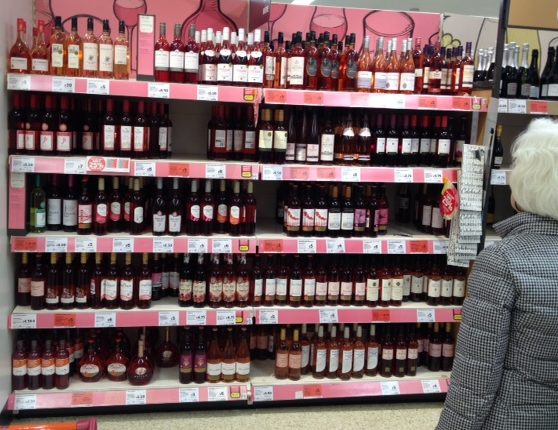
great wall of roseThis picture, taken at a Sainsbury’s grocery store in Londonderry in Northern Ireland, speaks volumes about how far we’ve come in our effort to make rose respectable. Who would have expected that a supermarket in Northern Ireland would have that much rose? Or that there would be so many empty spaces on the shelves? Many thanks to regular visitor Rex Warburton for taking the picture and passing it along.

Still, much remains to be done. That is more rose than most grocery stores in the U.S. carry; the two I shop most often in Dallas have a half dozen labels at best, and even some liquor stores here don’t stock that much.

How can you help? I’ve added the PDF printer to this post. Feel free to print the post and take it with you the next time you’re in a retailer where rose is still the pink-headed stepchild. Because if they can do it in Northern Island, why not where you are?