



Tag Archives: fake wine

Winebits 734: Cheap wine, movie wine, wine marketing

This week’s wine news: Cheap wine — surprise, surprise — is top seller, plus New Yorkers can buy wine at the movies and a legendary marketer’s advice about consumers

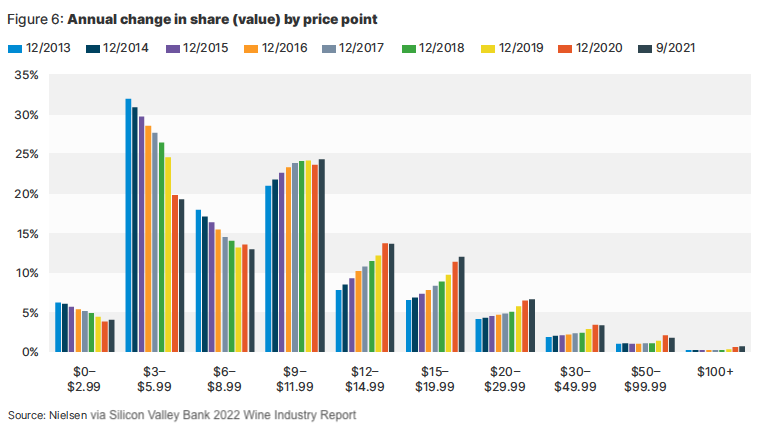
Got $10? One more bit from last week’s Silicon Valley Bank bombshell, since it confirms I’ve been on the right path for almost 15 years and the wine business has been, well, the wine business. The chart at the top of the post showcases wine’s best-selling price points since 2013, and it isn’t anything costing more than $12. Which you’d be hard-pressed to know talking to most people in the wine business (or reading the nasty comments on the old blog). In other words, it’s the wine I have been writing about since my days at Advocate magazine in Dallas and the Star-Telegram newspaper in Fort Worth: The $10 to $12 stuff that — shock of shocks — most of us buy. A little Tariquet, anyone?

Bring on the wine: Movie-goers in New York City will be able to buy wine, thanks to a recent ruling by the state’s liquor cops. The New York Post reports that theaters can sell wine and beer at concession stands and patrons will be able to bring their drinks into the theater. Previously, the theater had to have either restrictive restaurant or tavern licenses to sell beer or wine, so many didn’t bother. Now the big question: what wine pairs with Spider-Man?

Good advice: Laurel Cutler was an advertising legend — so much so that she was named both man and woman of the year by an industry trade group. Cutler, who died recently, made her name by understanding consumers and rarely underestimating them: “We are dealing with the smartest consumer we’ve ever dealt with. She’ll pay the difference if she can see it, taste it, smell it, feel it or show it off somehow. But if she can’t, she won’t.” Which, of course, is something the wine business needs to figure out.

Chart via Wine Industry Insight
Winebits 668: Fake wine, winery values, money-back guarantee

fake wineThis week’s wine news: Italian police bust up a fake wine ring, plus bad news for high-end winery profits and Hardys money-back wine guarantee

Phony Sassicaia: Italian police seized almost 350 cases of fakes of one of Italy’s most famous wines, which can cost as much as $400 a bottle. Operation Bad Tuscan, reports Manchester’s Guardian newspaper, uncovered a ring that used cheap wine from Sicily to counterfeit Bolgheri Sassicaia, what the story called a “prestigious Super Tuscan wine.” The wine included fakes from the highly-praised 2010 and 2015 vintages. The wines, sold for two-thirds less than their usual price, were destined for Russia, Korea, and China. So far, 11 people have been arrested. Italy’s wine cops have been busy this year: They raided Sicily’s Feudo Arancio winery as part of a Mafia investigation into money laundering.

No profit here: The Seeking Alpha financial website details just how difficult it is to make money in the wine business, even – and especially – if the company makes high end wine. Analyst Ian Bezek is frank about Crimson Wine Group, whose brands include $100-plus producers Pine Ridge and Archery Summit: “Simply put, if a company like Crimson can only earn 26 cents a share in the best of times, and outright loses money during industry downturns, the stock isn’t worth a whole lot on a P/E basis.” That an analyst outside the wine business has noticed what’s going on with wine speaks volumes about the problems the industry faces, and that hopefully the industry will address.

Money-back guarantee: The Australians know how to sell wine: Hardys is offering its Aussie, British, and Irish customers a 100-percent refund if they don’t like the Hardys wine they bought. This is a brilliant idea, which is why (assuming it’s legal in the U.S.) we won’t see it in this country. The guarantee includes all the brand’s wines, from the US$80 Eileen Hardy Shiraz to the US$10 Nottage Hill label. Why brilliant? Because the biggest obstacle most consumers face with trying something new is that they don’t want to waste money on something they aren’t sure about. This promotion eliminates that uncertainty.

Winebits 572: Texas ABC, restaurant wine, fake Prosecco

Texas ABCThis week’s wine news: Texas liquor retailer sues the Texas ABC, plus a restaurant tries to solve the industry’s wine problem and Italian authorities seize fake Prosecco

Texas ABC lawsuit: The Texas Alcoholic Beverage Commission, which has been plagued by scandal, mismanagement, and more scandal over the past several years, is in even bigger trouble. Spec’s, the largest independent retailer in the state, has sued the agency for malicious enforcement. The federal lawsuit is the result of the TABC’s attempt to fine Spec’s $700 million after a lenghty investigation a couple of years ago.. The catch? Two judges dismissed the agency’s suit against Spec’s, saying the charges were completely unsubstantiated. Why does this matter to wine drinkers in the rest of the country? Because it might mean the end of the TABC when the state legislature meets early next year. It almost dissolved the agency two years ago, and pressure is mounting to kill it in the upcoming session. If that happens, it will send a message to liquor cops across the country about how they enforce three-tier.

One last chance: An English restaurant chain, emerging from bankruptcy, says its new plan revolves around selling better quality wine. Says the new wine buyer for the Argentine-themed Guacho: “It’s always the big wineries [who are represented] – those who can afford PR, travel and marketing. But there are so many super-interesting smaller wineries in Argentina. It’s my duty to champion those guys. If no one gives them a chance they’re never gonna get an importer.” It’s a fair plan, the idea of moving away from Big Wine, and stands an even better chance of working if the chain keeps fair pricing in mind.

Lots and lots of fake Prosecco: Italian police have seized more than 80,000 cases of Prosecco from two producers. Police said each added extra sugar to the wine during fermentation to increase the alcohol content and exceeded their production quotas. The authorities became suspicious after finding some two tons of sugar at the wineries. No doubt the wineries should have been more subtle.

Just in time for Mother’s Day: Artificial wine

artificial wine
“Grapes? We don’t need no stinkin’ grapes.”

A San Francisco startup has a unique Mother’s Day gift: artificial wine, made without the need for grapes

The Wine Curmudgeon has waxed philosophic many times about the future of wine criticism, most recently with the arrival of artificial intelligence. Machines might be able to improve upon what one researcher calls the “exercise in pretentiousness” that is a wine review.

And what better product for artificial intelligence to review but artificial wine? And just in time for Mother’s Day, too.

We can thank a San Francisco startup called Ava Winery, where “wine” is made in a lab from a combination of ethanol (the alcohol bit), water, sugar and assorted chemicals. No grapes needed, of course, because they just get in the way, what with farming, harvesting, and the rest of that foolishness.

Is this a joke? Far from it, for Ava’s founders already have millions of dollars behind them from two multi-nationals, and are getting ready to embark on the fairy dust adventure that is venture capital funding.

Technically, Ava does not make wine, since a product called wine must, by law, contain grapes; I wonder how they’ll get around that on the label. But that hasn’t stopped the company, which expects to launch three “wines” next year – a pinot noir, cabernet sauvignon, and moscato. There is already a prototype for the last (and you can imagine how much it pained me to type that sentence).

Esther Mobley, writing in the San Francisco Chronicle, bends over backwards to be fair to Ava, but eventually has to ask the most important question: Why does the world need artificial wine? What’s wrong with what we have now?

The Ava founders hem and haw, but don’t really have a good answer. My guess is that they’re doing it because they can, that the technology exists, and that they can get rich doing it. Which is all well and good, since that’s the way the world works. But it does seem to be a lot of trouble to go to create something that, in the end, will not be much different than Cherry Coke with a buzz. Which is not why most of us love wine.

Winebits 471: The not quite New Year’s edition

fake boozeThis week’s wine news: More Chinese fake booze, plus soaring Napa land prices and good news for ice wine drinkers

Fake booze: The Chinese just can’t seem to get a break when it comes to alcohol fraud. This time, reports thedrinksbusiness.com. Police in two provinces broke up counterfeiting rings earlier this year, one specializing in the fabled Chinese spirit baijiu, while the other filled empty bottles with cheap bulk wines and sold them as big name wines costing as much as RMB 3,000 (about US$431). The magazine says the fake wine had “convincing labels and caps.” Note to Chinese wine drinkers (as well those in the U.S. who buy this stuff): I write about wine, and I can’t get most of the wines they’re selling you. What does that say about the wines’ provenance?

Real estate boom: Want to buy an acre of prime vineyard land in California’s Napa Valley? Then be prepared to pony up as much as $5 million, reports Lew Perdue at Wine Industry Insight. The chart that details these prices is as depressing as it is fascinating – even some Sonoma vineyard land is approaching Napa prices, something that has never really happened before. In other words, as land prices rise, more and more of the best California wine will be priced out of the reach of most wine consumers, and could even pressure prices upward for the wine we can afford to drink.

Ice wine: Warm winters in the U.S., Canada, and Europe over the past decade have drastically cut the quality and quantity of ice wine, which is so sweet and amazing that it can be worth what it costs – $60 or more for a half bottle. The good news is that it has been cold enough in Michigan this year so that a couple of wineries will make ice wine this vintage, what one winemaker calls a rarity that always sells out. One of the great moments in my teaching career came when I let a Cordon Bleu class taste ice wine; they loved me forever.

Winebits 193: Wine names, wine and alcohol, fake wine

? What's in a name? A lot, if you make Budweiser beer. Anheuser-Busch, the multi-national behind the brand, has threated a small Argentine winery called Budini. The latter's name is too similar to Bud, says Anheuser-Busch, and you'd better change your name or else. Which Budini has done; it's now Bodini in the U.S. The Wine Curmudgeon wonders if everyone who has a child named Clyde will now have to change it to Claude, given the Budweiser Clydesdales. I'm baffled as to why so many huge companies are so terrified of smaller companies with barely similar names. No doubt this is one of those things that, to paraphrase Mel Brooks, company bosses have to do to protect their phony baloney jobs.

? Getting drunk: An article by Michael Apstein in the San Francisco Chronicle notes that higher alcohol wines get people drunk more quickly. This doesn't get much attention in the discussion about high alcohol wines (even I don't talk about it much), but it should. Apstein says two glasses of 15 percent wine can get you more drunk than two glasses of 12 percent wine, taking into account weight, gender, and how often you drink. Even though the alcohol content of the wine increases only one-quarter (from 12 to 15 percent), the blood alcohol content goes up by 35 percent. For some people, that will put them over the legal limit.

? Fake Chinese wine: How about walking into a Beijing grocery store and finding counterfeit wine, including "bottles of Bordeaux wine that have been diluted with sugared water and had coloring agents and artificial flavorings added, before being sold for exorbitant prices." That's the situation in China, where more bottles of some high-end wines are for sale than were ever produced. I wonder: Would the Chinese have this problem if they weren't so obsessed with expensive wine. Who is going to counterfeit a bottle of $10 wine?