Tag Archives: drunk driving

Winebits 788: Blood alcohol, trading down, wine thefts

family eating dinner
“No. no, no — no wine with dinner.”

This week’s wine news: Washington state wants to criminalize wine with dinner, plus restaurant diners are trading down and wine thieves strike again

Two glasses is too many: The Washington state legislation will consider a bill to cut the state’s legal blood alcohol limit from .08 to .05. The change, following a similar bill in Utah, pretty much makes anyone who drinks a couple of glasses of wine with dinner legally drunk. The bill will also cut limits for marijuana and other drugs. We’ve discussed this subject on the blog many times before, and there is no easy way to parse the argument. Yes, we want to cut drunk driving deaths. But will cutting the limit do it? The results from Utah are inconclusive. And do we want to criminalize what is otherwise legal behavior? Reporter Renee Diaz does a fine job of outlining just that conundrum.

Cheaper restaurants: Consumers are opting for less expensive restaurants, says a new report, and that’s not good news for the wine business. Consumers “have begun trading down, nonetheless – illustrating they have some simmering anxiety about what is happening or what’s to come. At least, that’s the gist from the first two weeks of public restaurant earnings calls – a solid indicator of consumer confidence given the industry’s ubiquity and discretionary position.” The downside is twofold for wine: first, even though we’re still eating out, we’ve switched to less expensive restaurants and which don’t necessarily serve wine; and second, that if we’re not eating at wine restaurants, how will that sector recover from the pandemic?

• More wine thefts: The Wine Spectator notes that wine thieves have been busy in Europe over the past several months, hitting cellars of wine-focused restaurants in Norway and Spain, as well as at retailer-grower in Austria. The magazine says there is no evidence the crimes are related, but that the thieves knew what they wanted. The stolen wines included some of the greatest names in the business, such as Harlan, Haut-Brion, Lafite Rothschild, Latour, Margaux, Mouton-Rothschild, Pétrus, Pingus, Sine Qua Non, Solaia and Yquem. All told, the value could have exceeded a quarter of a million dollars.
Winebits 776: Ken Forrester, drunk driving, luxury wine

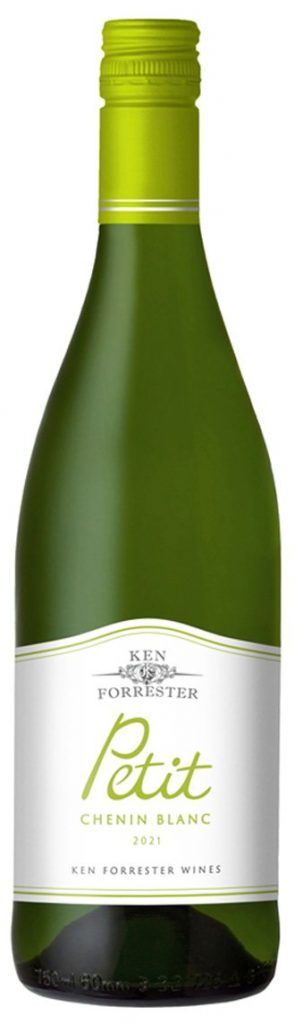
Ken Forrester petit chenin bottle
Wine costing about $12 doesn’t get much better than this.

This week’s wine news: High praise for South Africa’s Ken Forrester, plus intriguing drunk driving numbers and the increasing popularity of luxury wine

Ken Forrester: Wine Anorak’s Jamie Goode sings the praises of one of the WC’s favorite winemakers, South Africa’s Ken Forrester. Forrester is famous for chenin blanc; he has even been called Mr. Chenin Blanc for his work in helping South Africa move on from all those years of poorly-made steen. My only wish: Goode parses all the most expensive wine, but doesn’t talk about the Forrester entry-level chenin, which is one of the all time great cheap wines.

Only in certain states? Mostly rural states have the highest drunk driving rates in the country, including to numbers compiled by Forbes Advisor. That means Montana, Wyoming, the Dakotas, and Texas (most of which remains decidedly rural). On the other hand, mostly urban states had the lowest rates, the lowest of which (in the District of Columbia) was only about one-eighth of the highest, Montana. This is intriguing information, especially given that the neo-Prohibitionists claim drunk driving is rampant throughout the country. And the Forbes Advisor methodology looks good – using six key metrics from the National Highway Traffic Safety Administration and the FBI.

The very rich: “The company behind Moët & Chandon, Veuve Clicquot, Krug and Dom Pérignon has said it is ‘running out of stock on our best champagnes’ as the wealthy spend big on luxury goods in a new ‘roaring 20s’ age of decadence.” No, the WC didn’t write that; it comes from Britain’s Guardian newspaper, discussing the profit outlook for Champagne producer LVMH in the wake of rampant inflation in Europe and Britain and the near collapse of the British pound last month. Who says I’m the only cranky journalist left in the world who can offer a little perspective?

Winebits 482: Utah drunk driving, Aussie wine laws, Italian wine thieves

Utah drunk driving
“Two glasses of wine? That’s wine too many, pal.”

This week’s wine news: Utah makes it a crime to have wine with dinner, plus Australia restricts wine sales, and Italian wine thieves

Utah drunk driving: Utah’s new legal drinking limit – the toughest in the country – will turn almost anyone who has a couple of glasses of wine with dinner into a criminal. How else to explain the state’s .05 limit, which translates to drinking two glass of wine for an ordinary sized man and one glass of wine for an ordinary sized woman? We’ve written about this before, part of the Neo-Prohibitionist movement to restrict drinking by focusing on health, and what’s more health-related than drunk driving? That it will criminalize legal behavior – “Utah: Come for vacation, leave on probation,” said one ad opposing the law – doesn’t seem to bother them. Ironically, phone calls to the governor of the predominantly Mormon state, and Mormons aren’t supposed to drink, ran 9 to 1 against the law.

Not just in the U.S.: Costco, the world’s largest wine retailer, not only has to endure our old pal the three-tier system in the U.S., but an Australian version as well. It can’t sell alcohol in the state of South Australia, even though it sells wine in three other Aussie states. I can’t quite figure out why, though there seems to be opposition from other retailers as well as more restrictive licensing in the state.

Gotcha! Italian police have broken up a crime gang in northern Italy, but only after they stole 16,000 bottles of fine wine, worth around €100,000 (US$108,000), as well as €80,000 (US$87,000) worth of Parmigiano-Reggiano cheese and an undisclosed amount of Modea balsamic vinegar. Police launched Operation Wine and Cheese, as it was called, following a series of high-value food thefts between 2015 and 2016. The thefts are quite common in Italy, and especially for the pricey Parmigiano-Reggiano.

Winebits 473: New Year wine legal affairs edition

wine legal affairsThis week’s wine news: We start 2017 with items from the almost Python-esque world of wine legal affairs

What’s in a name? Regular visitors here know how much the Wine Curmudgeon appreciates lawsuits about wine names, and there is another one – the small producer that makes a label called Six Degrees is suing the big producer that makes a label called 6°. To make the case more interesting, the small producer is family owned and the big producer is owned by members of the family that owns Bronco Wine, one of the biggest wine companies in the world. And there’s a great lawyer’s quote, too, hinting at blackmail. With a spectator sport like this, who needs football?

Only in Michigan: Utah is generally considered to have the most restrictive liquor laws in the country, but Michigan – home to the Granholm direct shipping case – is also a contender. That’s why this news, that the state is relaxing its notorious direct shipping requirements, is notable. The post is difficult to follow unless you practice wine law, but this analogy works: Previously, shipping wine into Michigan was the equivalent of wearing three pairs of socks when most of us only wear one pair. Now, it’s the equivalent of wearing two pairs of socks. Still unnecessary, but not as awkward.

Yes, but what about Utah? Not to be outdone by Michigan, a Utah legislator has proposed lowering the state’s legal alcohol limit to .05%, the lowest in the country – about the same as couple of of glasses of wine with dinner and which would make drunk drivers out of every social drinker in the state. The idea is not new, and it’s just as noxious now as it was then. As this well-reported story from the Las Angeles Times notes, drunk driving deaths in the U.S. have fallen by one-third over the past three decades. As Mothers Against Drunk Driving pointed out a couple of years ago, social drinkers aren’t the problem. It’s the repeat offender who drives drunk, even after arrests and license suspensions.

Wine is apparently causing our political gridlock

drunken politicianWonder why government doesn’t seem to work anymore? The Wine Curmudgeon, after poring through hundreds of news stories (and yes, that pun is fully intended), has discovered the answer: Our leaders are drunk, often from wine — call it the drunken politician conspiracy theory. Where’s

The latest development comes from Calgary, in the Canadian province of Alberta. The mayor told a city council meeting: ?I have received multiple complaints about council members getting blotto at community events, ? and that he has received reports of his peers being ?totally drunk ? on wine.

Frankly, if this happens in Canada — where politics is much more convivial than it is in the U.S., and where we know they drink beer — then we’re on to something. And this is not an isolated incident. It seems to be going on everywhere and at all levels of government:

? The California state senator who told state police he only had three glasses of wine when they pulled him over for drunk driving.

? A Google search for “Congressman drunk driving” turns up a quarter-million results, questioning the sobriety of everyone from house speakers to U.S. senators, and from every party imaginable. Imagine if I had used Congresspeople.

? A Memphis city councilwoman, who may have been drunk at a council meeting.

In fact, once I discovered this pattern, the CDC’s anti-drinking crusade made perfect sense. The federal health cops are trying to save the government from itself; how else can it assure its funding unless someone is sober enough to vote?

And scores now make sense in a way they never have before. If you’re getting loaded, what’s the easiest way to figure out what to drink? Check the score. Who wants to get trashed on a 73-point wine?

The federal government’s three-drink limit

The federal government's three-drink limitThe logic behind the proposal by the federal National Transportation Safety Board is impeccable: Cut the legal drinking limit to about three glasses of wine in 90 minutes, and fewer people will drive drunk and so fewer people will die.

But logical doesn ?t always mean sensible.

This is not an endorsement of drunk driving or a rant against Big Government. There are plenty of other places on the Internet to find those. And I know the problem first-hand, living in Texas — one of the worst states in the country for drunk driving and where going the wrong way on high-speed highways after getting liquored up is particularly popular.

Rather, this is a look at whether lowering the legal drinking limit, as measured by blood alcohol levels, is the best way to solve the problem. Or, as noted by a spokeswoman for a restaurant trade association, is that ?moving from 0.08 to 0.05 would criminalize perfectly responsible behavior. ? There are four glass of wine in a bottle, which means that a 130-pound woman who had three glasses would be legally drunk under the proposed standard. A 190-pound man could drink only three glasses.

This assumes two things: First, that social drinkers are a serious part of the drunk driving problem, and second, that the only way to solve the social drinker problem is to criminalize social drinking.

The statistics can be interpreted either way. The government says people with a blood-alcohol level of 0.05 percent, the proposed limit, are about one-third more likely to be involved in a crash than those who have not been drinking. Those with a blood-alcohol level of 0.08 percent, the current limit, are 169 percent more likely.

On the other hand, more than two-thirds of drunk drivers involved in fatalities in 2010 had a blood-alcohol level of .15 or higher ? hardly social drinkers, and a figure that has remained the same for about decade. And repeat drunk drivers are more likely to have higher blood-alcohol levels than those arrested only once. All of this seems to indicate that the nut to crack is not the social drinker, but the hard-core drunk.

The proposal also overlooks the role age plays in drunk driving. In 2010, drivers younger than 34 who were legally drunk accounted for almost two-thirds of fatal crashes. Those of us older than 44 made up only 11 percent of the the total. Would it not be more efficient to raise the drinking age from 21 to 25?

Finally, the safety board doesn ?t give enough credit to the role education has played in cutting drunk driving deaths, which have declined by more than half in the past 20 years. When I was younger, no one thought about designated drivers or calling a cab for a friend who was drunk. My early-1970s driver ?s ed class barely touched on the subject, and it was a badge of honor for young men in the Midwest to drive drunk. None of that is true today.

Perhaps the biggest argument against the new limits, though, comes from Mothers Against Drunk Driving, and that should speak volumes in any debate on the subject. It would rather see technical changes, like car Breathalyzer interlocks, and greater police powers when arresting drunks. Punishing social drinkers may not be worth the effort, especially in political capital.

Cartoon courtesy of Dear_Theophilus at OpenClipArt.org, using a Creative Commons license